1
WRITTEN CASE #1: TWITTER
Nina Grabowiecki
GBA 490-009
2
Table of Contents Page
Table of Contents
Table of Contents Page ……………………………………………………………………………………………. 2
Executive Summary ………………………………………………………………………………………………… 3
Issue #1: Globalization …………………………………………………………………………………………….. 4
Issue #2: Poor Financial Performance …………………………………………………………………………. 5
Issue #3: High Levels of Competition ………………………………………………………………………….. 6
Key Recommendation ……………………………………………………………………………………………… 7
Appendix A: PESTAL Analysis ……………………………………………………………………………………. 8
Appendix B: Five Forces Analysis ……………………………………………………………………………….. 9
Appendix C: Driving Forces Analysis …………………………………………………………………………. 10
Appendix D: Strategic Group Map ……………………………………………………………………………. 11
Appendix E: Competitor Analysis …………………………………………………………………………….. 12
Appendix F: Key Success Factors & Industry Outlook for Profitability …………………………..…. 13
Appendix G: Financial Analysis………………………………………………………………………………… 14
Appendix H: Resources and Capabilities Analysis ……………………………………………………….. 16
Appendix I: Weighted Competitive Strength Assessment ……………………………………………… 17
Appendix J: Value Chain Analysis …………………………………………………………………………….. 18
Appendix K: SWOT Analysis ……………………………………………………………………………………. 19
Appendix L: Current Strategy ………………………………………………………………………………….. 20
3
Executive Summary
Twitter had experienced rapid growth since its founding and by January 2018, there were
more than 330 million active monthly users. Despite the high number of users and volume of
use, Twitter had failed to provide any financial gains until the fourth quarter of 2017. The lack of
profitability and troubling total costs and expenses was putting Twitter in a horrible position to
be run out of the industry or be bought out. After analyzing Twitter’s profits and number of users
the company is faced with three major issues: globalization, poor financial performance, and a
high level of competition. Twitter needs to increase users globally, make a larger profit each year
and not depend on only ad revenue, and finally beat out their competition by differentiating the
services they provide.
Their first issue is globalization. Twitter is very well-known throughout the celebrity
community, high profile people such as world leaders constantly use Twitter to break news and
share thoughts on current events. This has put Twitter in the news daily since 2016, giving them
much deserved recognition. Although this makes it seem like Twitter has reached their maximum
audience, when compared to their competition Twitter falls short with their global reach.
Platforms like Facebook and Instagram have billions of users while Twitter still is only in the
hundreds of millions mark. The reason why Twitter can’t acquire more users is because the
breadth of their product isn’t large enough compared to Instagram and Facebook. Right now,
Twitter is working closely together to solve this problem by coming up with a different strategic
approach to globalize their app more.
Next is their issue of poor financial performance. It seems the only years Twitter has
made a profit is when a Tax Act was put in place giving them the illusion of making revenue.
This had nothing to do with their performance as a company. Twitter’s financial performance
was attempted to be fixed by focusing only on the relationships with major advertising agencies.
While this may seem like a good strategic move for Twitter to do, it placed too much
overdependence on advertisements and ad campaigns and took focus away from trying to
differentiate the app with new updates.
Finally, the issue of a high level of competition. Social media is an industry of high
rivalry because each platform is working to steal users from each other and gain the most
attention worldwide. Twitter believed it needed to build a stronger culture and prepare the
company for more creativity and innovation to stay relevant. To do this they merged its agency
development and applications program to focus on making relationships with major advertising
agencies. This still wasn’t enough to beat out competitors like Facebook, who is able to buy out
their competition and absorb their users. Twitter needs to find a way to block out substitutes and
differentiate themselves from apps like Facebook to stay in the running of being a top
performing social media platform.
My overall recommendation for Twitter would be to enhance app features such as
remove the character count for users and change the dynamic of the layout by adding more
interactive features such as a reel page for videos. Twitter hasn’t changed their platform since it
was founded in 2006, and since then apps have been constantly upgrading to keep up with
society. With an enhancement of their features, it will help Twitter in every aspect and solve
their issues of not being able to have enough users globally, along with finances, and rivalry.
TikTok is a global giant right now and if Twitter doesn’t make changes, they will eventually be
drowned out by the newer features of other applications.
4
Issue #1: Globalization
Twitter has become very well-known because of their high-profile users such as world
leaders and celebrities. U.S President Donald Trump used Twitter regularly to break news, praise
friends, and even feud with enemies, because of this Twitter has been in the news daily since
2016. Twitter is also used as a news outlet. In 2009 a plane crash in New York’s Hudson River
was first told to Twitter and other groundbreaking stories such as the Osama Bin Laden kill was
put on Twitter over nine hours before it reached media outlets (see Appendix F: Key Success
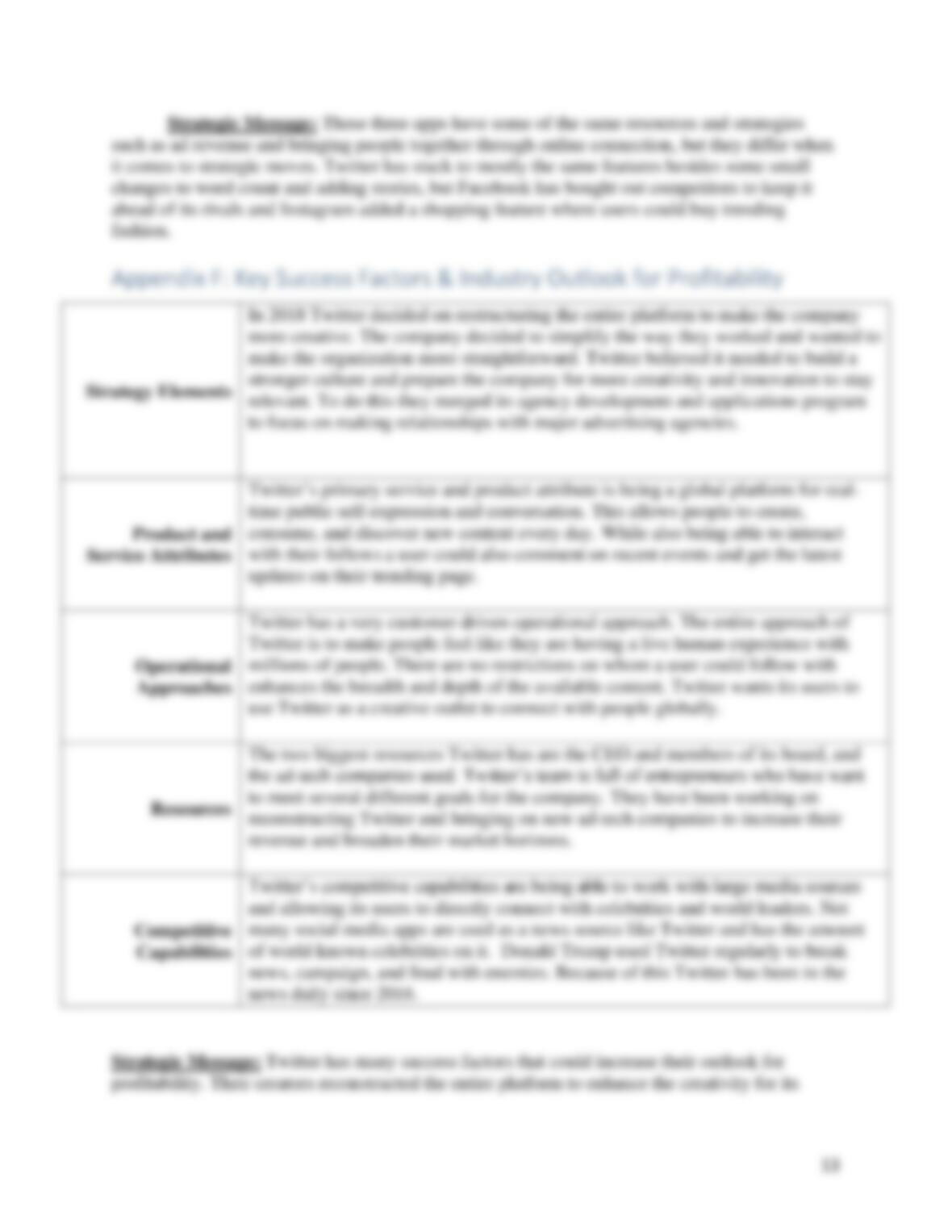
Factors on page 13 for more information on Twitter’s competitive capabilities). Twitter’s
competitive capabilities are being able to work with large media sources and allowing its users to
directly connect with celebrities and world leaders. Not many social media apps are used as a
news source like Twitter and has the amount of world known celebrities on it.
Although it seems Twitter has reached a huge audience with millions of people
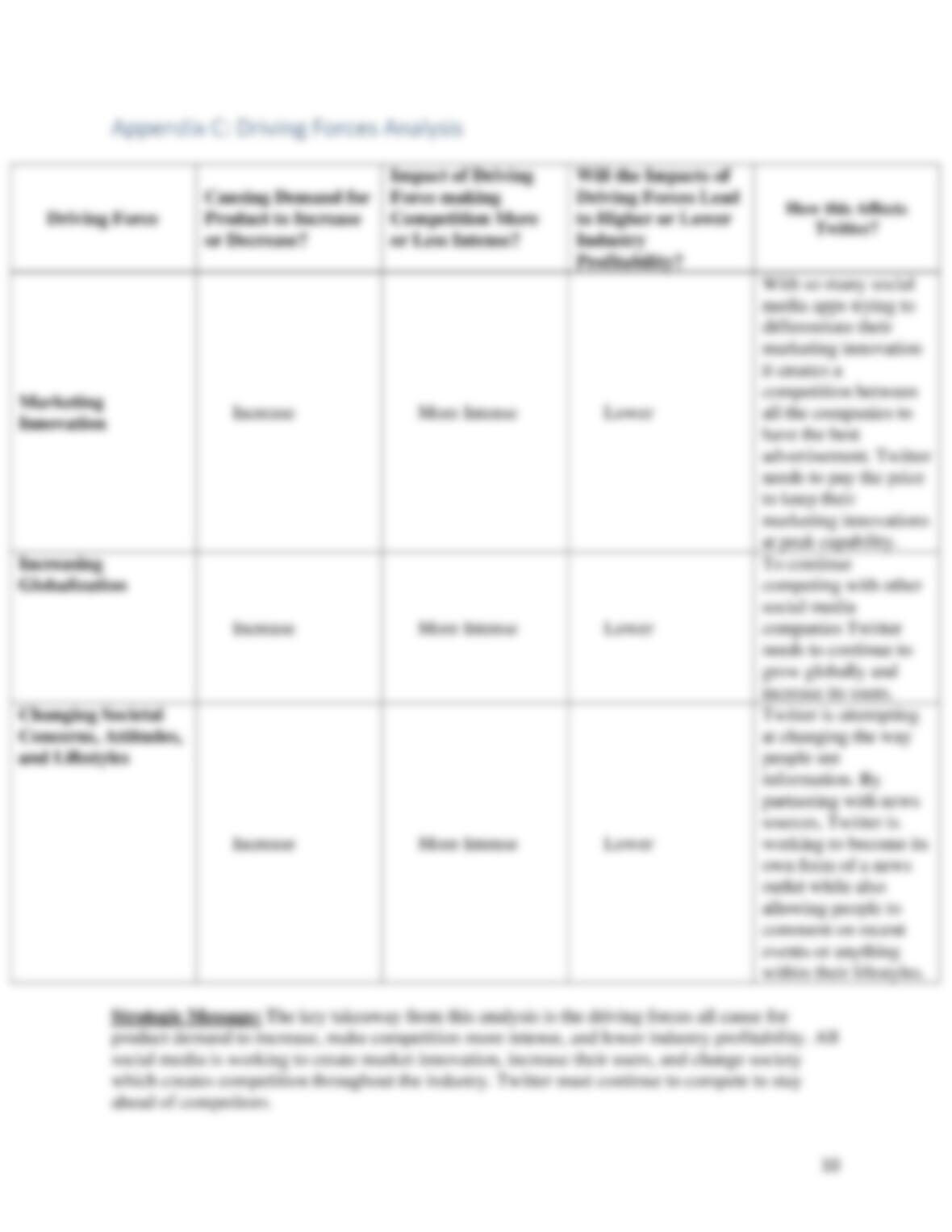
worldwide there is still a lot to do to increase globalization (see Appendix C: Driving Forces
Analysis on page 10 for more information on Twitters driving forces). Wanting to increase
globalization also increases competition because every social media platform wants to be known
worldwide. To continue competing with other social media companies Twitter needs to continue
to grow globally and increase its users by differentiation of the app to bring users to it.
Having news outlets working with Twitter is helping the globalization aspect but they
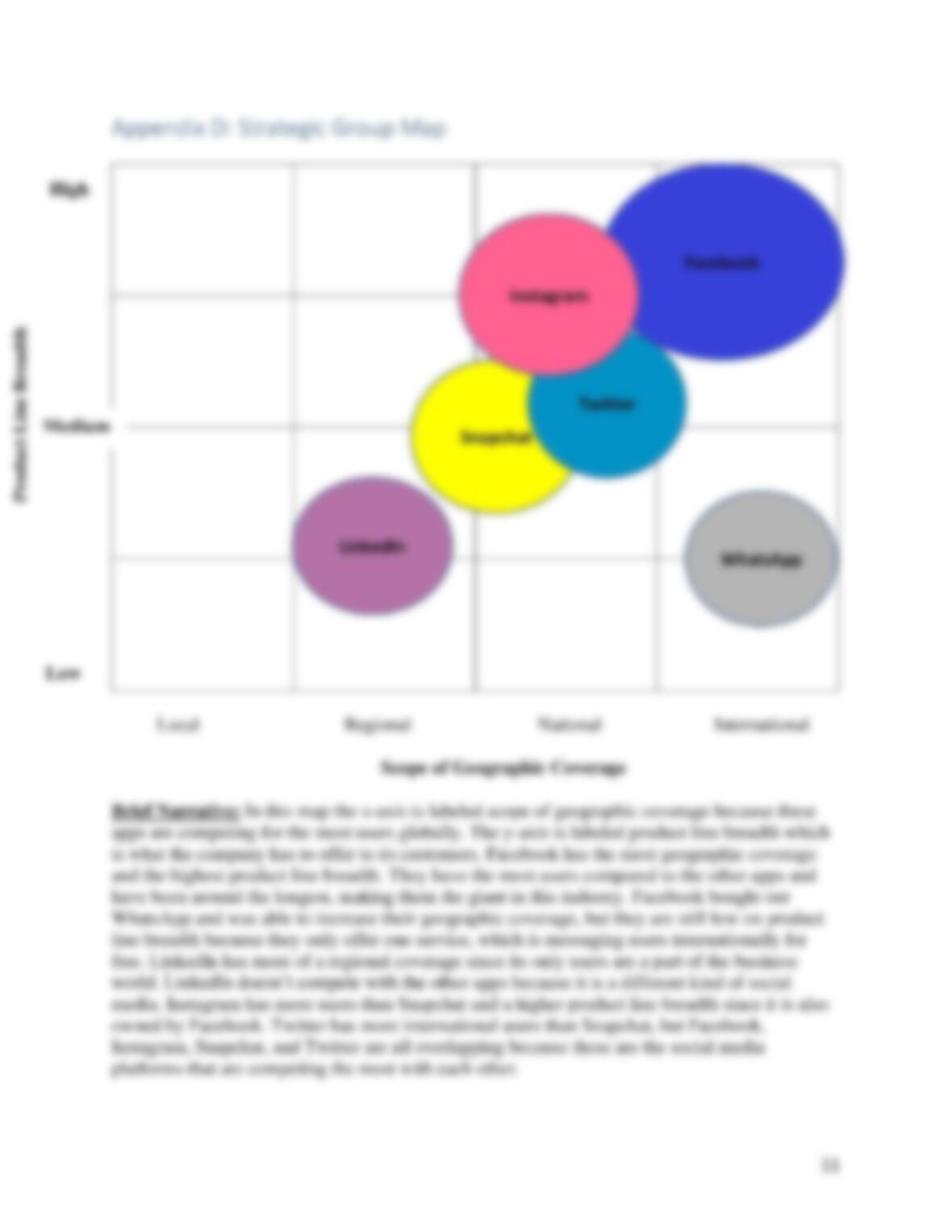
still aren’t in first place for being known worldwide (see Appendix D: Strategic Group Map on
page 11 to see where Twitter falls globally compared to competitors). Facebook still has the most
geographic coverage and the highest product line breadth. They have the most users compared to
the other apps and have been around the longest, making them the giant in this industry.
Facebook bought out WhatsApp and was able to increase their geographic coverage by
absorbing their users. Instagram has more users than Snapchat and a higher product line breadth
since it is also owned by Facebook. Twitter has more international users than Snapchat, but
Facebook and Instagram are still more known globally because Facebook was able to buyout
Instagram and all its users. Based on this analysis Twitter needs to increase their product line
breadth to make more users want to join the app. Facebook and Instagram have many different
aspects to their product and that is why over a billion people worldwide use these apps. Not
everyone sees a meaningful reason to join Twitter.
Twitter is working to fix their globalization issue with their current strategy (see
Appendix L: Current Strategy on page 20 for more information on what Twitter needs to do to
fix their issues). Twitter is working towards a broad differentiation strategy which appeals to
help increase their global usage long-term. Twitter needs to increase profits and to do that they
need to use their strategy to maximize brand awareness outside of the U.S. Twitter is failing at
reaching the maximum global capacity they are capable of because they aren’t enhancing their
platform enough for users to want to interact. CEOs are working on restructuring the entire app
to make it more straightforward and entice creativity with its users. Twitter still needs to work
on making their app a more interactive experience for their users so they could increase the
amount of people using the app and therefore grow globally. If they keep the layout the same as
it is now and don’t upgrade, it. There is a chance Twitter could fail and be washed out by up–
and-coming applications who reach more people globally.
5
Issue #2: Poor Financial Performance
Despite the number of users and the volume of use Twitter has, they have still failed to
provide any financial gains until the 4th quarter of 2017. The only reason they were able to
achieve this “profit” was because they cut costs instead of growing the business. With this loss in
money, Twitter had to cut research, development, sales, and marketing expenses. These
programs are vital to the success of Twitter so having to cut them put a toll on the overall
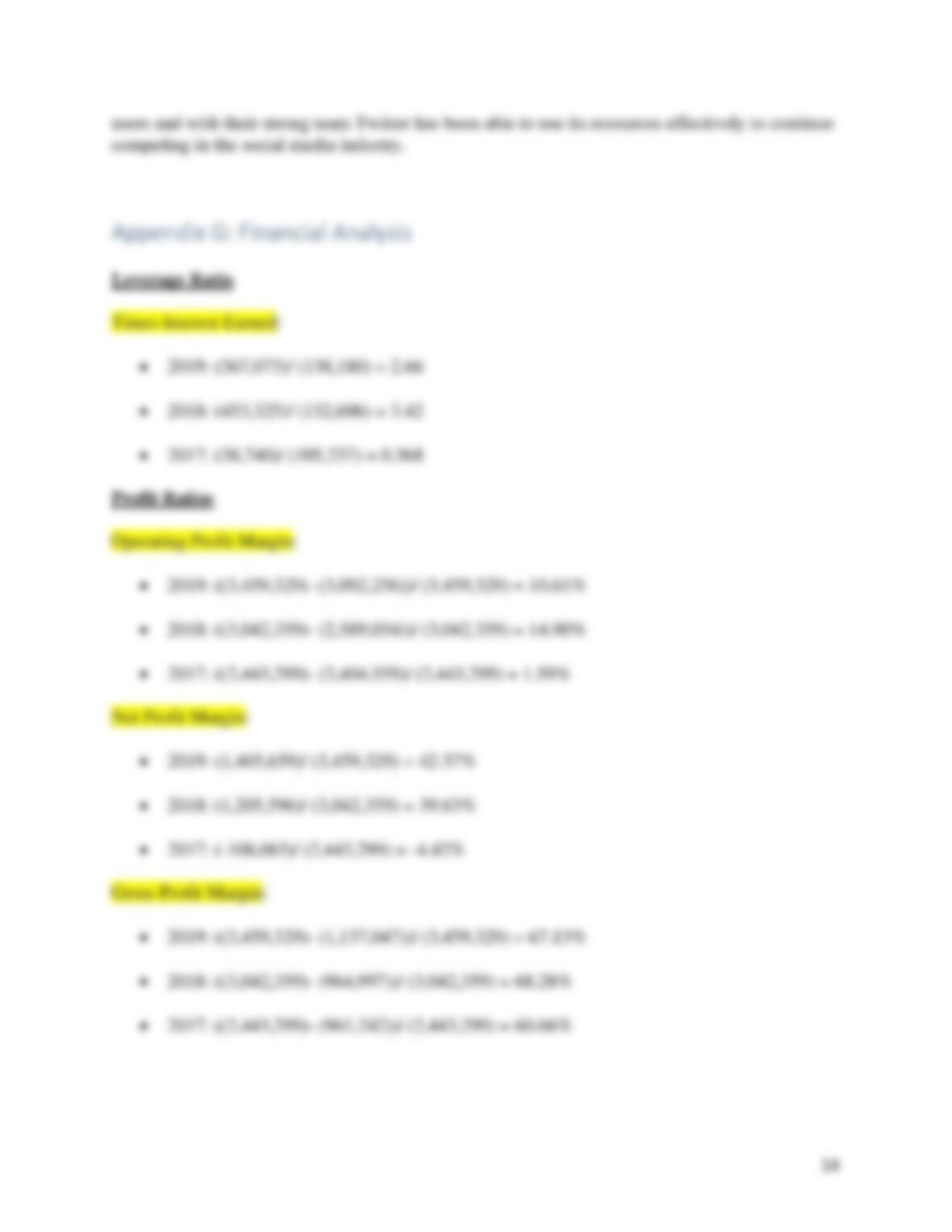
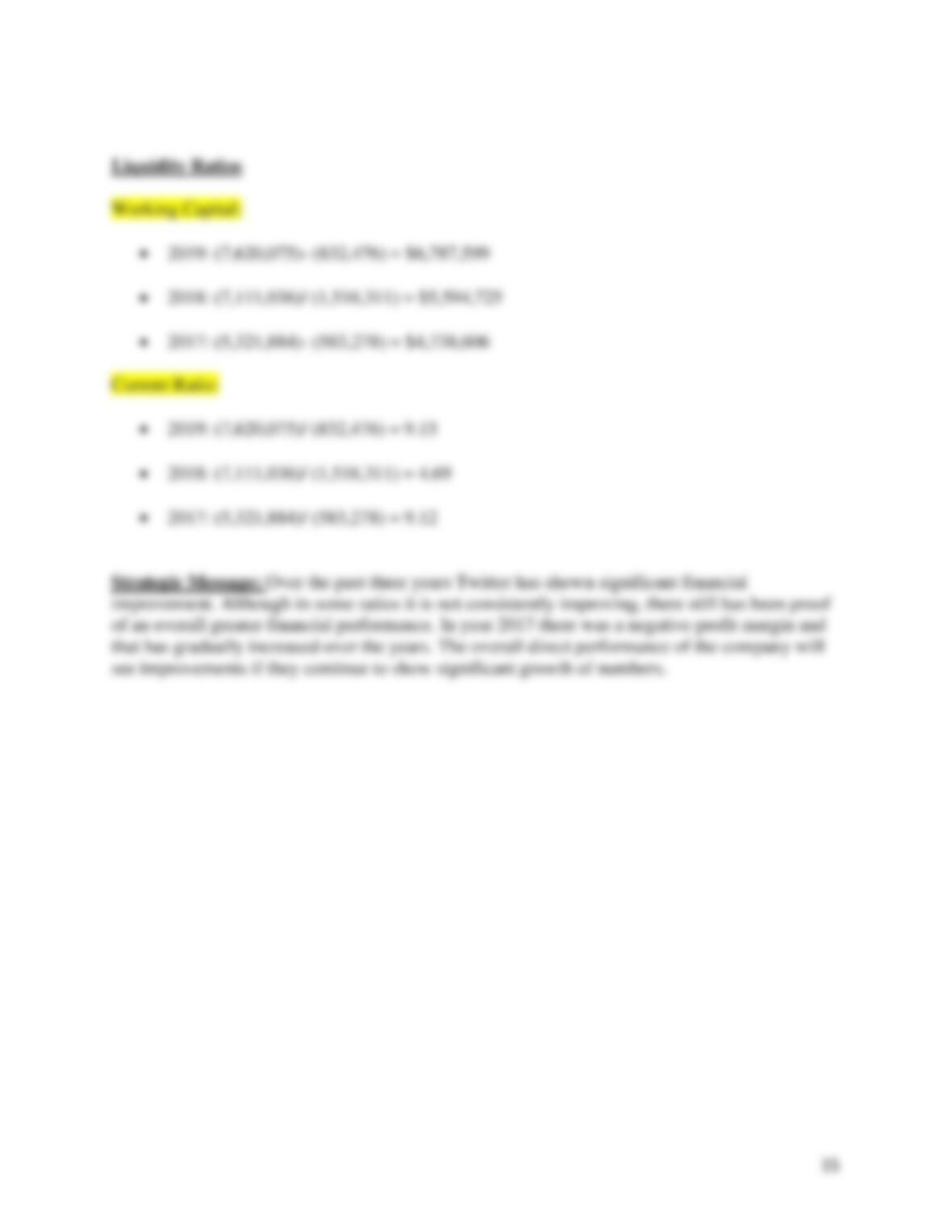
performance of the company (see Appendix G: Financial Analysis on page 14 for more
information on the overall finances of Twitter). In some ratios there is not constant improvement,
for example in year 2017 there was a negative profit margin and that has gradually increased
over the years. The overall direct performance of the company will see improvements if they
continue to show significant growth of numbers.
Although Twitter finally showed its first full year of profit in 2018, it was only due to the
face it was maintaining low costs and the impact of the Tax Act (see Appendix A: PESTEL
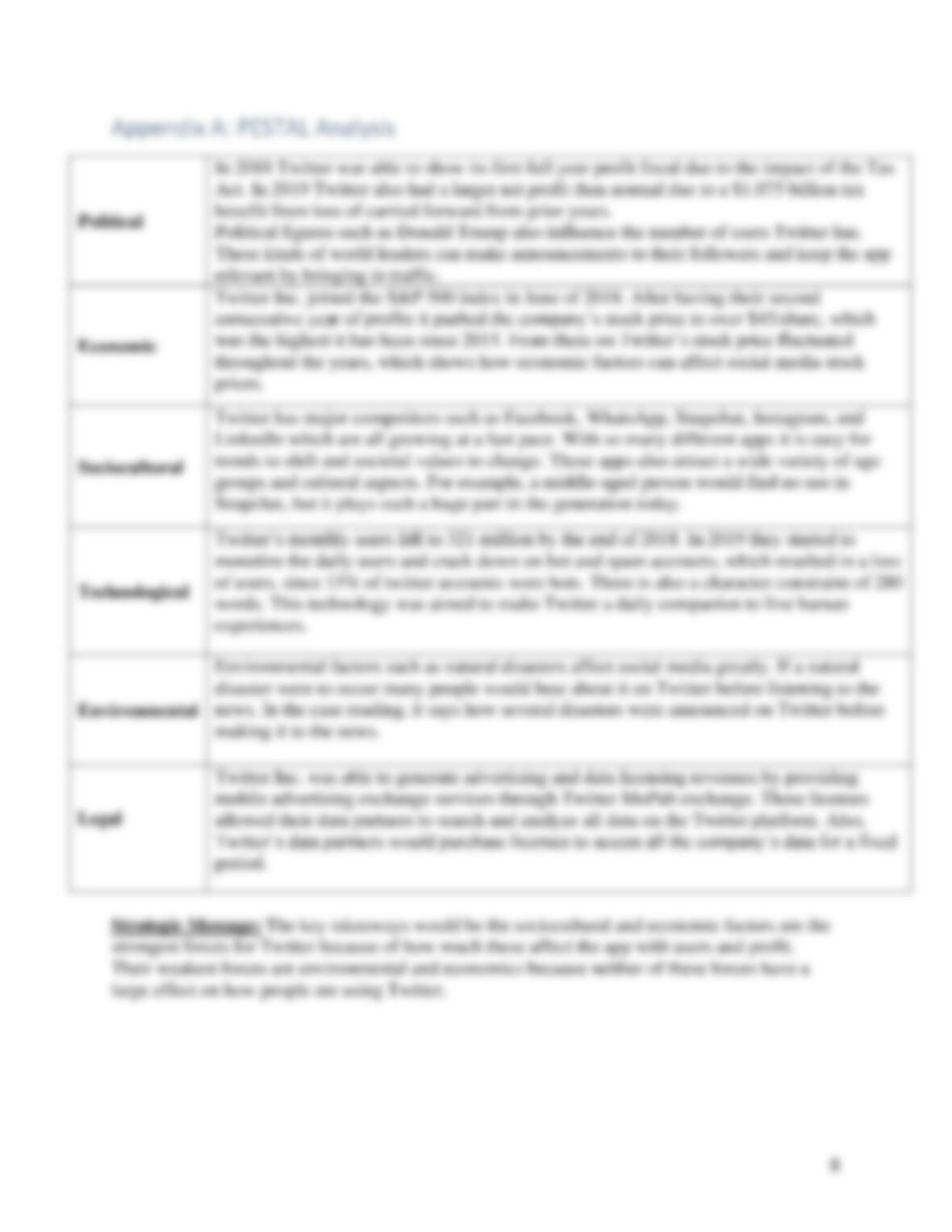
Analysis on page 8 for more information on the political aspect that affected Twitters profit). In
2019 Twitter also had a larger net profit than normal due to a $1.075 billion tax benefit from loss
of carried forward from prior years. But costs for research, development, sales, marketing, total
costs, and expenses were below the 2016 levels. So, it seemed like Twitter was making money
for being a successful company, when in reality they were only able to show a profit due to
political tax acts and cuts.
In 2019 Twitter had another profitable year with a net income of $1.5 billion, but if you
look deeper into that it was due to another $1.075 billion tax benefit. Also, because management
didn’t examine the company’s operations, their cost of revenue increase to 33 percent. Total
costs and expenses increased from 85 to 89% in 2019. This caused the operating to fall from 15
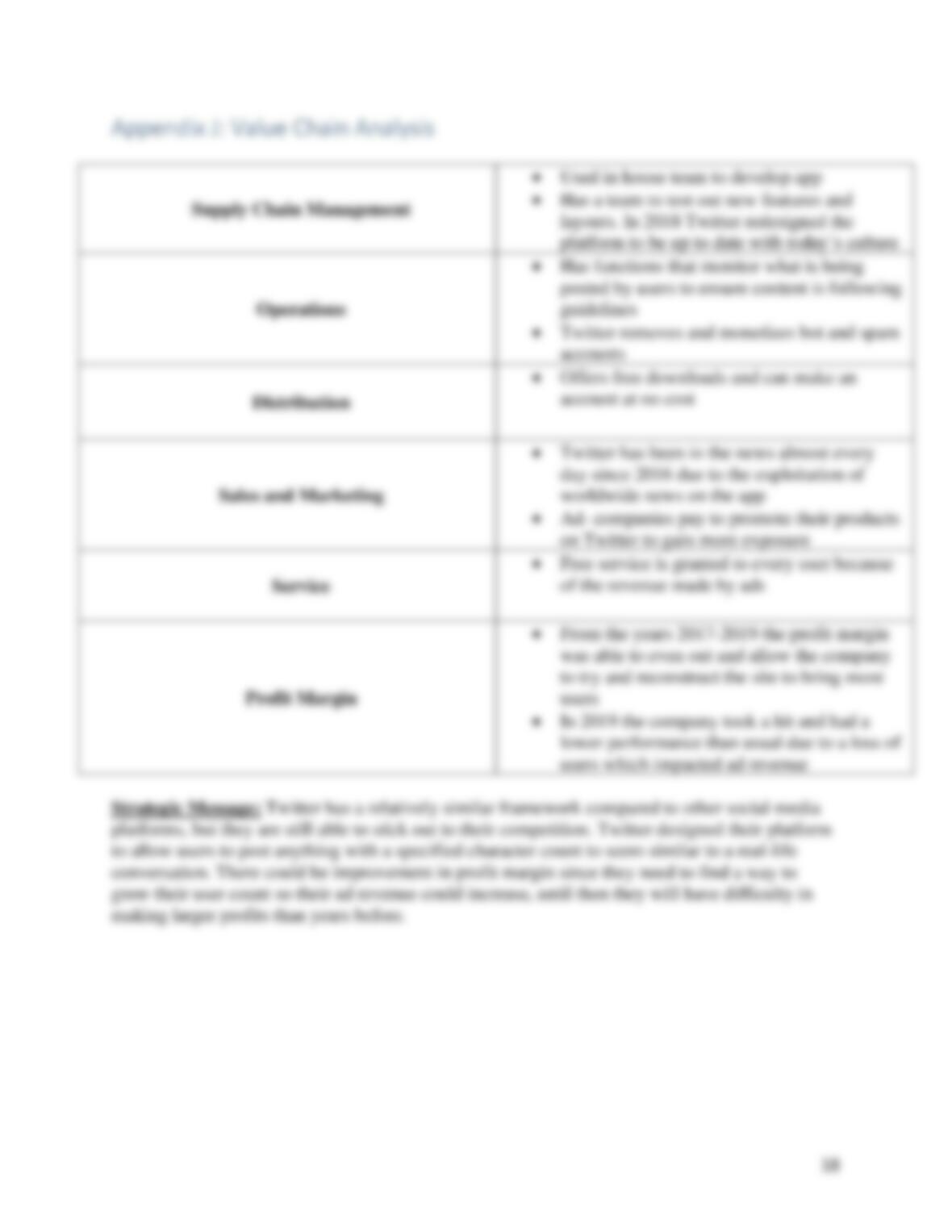
to 11 percent in 2019 (see Appendix J: Value Chain Analysis on page 18 for more information
on how Twitter runs operations and supply chain management). There could be improvement in
profit margin since they need to find a way to grow their user count so their ad revenue could
increase, until then they will have difficulty in making larger profits than years before.
Twitter’s financial performance was attempted to be fixed by putting all their focus into
merging their agency development and applications program. They wanted to focus on the
relationships with major advertising agencies. While this may seem like a good strategic move
for Twitter to do, it placed too much overdependence on advertisements and ad campaigns and
took focus away from trying to differentiate the app with new updates. With all social media
apps competing for ad revenue, it makes it complicated to make a profit when that is the only
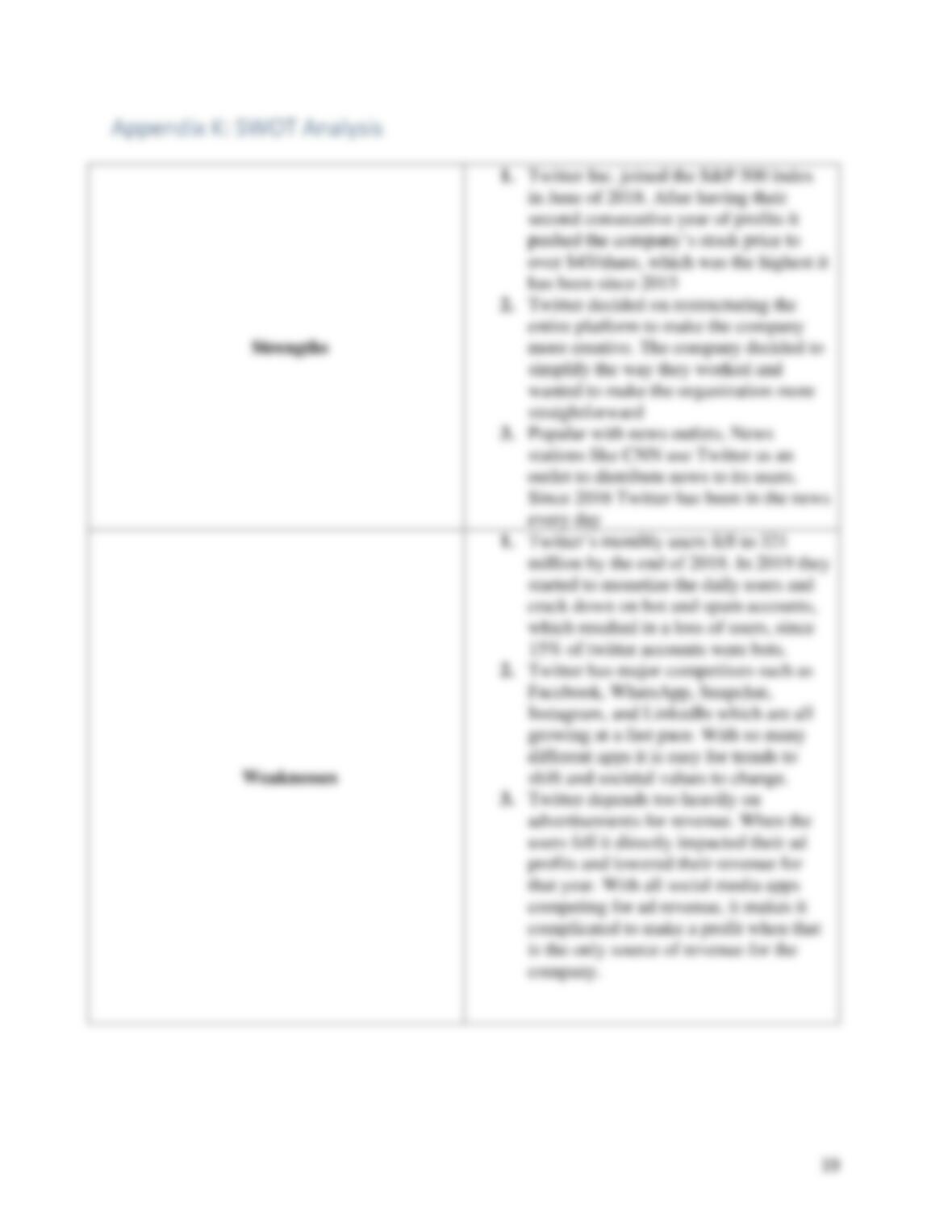
source of revenue for the company (see Appendix K: SWOT Analysis on page 19 for more
information on financial weaknesses of Twitter).
In addition to the weak financial performances in the past, Twitter also showed troubling
signs in the first quarter of 2020. The financial results took a negative turn after revenue going up
three percent over the past few years. Twitters revenue was down 20% from $1,007 million
fourth quarter of 2019. Twitter made a statement saying the revenue decline was due to the
impact of COVID-19 and showed a net loss of $8.4 million, versus the $191 million net income
in 2019. Due to concerns of the impact of the pandemic Twitter decided to not release any
revenue or income information for the second quarter of the year.
In conclusion, Twitter has a lot of work to do to improve their financial performance and
delegate their expenses. There has been improvement over the past few years, but it needs to
continue for Twitter to make a steady profit over the next fiscal years.
6
Issue #3: High Levels of Competition
Social media has a high level of competition throughout the industry. Every app’s goal is
to reach a limitless number of users and take other users from different platforms. Twitter is
working very hard to keep up with its competition to grow their recognition worldwide, by
reconstructing the platform to stay up to date with today’s culture (see Appendix F: Key Success
Factors on page 13 for information on how Twitter is working to stay ahead on competition). In
2018 Twitter decided on restructuring the entire platform to make the company more creative.
The company decided to simplify the way they worked and wanted to make the organization
more straightforward. Twitter believed it needed to build a stronger culture and prepare the
company for more creativity and innovation to stay relevant. To do this they merged its agency
development and applications program to focus on making relationships with major advertising
agencies. With these new innovations Twitter has hopes users will want to come back to Twitter
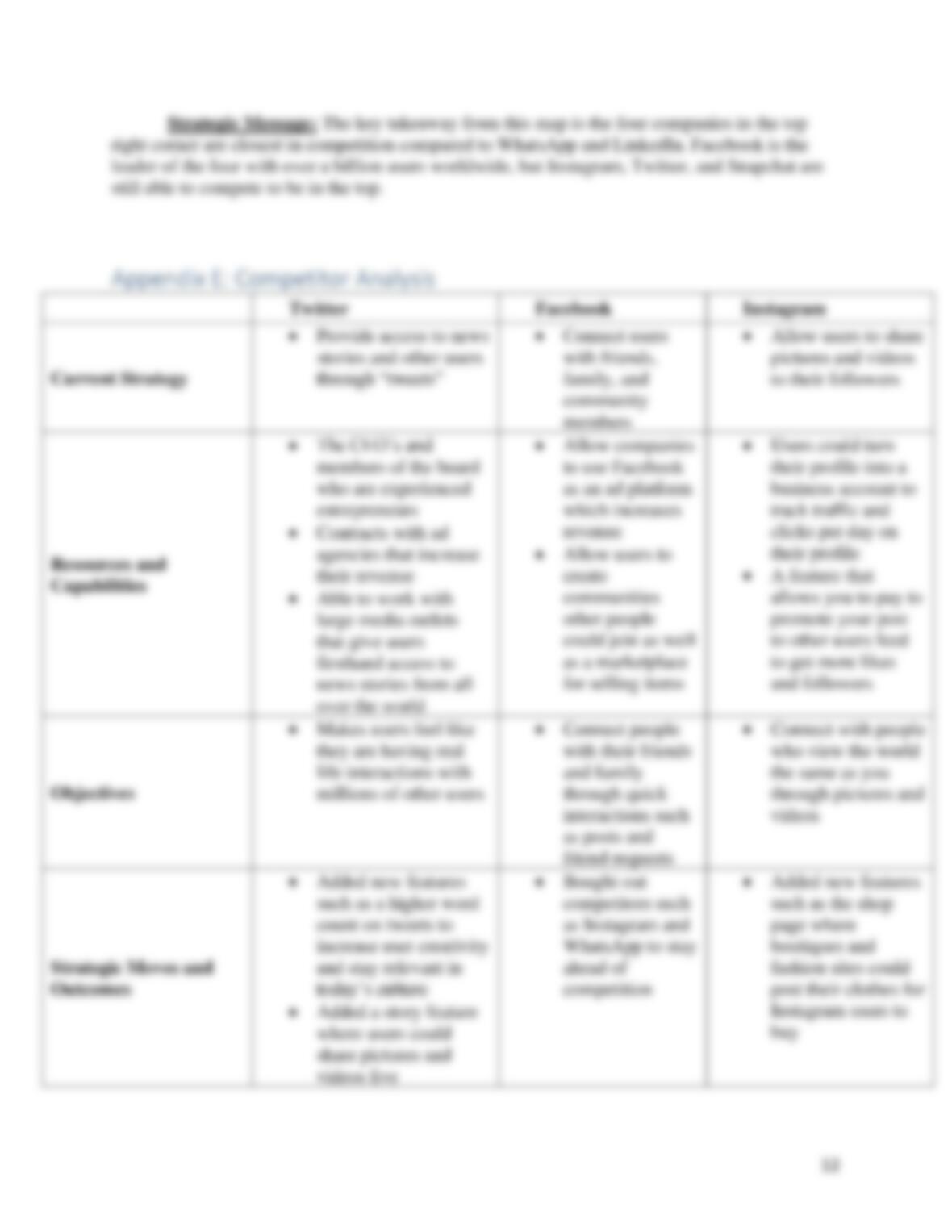
after losing 15% of users to other platforms (see Appendix E: Competitor Analysis on page 12
for information on who Twitter is competing with). Facebook and Instagram have done a much
better job of fighting competitors. Facebook was able to buy out its rivals (Instagram and
WhatsApp) giving them an advantage to control the industry. Along with being able to fight off
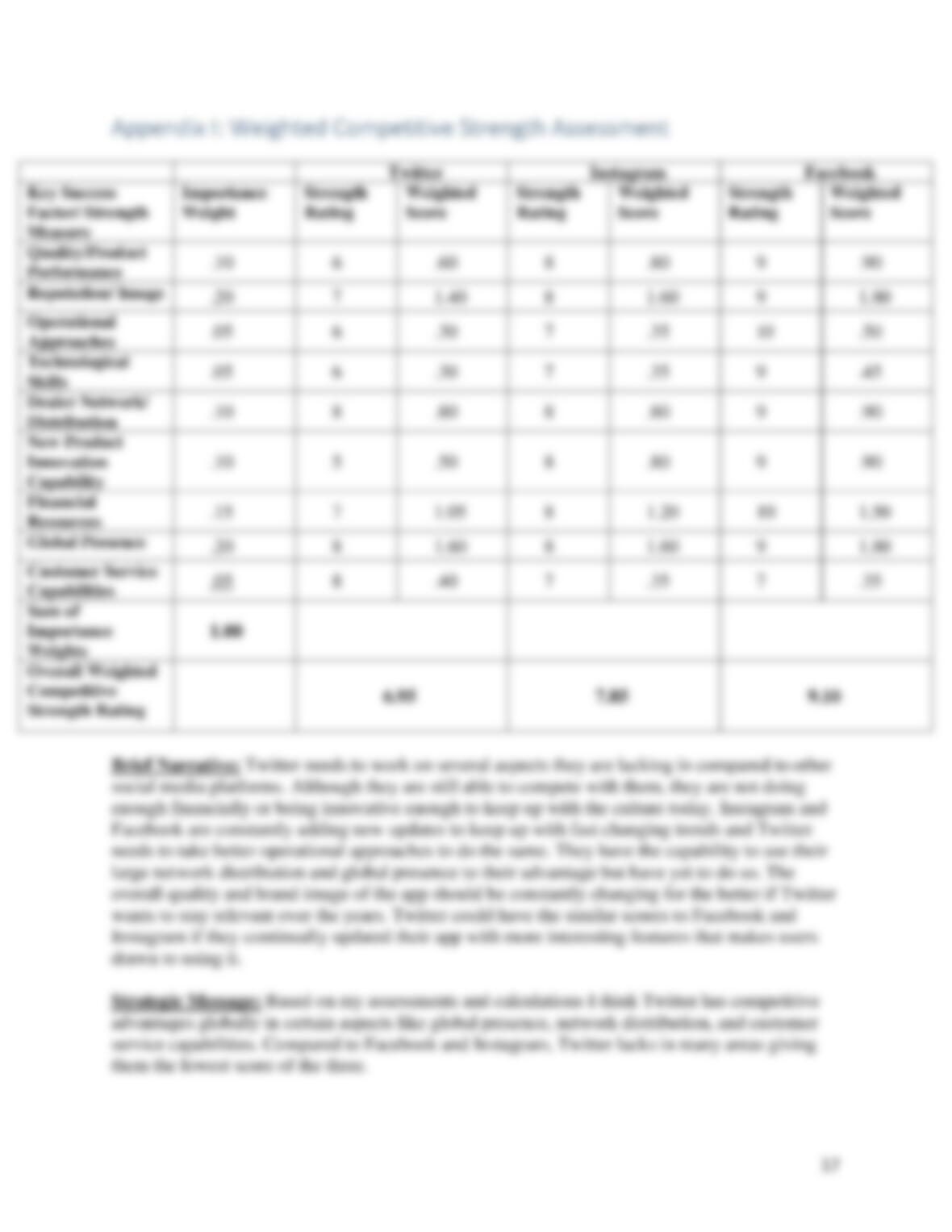
rivals, Facebook and Instagram have an overall better performance rating than Twitter (see
Appendix I: Weighted Competitive Strength Assessment on page 17 for more information on
how Twitter is rated compared to its largest competitors). Twitter is overall not doing enough
financially or being innovative enough to keep up with the culture today. Instagram and
Facebook are constantly adding new updates to keep up with fast changing trends and Twitter
needs to take better operational approaches to do the same.
Twitter has the capability to use their large network distribution and global presence to
their advantage but have yet to do so. The overall quality and brand image of the app should be
constantly changing for the better if Twitter wants to stay relevant over the years. Twitter has
been able to compete with Facebook and Instagram but need to continually update their app with
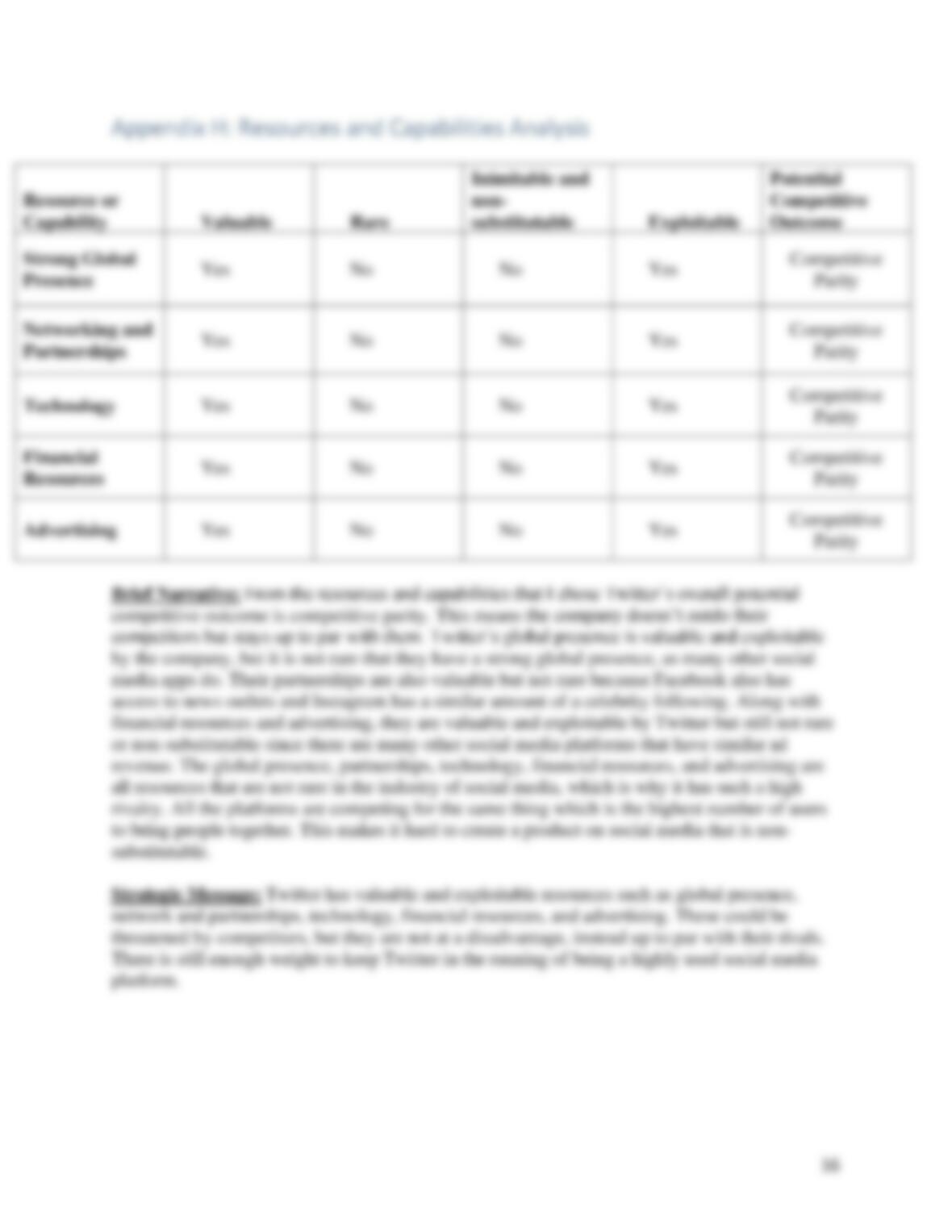
more interesting features that make users more drawn to using it (see Appendix H: Resources
and Capabilities Analysis on page 16 for more information on what is valuable, rare, non-
substitutable, and exploitable for Twitter’s success). With the VRINE analysis it pointed out the
value of the resources that Twitter has and could use to their benefit.
In conclusion social media is overall a very competitive industry to enter. The goals of
these platforms are all relatively the same and each company fights for the most ad revenue and
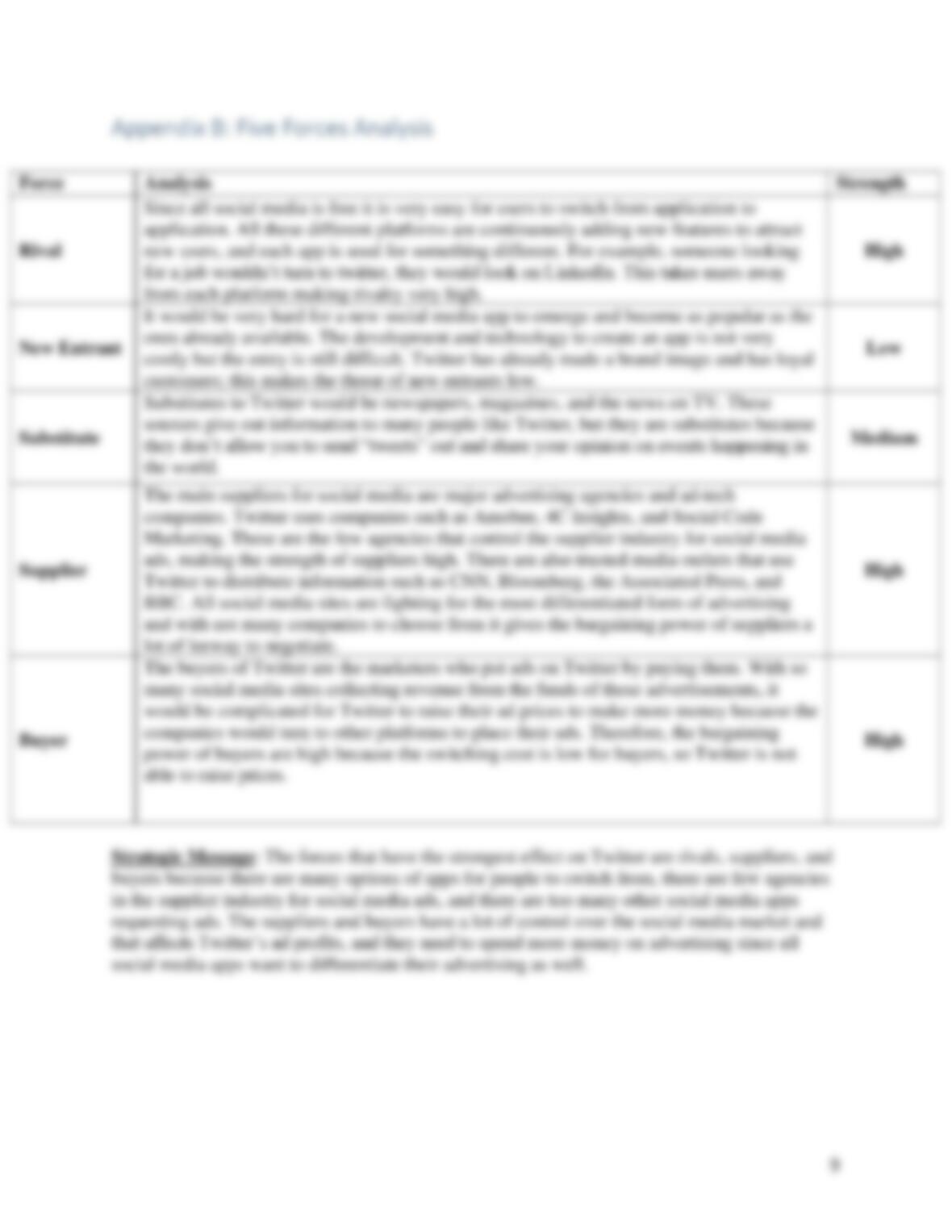
users (see Appendix B: Five Forces Analysis on page 9 to see what forces have the largest effect
on Twitter). Although the strength of new entries is low, the rival force is still high because it is
easy for users to switch from platform to platform since all social media is free to use. Twitter
needs to find a way to block out substitutes and differentiate themselves from apps like Facebook
to stay in the running of being a top performing social media platform.
Key Recommendation
The three recommendations I would give to Twitter are enhance app features, get bought
out by a larger company such as Facebook, or add a marketplace feature like Instagram and
Facebook. Each of these recommendations solves the three main issues Twitter has such as
globalization, poor financial performance, and a high threat of rivalry. If Twitter were to use one
of these recommendations, there issues would be solved, and they would be considered one of
the most used apps again.
The first recommendation I would offer to Twitter is to add a marketplace feature like
Instagram and Facebook. If Twitter were to add this feature it would open many opportunities for
them to partner with other companies to sell their products. This would give them another source
of revenue besides only the ads they depend on. A marketplace will also bring more users to the
app. Once people find out that Twitter also is capable of selling items, more users will want to
join to sell the products they have on another platform besides Instagram and Facebook. When
users are on the marketplace version of Twitter, they will also be spending more time on the app,
bringing in more traffic for ad revenue. This would be a perfect feature for Twitter since its rivals
have it as well.
Another recommendation I have for Twitter is to allow themselves to be bought out by a
competitor. When Twitter was at its lowest point the media was suggesting that Twitter should
try and get bought out to save themselves from the loss of profit. If Twitter decided to do this, it
would get rid of their financial issues and solve another problem for them. Once they are bought
out the CEO could still possibly be involved with the company under a new CEO and give his
advice and point of view on the new direction Twitter will be going. With the stress of their