Application: Problem Set
Muriel Yunis Khalilie
MMBA – 6252V – 2 International Finance
Walden University
Tim Truitt
Sunday March 29th, 2015

“Application: Problem Set”
CHAPTER 5
PROBLEM 2: Using Exhibit 5.4, calculate the one-, three-, and six-month forward cross-
exchange rates between the Canadian dollar and the Swiss franc using the most current
quotations. State the forward cross-rates in “Canadian” terms.
Solution: The formulas we want to use are:
FN(CD/SF) = FN($/SF)/FN($/CD)
or
FN(CD/SF) = FN(CD/$)/FN(SF/$).
We will use the top formula that uses American term forward exchange rates.
F1(CD/SF) = .9052/.9986 = .9065
F3(CD/SF) = .9077/.9988 = .9088
F6(CD/SF) = .9104/.9979 = .9123
Analysis: According to Eun and Resnick, cross-exchange rate is an exchange rate between a
currency pair where neither currency is the U.S. dollar. The cross-exchange rate can be
calculated from the U.S. dollar exchange rates for the two currencies, using either European or
American term quotations. For example, the €/£ cross-rate can be calculated from American
term quotations as follows: S(€/£) (4.5) (where from the following:
The reciprocal relationship between European and American term quotes implies: S(£/$a )
(4.4) .6550 Thus, the bank dealer’s ask price of £0.6550 per U.S. dollar is indeed greater than its
bid price of £0.6548. Examination of Exhibit 4.4 indicates that for most currencies, quotations
are carried out to four decimal places in both American and European terms. However, for some
currencies (e.g., the Japanese yen, Slovakian koruna, South Korean won) quotations in
European terms are carried out only to two or three decimal places, but in American terms the
quotations may be carried out to as many as eight decimal places (see, for example, the Turkish
lira)).
so, S(€/£) 1.5641 That is, if £1.00 cost $1.5272 and €1.00 cost $0.9764, the cost of £1.00 in
euros is €1.5641.
So, it is good to say that “With this mode of operation, markets prevent the listing of many
individual rates between currencies”[ CITATION Mer \l 13322 ].
PROBLEM 4: Restate the following one-, three-, and six-month outright forward European
term bid-ask quotes in forward points.
Spot 1.3431-1.3436
One-Month 1.3432-1.3442
Three-Month 1.3448-1.3463
Six-Month 1.3488-1.3508
Solution:
One-Month: 01-06
Three-Month: 17-27
Six-Month: 57-72
Analysis: “In conjunction with spot trading, there is also a forward foreign exchange market.
The forward market involves contracting today for the future purchase or sale of foreign
exchange. The forward price may be the same as the spot price, but usually it is higher (at a
premium) or lower (at a discount) than the spot price. Forward exchange rates are quoted on
most major currencies for a variety of maturities. Bank quotes for maturities of 1, 3, 6, 9, and 12
months are readily available. Quotations on nonstandard, or brokenterm, maturities are also
available. Maturities extending beyond one year are becoming more frequent, and for good bank
customers, a maturity extending out to 5, and even as long as 10 years, is possible”[CITATION
Eun04 \l 13322 ].
“Multinational companies, banks and other financial institutions enter into forward contracts to
take advantage of the forward rate for purposes of cobertura.2 The forward exchange rate is
determined by a relationship of parity between the spot rate and differences in interest rates
between two countries, reflecting an economic equilibrium in the foreign exchange market, in
which arbitrage opportunities are eliminated. When balance and interest rates vary between two
countries, the parity condition implies that the forward rate includes a premium or discount that
reflects the interest rate differential. The forward exchange rates have important theoretical
implications for predicting future spot exchange rates. Financial economists have advanced a
hypothesis that the forward rate accurately predicts future spot rate, for which empirical
evidence is mixed”[ CITATION Dic12 \l 13322 ].
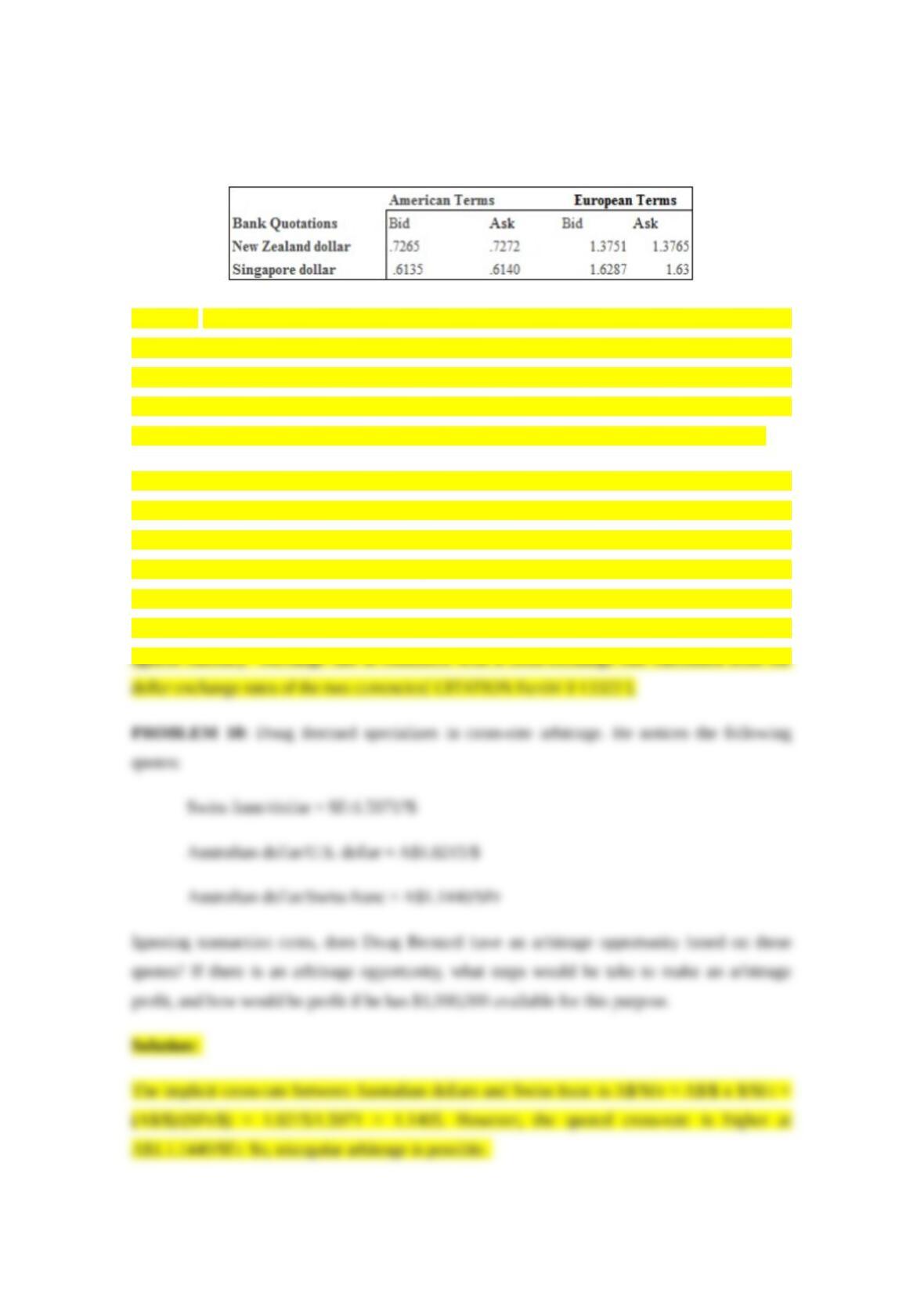
PROBLEM 9: Given the following information, what are the NZD/SGD currency against
currency bid-ask quotations?
Solution: Equation 5.12 from the text implies Sb (NZD/SGD) = Sb ($/SGD) x Sb (NZD/$) = .
6135 x 1.3751 = .8436. The reciprocal, 1/Sb (NZD/SGD) = Sa (SGD/NZD) = 1.1854.
Analogously, it is implied that Sa (NZD/SGD) = Sa ($/SGD) x Sa (NZD/$) = .6140 x 1.3765 = .
8452. The reciprocal, 1/Sa (NZD/SGD) = Sb (SGD/NZD) = 1.1832. Thus, the NZD/SGD bid-
ask spread is NZD0.8436-NZD0.8452 and the SGD/NZD spread is SGD1.1832-SGD1.1854.
Analysis: “In the Forex market, we have to considerate the crossover rate of supply and demand
of foreign exchange; when a company works on different product lines but the lines maintain
the same outcome and the same profit margin. For example, a company that manufactures two
different washers but still achieves the same quality service and profitability. So, we have to
take into account the differential between two nations”[ CITATION Bus15 \l 13322 ]. According
with Eun, and Resnick the trade is effectively going through the dollar because the “currency