Trait Approach & Skills Approach (Paper 2) Michelle King
Introduction
Within the sphere of leadership theories, two well-studied theories come to the forefront.
Traits approach to leadership, focuses on the innate or inherent characteristics that “leaders exhibit and
who has these traits” (Northouse, P. G. 2016). In contrast, skills approach focuses on the leadership
performance outcome and the individual attributes and competencies necessary to be an effective
leader. The skills mode “contends that leadership outcomes are the direct result of a leader’s
competencies in problem-solving skills, social judgment skills, and knowledge” (Northouse, P. G. 2016).
This paper will review each theory, provide an analysis of case studies related to each approach,
and provide a reflection of a personal leadership assessment.
Overview of Traits and Skills Leadership Theories
After reading both Chapter 2 and 3 in Leadership: Theory and Practice, it is clear that both trait
and skill leadership theories are leader-centered models. “Skills are what leaders can accomplish,
whereas traits are who leaders are” (Northouse, P. G. 2016). Trait approach emphasizes innate
characteristics that are necessary for someone to be an effective leader. It distinguishes between those
who hold certain characteristics as being leaders and those who do not as nonleaders. Although there
has been adaptations to the list of characteristics over time, including the addition of masculinity during
time periods when the workforce was male dominated, the major leadership traits have been
centralized on: intelligence, self-confidence, determination, integrity and sociability. The trait approach
is considered straightforward as the followers are not considered part of the focus. It is also considered
as an effective tool for self-evaluation and development.
”Rather than emphasizing what leaders do, the skills approach frames leadership as the
capabilities (knowledge and skill) that make effective leadership possible” (Mumford, Zaccaro, Harding,
et al., 2000, p.12 as cited by Northouse, P. G. 2016). The skills approach is considered descriptive not
prescriptive, like the traits approach. There are three components to the skills model: individual
attributes, competencies and leadership outcomes. This model focuses on skills that can be learned and
developed, making leadership available to more than just those who were born with a particular set of
characteristics. For instance, rather than an emphasis on intelligence, the skills model focuses on
knowledge. But there are similarities between the two models. The skills model has the individual
attribute of personality, which is a trait, not a learned skill. According to the model, to be an effective

leader you must have personality traits like “openness, tolerance for ambiguity, and curiosity”
(Northouse, P. G. 2016), as these affect your motivation to solve organizational problems.
Although trait approach is a simpler approach, skills model relies more on personal
characteristics than is evident from the initial description. You can teach someone to understand
emotional intelligence, or social judgment, but there is no evidence presented that providing training in
these areas is effective without some innate motivation to drive the application of skill development.
Analysis of Case Study from Chapter 2
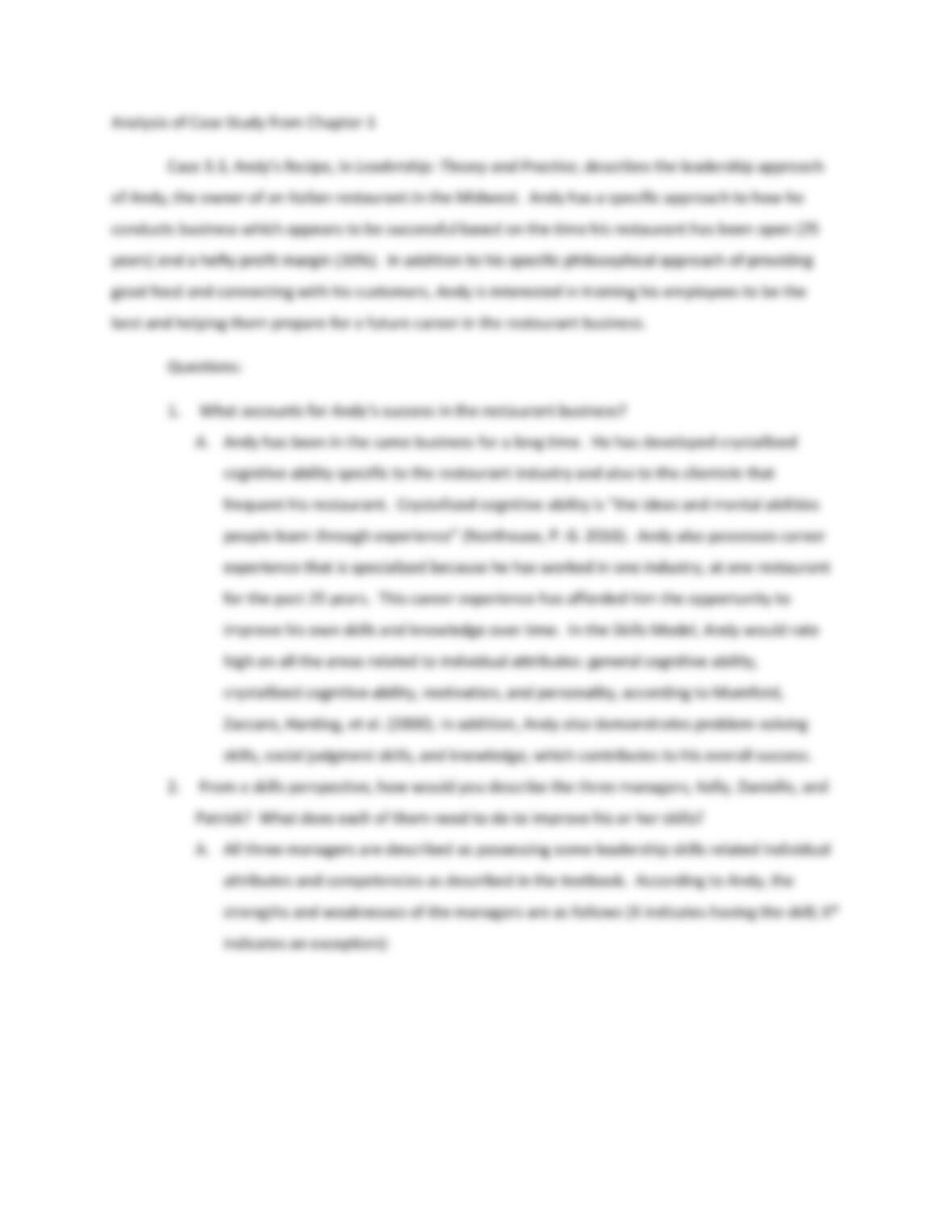
Case 2.3, Recruiting for the Bank, in Leadership: Theory and Practice, describes the recruiting
methodology of Pat Nelson the assistant director of human resources for Central Bank. Despite
successfully recruiting college seniors for the past 10 years for the entry level credit analyst position, Pat
is receiving pressure to change his recruitment tactics to focus on recruits with potential for promotion.
There is also a concern that the turnover rate for new hires after one year is high – 25%.
Questions:
1. Based on ideas described in the trait approach, do you think Pat is looking for the right
characteristics in the people he hires?
A. Pat’s methodology is to look for people who have strong interpersonal skills,
confidence, are poised and take initiative. He also looks for applicants who have a
strong sense of confidentiality and ethics due to the type of industry. Because the
position is also a technical one, he looks for recruits who have knowledge of
computers, analytical and technical skills. Finally, he looks for applicants who are
determined and persistent.
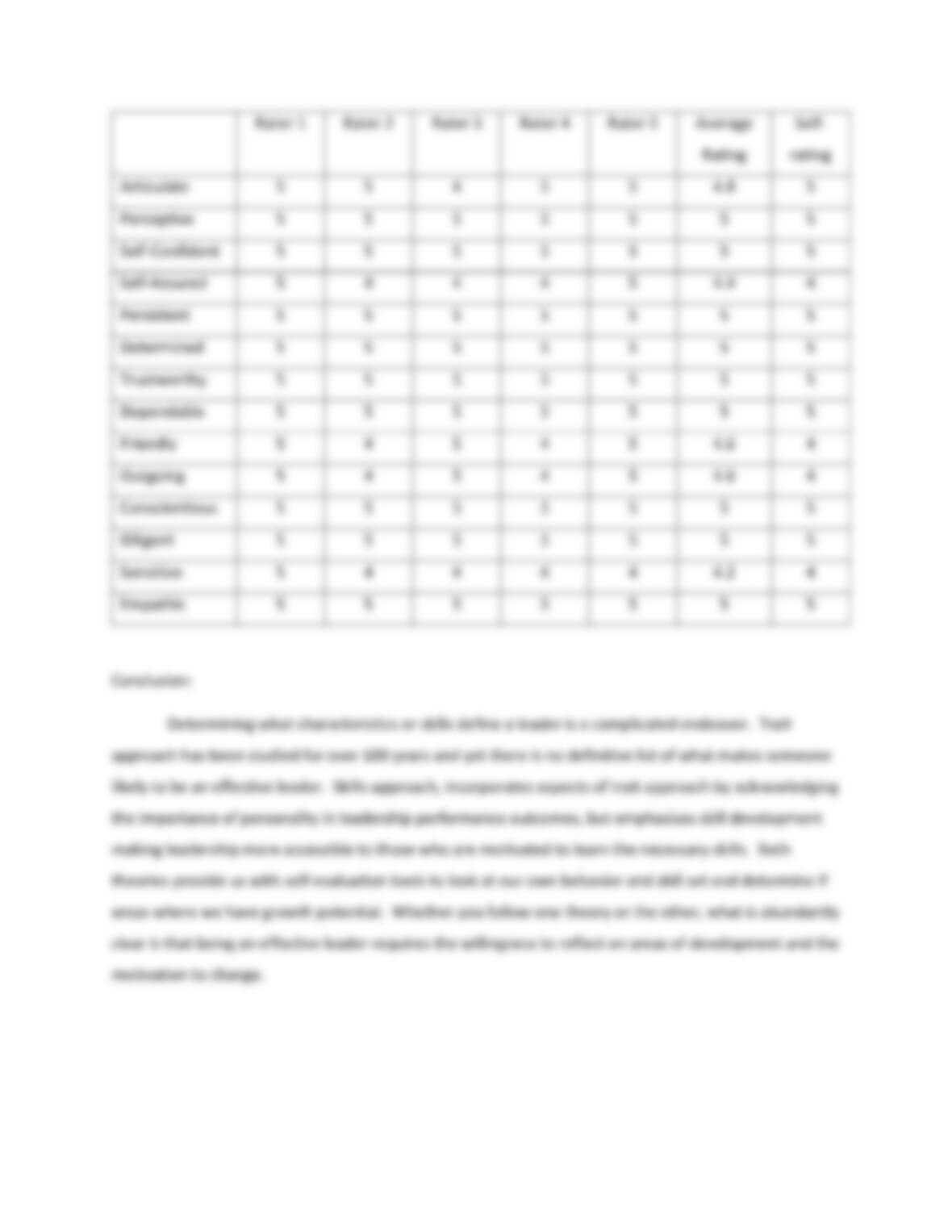
If we apply the trait leadership approach using the Leadership Trait Questionnaire
from the textbook, we can see that Pat is focused on the following traits:
dependable, persistent, determined, conscientious, trustworthy, diligent, and self-
confident. According to trait-based leadership approach, Pat has selected several of
the leadership qualities that demonstrate personal characteristics of leadership.
There are, however, several leadership traits he does not appear to be focusing on:
articulate, perceptive, self-assured, friendly, outgoing, sensitive and empathic. If
Pat were to expand his criteria using a trait leadership approach, he may find more
candidates with greater potential for leadership positions in the long-term. Pat
might also consider the Big Five personality factors: neuroticism, extraversion,
openness, agreeableness, and conscientiousness when evaluating potential
candidates as there is a direct connection between these traits and being an
effective leader (Judge et al. 2002 as cited by Northouse, P. G. 2016). Primarily he
may want to focus on extraversion as this was cited by Judge et al., as the “most
strongly associated with leadership” (Northouse, P. G. 2016).
2. Could it be that the retention problem raised by upper management is unrelated to Pat’s
recruitment criteria?
A. A 25% attrition rate is considered very high for banking and finance. According to
Compensation Force, the average (voluntary) turnover rate for banking and finance
in 2015 was 14.2% (compensationforce.com. 2015). Based on the statistics it is
natural that the bank is concerned about the high turnover rate. Hiring and training
employees is a significant investment and studies indicate that the average cost to
replace an employee at the level Pat is hiring (mid-range) would be from $6,000 to