Training and Development: Issues and HRIS Applications
Training is one of the major programs offered by HR departments and is an important aspect of
the organization’s talent management program. Organizations use training not only for both
skill and knowledge learning but also to develop employees for future positions. In addition,
training plays an important role in the motivation of employees. It shows that the organization
is concerned about the development of the employees and would like to retain them. However,
training generally captures the largest portion of the HR department budget. Due to the heavy
costs, the application of an HRIS to save money is very important.
Training and Development
In the new global economy, knowledge is now the new lever for success, since knowledge
potentially adds more value than the traditional factors of production – capital, raw material,
and labor. This new knowledge-based economy is directly based on production, distribution,
and use of knowledge and information.
Knowledge is created by a firm’s knowledge assets. That is, its human capital which has long
been recognized as one of the key sources or competitive advantage. Hence the learning,
training and development (LT&D) of employees has now taken center stage in today’s
organizations to ensure
(a) long term competitiveness
(b) quality
(c) flexibility
(d) adaptability
Reasons why organizations train and develop their work force
• enable workers to cope with their daily workload
• Alleviates possible future skill shortages
• Foster employee motivation and satisfaction
Training and development (T&D) are a function of human resource management concerned
with organizational activity aimed at bettering the performance of individuals and groups in
organizational settings.
T & D is closely allied with the performance management and talent management process.
HRIS are used to collect, store, and analyze T & D information.
Strategic Implications & Learning Organizations
There are a number of key terms associated with Training and Development:
• Education – aimed at developing, usually as part of a formal program of study, general
knowledge, understanding and moral values
• Training – the planned acquisition of knowledge, skills, and abilities (KSA) to carry out a
specific task or job in a vocational setting. The purpose of training interventions is to
attain a positive change in performance.
• Development – a continuous process of systematic advancement, of becoming
increasingly more complex, more elaborate, and differentiated, by virtue or learning and
maturation. Development in an organizational context ensures that employees possess
the KSA required to fulfill future roles in the organization.
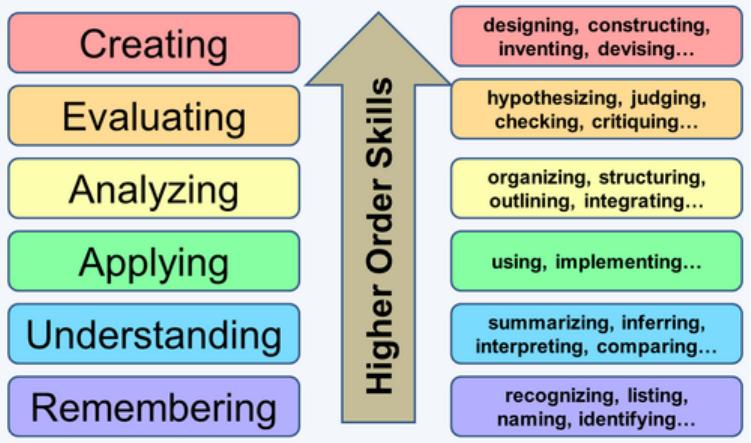
• Skills – directly related to performance and the ability to carry out a task. Blooms
taxonomy of learning identifies six increasingly higher levels of thinking.
• Competencies – consist of KSA and the underlying characteristics of a person that allow
the jobholder to perform a task effectively
• Knowledge – a tacit commodity, and intangible asset. It is associated with an
understanding of and a constructive application of information.
• Knowledge Management (KM) – consists of five separate activities, which are the
acquisition, documentation, transfer, creation, and application of knowledge.
* Training focuses on immediate job performance, whereas development centers on long-term
continuous changes of an individual’s potential.
Employee Learning & Success
An organization should cultivate the following disciplines amongst their employees to engender
learning and success:
• Personal Mastery – individual growth & learning
• Mental models– deep rooted assumptions that affect the way in which employees
perceive people, situations, and the organization