Training and Development in Organizations (MGT 317–01)
Spring 2018
Course/Section Time/Day Room
MGT 317 – 01
12:30 p.m. – 1:45 p.m. T/TH
Bryan 204
Assistant Professor
Anju M
eht
a
O
f
fice
Bryan Building # 350
Phone
336
–334–
3465
Email
a_mehta@uncg.edu
Office Hours
T/TH: 2:00 – 3:00 p.m. and by appointment
Computer Use: UNCG email and CANVAS
All students officially registered for the course can access the course Canvas website
(http://courses.uncg.edu). The Canvas website includes a course syllabus, class announcements,
assignments, PowerPoint slides, and other relevant course information.
Modes of instruction: Lecture, discussion and assignments, audio/visual
Course Objectives
MGT 317 is designed to provide students with a basic understanding of training, development, and
organizational learning (OL) as it is found in business and industry today. The course covers training
needs assessment, training design, training methods, training evaluation, adult learning theory,
management development, organizational learning, and knowledge management. The course is designed
primarily for undergraduate management majors who wish to concentrate in HR, but will benefit any
business major who is attempting understand the strategic role of training, development, and OL in
organizations.
The students will also get an understanding of how training and development function is changing as a
result of the global business environment, multi-cultural workforce, and globally distributed work.
We will also discuss the role of technology and social media in training and development today and the
essential role of leadership in setting a learning culture in organizations.
Text and
Readings
Course Text:
Blanchard, P.N. & Thacker, J.W.,
Effective Training, 5
th
edition, Pearson.
Recommended reading: Beitler, Michael (2010). Strategic Organizational Learning, Second Edition.
Practitioner Press International.
You are responsible for reading the textbook and other assigned materials ahead of class as a basis
for discussion and in the event of a quiz. Reading the chapter ahead of class will substantially
increase your understanding of the concepts and help you earn a better grade. Additionally,
discussing each and every topic from the textbook will not be possible in class due to time
constraints. In class, we w i l l c o n c e n t r a t e on r e l a t i v e l y i m p o r t a n t and c o m p l e x
concepts. However, you will be tested on textbook material not covered in the class. Therefore,
you will be responsible for reading the textbook thoroughly and being prepared to
answer test questions based on textbook and other material.
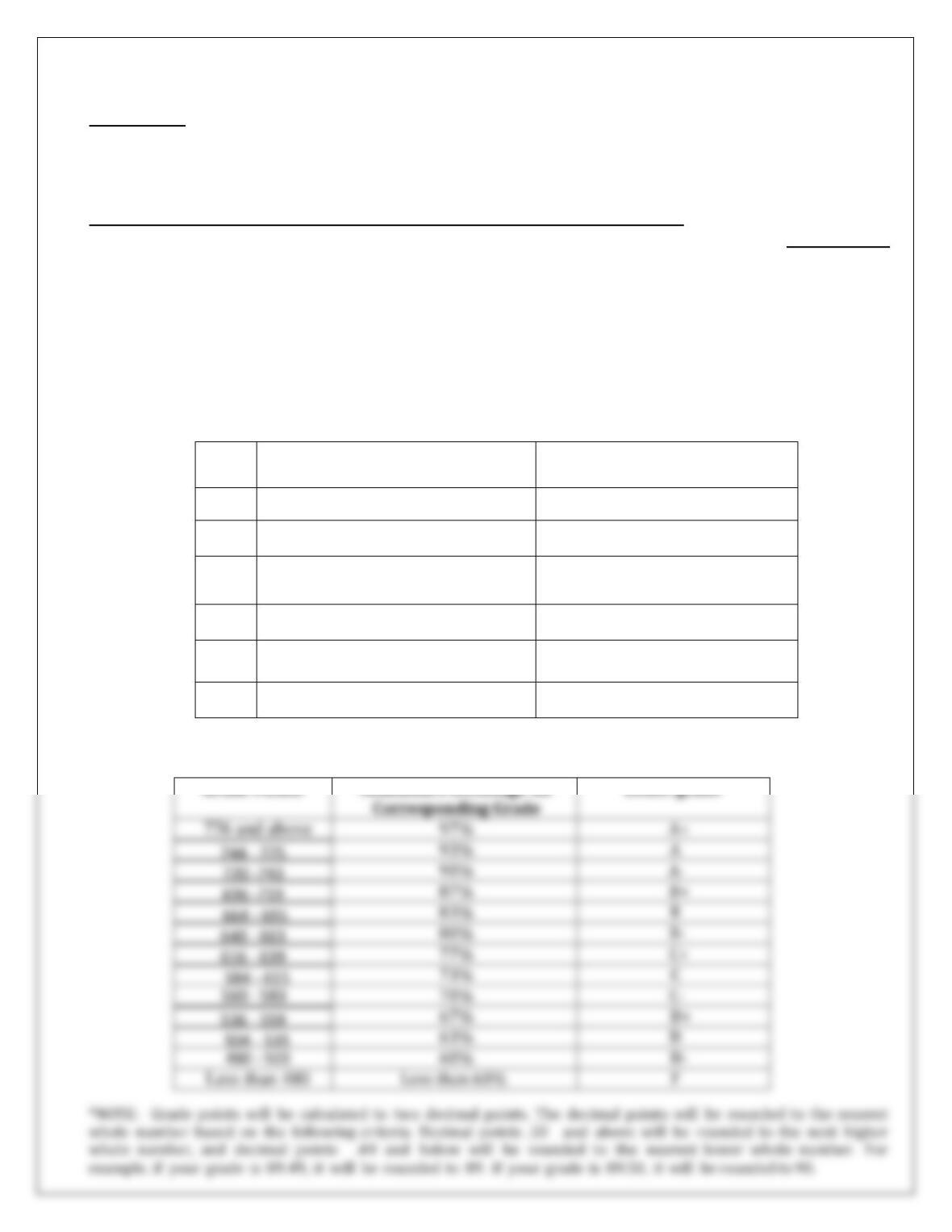
Course Grading Criteria
S. No.
Course Components
Points
1
Exams 1–3
360
2
Quizzes
120
3
Team Presentation & Peer
Evaluation
120
4
Training Assignments/cases
120
5
Class participation and activities
80
TOTAL
800
Grade Distribution S
cheme
*