A TERM PAPER ON
TOYOTA
Course Name: Management of Organization & Systems
Course No: MGT 701
Submitted To:
Professor Dr. Md. Faridul Islam
BRAC Business School
BRAC University
Submitted By:
Subrata Roy (ID:18374017)
Ekramul Hoq (ID: 18174019)
MD Shaukat Hossain (ID:18374006)
Sadia Jahan (ID:18174019)
Mohammad Shamim (ID:17274026)
EXECUTIVE SUMMARY
Toyota Motor Corporation (further Toyota) is the world’s leading automaker
(often tied with Volkswagen for 1st-2nd place) based in Toyota City, Japan.
In 2012, the company was the first automotive company to produce over 10
million vehicles in a single year.
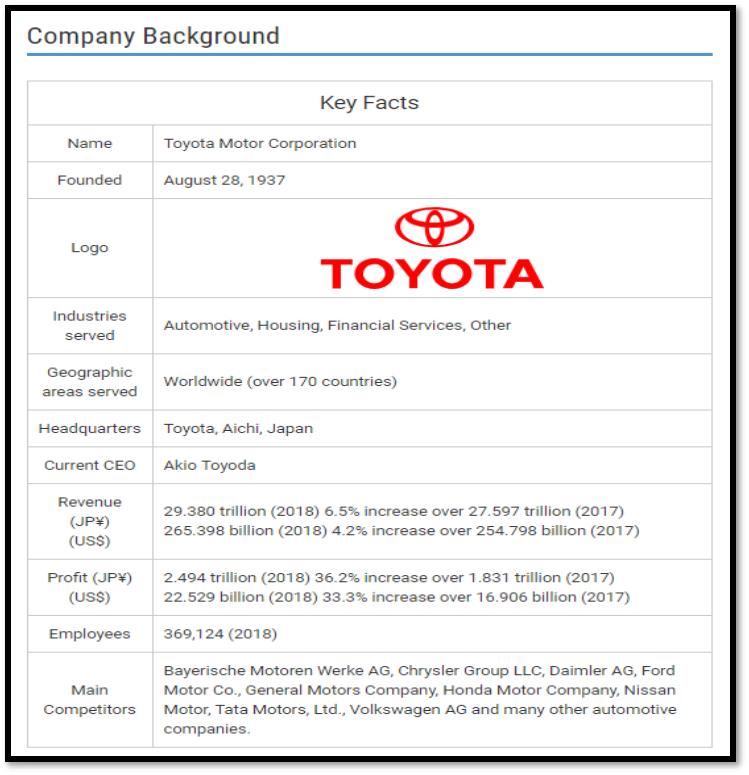
The company operates 4 different brands: Daihatsu, Hino, Lexus and Toyota.
Toyota’s brand is the world’s 7th most valuable brand in the world and the
most valuable automotive brand, worth US$50.291 billion. The main
Toyota’s markets are Japan, United States and China, where the company sells
over 50% of its vehicles. The company produces the best-selling hybrid
vehicle Prius.

INTRODUCTION
The aim of this paper is to discuss the environmental analysis of Toyota. In
today’s business scenario most of the companies are astonished by the amount
and type of changes taking place in their external environment. Companies of
any type of industries are facing the uncertainties of the external environment.
So in this paper we will discuss the external environment of Toyota and how
external environment affects the functioning of the company and how the
company responds to these uncertainties.
Toyota Motor Corporation competes in the automotive industry. The past five
years were tumultuous for automobile manufacturers. Skyrocketing fuel
prices and growing environmental concerns have shifted consumers’
preferences away from fuel-guzzling pickup trucks to smaller, more fuel-
efficient cars. Some automakers embraced the change by expanding their
small-car portfolios and diversifying into the production of hybrid electric
motor vehicles. Other automakers were more reluctant to shift their focus
from big to small cars, expecting the price of fuel to contract eventually,
bringing consumers back to the big-car fold. When fuel prices did fall during
the second half of 2008, it was due to the US financial crisis ripping through
the global economy. This had a domino effect throughout the developed and
emerging worlds, with many Western nations following the United States into
recession. Industry revenue fell about 15.4% in 2009. 2 Pent-up demands will
aid industry revenue growth, estimated at 2.1% in 2013, thus bringing overall
revenue to an estimated $2.3 trillion. 3 Overall, the large declines followed by
recovery are expected to lend the industry average growth of 2.2% per year
during the five years to 2013. Throughout the past five years, growth in the
BRIC countries supported production. Rising income in these countries led to
an increase in the demand for motor vehicles. Also, Western automakers
moved production facilities to BRIC (Brazil, Russia, India and China)
countries to tap into these markets and benefit from low-cost production. Over
the next five years, the emerging economies will continue their growth, and
demand for motor vehicles in the Western world will recover. Industry
revenue is forecast to grow an annualized 2.5% to total an estimated $2.6
trillion over the five years to 2018.
The current stage of Toyota is that of a leading motor company which offers
a wide range of products from mini vehicles to trucks. The company has
dealerships and manufacturing plants all over the world. The fact that Toyota
puts the customer first provided the company the possibility of growth and
also the possibility of increasing the market share. Their vision is about a
sustainable future with new petrol and diesel engines.
The challenge that represents the global warming and urban pollution made
Toyota try to develop new and innovative environmental technologies and
vehicles. Due to this, Toyota is well known for being the first motor company
that produced a hybrid car. Another innovation of Toyota was the Toyota D-
CAT (Diesel-Clean Advanced Technology) concept. This last innovation was
created in order to reduce the diesel emissions. Toyota is a company that is
environmentally-driven and it sustains the “zero-emissions” concept.

ORGANIZATION ENVIRONMENT
Every organizations affect by its outside world force as well as inside forces.
Both forces have huge impact to an organization to take proper planning,
proper use of resources and going to ultimate goal. There are two main parts
of environmental factors. These are:
1. INTERNAL ENVIRONMENT
2. EXTERNAL ENVIRONMENT
1. INTERNAL ENVIRONMENT:
The internal environment is the environment that has a direct impact on the
business. Here there are some internal factors which are generally controllable
because the company has control over these factors. It can alter or modify
such factors as its personnel, physical facilities, and organization and
functional means, like marketing, to suit the environment.
A) Value system: The value system of the founders and those at the helm of
affairs has important bearing on the choice of business, the mission and the
objectives of the organization, business policies and practices.
B) Mission, vision and objectives: Vision means the ability to think about
the future with imagination and wisdom. Vision is an important factor in
achieving the objectives of the organization. The mission is the medium
through which the objectives are achieved.
C) Management structure and nature: The structure of the organization also
influences the business decisions. The organizational structure like the
composition of board of directors, influences the decisions of business as
they are internal factors. The structure and style of the organization may
delay a decision making or some other helps in making quick decisions.
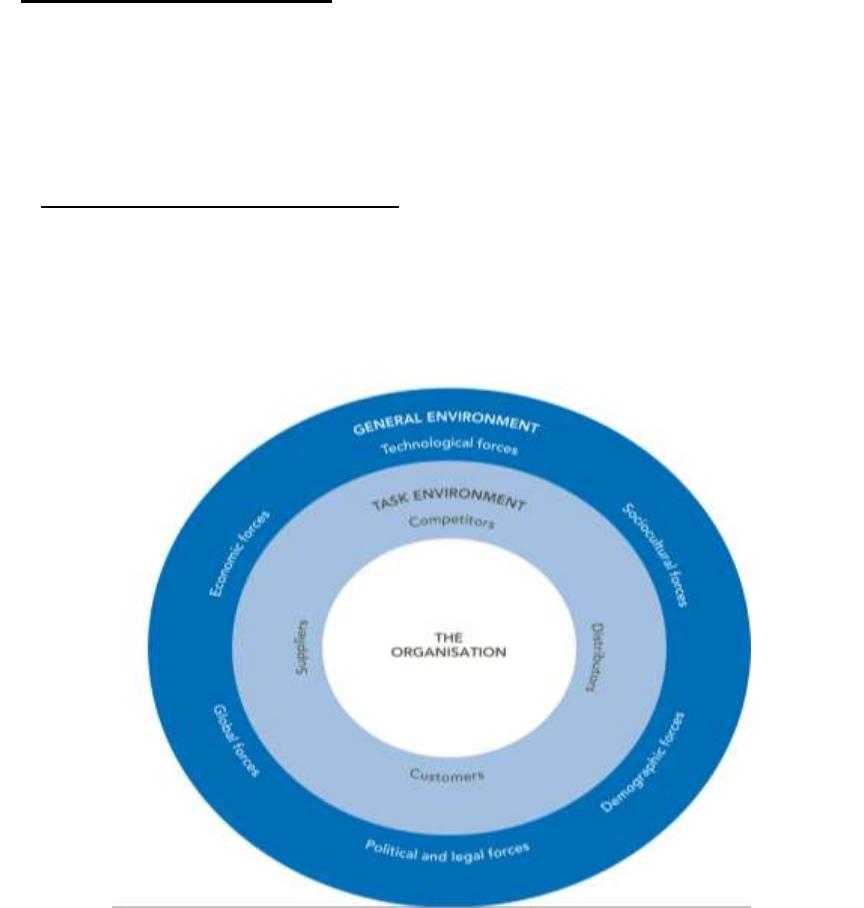
2. EXTERNAL ENVIRONMENT:
It refers to the environment that has an indirect influence on the business. The
factors are uncontrollable by the business. There are two types of external
environment:
1. Task/Micro Environment
2. General/Macro Environment.
1. Task/Micro Environment: Task Environment of an organization is the
environment which directly affects the organization from attaining business
goals. In brief, Task Environment is the set of conditions originating from
suppliers, distributors, customers, stock markets and competitors which
directly affects the organization from achieving its goals.
2. General/Macro Environment: The factors and conditions (such as
economic, legal, political, and social circumstances) that generally affect
everyone in an industry or market in more or less similar manner. It consists
of five dimensions: Economic, Technological, Sociocultural, Political–
Legal and International.
OBJECTIVE OF THIS PAPER
TO DISCUSS POLITICAL-LEGAL FORCES OF TOYOTA
TO STUDY THE SWOT ANALYSIS OF TOYOTA
TO STUDY THE COMPETITIVE ANALYSIS OF TOYOTA
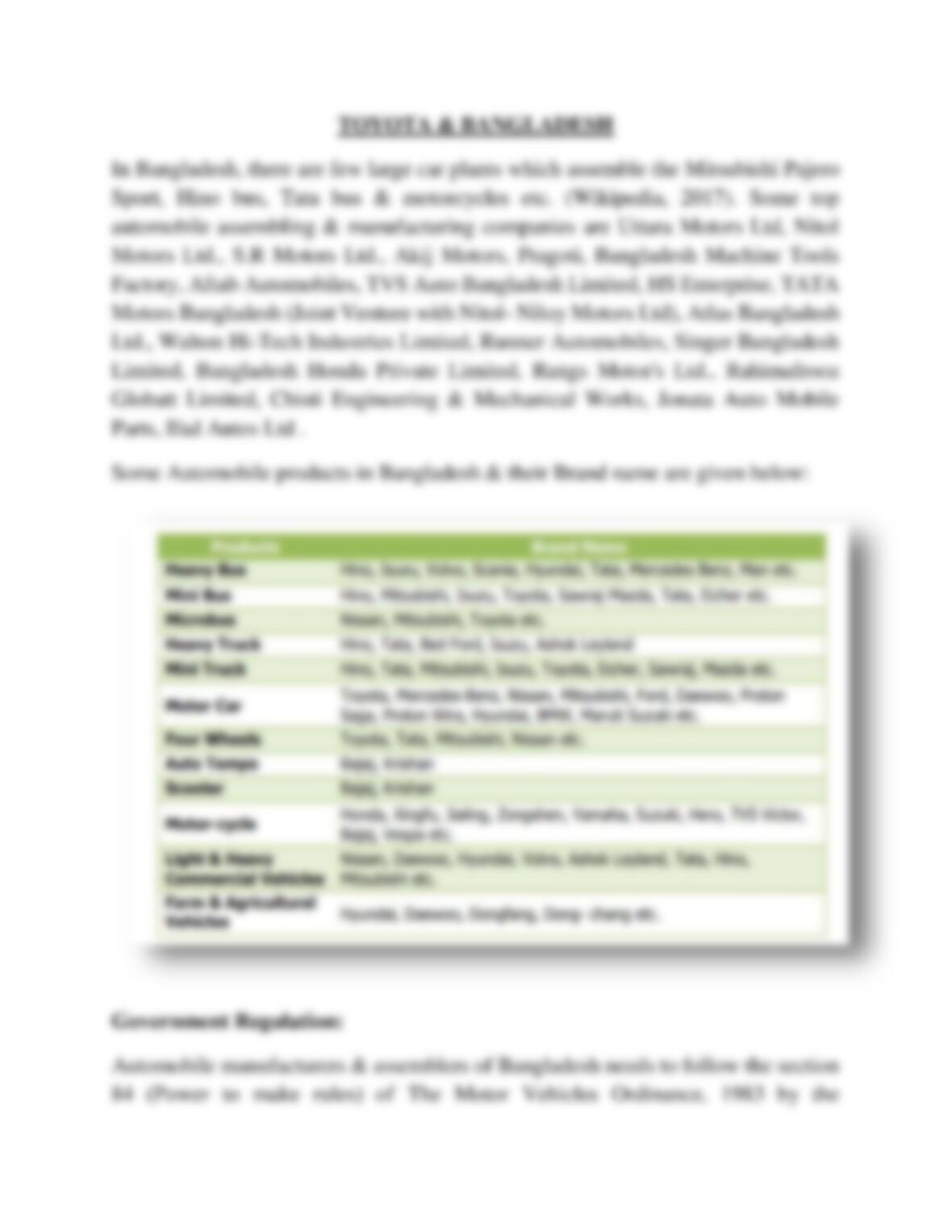
TOYOTA & BANGLADESH
POLITICAL-LEGAL FORCES OF TOYOTA
The worldwide automotive industry is subject to various laws and governmental
regulations such as –
Government
Trading policies,
Funding grant and Initiatives,
International pressure group,
vehicle safety
Wars and conflicts,
Government