B E N E D I C T I N E U N I V E R S I T Y
Group 6: Nguyen Quoc Anh (2355275), Luu My Linh (2340032), Ngo Phong Lam (2345496), Le Cong Nguyen
(2340052), Tran Duc Hung (2332751)
Toyota: Investigating the 2009 – 2011 Toyota
recall from a leadership and ethical standpoints
TABLE OF CONTENTS
I. EXECUTIVE SUMMARY……………………………………………………………………………………………………….3
II. AN INTRODUCTION TO TOYOTA………………………………………………………………………………………..4
II.1. A BRIEF HISTORY………………………………………………………………………………………………………….4
II.2. MAJOR PRODUCTS……………………………………………………………………………………………………….5
II.4. KEY LEADERS IN TOYOTA’S HISTORY AND THEIR LEADERSHIP’S IMPACTS…………….6
III. SURFACE REASONS BEHIND THE RECALL……………………………………………………………………….8
III.1. AN OVERREACTED MEDIA………………………………………………………………………………………….9
III.2. CONFLICTING POLICAL INTERESTS…………………………………………………………………………..9
III.3. AGGRESSIVE GROWTH LED TO TECHNICAL PROBLEMS…………………………………………10
IV. THE PERFOMANCE IMPACTS OF THE ISSUES………………………………………………………………….11
V. DIFFERENT PARTIES’ REACTIONS…………………………………………………………………………………….12
V.1 SOCIETY’S REACTIONS TOWARD TOYOTA RECALL…………………………………………………..12
V.2. LEADERSHIP REACTIONS – THE CAUSE OF THE CRISIS……………………………………………14
VI. THE ETHICAL AND LEADERSHIP NATURE OF THIS CRISIS…………………………………………….15
VI.1. ABANDONING ETHICAL STANDARD FOR PROFITS………………………………………………….15
VI.2. LACK OF FOCUSED LEADRSHIP……………………………………………………………………………….16
VI.3. INCORRECT SET OF LEADERSHIP SKILLS………………………………………………………………..16
VII. RECOMMENDATIONS AND IMPLEMENTATION PLANS………………………………………………….17
VII.1. RECOMMENDATIONS……………………………………………………………………………………………….17
VII.1.1. Being ethically responsive to crises…………………………………………………………………………..17
VII.1.2. Opportunity out of crisis through ethically creative actions………………………………………….17
VII.1.3. Ethical standards part of long term leadership skills……………………………………………………18
VII.1.4. Finding a new generation of leaders………………………………………………………………………….18
VIII.2 IMPLEMENTATION PLAN…………………………………………………………………………………………19
IX. CONCLUSIONS…………………………………………………………………………………………………………………20
X. APPENDIX…………………………………………………………………………………………………………………………21
XI. BIBLIOGRAPHY……………………………………………………………………………………………………………….25
I. EXECUTIVE SUMMARY
The recall crisis of 2011 from Toyota has always been a very interesting event that attracts
attention from many different researchers trying to understand corporate crisis. Though using different
views and analysis, scholars can learn much about how a corporation can get into and get out of crisis.
However, in this case, we believe researchers have placed too much emphasis on the surface
consequences of the recall and forgotten that they have deep roots in Toyota’s eroding leadership and
ethical structures. In this research, we argue that Toyota’s 2010 recall was more than the perfect
combination of media, government or society effects; it actually showed a successful company replacing
leaders’ traditional focus on excellence, ethical focus on humanity in pursuit of unsustainable corporate
goals.
The research started out with a quick introduction about Toyota including a brief history, its main
products, main strategy and key leaders. We then explore how previous researches having examined
Toyota 2010 recall through researching the common technical effects, media effects and government
effects. The financial impacts are analyzed to understand how this crisis affects Toyota financially and
operationally. Afterwards, we explore the society’s and leadership’s reactions to further unearth the
underlying issues. Only then we make our main arguments, focusing on Toyota’s leadership and ethical
aspects.
Finally, we concluded the research with exploring different ethical and leadership
recommendations that Toyota could have taken: being ethically responsive, making opportunity out of
crisis, ethical standards as part of long term leadership and finding a new generation of leader. We go
further by suggesting an implementation plan for these recommendations.
II. AN INTRODUCTION TO TOYOTA
II.1. A BRIEF HISTORY
Kiichiro Toyoda, the son of Sakichi Toyoda who was renowned for founding the Toyoda
automatic loom, established Toyota in 1937. The company first passenger car is the A1 and its first truck
is the G1 in 1938 [ CITATION Toy16 \l 1033 ].
During the Second World War, Toyota, similar to other manufacturers, provided trucks for the
Japanese Imperial Army. After the war, it became the first Japanese company to produce the 100,000 th car
domestically in Japan. In this post war period, the company also oversaw various financial crises and
labor disputes due to the highly inflationary post-war Japanese economy. This led to the famous
“voluntary retirements” of a part of its workforce and even Kiichiro Toyoda’s resign in 1950. The
company also started its United States operation in 1957 and opened its Brazil production factory in 1959
[ CITATION His08 \l 1033 ].
The 1960s and 1970s saw Toyota growing itself out of the previous crises with booming domestic
and global economies. Domestically, it passed the one-millionth domestic car sales in 1962 and
entrenched itself as the dominant market leader with more than 40% of total sales. Globally, the company
passed the one-millionth cumulative export mark in 1969. This sale figure increased ten-fold during the
1970s as the company’s small cars sector paid off during the financial crises with the prime example
being the Corolla, introduced in 1966. Toyota also started to push on the export front and building a new
initiative called Total Quality Control (TQC) to improve its quality program after Nissan worked the
Deming Prize for quality control in 1960 (45). Various research and development labs were created as a
result (Babson, 1998, p. 95).
After having establishing itself in a multiple market, the companies started to open more factories
and shift its production lines to other segments in 1980s and 1990s to fill the increasing demand. The
company cumulative car sales gradually passed fifty millions in 1983 and one hundred millions in 1992.
It also involved itself to the luxury brands with the introduction of the Lexus in 1989 that quickly became
one of the best-selling luxury cars globally. The company also introduced the iconic model Camry in
1983 [ CITATION Suc07 \l 1033 ].
After 2000, Toyota has become a powerful brand and aggressively competed with GM, Ford, and
Volkswagen on all global markets. It not only handled the 2008 financial crisis better than other
competitors but also used the opportunity to surpass GM to become American number one selling
automotive brand. As of February 2016, Toyota is the 13th largest company in the world by revenue
[ CITATION Cum \l 1033 ].
II.2. MAJOR PRODUCTS
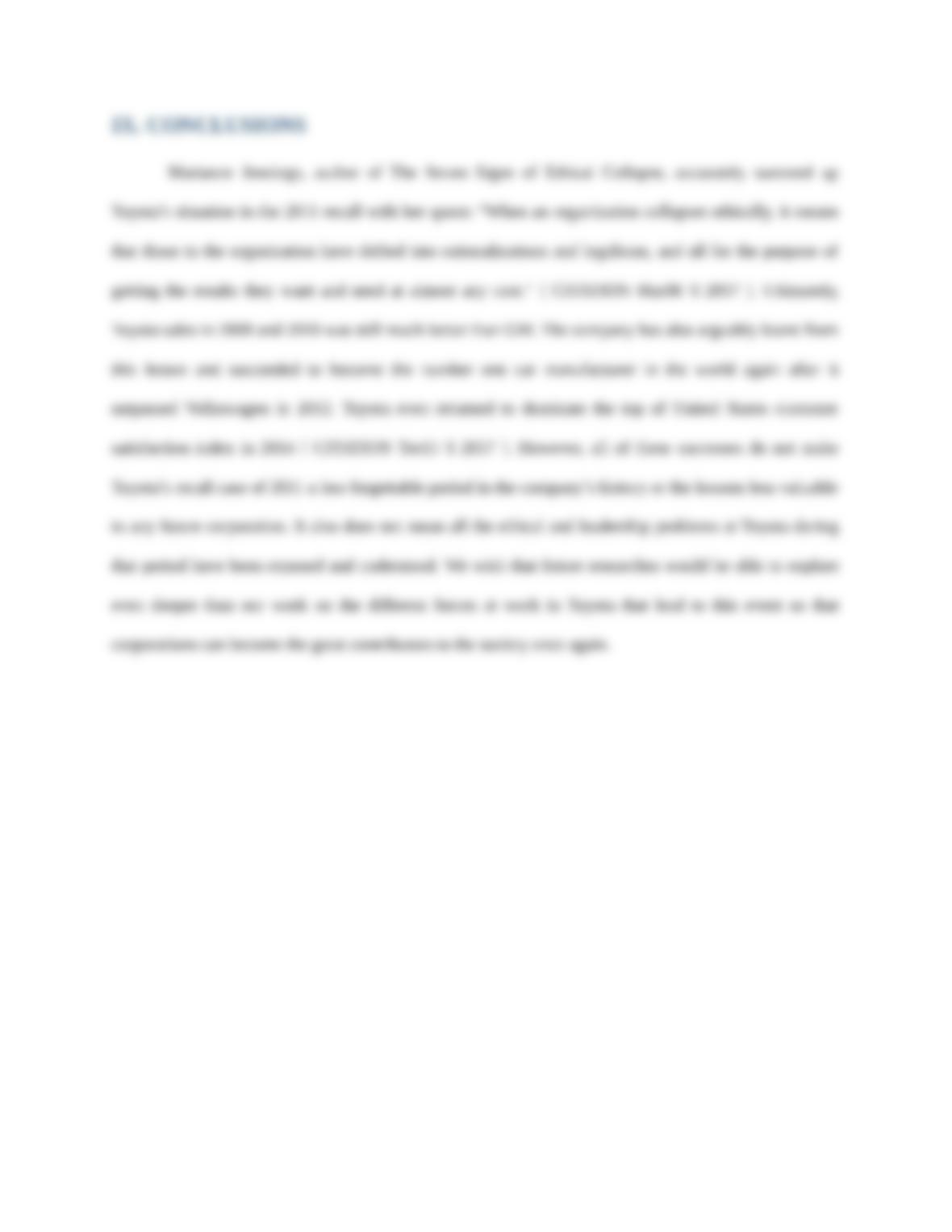
Toyota has products to cover various customers’ needs. Figure 2 shows that the company’s
products can be divided into three main segments: Passenger (76% of total sales), Van and Trucks (17%
of total sales) and Lexus (7% of total sales). In total, the company has created around 61 continuing and
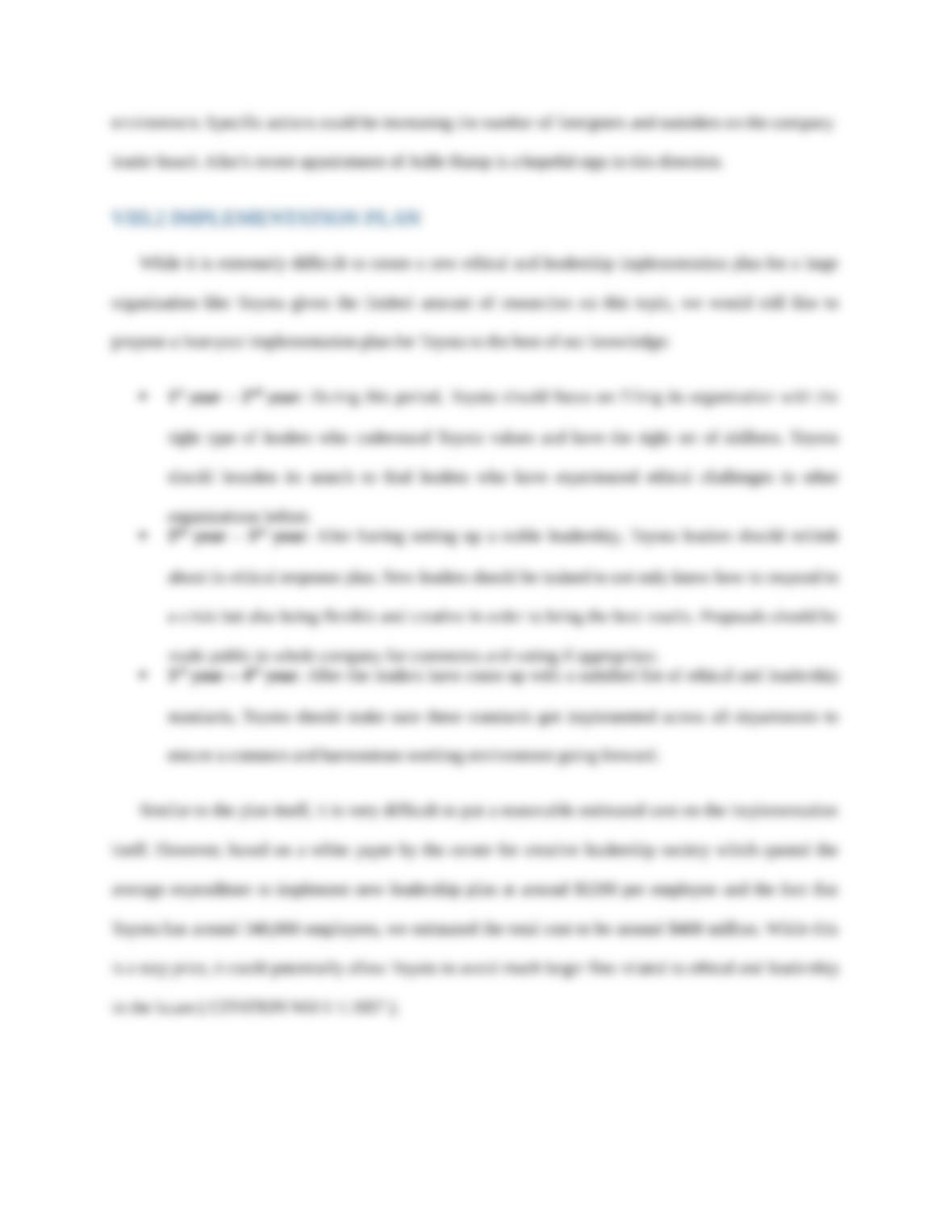
expired models (Figure 1 shows detailed names for each) throughout its history with many household
names such as Camry, Corolla, Rav4, Land Cruisse, etc. [ CITATION Toy161 \l 1033 ].
Within the Passenger segment, there are five major categories: Mini Vehicles, Sport Utilities,
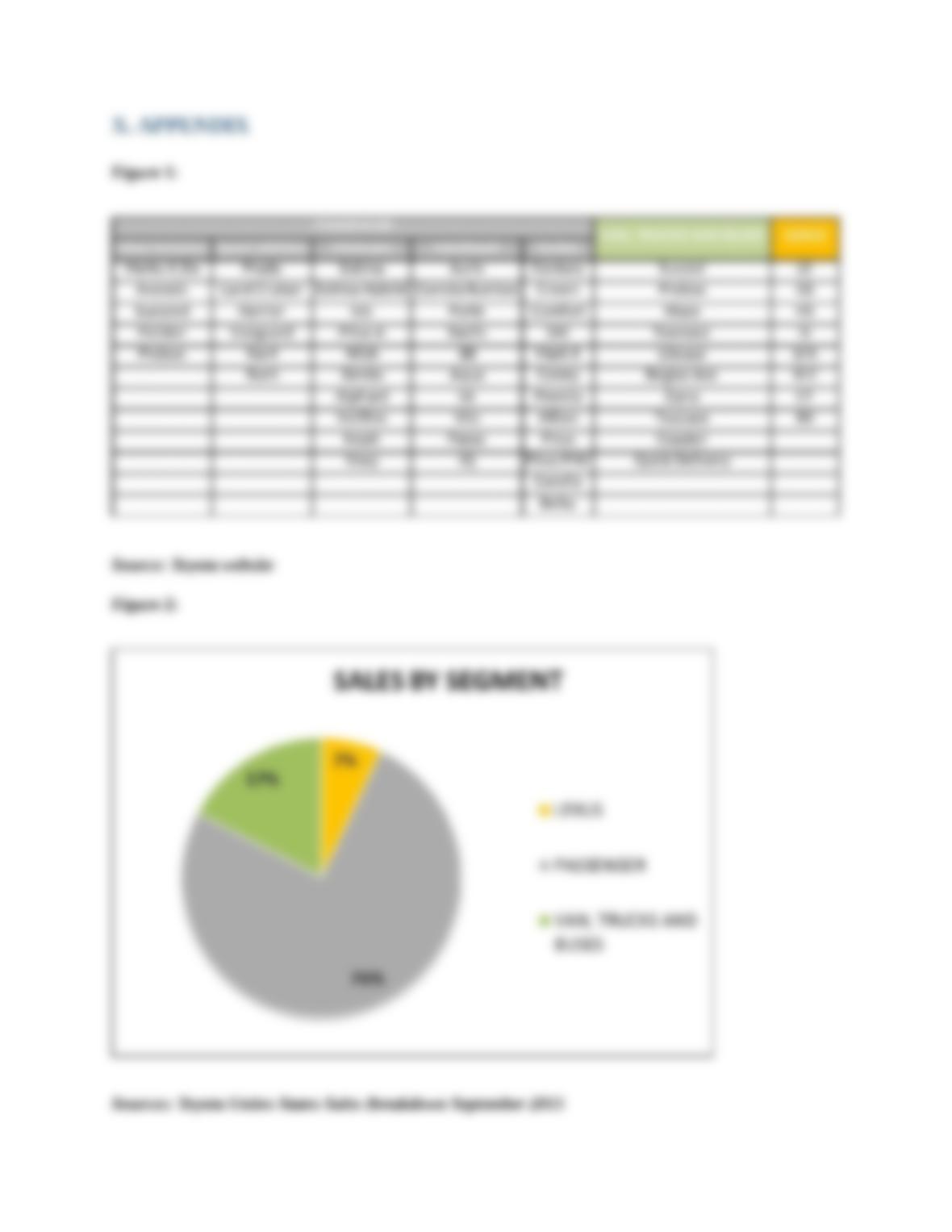
Minivans, Hatchback and Sedan. Figure 3 shows that this segment is the cornerstone of the company
throughout its history and represents 76% of sales. According to the September 2015 United States Toyota
sales breakdown for available models, the three biggest models in the passenger segment are: Camry
(25.3%), Rav4 (19.9%) and Corolla (19.6%). The company’s successful hybrid model also contributes
about 11.8% of total vehicle sale [ CITATION Toy15 \l 1033 ].
The Van, Trucks and Buses segment has been one of the less focused segments in Toyota due to
low demand in Japan. However, given the company’s expansion toward the United States, the business
has seen exceptional growth over few years. As of late 2015, reports show that recent truck models such
as Tacoma and Tundra are in such high demand that Toyota supplier fail to keep up production
[ CITATION Mar15 \l 1033 ]. According to the same report above, the three most successful models in
this category are: Tacoma (37%), Sienna (34%) and Tundra (26%) [ CITATION Toy15 \l 1033 ].
Starting out as the answer to Eiji Toyoda’s quest to create the world’s best car in 1980’s, Lexus
quickly become one of the most favorite luxury brand in the United States with reputations for their
durability, quality materials and well-inspected engines [ CITATION Bri \l 1033 ]. As of 2016, Lexus is
ranked by Forbes as the world 63 most valuable brand in the world with a brand value of $9 billion
[ CITATION For16 \l 1033 ]. Lexus’s three most successful models are: ES – a comfort sedan (41.4% of
total sale), IS – a sedan sport car (24.9%) and GS – another sport sedan (12.6%). In the upcoming period,
Toyota is trying to expand the Lexus’s success story into other markets, a daunting task considering the