
Table of Contents
Table of Contents 1
Introduction 3
The Magoosh Team 4
What is Magoosh? 5
Meet the Authors 7
Introduction to the TOEFL iBT 8
What’s on the TOEFL? 9
How Hard is the TOEFL? 10
What to Expect on Test Day 15
Scoring 17
How the TOEFL Scoring System Works 18
What’s a Good TOEFL Score? 19
The Reading Section 22
Meet the Reading Section 23
The Topics You’ll See in Reading Passages 24
Reading Question Type Overview 26
Common Reading Difficulties 52
Finding Evidence and Using Keywords 53
Identifying the Main Ideas 55
Understanding New Vocabulary and Difficult Sentences 57
Types of Wrong Answers 59
Pacing Strategies 62
The Best Reading Practice 63
The Listening Section 66
Meet the Listening Section 67
Types of Listening Recordings on the TOEFL 68
Types of Listening Questions 69
Tips for Note-Taking 84
Balancing Notes and Listening 86
Pacing Strategies 88
Common Listening Difficulties 89
The Best Listening Practice 91
toefl.magoosh.com
1

The Speaking Section 95
Meet the Speaking Section 96
The Topics You’ll Speak About 97
Independent Speaking Tasks 98
Integrated Speaking Tasks 101
Planning Your Answer 107
Structuring Your Response 109
Staying Focused When Speaking 111
Answering the Whole Question 112
Pacing Strategies 113
Improving Your Pronunciation 115
Common Speaking Difficulties 118
How to Practice Speaking Alone 119
The Writing Section 123
Writing Section Breakdown 124
The Topics You’ll Write About 125
Essay 1: The Integrated Writing Task 126
How to Structure Your Integrated Essay 128
Quoting and Paraphrasing 129
Essay 2: The Independent Writing Task 131
How to Structure Your Independent Essay 132
Using Examples 134
Common Writing Difficulties 137
Brainstorming 138
Planning Your Essay 141
Using Transitions and Structure 142
Varying Sentence Types 144
Pacing Strategies 147
How to Improve Your Writing Skills 148
Additional Resources 151
toefl.magoosh.com
2

Introduction
This eBook is meant to serve as a roadmap that provides a comprehensive overview of
the TOEFL, combining crucial information on test structure and question types and
providing essential strategies and tips for doing the best you can on test day. The
information in this eBook is a synthesis of some of the best content on the Magoosh
TOEFL blog. No matter where you are in your studies, if you’re preparing for the TOEFL,
this eBook is for you!
toefl.magoosh.com
3

The Magoosh Team
Who is Magoosh?
Magoosh is a group of passionate educators in Berkeley, California.
Email us at help@magoosh.com if you have any questions, comments, or suggestions!
toefl.magoosh.com
4

What is Magoosh?
Magoosh is an online TOEFL prep course that offers:
●over 100 TOEFL video lessons
●practice questions
●material created by expert tutors
●e-mail support
●personalized statistics based on performance
●access anytime, anywhere from an internet-connected device
Featured in
toefl.magoosh.com
5
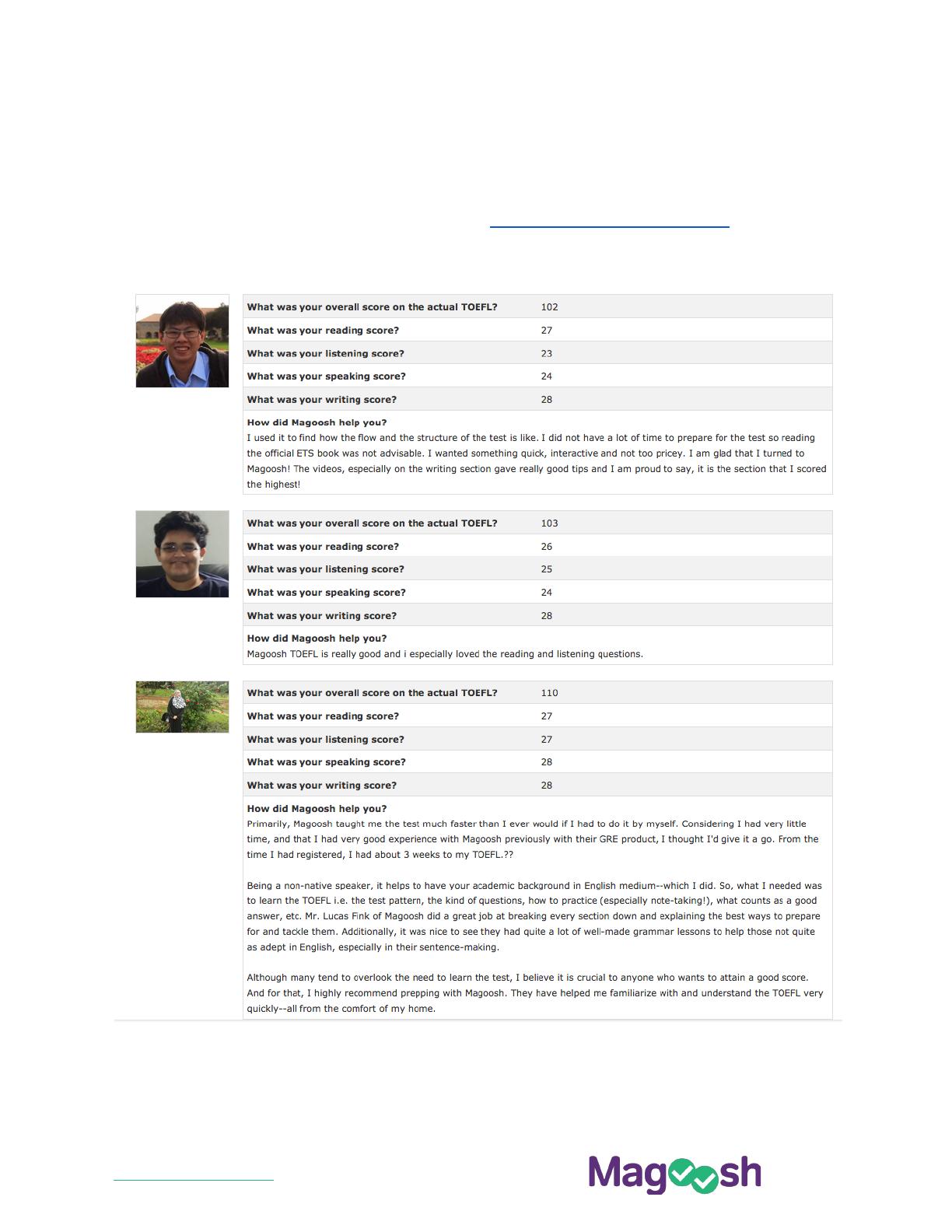
Why Our Students Love Us
These are survey responses sent to us by students after they took the TOEFL. All of
these students and many more have used the Magoosh TOEFL prep course to improve
their scores!
toefl.magoosh.com
6

Meet the Authors
Lucas Fink is the resident TOEFL expert at Magoosh. Standardized tests and English
grammar are two of Lucas’s favorite things, and he’s been teaching both since 2008. He
is a lifelong writer, a choosy reader, a persnickety editor, and a puzzle enthusiast.
David Recine has an MA TESOL and is an expert blogger at Magoosh. He has been
teaching ESL since 2007, and has worked with students from every continent. When he’s
not teaching or writing, David studies Korean, plays with his four year old son, and takes
road trips.
Kate Hardin has 6 years of experience teaching foreign language and writes for the
Magoosh blog. She graduated from Sewanee in 2012, where she studied and taught
German, and recently returned from a year spent teaching English in a northern Russian
university.
toefl.magoosh.com
7

Introduction to the
TOEFL iBT
toefl.magoosh.com
8

What’s on the TOEFL?
The TOEFL iBT Format
The TOEFL iBT is divided into four sections, each of which tests one language skill. The
test isn’t adaptive, which means the questions don’t get harder if you do really well or
easier if you get a few questions wrong. Multiple forms of the test exist and they change
often, which helps to prevent cheating, but all of the tests are close to equally difficult.
You can learn about each of the four sections individually below, and later on, we’ll
dedicate an entire section to each part of the test.
The Reading Section
This first section tests your ability to understand academic written English. The material in
this section may be different from the English you’ve read before, especially if you read
fiction or popular literature, because it is based on material that English-speaking college
students are expected to read and understand. So it’s a good idea to get familiar with
this style of writing. The reading passages can cover a wide variety of topics including
art, history, science, and social sciences, which we’ll cover later on.
You will have one hour to read the three reading passages and answer the
accompanying questions. After the full text is printed, questions will be grouped by
paragraph, which saves you some time and makes it easier to find the information you
need. You will see some unfamiliar words in this section, but that’s OK–if the word is
necessary, can’t be figured out from context, and is specific to the topic of the text (not
used in normal English), the test may allow you to click on the word and get a definition.
Each question is worth the same amount, so don’t get stuck for too long on one question.
You will have 20 minutes per passage, including the questions.
toefl.magoosh.com
9

The Listening Section
Now that your language skills are warmed up, you’ll move on to listening, which will test
your ability to understand both academic lectures and conversations related to university
life. Like the reading section, the listening section will last about an hour. Throughout the
entire test, you will have the option of taking notes; in the listening section, this will be
essential. Practice listening and writing at the same time, because the lectures are 3-5
minutes long, and you will not be able to remember all the necessary information. The
conversations will be shorter, but note-taking will still be very helpful. In all you will listen
to 4 or 6 lectures and 2 or 3 conversations.
The Speaking Section
The speaking section is the shortest, lasting about 20 minutes. It will involve some
independent tasks, which require you to express an opinion briefly (you will have up to a
minute to speak), and some integrated tasks, in which you will need to use information
from reading and listening in your spoken answers. There are two questions that require
you to read, listen and speak, and two that require you only to listen then speak. In all
you will answer 6 questions in the speaking section.
The Writing Section
As in the speaking section, you will complete an integrated task (20 minutes) and an
independent task (30 minutes). The independent task is a persuasive essay, meaning
you should express and support an opinion. The integrated task will give you an excerpt
from a lecture, an excerpt from a written article, and a question. Your task will be to
combine the information from the lecture with that from the written article in order to
answer the question. Manage your time well! On the TOEFL you will use a standard
QWERTY keyboard. If you need to, now is a good time to practice typing in English, as
you will not want to waste time searching for the right letter on the keyboard.
toefl.magoosh.com
10


The Experimental Section
Generally speaking, we consider the TOEFL to have an hour of reading, an hour of
listening, twenty minutes of speaking, and fifty minutes of writing. But you may have
noticed that there’s some flexibility in the schedule: the reading section, officially, can be
sixty or eighty minutes, and the listening section may be just an hour or an hour and a
half. This is because there are extra questions in one section of the test—the
“experimental section.”