ANSWERS TO FINAL (ON CHAPTERS 12-15 AND 18-20) ECO 304 SPRING 2007
UDAYAN ROY
The answers to the multiple-choice questions are given on the last two pages. The
answers to the short-answer questions are given after each such question on pages 9
and 10.
Chapter 12
Table 12-2
Ski Weekend Trip
Value to Allyn $85
Value to Pam $75
Value to Greg $65
Value to Dana $40
____ 1. Refer to Table 12-2. The price of a weekend ski pass is $38 and this is also the actual unit cost of
providing a weekend of skiing for one person. If the government imposes a tax of $15 on each
weekend ski pass, the deadweight loss associated with the tax is
a. $2.
b. $37.
c. $52.
d. $97.
____ 2. If a poor family has three children in public school and a rich family has two children in private
school, the benefits principle of taxation would suggest that
a. the poor family should pay more in taxes to pay for public education than the rich family.
b. the rich family should pay more in taxes to pay for public education than the poor family.
c. the benefits of private school exceed those of public school.
d. public schools should be financed by property taxes.
____ 3. The theory that the wealthy should contribute more to police protection than the poor because
they have more to protect is based on
a. the ability-to-pay principle.
b. a consumption tax plan.
c. the benefits principle.
d. property tax assessments.
Chapter 13
Figure 13-5
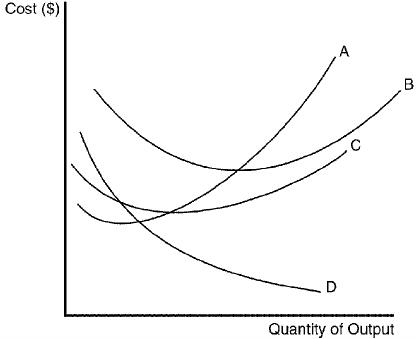
____ 4. Refer to Figure 13-5. Which of the curves is most likely to represent average total cost?
a. A
b. B
c. C
d. D
____ 5. Refer to Figure 13-5. Which of the curves is most likely to represent average fixed cost?
a. A
b. B
c. C
d. D
____ 6. Refer to Figure 13-5. Which of the curves is most likely to represent average variable cost?
a. A
b. B
c. C
d. D
____ 7. Refer to Figure 13-5. Which of the curves is most likely to represent marginal cost?
a. A
b. B
c. C
d. D
Chapter 14
____ 8. Which of the following statements best reflects a price-taking firm?
a. If the firm were to charge more than the going price, it would sell none of its goods.
b. The firm has no incentive to charge less than the going price.
c. The firm can sell as much as it wants to sell at the going price.
d. All of the above are correct.
____ 9. If a firm in a competitive market reduces its output by 20 percent, then as a result the price of its
output is likely to
a. increase.
b. remain unchanged.
c. decrease by less than 20 percent.
d. decrease by more than 20 percent.
2
____ 10. The Wheeler Wheat Farm sells wheat to a grain broker in Seattle, Washington. As the market for
wheat is competitive, the Wheeler Wheat Farm maximizes its profit by choosing
a. to produce the quantity at which average total cost is minimized.
b. to produce the quantity at which average fixed cost is minimized.
c. to sell its wheat at a price where marginal cost is equal to average total cost.
d. the quantity at which market price is equal to the farm’s marginal cost of production.
____ 11. In 1999, sheepherders in the western United States slaughtered 10,000 sheep and buried them in
large open pits rather than truck them to the market to be sold. This behavior is most likely
explained by
a. sheepherders making a shut-down decision to save the variable cost of transporting sheep
to a slaughter house.
b. sheepherders making an exit decision to recover the fixed cost of raising the sheep.
c. the rising marginal cost of producing sheep.
d. irrational behavior of sheepherders.
____ 12. When profit-maximizing firms in competitive markets are earning profits,
a. market demand must exceed market supply at the market equilibrium price.
b. market supply must exceed market demand at the market equilibrium price.
c. new firms will enter the market.
d. the most inefficient firms will be encouraged to leave the market.
____ 13. A competitive firm sells its output for $20 per unit. The 50th unit of output that the firm produces
has a marginal cost of $22. It follows that the production of the 50th unit of output
a. increases the firm’s total revenue by $20.
b. increases the firm’s total cost by $22.
c. decreases the firm’s profit by $2.
d. All of the above are correct.
____ 14. The competitive firm’s short-run supply curve is that portion of the
a. average variable cost curve that lies above marginal cost.
b. average total cost curve that lies above marginal cost.
c. marginal cost curve that lies above average variable cost.
d. marginal cost curve that lies above average total cost.
____ 15. In long-run equilibrium of a competitive market, the number of firms in the market adjusts so that
the price is equal to
a. sunk cost.
b. the maximum value of marginal cost.
c. the minimum value of average total cost.
d. the minimum value of average variable cost.
____ 16. When firms are neither entering nor exiting a perfectly competitive market,
a. total cost must equal total revenue.
b. economic profits must be zero.
c. average revenue must equal average total cost.
d. All of the above are correct.
Figure 14-9
3
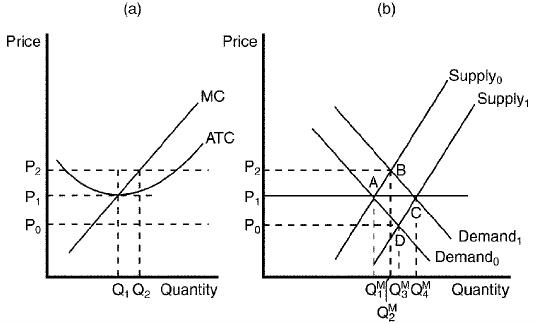
____ 17. Refer to Figure 14-9. Assume that the market starts in equilibrium at point A in panel (b). An
increase in demand from Demand0 to Demand1 will result in
a. a new market equilibrium at point D.
b. an eventual increase in the number of firms in the market and a new long-run equilibrium
at point C.
c. rising prices and falling profits for existing firms in the market.
d. falling prices and falling profits for existing firms in the market.
Chapter 15