Affirmative
This house believes that Korea should go under education reform.
Introduction
The history of education in Korea dates back to the ancient times. During the
period of the Three Kingdoms until the Josun Dynasty, education was for the
upperclassmen and the nobles, with the Confucian philosophy infused in it. In the 18th
and 19th centuries, education in Korea started to be spread throughout the nation,
allowing everyone to be educated and literate. The development, however, was
interrupted by the Japanese colonization. It was only after its independence from
Japan that Korea was allowed to create educational programs suitable for its people.
There were many revisions to reflect the current trends and situations.
Koreans treat education with utmost value. In his remarks to the Hispanic
Chamber of Commerce, US President Barack Obama praised South Korea of its
enthusiasm in education. “… Our children spend over a month less in school than
children in South Korea — every year. That’s no way to prepare them for a 21st
century economy… The challenges of a new century demands more time in the
classroom,” President Obama said.1 Yes, it may be true that more time in the
classroom better prepares today’s children to become tomorrow’s leaders. But is it
really the Korean education that Obama is telling his people to look up to? The
answer is no. He was only referring to the enthusiasm and time Koreans invest into
education. The time Korean children are spending in their classrooms are in fact not
spent the wisest way. The purpose of this policy paper is to explore the problems
aroused by the status quo of Korean education.
1 Obama, Barack. “NY Times Advertisement.” The New York Times – Breaking News, World News &
Multimedia. The New York Times, 10 Mar. 2009. Web. 28 Nov. 2011.
<http://www.nytimes.com/2009/03/10/us/politics/10text-obama.html?_r=1>.

Definition of Terms
Korean education
For this particular paper, Korean education refers to the nine years of
mandatory education (six years of elementary and three years of middle school
education) and three years of high school.2 The scope of public schools would be all
schools under the jurisdiction of the Korean government, excluding foreign language
high schools and special-purpose high schools.
Rote learning
Rote learning is a dominant feature in Korean education. K12 Academics
defines rote learning as “a learning technique which avoids understanding the inner
complexities and inferences of the subject that is being learned and instead focuses on
memorizing the material so that it can be recalled by the learner exactly the way it
was read or heard. In other words, it is learning “just for the test”.”3
Teacher Self-Ecacy
Bandura defines self-ecacy as a judgment of one’s capability
to accomplish a given level of performance. Tschannen-Moran and
Woolfolk Hoy (in press) defined teacher efficacy as a teacher’s “judgment of his or
her capabilities to bring about desired outcomes of student engagement and learning,
even among those students who may be difficult or unmotivated.” It is in essence
how the teachers view their ability to achieve their tasks as
teachers.
2 “교교교교교.” 교교교교교교교교교. Web. 03 Dec. 2011. <http://likms.assembly.go.kr/law/jsp/law/Law.jsp?
WORK_TYPE=LAW_BON>.
3 “Rote Learning.” K12 Academics. Web. 04 Dec. 2011. <http://www.k12academics.com/educational-
psychology/rote-learning>.

Policy
Harm 1 – Rote learning hinders development of critical thinking skills
Due to the rote learning methods that have been existent as long as the history
of Korean education, Korean students lack the ability to think critically. It is an actual
and a potential harm that impedes the growth of students into globally competitive
persons, thereby deterring Korea’s international competence. Critical thinking — in
being responsive to variable subject matter, issues, and purposes — is incorporated in
a family of interwoven modes of thinking, among them: scientific thinking,
mathematical thinking, historical thinking, anthropological thinking, economic
thinking, moral thinking, and philosophical thinking.4 The present state of the Korean
education completely puts a barrier between the students’ learning and thinking.
Harm 2 – Innovation aids students, not teachers
The modern technology allows for easy access to information and facts. This
access is almost ubiquitous, with Internet and mobile devices available almost
everywhere. This access provides even more data and information than what teachers
can offer to teach. While the schools are stuck with presenting the students with
existing facts and the students memorizing them, the roles of the teachers have been
reduced to mere presenters. For this, the teachers’ expertise as educators retrogresses
because their tasks are limited to delivering textbook knowledge and possible
questions for the CSAT. This may train the teachers as professional admission
counselors, but not as educators who can aid their students in learning practical
knowledge. The world is changing and everyone is adjusting to the changes. Even
when the universities in Korea are changing their admission standards to discover
outstanding individuals who are in line with their visions, the government of Korea is not
actively seeking for change.
Harm 3 – Purpose of studying shifts from learning to name values
The sole purpose of studying has shifted from pure intentions of learning to
entering top ranking universities. It is a general misconception that name value of
undergraduate schools is all that matters for one to succeed in life. This has brought
the entire nation to be obsessed with high quality education. No Korean would be
surprised at hearing about a third grader going to five afterschool tutorials everyday
and sleeping past midnight. It is no surprise to hear that middle school students start
preparing their GPAs from year one to enter prestigious high schools that can lead
them to topnotch universities. The Korean education completely ignores the essence
of learning and focuses on university admissions. This has created a phenomenon
wherein the students who entered top ranking universities drop out on their own after
4 Scriven, Michael, and Richard Paul. “Defining Critical Thinking.” Critical Thinking Index Page. The Critical
Thinking Community. Web. 03 Dec. 2011. <http://www.criticalthinking.org/pages/defining-critical-thinking/410>.

discovering that their life has been pointless. They feel that they have been chasing a
wrong purpose in life. In March 2010, a business major Kim Ye Seul dropped out of
Korea University. Then in October 2011 and November 2011, Yoo Yoon Jong and
Jang Hye Young dropped out of the Seoul National University and Yonsei University,
respectively.5 These students loathed how the schools did not serve as a hall of
learning but pool of competitions where everyone is fighting to get into large
companies. There is a big paradox in the Korean society that is leading everyone into
blunder in his or her life. Students from elementary to high school level are sacrificing
their youths for universities just because the society requires them.
“Resolved: that the Korean government should shift all public school
management to reformed school management.”
A policy to bring reforms and resolutions to these harms must be introduced.
The affirmative hereby would like to propose the policy proposition, “Resolved: that
the Korean government should shift all public school management to reformed school
management.” Currently, all schools, public and private, are all under
some forms of government jurisdiction. In terms of curriculums and
management, public schools follow regulations prescribed by the
government, having less freedom than the private schools. Article 4
Section 1 of the education legislation of Korea states that the
minister of education has the authority in determining the
curriculum and contents.6 Reformed schools, on the other hand,
bestow the freedom of management and curriculum planning upon
individual schools. The diagram below illustrates the management
mechanics of Gyeonggi Province’s reformed school:
5 Kim, Kyung Su. “교교교 교교교 ‘교교 교교’ 교교.” 교교교교교교. 17 Nov. 2011. Web. 04 Dec. 2011.
<http://www.fnnews.com/view?ra=Sent1501m_View>.
6 “교·교교교교교.” 교교교교교교교교교. Web. 03 Dec. 2011. http://likms.assembly.go.kr/law/jsp/law/Law.jsp?
WORK_TYPE=LAW_BON&LAW_ID=A0811&PROM_NO=11065&PROM_DT=20110930&HanChk=Y>
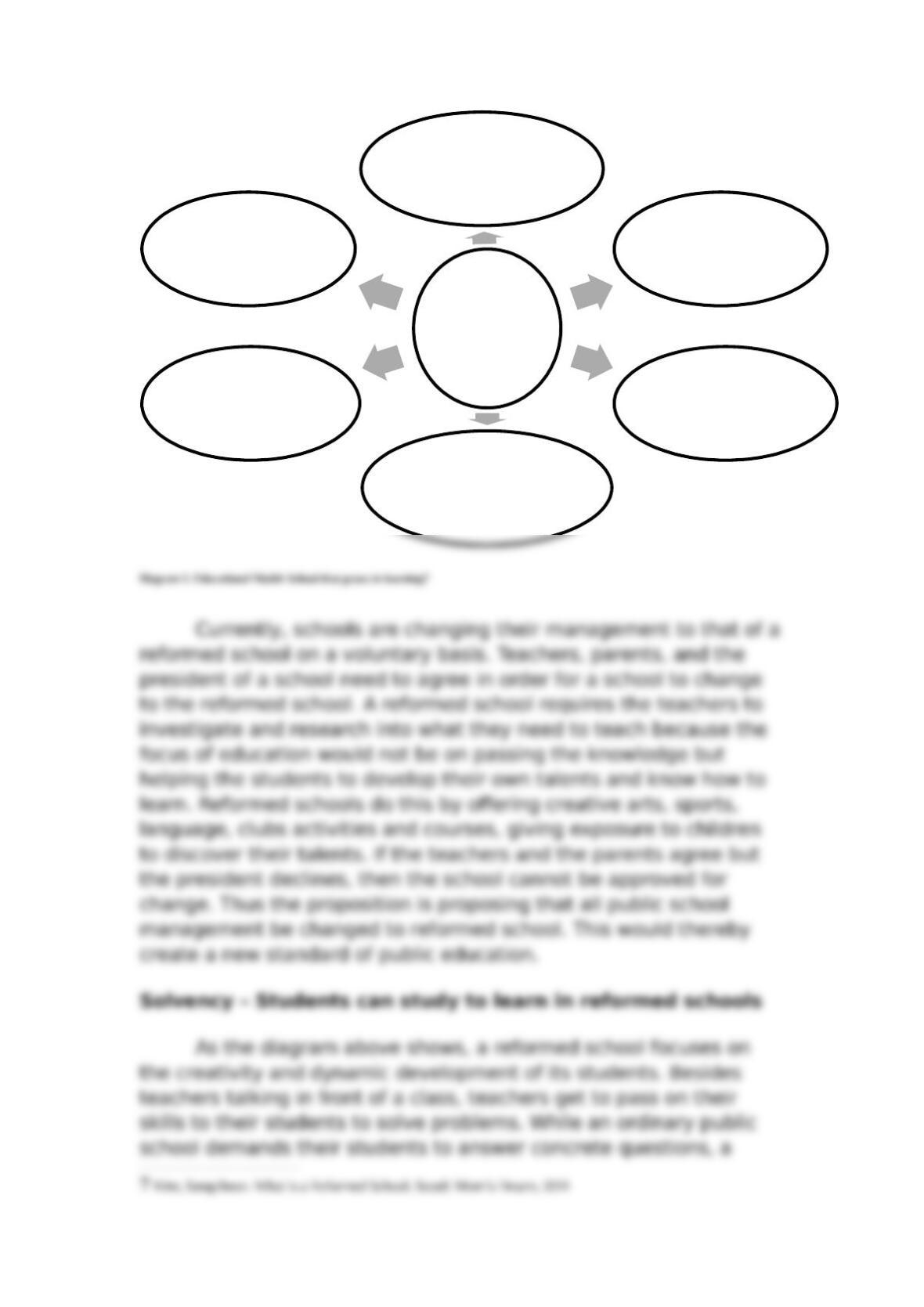
Reformed School
– publicness
– democracy
– dynamism
– creativity
– globalism
Establish self-regulatory reformed
school system
– freedom to choose members
– boost sense of obligations
Create productive school culture
– share value and vision
Expand interschool cooperation
and participation
– parent and community
cooperation
Diversification and characterization of
curriculum
– tailored education, development of
Establish professional learning
community
– hone teaching skills, subject
expertise
Establish teaching-learning
mangament system
– reduce tasks, restructure system