ESSAYS ON HORIZONTAL MERGERS AND ANTITRUST
A DISSERTATION
SUBMITTED TO THE GRADUATE SCHOOL OF BUSINESS
AND THE COMMITTEE ON GRADUATE STUDIES
OF STANFORD UNIVERSITY
IN PARTIAL FULFILLMENT OF THE REQUIREMENTS
FOR THE DEGREE OF
DOCTOR OF PHILOSOPHY
Przemyslaw Jeziorski
June 2010
http://creativecommons.org/licenses/by-nc/3.0/us/
This dissertation is online at: http://purl.stanford.edu/bb599nz4341
© 2010 by Przemyslaw Jeziorski. All Rights Reserved.
Re-distributed by Stanford University under license with the author.
This work is licensed under a Creative Commons Attribution-
Noncommercial 3.0 United States License.
ii
I certify that I have read this dissertation and that, in my opinion, it is fully adequate
in scope and quality as a dissertation for the degree of Doctor of Philosophy.
Peter Reiss, Primary Adviser
I certify that I have read this dissertation and that, in my opinion, it is fully adequate
in scope and quality as a dissertation for the degree of Doctor of Philosophy.
Ali Yurukoglu
I certify that I have read this dissertation and that, in my opinion, it is fully adequate
in scope and quality as a dissertation for the degree of Doctor of Philosophy.
C. Lanier Benkard
Approved for the Stanford University Committee on Graduate Studies.
Patricia J. Gumport, Vice Provost Graduate Education
This signature page was generated electronically upon submission of this dissertation in
electronic format. An original signed hard copy of the signature page is on file in
University Archives.
iii
Abstract
This thesis contributes to understanding the economics of mergers and acquisitions.
It provides new empirical techniques to study these processes, based on structural,
game theoretical models. In particular, it makes two main contributions. In Chapter
2, I study the issues arising when mergers take place in a two-sided market. In such
markets, firms face two interrelated demand curves, which complicates the decision
making process and makes standard merger models inapplicable. In Chapter 3, I
provide a general framework to identify cost synergies from mergers without using
cost data. The estimator is based on a dynamic model with endogenous mergers and
product repositioning. Both chapters contain an abstract model that can be tailored
to many markets, as well as a specific application to the merger wave in the U.S.
radio industry.
iv
Acknowledgments
I would like to thank my advisers Lanier Benkard and Peter Reiss for their guidance
over the years, their patience and their constant feedback that helped me to consider-
ably improve my work. Moreover, I would like to express my gratitude to numerous
people I encountered who believed in me and supported me along my path to this
degree. In particular, this thesis would have been impossible without my adviser
Tomasz Szapiro at the Warsaw School of Economics. He motivated me and directly
helped me to make my adventure in the United States possible. My interest in game
theory and dynamic models was triggered by great conversations with my adviser
Rabah Amir at the University of Arizona. I would like to thank him for his support
and help while applying to Stanford GSB. Last but not least, I am grateful to all the
community at Stanford University – professors, fellow students and casual friends –
for creating a unique environment for my intellectual and personal development.
v
Contents
Abstract iv
Acknowledgments v
1 Introduction 1
2 Mergers in two-sided markets: Case of U.S. radio industry 5
2.1 Preface…………………………….. 5
2.2 Introduction………………………….. 6
2.3 Radio as a two-sided market . . . . . . . . . . . . . . . . . . . . . . . 9
2.3.1 Industrysetup……………………… 11
2.3.2 Listeners………………………… 12
2.3.3 Advertisers ………………………. 13
2.3.4 Radio station owners . . . . . . . . . . . . . . . . . . . . . . . 16
2.4 Datadescription ……………………….. 17
2.5 Estimation…………………………… 19
2.5.1 Firststage……………………….. 19
2.5.2 Secondstage ……………………… 20
2.6 Results…………………………….. 22
2.6.1 Listeners’ demand . . . . . . . . . . . . . . . . . . . . . . . . . 23
2.6.2 Advertisers’ demand . . . . . . . . . . . . . . . . . . . . . . . 23
2.6.3 Supply…………………………. 27
2.7 Counterfactual experiments . . . . . . . . . . . . . . . . . . . . . . . 29
2.7.1 Impact of mergers on consumer surplus . . . . . . . . . . . . . 29
vi
2.7.2 Effects of product variety and market power . . . . . . . . . . 31
2.8 Robustnessanalysis………………………. 32
2.9 Conclusion…………………………… 33
3 Estimation of cost synergies from mergers without cost data: Ap-
plication to U.S. radio 35
3.1 Preface…………………………….. 35
3.2 Introduction………………………….. 36
3.3 Merger and repositioning framework . . . . . . . . . . . . . . . . . . 38
3.3.1 Industrybasics …………………….. 38
3.3.2 Players’ actions . . . . . . . . . . . . . . . . . . . . . . . . . . 39
3.3.3 Payoffs and equilibrium . . . . . . . . . . . . . . . . . . . . . 41
3.4 Estimation…………………………… 42
3.4.1 Data………………………….. 42
3.4.2 Policy estimation . . . . . . . . . . . . . . . . . . . . . . . . . 43
3.4.3 Minimum distance estimator . . . . . . . . . . . . . . . . . . . 46
3.5 Application ………………………….. 48
3.5.1 Industry and data description . . . . . . . . . . . . . . . . . . 48
3.5.2 Staticprofits ……………………… 50
3.5.3 Estimation details . . . . . . . . . . . . . . . . . . . . . . . . . 51
3.5.4 Results…………………………. 53
3.6 Conclusions ………………………….. 56
A Additional material to Chapter 2 57
A.1 Advertising demand: Micro foundations . . . . . . . . . . . . . . . . . 57
A.2 Numerical considerations . . . . . . . . . . . . . . . . . . . . . . . . . 59
B Additional material to Chapter 3 61
B.1 Estimation without acquisition prices . . . . . . . . . . . . . . . . . . 61
B.2 Radio acquisition and format switching algorithms . . . . . . . . . . . 62
B.3 Policy function covariates . . . . . . . . . . . . . . . . . . . . . . . . 63
B.4 First stage estimates: Dynamic model . . . . . . . . . . . . . . . . . . 65
vii
Bibliography 68
viii
List of Tables
2.1 Simple example of advertising weights . . . . . . . . . . . . . . . . . . 15
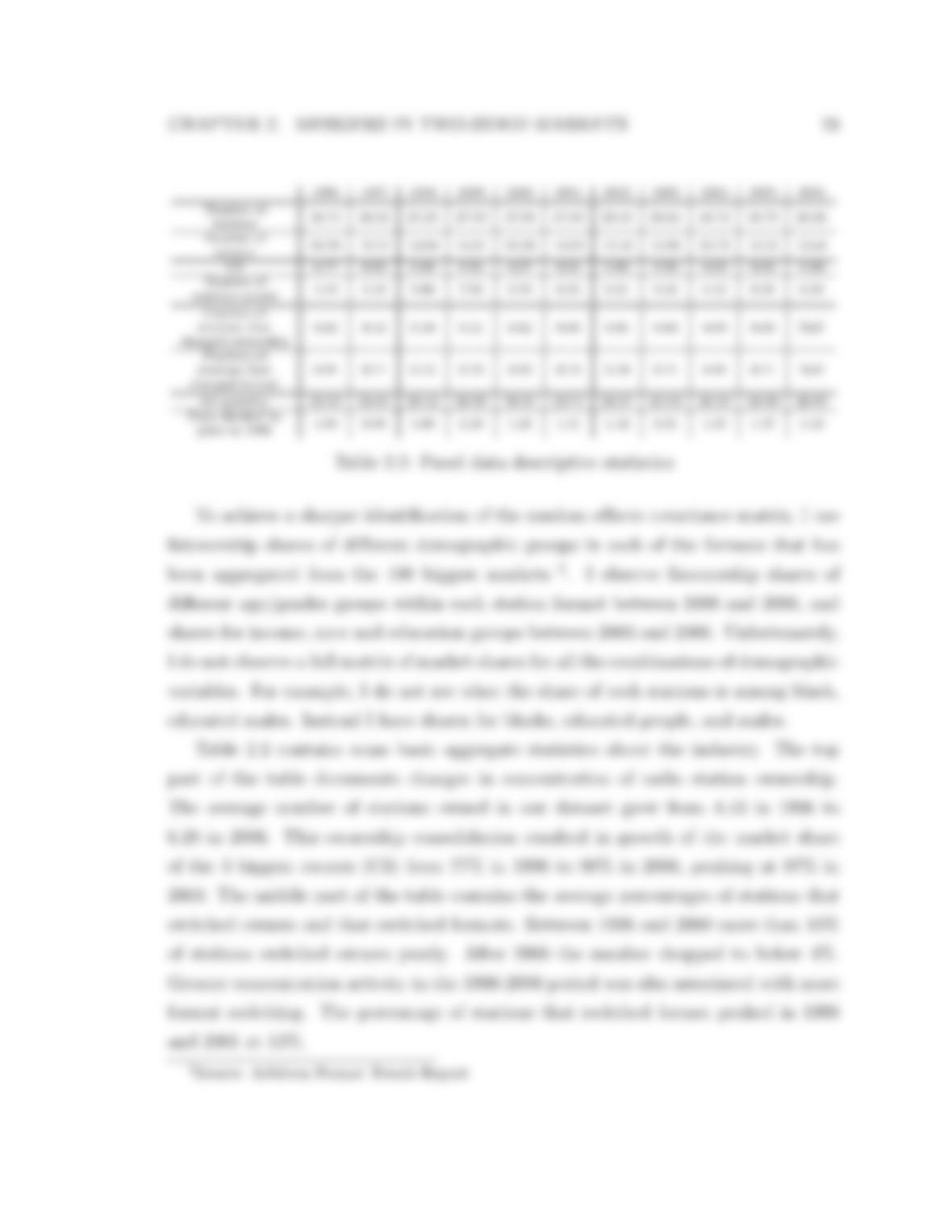
2.2 Panel data descriptive statistics . . . . . . . . . . . . . . . . . . . . . 18
2.3 Estimates of mean and random effects of demand for radio program-
ming. Stars indicate parameter significance when testing with 0.1, 0.05
and0.01testsizes. ………………………. 24
2.4 Interaction terms between listeners’ demographics and taste for radio
programming………………………….. 25
2.5 Product closeness matrices for chosen markets . . . . . . . . . . . . . 26
2.6 Slope of the inverse demand for ads θA
2, by market size . . . . . . . . 27
2.7 Estimated marginal cost (in dollars per minute of broadcasted advertis-
ing) and profit margins (before subtracting the fixed cost) for a chosen
setofmarkets…………………………. 28
2.8 Counterfactuals for all markets . . . . . . . . . . . . . . . . . . . . . 29
2.9 Counterfactuals for small markets (less than 500k people) . . . . . . . 30
2.10 Counterfactuals for large markets (more than 2,000k people) . . . . . 30
2.11 Slope of the inverse demand for ads θA
2, by market size . . . . . . . . 33
2.12 Robustness of counterfactuals . . . . . . . . . . . . . . . . . . . . . . 33
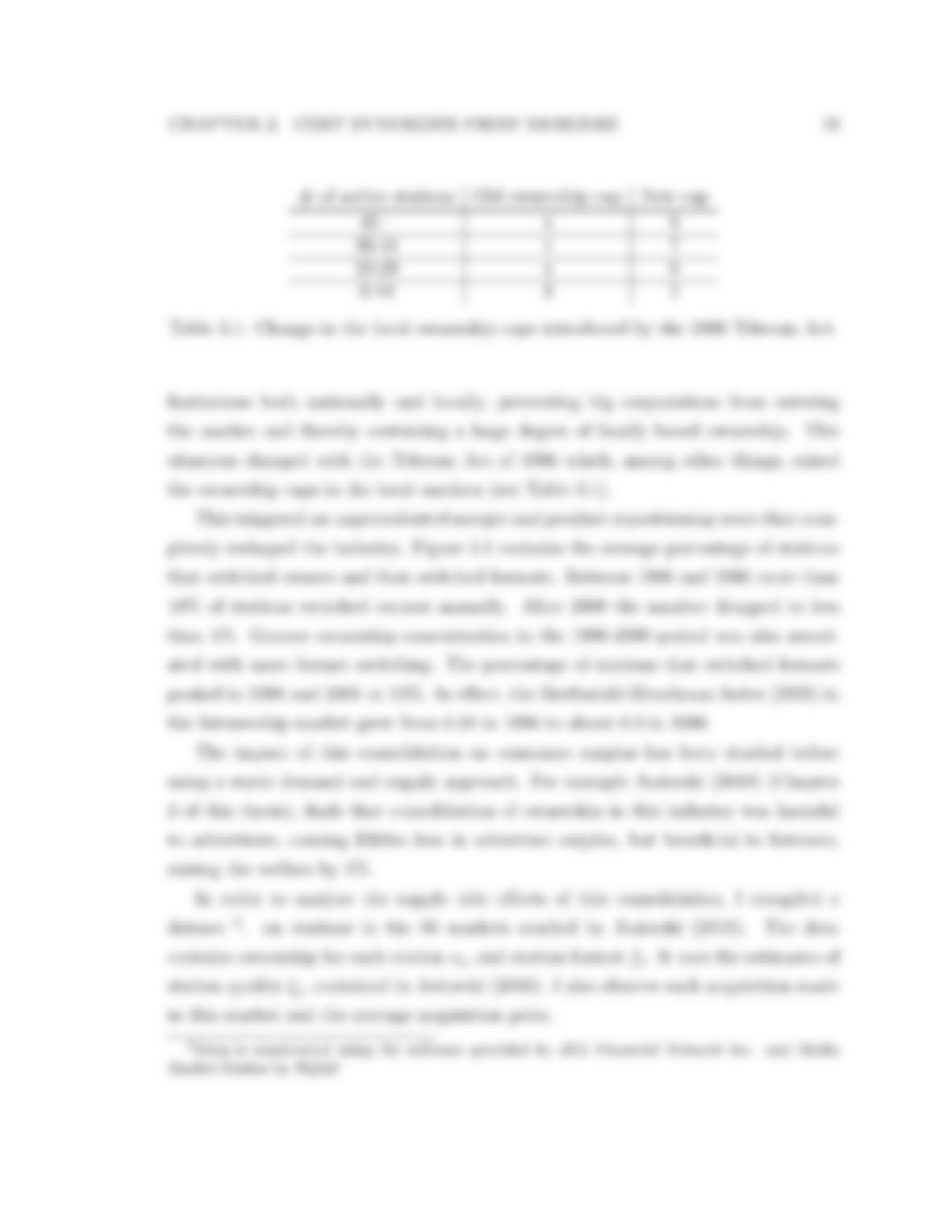
3.1 Change in the local ownership caps introduced by the 1996 Telecom Act. 49
3.2 Savings when two stations are owned by the same firm vs. operating
separately …………………………… 55
3.3 Total cost savings created by mergers after 1996, compared to demand
effects from Jeziorski (2010) . . . . . . . . . . . . . . . . . . . . . . . 55
3.4 Format switching cost for chosen markets . . . . . . . . . . . . . . . . 55
ix

B.1 Covariates for the format switching strategy multinomial logic regression. 63
B.2 Covariates for the purchase strategy logic regression. . . . . . . . . . 64
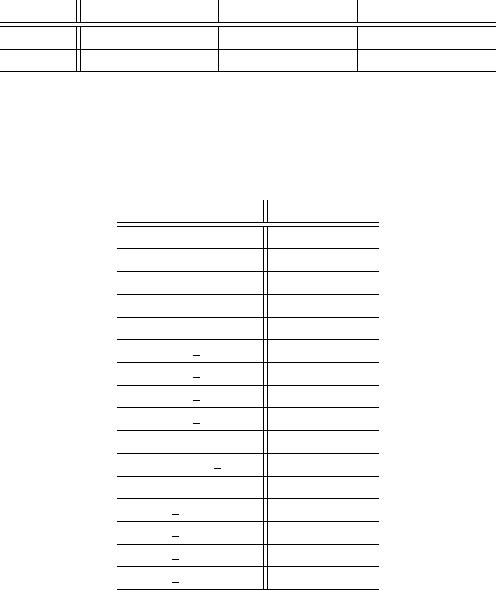
B.3 Station purchase policy estimates – buyer/seller dummies . . . . . . . 65
B.4 Station purchase policy estimates – other variables . . . . . . . . . . . 65
B.5 Format switching policy estimates – format dynamics . . . . . . . . . 66
B.6 Format switching policy estimates – current demographics . . . . . . . 66