molecules
Article
Thermal Conductivity of Epoxy Resin Composites
Filled with Combustion Synthesized h-BN Particles
Shyan-Lung Chung 1,2,* and Jeng-Shung Lin 2
1Advanced Optoelectronic Technology Center, National Cheng Kung University, Tainan 70101, Taiwan
2Department of Chemical Engineering, National Cheng Kung University, Tainan 70101, Taiwan;
N38981232@mail.ncku.edu.tw
*Correspondence: slchung@mail.ncku.edu.tw; Tel.: +886-6-275-7575 (ext. 62600); Fax: +886-6-234-4496
Academic Editors: Philippe Miele, Samuel Bernard and Zheng Liu
Received: 28 March 2016; Accepted: 16 May 2016; Published: 20 May 2016
Abstract:
The thermal conductivity of epoxy resin composites filled with combustion-synthesized
hexagonal boron nitride (h-BN) particles was investigated. The mixing of the composite constituents
was carried out by either a dry method (involving no use of solvent) for low filler loadings or a solvent
method (using acetone as solvent) for higher filler loadings. It was found that surface treatment
of the h-BN particles using the silane 3-glycidoxypropyltrimethoxysilane (GPTMS) increases the
thermal conductivity of the resultant composites in a lesser amount compared to the values reported
by other studies. This was explained by the fact that the combustion synthesized h-BN particles
contain less –OH or active sites on the surface, thus adsorbing less amounts of GPTMS. However,
the thermal conductivity of the composites filled with the combustion synthesized h-BN was found
to be comparable to that with commercially available h-BN reported in other studies. The thermal
conductivity of the composites was found to be higher when larger h-BN particles were used.
The thermal conductivity was also found to increase with increasing filler content to a maximum and
then begin to decrease with further increases in this content. In addition to the effect of higher porosity
at higher filler contents, more horizontally oriented h-BN particles formed at higher filler loadings
(perhaps due to pressing during formation of the composites) were suggested to be a factor causing
this decrease of the thermal conductivity. The measured thermal conductivities were compared to
theoretical predictions based on the Nielsen and Lewis theory. The theoretical predictions were found
to be lower than the experimental values at low filler contents (< 60 vol %) and became increasing
higher than the experimental values at high filler contents (> 60 vol %).
Keywords:
h-BN/Epoxy resin composites; self-propagating high temperature synthesis (SHS);
hexagonal boron nitride (h-BN); thermal conductivity
1. Introduction
As microelectronic devices have become more integrated and denser, heat dissipation has also
become an important problem because heat generation can increase the temperature of devices causing
fatal damage and induce thermal fatigue that reduced operational efficiency and service life [
1
–
3
].
To solve this problem, application of high thermal conductivity materials is necessary in addition to the
design of devices for heat dissipation. For this purpose, in addition to high thermal conductivity, many
other properties such as moisture resistance, adhesiveness, mechanical strength and low temperature
processability are often required for these high thermal conductivity materials. Since no single material
can meet all these requirements, development of high thermal conductivity composite materials
is necessary.
Epoxy resins have been widely used in coatings, adhesives, highly-integrated memory chips,
electronic packaging and light emitting diodes (LEDs) because of their chemical stability, adhesive
Molecules 2016,21, 670; doi:10.3390/molecules21050670 www.mdpi.com/journal/molecules
Molecules 2016,21, 670 2 of 11
properties, excellent resistance to several solvents, good mechanical properties and superior electrical
resistivity [
4
–
6
]. However, epoxy resins have a poor thermal conductivity (0.15–0.25 W/mK [
7
,
8
]).
In order to enhance the thermal conductivity, thermally conductive but electrically insulative materials
should be introduced to form composite materials. Silica and alumina particles have long been used
as fillers for epoxy resin composites in industry. However, the thermal conductivities of these oxides
are one to two orders lower than that of some nitrides, i.e., aluminum nitride (AlN) and boron nitride
(BN) [
9
–
11
]. Since AlN is reactive to moisture and water, but BN is chemically stable and inert to
environment, BN has been considered as a potential filler candidate for the fabrication of high thermal
conductivity epoxy resin composites for industrial applications.
Many studies have been devoted to studying the processing and characterization of polymer
composites filled with various inorganic fillers [
1
,
2
,
12
–
18
]. For enhancement of the thermal
conductivity of epoxy resin by filling with h-BN particles, it has been reported in many studies [
16
–
21
]
that surface treatment can further increase the thermal conductivity of the composites. Due to poor
affinity between the naked (untreated) h-BN particles and epoxy resin, pores (or voids) are easily
formed at the interface, resulting in a high thermal conduction barrier. These pores (or voids) can be
reduced by improving the interface affinity by some type of surface treatment. The interface thermal
conduction resistance can thus be reduced, resulting in a further increase in thermal conductivity
of the composites. Xu et al. [
16
] prepared h-BN/epoxy resin composites by using 5–11
µ
m h-BN
particles, equiaxial in shape, and obtained a thermal conductivity of 10.3 W/mK at a filler content
of 57 vol % with the h-BN particles surface-treated by the silane Z-6040, as compared to 5.27 W/mK
when using the same size of h-BN particles but with no surface treatment. By using 0.6–1.2 µm h-BN
particles, Gu et al. [
17
] obtained epoxy resin composites with thermal conductivity of 1.052 W/mK
or 0.97 W/mK at a filler content of 60 vol % when the h-BN particles were surface-treated with
γ
-aminopropyltriethoxysilane (KH550) or were not surface-treated, respectively. Wattanakul et al. [
18
]
and Kim et al. [
19
] also prepared epoxy resin composites by using h-BN particles with different surface
treatments and concluded that surface treatment led to improved wettability of epoxy resin on the
treated surface, improving the interfacial adhesion between BN and epoxy resin, and thus increasing
the thermal conductivity (by 22%–80%). Besides, the size and shape of h-BN particles were also found
to affect the thermal conductivity of h-BN/epoxy resin composites [20,21].
In all the studies mentioned above, however, commercially available h-BN powders were used
and inconsistency was often found between their experimental results. Recently, we have developed
a combustion synthesis method for the synthesis of h-BN powder [
22
], which is characterized by
low energy consumption, fast reactions, simple processing and low production cost. As mentioned
previously, the interface between h-BN particles and epoxy resin presents a major thermal barrier in
the heat conduction of composites. Different synthesis methods may produce h-BN particles with
different surface properties, which may affect the effectiveness of any surface treatment and create
different interface environments, affecting the thermal conduction resistance and thus resulting in
different thermal conductivity. Besides, a h-BN powder with a low production cost can significantly
boost the practical applications of h-BN/epoxy resin composite materials. We therefore investigate in
this work the thermal conductivity of epoxy resin composites filled with h-BN powders synthesized by
our newly developed combustion synthesis method. Effects of the surface treatment of h-BN particles
with GPTMS, a type of silane, particle size and filler loading on thermal conductivity were investigated
and the measured thermal conductivities were compared with theoretical predictions based on the
Nielsen and Lewis equation.
2. Results and Discussion
2.1. Examination of Surface Treatment
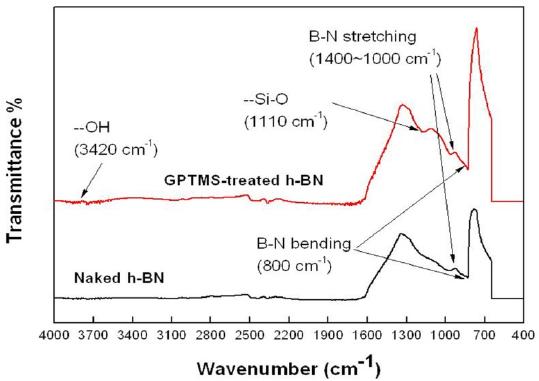
Figure 1shows the FT-IR spectra of the 2.4 wt % GPTMS-treated and naked h-BN powders.
As can be seen, Si-O bonding was detected on the treated h-BN surface but not on the naked powder,
Molecules 2016,21, 670 3 of 11
indicating a successful surface treatment of the h-BN powder with GPTMS. This successful surface
treatment is also indicated by the TGA analysis, in which the weight losses of the GPTMS-treated h-BN
were measured to be 3.132 wt % and 0.825 wt %, greater than that of the naked powders, i.e.,
2.588 wt %
and 0.575 wt % for particle sizes of 3.6
µ
m and 10.6
µ
m, respectively. However, these weight loss
differences are noted to be smaller than those reported by other study [
16
]. Besides, the –OH vibrational
absorption (at 3420 cm
´1
, see Figure 1) was marginally detected on the combustion-synthesized h-BN
but were clearly detected on a commercially available h-BN reported by Gu et al. and Li et al. [
17
,
23
].
These may be due to differences in the synthesis method used for h-BN: the combustion synthesized
h-BN may contain less –OH or active sites on the surface than the commercially available h-BN does,
thus adsorbing a lesser amount of GPTMS on its surface.
Molecules 2016, 21, 670 3 of 11
2. Results and Discussion
2.1. Examination of Surface Treatment
Figure 1 shows the FT-IR spectra of the 2.4 wt % GPTMS-treated and naked h-BN powders. As
can be seen, Si-O bonding was detected on the treated h-BN surface but not on the naked powder,
indicating a successful surface treatment of the h-BN powder with GPTMS. This successful surface
treatment is also indicated by the TGA analysis, in which the weight losses of the GPTMS-treated h-BN
were measured to be 3.132 wt % and 0.825 wt %, greater than that of the naked powders, i.e., 2.588 wt %
and 0.575 wt % for particle sizes of 3.6 μm and 10.6 μm, respectively. However, these weight loss
differences are noted to be smaller than those reported by other study [16]. Besides, the –OH
vibrational absorption (at 3420 cm−1, see Figure 1) was marginally detected on the combustion-synthesized
h-BN but were clearly detected on a commercially available h-BN reported by Gu et al. and Li et al. [17,23].
These may be due to differences in the synthesis method used for h-BN: the combustion synthesized
h-BN may contain less –OH or active sites on the surface than the commercially available h-BN does,
thus adsorbing a lesser amount of GPTMS on its surface.
Figure 1. FT-IR spectra of the 2.4 wt % GPTMS-treated and the naked h-BN powders with an average
particle size of 10.6 μm.
2.2. Optimum Amount of GPTMS for Surface Treatment
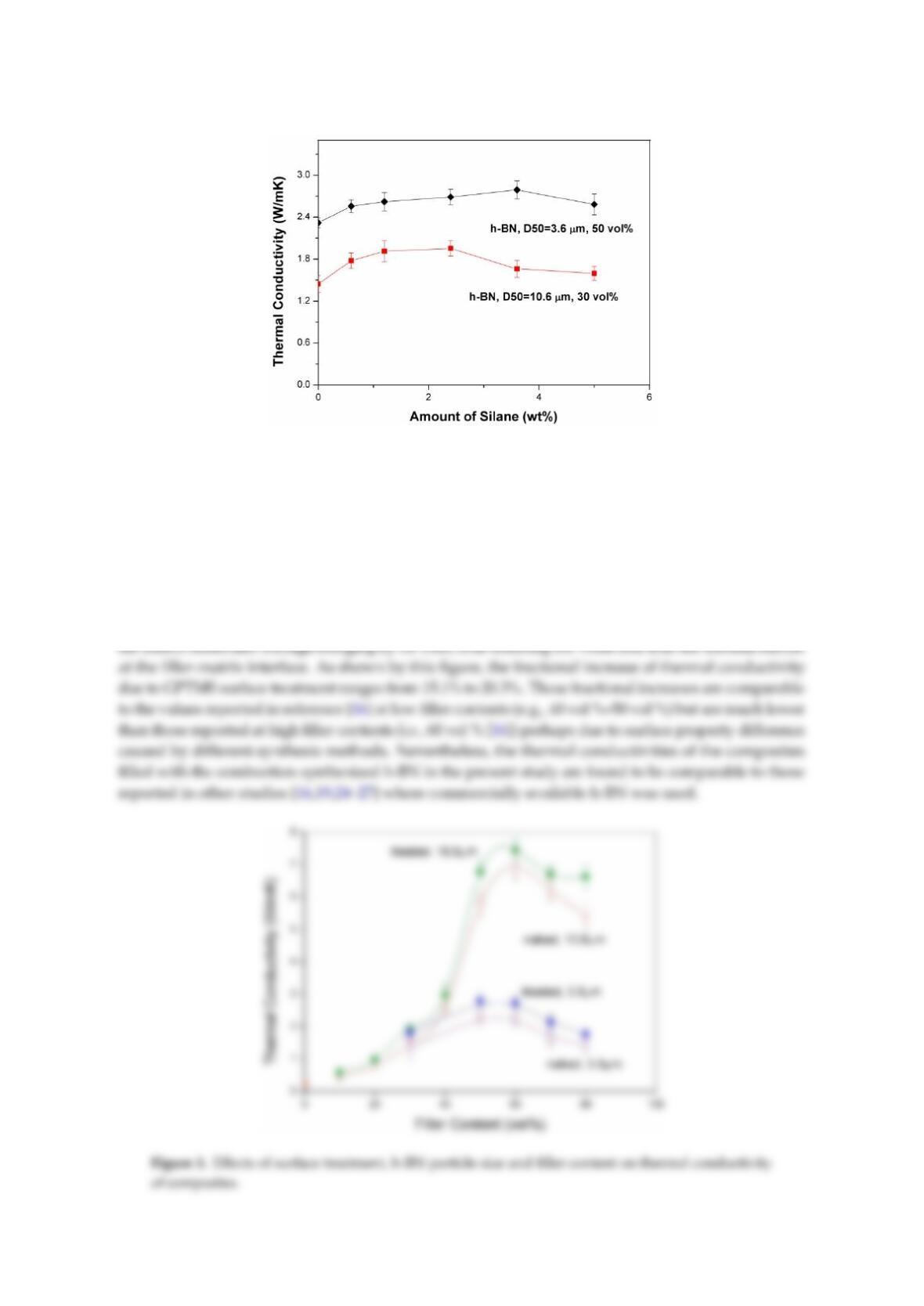
Figure 2 shows the effect of the amount of GPTMS used in the surface treatment on the thermal
conductivity of the composites. The thermal conductivities of the composites are seen to increase with
increasing amount of GPTMS to a maximum value (at amounts of 3.6 wt % and 2.4 wt % for particle sizes
of 3.6 μm and 10.6 μm, respectively) and then to decrease with further increases in the amount of
GPTMS. A similar phenomenon was also reported by Xu et al. [16]. Since the GPTMS serves as a
coupling agent bridging together the BN particle surface and the matrix molecules (thus reducing the
voids at the interface), the thermal conductivity of the composite thus increases with increasing amount
of GPTMS (in the region of low amount of GPTMS, i.e., ≤3.6 wt % or ≤2.4 wt % for 3.6 μm or 10.6 μm
h-BN particles, respectively). However, the GPTMS at the interface between the BN particles and the
matrix also presents as a thermal barrier. When an excess amount of GPTMS was used (i.e., >3.6 wt % or
>2.4 wt % for 3.6 μm or 10.6 μm h-BN particles, respectively), this thermal barrier effect dominated
over the coupling agent effect (due to a thick GPTMS layer at the interface), thus causing a decrease
in the thermal conductivity (these amounts of GPTMS, i.e., 3.6 wt % and 2.4 wt % for 3.6 μm and
10.6 μm h-BN particles, respectively, were thus considered as optimum for surface treatment and were
used in all the other experiments presented in this work). It is also noted that the optimum amount
of silane for surface treating 3.6 μm h-BN particles is higher than that for 10.6 μm h-BN particles due
to the higher specific surface area of the smaller particles.
Figure 1.
FT-IR spectra of the 2.4 wt % GPTMS-treated and the naked h-BN powders with an average
particle size of 10.6 µm.
2.2. Optimum Amount of GPTMS for Surface Treatment
Figure 2shows the effect of the amount of GPTMS used in the surface treatment on the thermal
conductivity of the composites. The thermal conductivities of the composites are seen to increase with
increasing amount of GPTMS to a maximum value (at amounts of 3.6 wt % and 2.4 wt % for particle
sizes of 3.6
µ
m and 10.6
µ
m, respectively) and then to decrease with further increases in the amount
of GPTMS. A similar phenomenon was also reported by Xu et al. [
16
]. Since the GPTMS serves as a
coupling agent bridging together the BN particle surface and the matrix molecules (thus reducing the
voids at the interface), the thermal conductivity of the composite thus increases with increasing amount
of GPTMS (in the region of low amount of GPTMS, i.e.,
ď
3.6 wt % or
ď
2.4 wt % for 3.6
µ
m or 10.6
µ
m
h-BN particles, respectively). However, the GPTMS at the interface between the BN particles and the
matrix also presents as a thermal barrier. When an excess amount of GPTMS was used (i.e., >3.6 wt %
or >2.4 wt % for 3.6
µ
m or 10.6
µ
m h-BN particles, respectively), this thermal barrier effect dominated
over the coupling agent effect (due to a thick GPTMS layer at the interface), thus causing a decrease in
the thermal conductivity (these amounts of GPTMS, i.e., 3.6 wt % and
2.4 wt %
for 3.6
µ
m and
10.6 µm
h-BN particles, respectively, were thus considered as optimum for surface treatment and were used in
all the other experiments presented in this work). It is also noted that the optimum amount of silane
for surface treating 3.6
µ
m h-BN particles is higher than that for 10.6
µ
m h-BN particles due to the
higher specific surface area of the smaller particles.
Molecules 2016,21, 670 4 of 11
Molecules 2016, 21, 670 4 of 11
Figure 2. Effect of the amount of GPTMS used in surface treatment of h-BN on the thermal
conductivity of the composites.
2.3. Effect of Surface Treatment on Thermal Conductivity of Composites
Figure 3 shows the effect of GPTMS surface treatment on the thermal conductivity of the
composites filled with h-BN with an average particle size (d50) of 3.6 μm or 10.6 μm. As can be seen,
GPTMS surface treatment does increase the thermal conductivity of the composites filled with either
small (3.6 μm) or large (10.6 μm) size h-BN particles. As mentioned previously, this increase of thermal
conductivity has been explained [16,24] by enhancing bonding between the filler particles and the
matrix molecules through bridging by GPTMS, thus reducing the voids and thus the thermal barrier
Figure 2.
Effect of the amount of GPTMS used in surface treatment of h-BN on the thermal conductivity
of the composites.
2.3. Effect of Surface Treatment on Thermal Conductivity of Composites
Figure 3shows the effect of GPTMS surface treatment on the thermal conductivity of the
composites filled with h-BN with an average particle size (d
50
) of 3.6
µ
m or 10.6
µ
m. As can be
seen, GPTMS surface treatment does increase the thermal conductivity of the composites filled with
either small (3.6
µ
m) or large (10.6
µ
m) size h-BN particles. As mentioned previously, this increase of
thermal conductivity has been explained [
16
,
24
] by enhancing bonding between the filler particles and
Molecules 2016, 21, 670 4 of 11
Figure 2. Effect of the amount of GPTMS used in surface treatment of h-BN on the thermal
conductivity of the composites.
2.3. Effect of Surface Treatment on Thermal Conductivity of Composites
Figure 3 shows the effect of GPTMS surface treatment on the thermal conductivity of the
composites filled with h-BN with an average particle size (d50) of 3.6 μm or 10.6 μm. As can be seen,
GPTMS surface treatment does increase the thermal conductivity of the composites filled with either
small (3.6 μm) or large (10.6 μm) size h-BN particles. As mentioned previously, this increase of thermal
conductivity has been explained [16,24] by enhancing bonding between the filler particles and the