ECO FINAL REVIEW CHP 13–14–17–18
Chapter 13 Money and The Banking System
Examples of Money:
-A dollar bill -A Check
-A traveler’s check
Money is anything that is regularly used in economic transactions or exchanges.
1.When money is accepted as payment for a good or service, it is being used as a medium of
exchange
2.When money is used to express the value of goods and services, it is functioning as a: unit of
account.
3. If money is used as a mechanism to hold purchasing power for a period of time it is
functioning as a: store of value.
M1:
-Includes the most liquid forms of money
–Is the narrowest definition of the money supply
-Includes travelers’ checks
M2:
-Deposits in savings accounts
-Money market mutual funds
Loans are examples of a bank’s: —> ASSETS
Deposits are examples of a bank’s: —>LIABILITIES
The fraction of deposits that banks are required by law to hold and not lend out are called its:
Required reserves.
If the banking system has required reserve ratio of 25%, then the money multiplier is: 4
“the money multiplier” = 1/(reserve ratio)
A bank may make loans until its —> excess reserves are exhausted.
1. An open market purchase by the Fed —> increases the total amount of reserves in the
banking system.
2. An open market purchase occurs when: —> The Federal reserve purchases Treasury
Bonds.
3. An open market sale by the Fed: —> decreases the total amount of reserves in the banking
system.
The most commonly used tool in monetary policy is: —> OPEN MARKET OPERATIONS.
The most important way the Federal Reserve changes the supply of money is —> Open Market
operations.
The tool for changing the money supply that the Federal Reserve uses least often is: —> The
reserve ratio.
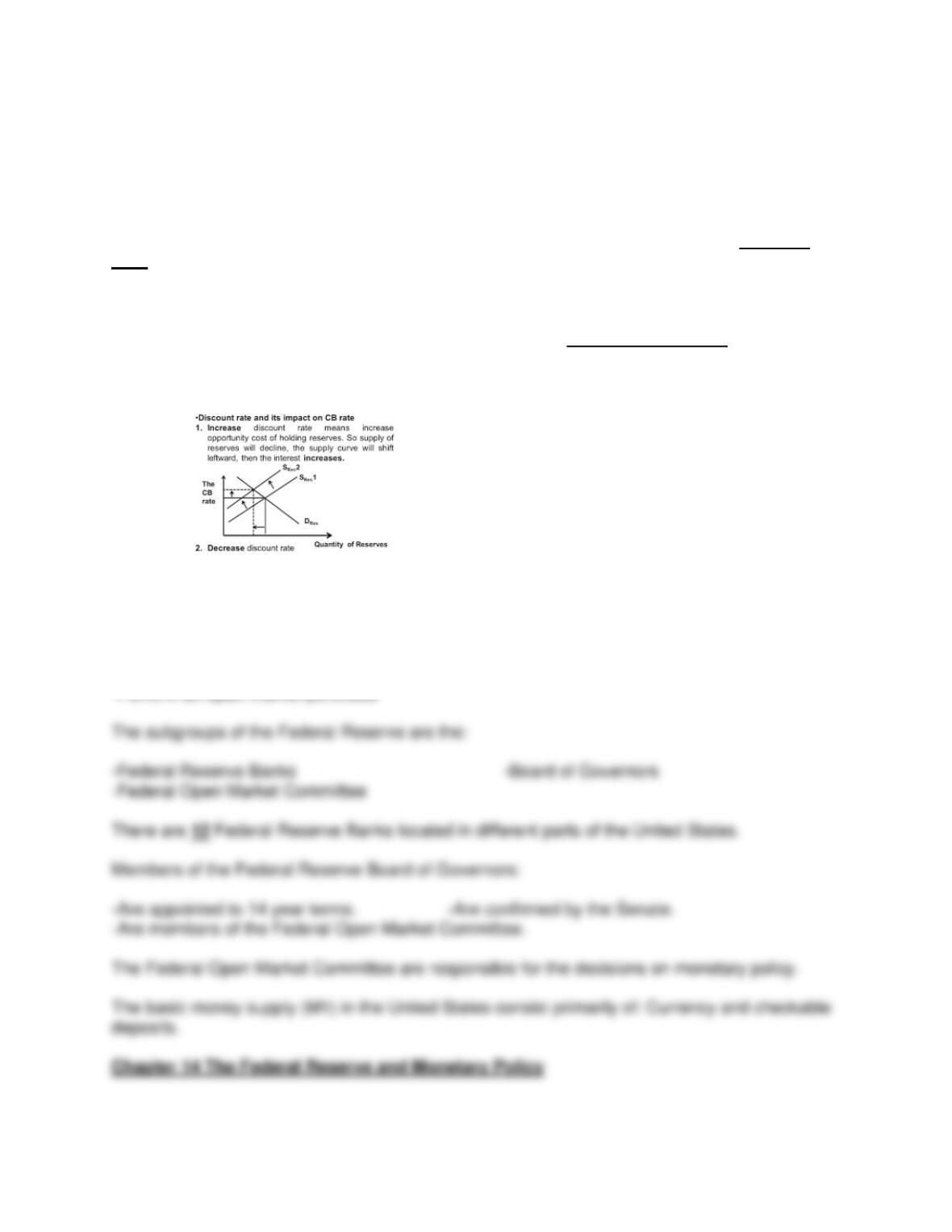
The rate of interest charged to commercial banks by the Fed for loans is called the discount
rate.
The Federal funds rate is the interest rate that: —> banks charge on loans to each other.
Reserves can be borrowed by one bank from another in the federal funds market.
An increase in the discount rate will: Decrease the money
supply.
If the Fed wishes to increase the money supply, it could:
-decrease the discount rate -Reduce the reserve requirement