Chapter 04 – The Value of Common Stocks
4-1
CHAPTER 4
The Value of Common Stocks
Answers to Problem Sets
1. a. True
b. True
2. Investors who buy stocks may get their return from capital gains as well as
dividends. But the future stock price always depends on subsequent dividends.
There is no inconsistency.
3. P0 = (5 + 110)/1.08 = $106.48
4. r = 5/40 = .125.
5. P0 = 10/(.08 – .05) = $333.33.
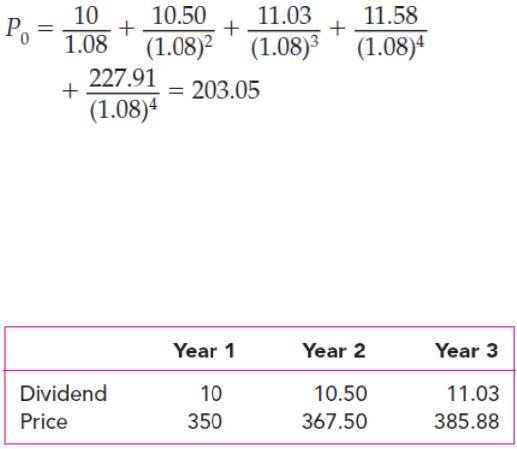
6. By year 5, earnings will grow to $18.23 per share. Forecasted price per share at
year 4 is 18.23/.08 = $227.91.
7. 15/.08 + PVGO = 333.33; therefore PVGO = $145.83.
8. Z’s forecasted dividends and prices grow as follows:
Calculate the expected rates of return:
Chapter 04 – The Value of Common Stocks
4-2
From year 0 to 1:
08.
33.333
)33.333350(10 =
−+
From year 1 to 2:
08.
350
)35050.367(50.10 =
−+
From year 2 to 3:
08.
50.367
)50.36788.385(03.11 =
−+
Double expects 8% in each of the first 2 years. Triple expects 8% in each of the
first 3 years.
9. a. False
b. True.
10. PVGO = 0, and EPS1 equals the average future earnings the firm could generate
under no-growth policy.
11. Free cash flow is the amount of cash thrown off by a business after all
investments necessary for growth. In our simple examples, free cash flow equals
operating cash flow minus capital expenditure. Free cash flow can be negative if
investments are large.
12. The value at the end of a forecast period. Horizon value can be estimated
using the constant-growth DCF formula or by using price–earnings or market–
book ratios for similar companies.
13. If PVGO = 0 at the horizon date H, horizon value = earnings forecasted for H +
1 divided by r.
14. Newspaper exercise, answers will vary

Chapter 04 – The Value of Common Stocks
4-3
15.
Expected Future Values
Present Values
Horizon
Period (H)
Dividend
(DIVt )
Price
(Pt )
Cumulative
Dividends
Future
Price
Total
0
100.00
100.00
100.00
1
10.00
105.00
8.70
91.30
100.00
2
10.50
110.25
16.64
83.36
100.00
3
11.03
115.76
23.88
76.12
100.00
4
11.58
121.55
30.50
69.50
100.00
10
15.51
162.89
59.74
40.26
100.00
20
25.27
265.33
83.79
16.21
100.00
50
109.21
1,146.74
98.94
1.06
100.00
100
1,252.39
13,150.13
99.99
0.01
100.00
Assumptions
1. Dividends increase at 5% per year compounded.
2. Capitalization rate is 15%.
16.
$100.00
0.10
$10
r
DIV
P1
A===
$83.33
.0400.10
$5
gr
DIV
P1
B=
−
=
−
=
++++++= 6
7
6
6
5
5
4
4
3
3
2
2
1
1
C1.10
1
0.10
DIV
1.10
DIV
1.10
DIV
1.10
DIV
1.10
DIV
1.10
DIV
1.10
DIV
P
$104.50
1.10
1
0.10
12.44
1.10
12.44
1.10
10.37
1.10
8.64
1.10
7.20
1.10
6.00
1.10
5.00
P6654321
C=
++++++=
At a capitalization rate of 10%, Stock C is the most valuable.
For a capitalization rate of 7%, the calculations are similar.
The results are:
PA = $142.86
PB = $166.67
PC = $156.48
Therefore, Stock B is the most valuable.
17. a.
$21.90
.027500.095
1.0275$1.35
$1.35
gr
DIV
DIVP 1
00 =
−
+=
−
+=
Chapter 04 – The Value of Common Stocks
b. First, compute the real discount rate as follows:
(1 + rnominal) = (1 + rreal) (1 + inflation rate)
1.095 = (1 + rreal) 1.0275
(1 + rreal) = (1.095/1.0275) – 1 = .0657 = 6.57%
In real terms, g = 0. Therefore:
$21.90
0.0657
$1.35
$1.35
gr
DIV
DIVP 1
00 =+=
−
+=
18. a. Plowback ratio = 1 – payout ratio = 1.0 – 0.5 = 0.5
Dividend growth rate = g= Plowback ratio × ROE = 0.5 × 0.14 = 0.07
Next, compute EPS0 as follows:
ROE = EPS0 /Book equity per share
0.14 = EPS0 /$50 EPS0 = $7.00
Therefore: DIV0 = payout ratio × EPS0 = 0.5 × $7.00 = $3.50
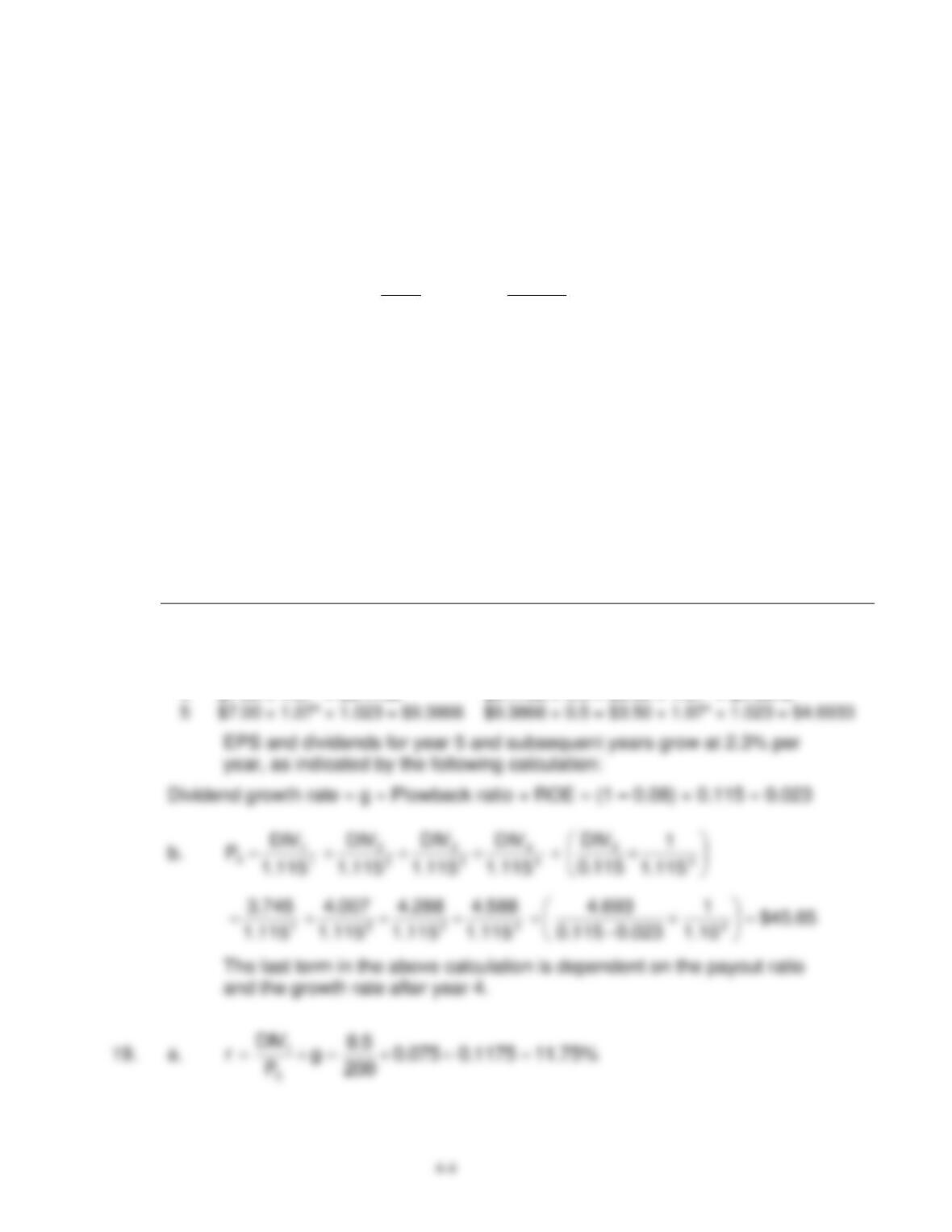
EPS and dividends for subsequent years are:
Year
EPS
DIV
0
$7.00
$7.00 × 0.5 = $3.50
1
$7.00 × 1.07 = $7.4900
$7.4900 × 0.5 = $3.50 × 1.07 = $3.7450
2
$7.00 × 1.072 = $8.0143
$8.0143 × 0.5 = $3.50 × 1.072 = $4.0072
3
$7.00 × 1.073 = $8.5753
$8.5753 × 0.5 = $3.50 × 1.073 = $4.2877
5
$7.00 × 1.074 × 1.023 = $9.3866
$9.3866 × 0.5 = $3.50 × 1.074 × 1.023 = $4.6933