RUNNING HEAD: THE UNITED STATES COAST GUARD 1
The United States Coast Guard
Harley D. Williams
Georgia Southern University
UNITED STATES COAST GUARD
2
Introduction and History: The Creation of the United States Coast Guard
On August 4th, 1790, President George Washington signs the Tariff Act. This act
permitted the production and construction of ten vessels, or “cutters”, to enforce federal tariff
and trade laws. These ten vessels operated as the “Revenue Cutter Service”. The purpose of
RCS was to prevent smuggling, yet the service expanded in responsibilities and size as the
developing nation grew. In 1915, the RCS merged with the U.S. Lifesaving Service, founded in
1878, and was officially renamed the United States Coast Guard (USCG). The merger created
the only maritime service dedicated to saving lives at sea while enforcing the nation’s laws. In
1939, President Roosevelt commanded the Lighthouse Service be absorbed by the USCG to
expand its responsibilities to maritime navigation. In 1946, Congress transferred the Commerce
Department’s Bureau of Marine Inspection and Navigation to the USCG. This further expands
the USCG to include merchant marine licensing and merchant vessel safety. In 1967, the coast
guard transferred to the Department of Transportation and in 2003, transferred for the last time to
the Department of Homeland Security or “DHS”. Today, the USCG is a federal law enforcement
agency and a military force. As an enforcement agency, it serves as a branch of the DHS
enforcing nation’s laws, protecting the marine environment, guarding the coastline and ports, and
performing lifesaving missions all during times of peace. However, in times of war, it operates as
part of the Department of the Navy to defend the nation against terrorism and foreign threats.
(Ostrom, 2004)
USCG Organization and Structure: Specialized Units and Missions
As of 2014, the Coast Guard has over 43,000 active duty members, not including civilians,
UNITED STATES COAST GUARD
3
auxiliary, or reserves. Although the USCG is the smallest military branch, it is the 12th largest
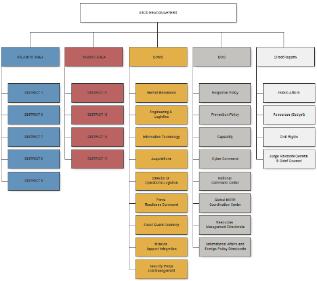
maritime force. (Ostrom, 2004). The USCG organization begins at Headquarters (Washington,
DC), then separates into the Atlantic Area, the Pacific Area, Deputy Commandant for Mission
Support (DCMS), Deputy Commandant for Operations (DCO) and Direct Report.
Figure 1. The Organizational structure of the USCG and Auxiliary. (Website) Retrieved from:
The United States Coast Guard U.S. Department of Homeland Security (2018)
Missions
According to the textbook, the USCG placement within the DHS was considered radical
until closer inspection of the USCG’s dedication to safety, security, and missions. The mission of
the USCG is Maritime Safety: “to eliminate deaths, injuries, and property damage associated
with maritime transportation, fishing, and recreational boating”, Maritime Security: “to protect
America’s maritime borders from all intrusions by a) halting the flow of illegal drugs, aliens, and
contraband, b) preventing illegal fishing, c) suppressing violations of federal law”, Maritime
Mobility: “to facilitate maritime commerce and eliminate interruptions and impediments to the
efficient and economical movement of gods and people, while maximizing recreational access”,
National Defense: “to defend the country as one of the five U.S. armed services”, and Maritime
Stewardess Council: “to eliminate environmental damage and the degradation of natural
resources associated with maritime transportation, fishing, and recreational boating.” (Nemeth,
UNITED STATES COAST GUARD
4
2017) The mission of the Coast Guard is very similar to that of the DHS, whose five missions
are: 1. Prevent terrorism and enhancing security; 2.Secure and manage our borders; 3. Enforce
and administer our immigration laws; 4. Safeguard and secure cyberspace; and 5. Ensure
resilience to disasters. (“DHS.GOV”, 2016) To fulfill these missions, the DHS and the USCG is
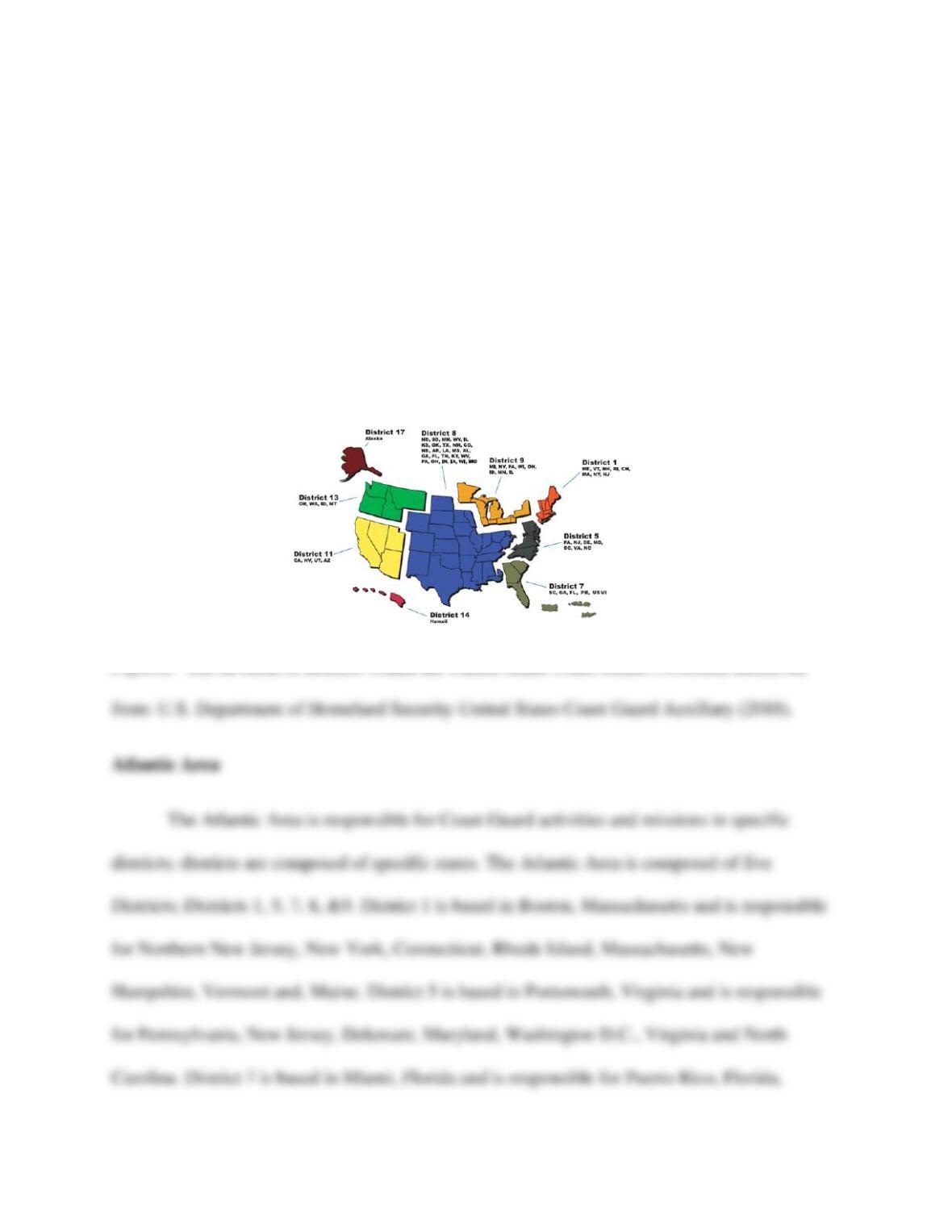
split into multiple different specialized divisions and units. The USCG is split up into five
subcategories (Atlantic Area, Pacific Area, DCM, DCO, and Direct Reports), nine divisions, and
twenty-one divisions. (previously listed in “USCG Organization and Structure”) (USCG.MIL,
2017)