FIN 3701 Chapter 2 :The Time Value of Money
1
Assumption University of Thailand
FIN3701
Corporate
Finance
Chapter 2
The Time Value
of Money
Dr. Chainarin Srinutchasart
1
After studying this chapter,
•You will understand the concept of future
value, with both annual and intra-year
compounding.
•Your will be able to distinguish between
future value and present value concepts.
•Your will be able to calculate the future
value and present value of a single
payment and an annuity.
•You will see how to utilize future value
and present value tables.
2
Principles Applied in This Chapter
•Principle 1: Money Has a Time Value
•Principle 3: Cash Flows Are the Source
of Value.
3
Corporate Finance addresses the
following 3 questions:
1. What long-term investments should the
firm engage in?
2. How can the firm raise money for the
required investments? (Alternatives:
Bonds, Stocks, Preferred Stocks=what
is the appropriate price?)
3. How much short-term cash flow does a
company need to pay its bills? and how
to raise it
4
We know that receiving $1 today is worth more
than $1 in the future. This is due to
opportunity costs.
The opportunity cost of receiving $1 in the
future is the interest (based upon inflation,
economy and other risks) we could have
earned if we had received the $1 sooner.
Today Future
So, interest rate = Rf + Inflation + Risk Premium
5
Intuition Behind Present Value
There are three reasons why a dollar tomorrow is
worth less than a dollar today.
•Individuals prefer present consumption to
future consumption. To induce people to give up
present consumption you have to offer them more
in the future.
•When there is monetary inflation. the value of
currency decreases over time. The greater the
inflation the greater the difference in value
between a dollar today and a dollar tomorrow.
•If there is any uncertainty (risk) associated with
the cash flow in the future, the less that cash flow
will be valued.
Interest rate = Rf + Inflation rate + Risk premium
6
FIN 3701 Chapter 2 :The Time Value of Money
2
Using Timelines to Visualize Cash
flows
•Atimeline identifies the timing and
amount of a stream of cash flows along
with the interest rate.
•A timeline is typically expressed in years,
but it could also be expressed as months,
days or any other unit of time.
7
Time Line Example
•The 4-year timeline illustrates the following:
•The interest rate is 10%.
•A cash outflow of $100 occurs at the beginning
of the first year (at time 0), followed by cash
inflows of $30 and $20 in years 1 and 2, a cash
outflow of $10 in year 3 and cash inflow of $50
in year 4.
The end of
period
0 1 2 3 4
Years
Cash flow -$100 $30 $20 -$10 $50
i=10%
8
The Time Value of Money
Compounding
and
Discounting Single Sums
9
If we can measure this
opportunity cost, we can:
•Translate $1 today into its equivalent in the future
(compounding).
•Translate $1 in the future into its equivalent today
(discounting).
Today Future
?
Today Future
?
10
Simple Interest and Compound
Interest
•What is the difference between simple
interest and compound interest?
•Simple interest: Interest is earned only
on the principal amount.
•Compound interest: Interest is earned
on both the principal and accumulated
interest of prior periods.
11
Simple Interest and Compound
Interest (cont.)
•Example: Suppose that you deposited
$500 in your savings account that earns
5% annual interest. How much will you
have in your account after two years
using (a) simple interest and (b)
compound interest?
12

FIN 3701 Chapter 2 :The Time Value of Money
3
Simple Interest and Compound
Interest (cont.)
Simple Interest
•Interest earned
•= 5% of $500 = .05×500 = $25 per year
•Total interest earned = $25×2 = $50
•Balance in your savings account:
•= Principal + accumulated interest
•= $500 + $50 = $550
13
Simple Interest and Compound
Interest (cont.)
Compound interest
•Interest earned in Year 1
•= 5% of $500 = $25
•Interest earned in Year 2
•= 5% of ($500 + accumulated interest)
•= 5% of ($500 + 25) = .05×525 =
$26.25
•Balance in your savings account:
•= Principal + interest earned
•= $500 + $25 + $26.25 = $551.25
14
Compound Interest and
Future Value
15
Future Value – single sums
•If you deposit $100 in an account earning
6%, how much would you have in the
account after 1 year?
16
Future Value – single sums
•If you deposit $100 in an account earning 6%,
how much would you have in the account
after 1 year?
PV = FV =
0
1
Calculator Solution:
P/Y = 1 I = 6
N = 1 PV = -100
FV = $106
-100 106
17
Future Value – single sums
•If you deposit $100 in an account earning 6%,
how much would you have in the account
after 1 year?
PV = FV =
0
1
Mathematical Solution:
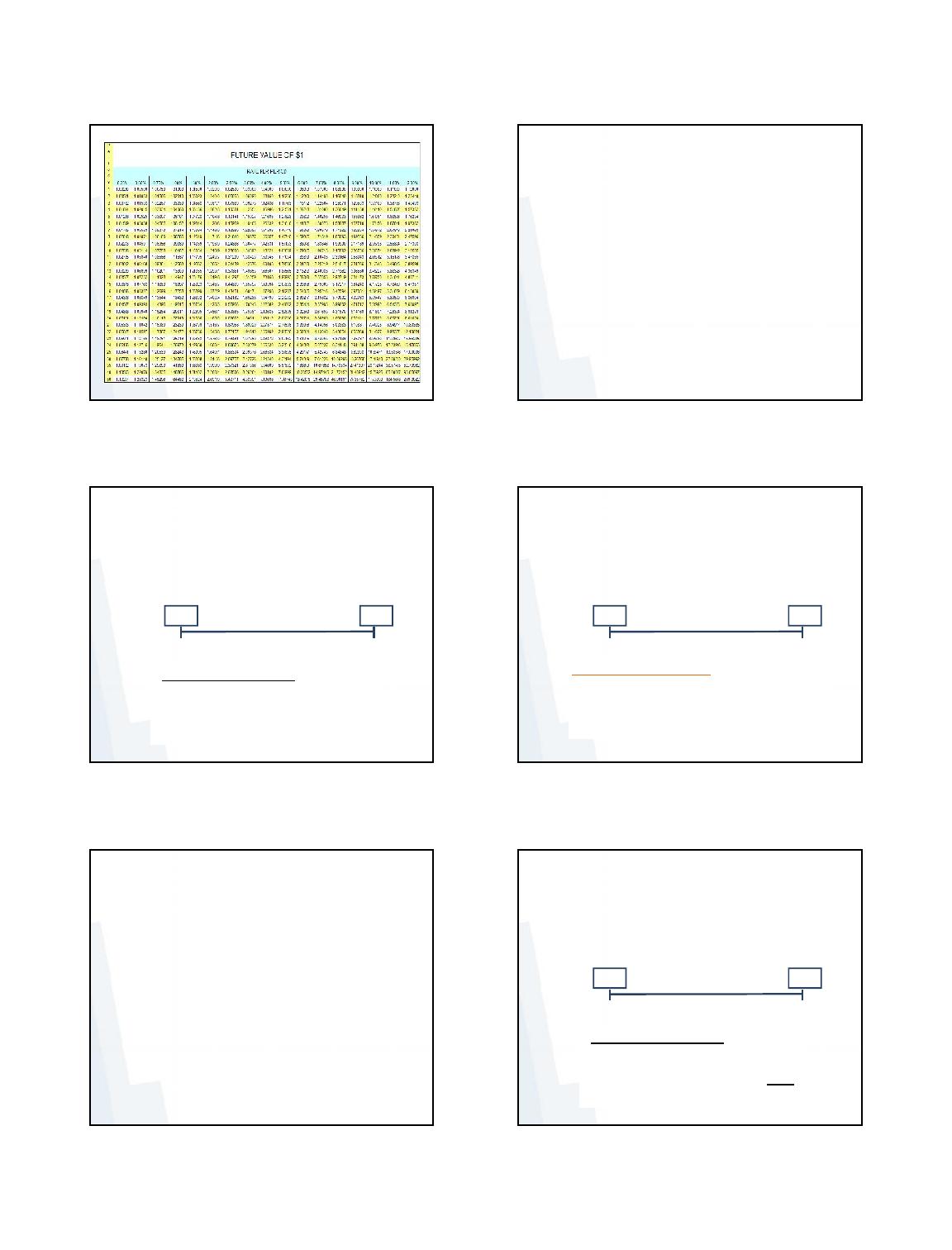
FV = PV (FVIF i, n )
FV = 100 (FVIF .06, 1 ) (use FVIF table, or)
FV = PV (1 + i)n
FV = 100 (1.06)1=$106
-100 106
18
FIN 3701 Chapter 2 :The Time Value of Money
4
19
Future Value – single sums
•If you deposit $100 in an account earning
6%, how much would you have in the
account after 5 years?
20
Future Value – single sums
•If you deposit $100 in an account earning 6%, how
much would you have in the account after 5
years?
PV = FV =
0
5
Calculator Solution:
P/Y = 1 I = 6
N = 5 PV = -100
FV = $133.82
-100 133.82
21
Future Value – single sums
•If you deposit $100 in an account earning 6%, how
much would you have in the account after 5
years?
PV = FV =
0
5
-100 133.82
Mathematical Solution:
FV = PV (FVIF i, n )
FV = 100 (FVIF .06, 5 ) (use FVIF table, or)
FV = PV (1 + i)n
FV = 100 (1.06)5 = $133.82
22
Future Value – single sums
•If you deposit $100 in an account earning
6% with quarterly compounding, how
much would you have in the account after
5 years?
23
Future Value – single sums
•If you deposit $100 in an account earning 6% with
quarterly compounding, how much would you
have in the account after 5 years?
PV = FV =
0
20
Calculator Solution:
P/Y = 4 I = 6
N = 20 PV = -100
FV = $134.68
-100 134.68
24

FIN 3701 Chapter 2 :The Time Value of Money
5
Future Value – single sums
•If you deposit $100 in an account earning 6% with
quarterly compounding, how much would you
have in the account after 5 years?
PV = FV =
0
20
-100 134.68
Mathematical Solution:
FV = PV (FVIF i, n )
FV = 100 (FVIF .015, 20 )(can’t use FVIF table)
FV = PV (1 + i/m) m x n
FV = 100 (1.015)20 =$134.68
25
Future Value – single sums
•If you deposit $100 in an account earning
6% with monthly compounding, how
much would you have in the account after
5 years?
26
Future Value – single sums
•If you deposit $100 in an account earning 6% with
monthly compounding, how much would you
have in the account after 5 years?
PV = FV =
0
20
Calculator Solution:
P/Y = 12 I = 6
N = 60 PV = -100
FV = $134.89
-100 134.89
27
Future Value – single sums
•If you deposit $100 in an account earning 6% with
monthly compounding, how much would you
have in the account after 5 years?
PV = FV =
0
20
Mathematical Solution:
FV = PV (FVIF i, n )
FV = 100 (FVIF .005, 60) (use FVIF table, or)
FV = PV (1 + i)n
FV = 100 (1.005)60 =$134.89
-100 134.89
28
Future Value – continuous
compounding
•What is the FV of $1,000 earning 8% with
continuous compounding, after 100
years?
29
Future Value – continuous
compounding
•What is the FV of $1,000 earning 8% with
continuous compounding, after 100 years?
PV = FV =
0
100
Mathematical Solution:
FV = PV (e in)
FV = 1000 (e .08×100) = 1000 (e 8)
FV = $2,980,957.99
-1000 $2.98m
30
FIN 3701 Chapter 2 :The Time Value of Money
6
Present Value and Annuities
31
Present Value – single sums
•If you receive $100 one year from now, what is the
PV of that $100 if your opportunity cost is 6%?
32
Present Value – single sums
•If you receive $100 one year from now, what is the
PV of that $100 if your opportunity cost is 6%?
PV = FV =
0
1
Calculator Solution:
P/Y = 1 I = 6
N = 1 FV = 100
PV = -94.34
100
-94.34
33
Present Value – single sums
•If you receive $100 one year from now, what is the
PV of that $100 if your opportunity cost is 6%?
PV = FV =
0
1
Mathematical Solution:
PV = FV (PVIF i, n )
PV = 100 (PVIF .06, 1 ) (use PVIF table, or)
PV = FV / (1 + i)n
PV = 100 / (1.06)1=$94.34
100
-94.34
34
35
Present Value – single sums
•If you receive $100 five years from now, what is
the PV of that $100 if your opportunity cost is 6%?
PV = FV =
0
5
Calculator Solution:
P/Y = 1 I = 6
N = 5 FV = 100
PV = -74.73
100
-74.73
36
FIN 3701 Chapter 2 :The Time Value of Money
Present Value – single sums
•If you receive $100 five years from now, what is
the PV of that $100 if your opportunity cost is 6%?
PV = FV =
0
5
Mathematical Solution:
PV = FV (PVIF i, n )
PV = 100 (PVIF .06, 5 ) (use PVIF table, or)
PV = FV / (1 + i)n
PV = 100 / (1.06)5=$74.73
100
-74.73
37
Present Value – single sums
•What is the PV of $1,000 to be received 15 years
from now if your opportunity cost is 7%?
PV = FV =
0
15
Calculator Solution:
P/Y = 1 I = 7
N = 15 FV = 1,000
PV = -362.45
1000
-362.
45
38
Present Value – single sums
•What is the PV of $1,000 to be received 15 years
from now if your opportunity cost is 7%?
PV = FV =
0
-362.
1000
45
Present Value – single sums
•If you sold land for $11,933 that you bought 5
years ago for $5,000, what is your annual rate of
return?
PV = FV =
0
-5,000 11,933