The Thai Piphat Ensemble and the Traditional Music of Thailand
The Thai Piphat Ensemble is one of Thailand’s traditional music ensembles.
Traditional music in Thailand is shaped by both traditions of the court and of the village
(Douglas, 2010), and Piphat music, which is ceremonial music for rituals and formal events,
is heavily influenced by these traditions. Thai culture can be quite complex as many ethnic
groups are blended together in present-day Thailand, such as the majority Siamese Thai,
Chinese, Khmer, and Mon people (Miller & Williams, 2008). This essay shall focus on the
traditional Piphat ensemble, as well as elements of Thai music, and cultural contexts of Thai
traditional music as a whole.
Thailand is variably divided into several regions, and of all, the central region is the
most prominent Piphat musical area in the country as compared to the other regions. For
example, the central region has a clearly developed performance model for Piphat Mon
ensemble. Most Piphat ensembles from other regions, except the central region, do not have a
raised stage or table for playing on due to additional costs it will incur (Jeeranai, Jampadaeng,
& Suk-Erb, 2013).
Cultural Characteristics of Thai Music
As a religion, Buddhism has also largely shaped Thai culture and its social structure.
The rites and ceremonies of Buddhism are an essential part of Thai life (Myers-Moro, 1993),
and these have also influenced Thai musical practices. Before Piphat performances, Buddhist
rites are traditionally performed and players will fold their hands in a praying position. This
is important as the Thai people see it as praying to the surrounding guardian spirits for luck
before their performances.
2
Due to the transformation of Thailand’s economy, politics and society, musical
customs and traditions have gradually changed over time, including Piphat music. This is
alongside the increase in influence of western music culture. As a result, the role of Piphat
ensembles in society, such as providing ceremonial music, was reduced. Piphat performers
nowadays must adapt to current societal trends (Jeeranai et al., 2013).
Fortunately, Thai traditional music could be found within Thailand’s educational
institutions today, and private ensembles that meet in the residences of masters (Miller &
Williams, 2008). Ensembles are also engaged to perform for festive occasions, temple fairs,
and tourist restaurants in Bangkok. A Piphat Mon ensemble may also be found performing
for background to funerals and processions in some Buddhist temples specialising in funerals.
Pedagogical Aspects of Thai Music
Traditional music in Thailand is predominantly ensemble-oriented, and solo-playing
is secondary to the ensemble (Miller & Williams, 2008). In the Piphat ensemble, musicians
are held in esteem for their extensive repertoire, lineage, and how they ornament their music,
rather than for virtuosic playing.
The student would live in the master’s home in the traditional method of training,
spending long hours in study and supervised practice daily. Every students obtained their
training orally from their masters (Duriyanga, 1973). The student learnt each phrase by
playing repeatedly until they memorised and mastered the entire music. Most importantly,
notation was not allowed and this way of training still prevails among traditional masters
today (Miller & Williams, 2008).
3
One development is the notation of Thai music, which had begun around 1920s.
Notations used by students are simple, such as tablature or pitch notation. Pitch notation
could be shown using Thai initials of the solfege system (Miller & Williams, 2008). Thai
musicians performed from memory and not from notation, apart from student ensembles
using stringed instruments.
The Piphat Ensemble
The Piphat ensemble is divided into two sections: the instruments of the woodwind
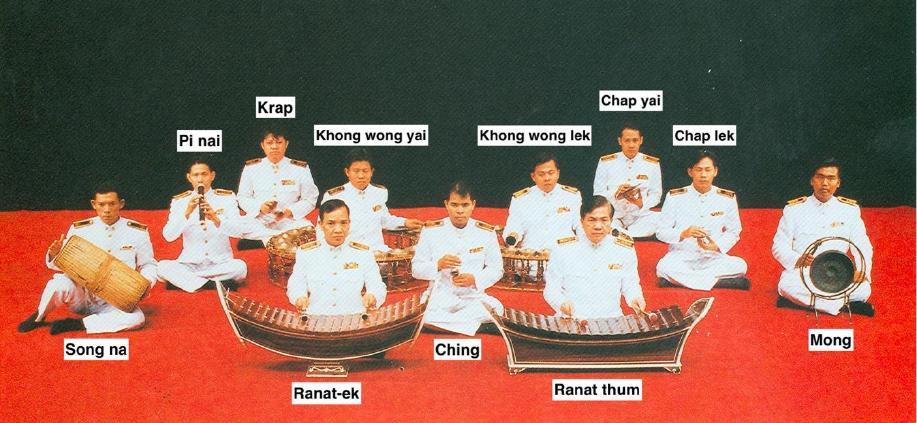
section and the percussion section. The above image shows the Piphat ensemble with
instrument names labelled. The woodwind section is represented by a single instrument,
which is classified as an aerophone, the Pi nai (Duriyanga, 1973).
The Pi nai is a quadruple reed oboe. In the Piphat ensemble, the Pi nai doubles the
principal melody, which is usually played by the Khong wong yai. The Pi nai embellishes the
melody with turns and ornaments. The musician needs to control his breath so as to ensure no
breaks from the start to the end of a tune (Duriyanga, 1973).
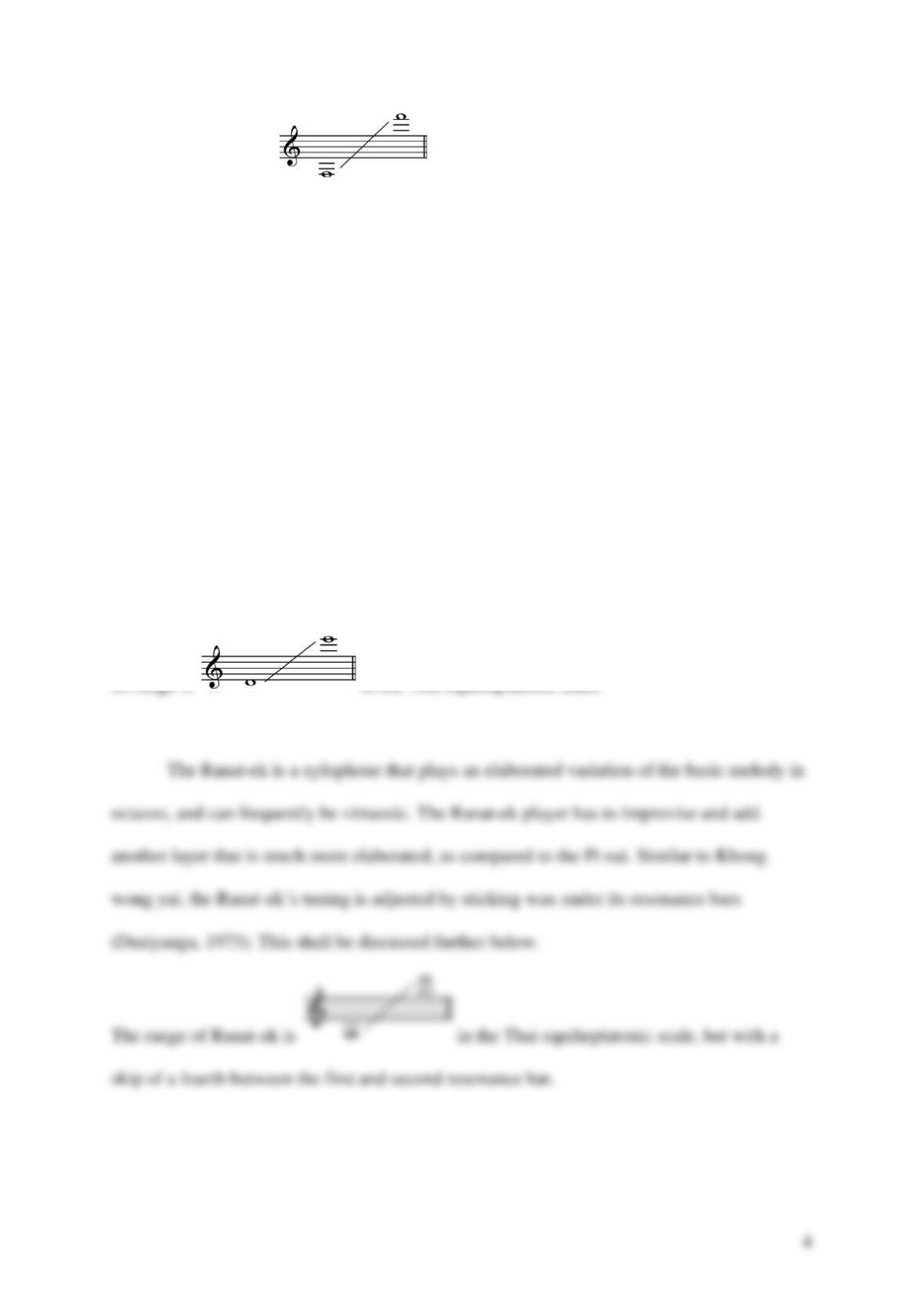
The range of Pi nai is in the Thai equiheptatonic scale.
The percussion section is further divided into two categories: the idiophones and the
membranophones. Under the category of struck idiophones, melodic instruments consist of
the Ranat-ek, Ranat-ek lek, Khong wong yai, Khong wong lek, Ranat thum, and Ranat thum
lek, while rhythmic instruments are Khong hui and Mong. Under the category of concussion
idiophones, we have the Chap, Ching, and Krap. Lastly, membranophones consist of
rhythmic instruments that are the Taphon, Song na, and Klong that.
The Khong wong yai is metallophone. Khong wong yai plays the principal melody in
Piphat ensemble and it is an instrument that is indispensable to the ensemble.