Learning objectives
Economic nature of taxes.
The basis of structure of taxes and taxation.
The tax system of RK: stages of
development and contemporary conditions.
Basic terminology
tax agent —a person who in accordance
with this Code is entrusted with the duty of
assessment, withholding and transfer of
taxes withheld at source of payment;
taxes —obligatory monetary payments to
the budget as established by the state
through legislation in a unilateral procedure,
except for the cases specified in this Code,
which are paid in certain amounts, which
are irrevocable and non-refundable
Basic terminology
▪A tax can be defined as a payment to support the cost
of government. A tax differs from a fine or penalty
imposed by a government because a tax is not intended
to deter or punish unacceptable behavior. On the other
hand, taxes are compulsory rather than voluntary on the
part of the payer.
▪A tax differs from a user’s fee because the payment of a
tax does not entitle the payer to a specific good or
service in return. In the abstract, citizens receive any
number of government benefits for their tax dollars.
Nevertheless, the value of government benefits received
by any particular person is not correlated to the tax that
person must pay.

Basic terminology
▪Ataxpayer is any person or organization required by law to
pay a tax to a governmental authority. In our country, the term
person refers to both natural persons (individuals) and
corporations. Corporations are entities organized under the
laws. These corporate entities generally enjoy the same legal
rights, privileges, and protections as individuals.
▪The incidence of a tax refers to the ultimate economic
burden represented by the tax. Most people jump to the
conclusion that the person or organization who makes a direct
tax payment to the government bears the incidence of such tax.
But in some cases, the payer can shift the incidence to a third
party. Consider the following examples.
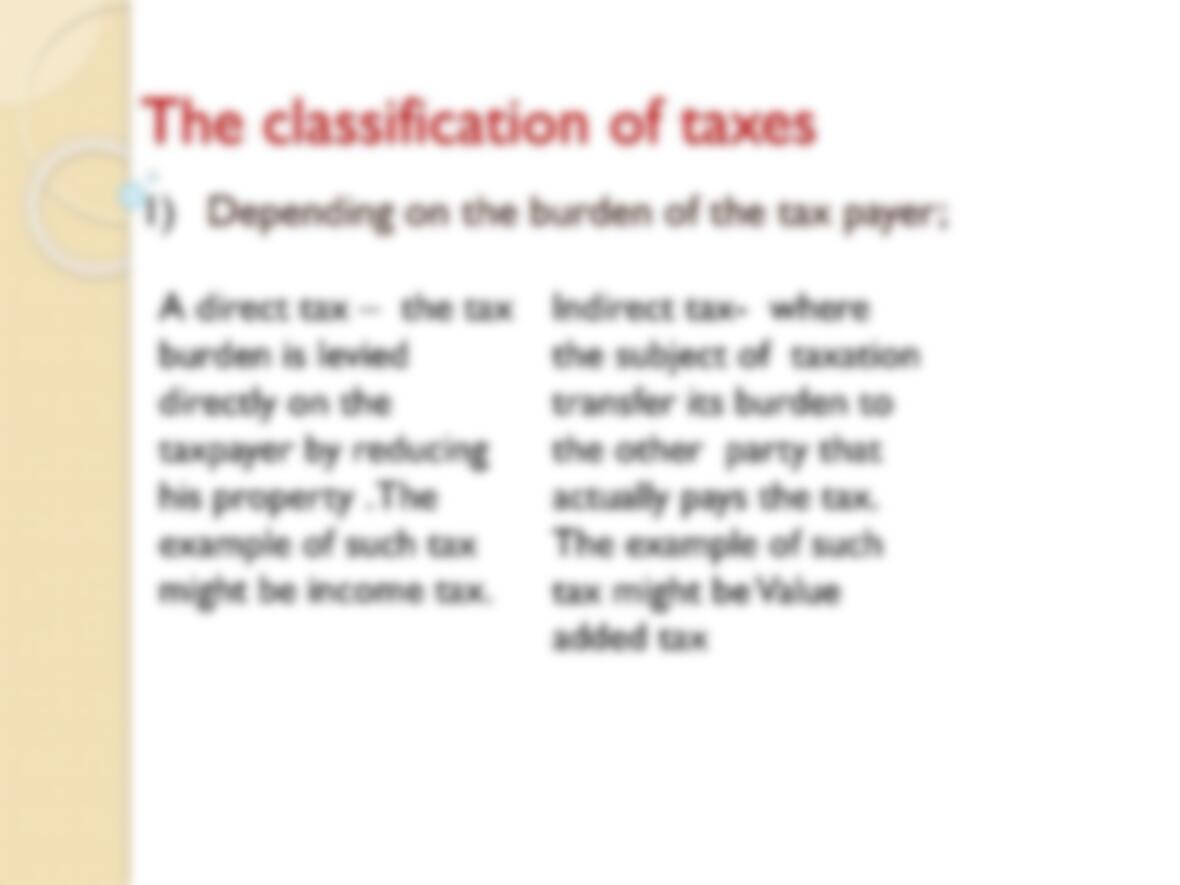
Income tax incidence
Government G imposes a new tax on corporate
business profits. A manufacturing corporation with
monopoly on a product in great demand by the
public responds to the new tax by increasing the
retail price at which it sells the product. In this case,
the corporation is nominally the taxpayer and must
remit the new tax to the government. The economic
burden of the tax falls on the corporation’s
customers who are indirectly paying the tax in the
form of a higher price for the same product.
The Relationship between Base, Rate,
and Revenue
Taxes are usually characterized by reference to their
base. A tax base is an item, occurrence, transaction,
or activity with respect to which a tax is levied. Tax
bases are usually expressed in monetary terms. For
instance, real property taxes are levied on the
ownership of land and buildings, and the dollar value
of the property is the tax base. When designing a tax,
governments try to identify tax bases that taxpayers
cannot easily avoid or conceal. In this respect, real
property is an excellent tax base because it cannot
be moved or hidden, and its ownership is a matter of
public record.
The Relationship between Base, Rate,
and Revenue
The amount of a tax is calculated by multiplying the
base by a tax rate, which is usually expressed as a
percentage. This relationship is expressed by the
following formula.