Calculus Lecture Notes Section 5.6 Page 1 of 4
Section 5.6 Exponential Functions as Mathematical Models
Example 1: The growth rate of the bacterium Escherichia coli, a common bacterium found in the human
intestine, is proportional to its size. Under ideal laboratory conditions, when this bacterium is grown in a
nutrient broth medium, the number of cells in a culture doubles approximately every 20 min.
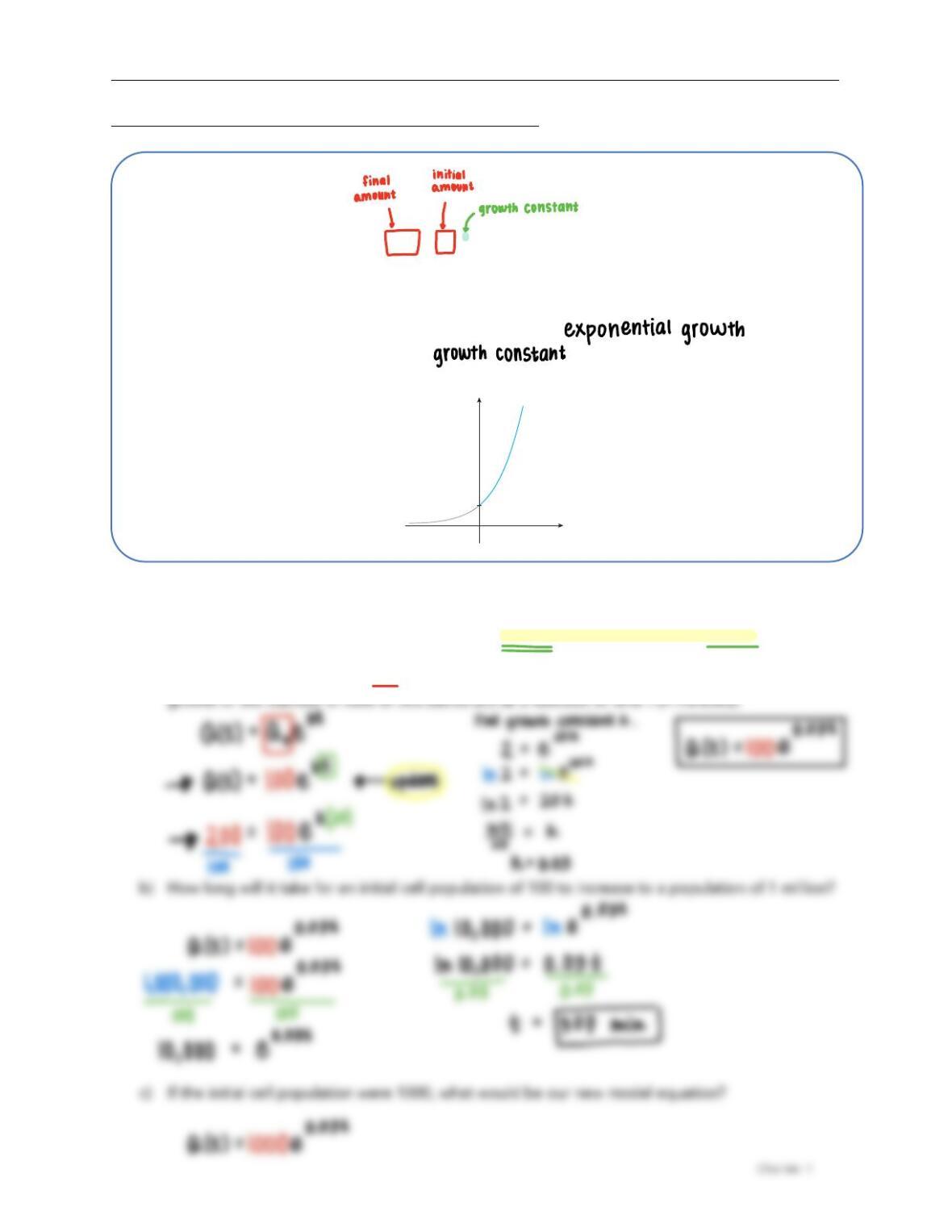
a) If the initial cell population is 100, determine the function Q(t) that expresses the exponential
EXPONENTIAL GROWTH
The exponential function
!(#)= !&‘()*********(0 ≤ # < ∞)
provides us with a mathematical model of a quantity Q(t) that is initially present in the amount
!(0)= !& and whose rate of growth at any time t is directly proportional to the amount of the
quantity present at time t. Such a quantity is said to exhibit ____________________________, and the
constant k of proportionality is called the ____________________________.
Exponential Growth
Many problems arising from practical situations can be described mathematically in
terms of exponential functions or functions closely related to the exponential function.
In this section, we look at some applications involving exponential functions from the
fields of the life and social sciences.
In Section 5.1, we saw that the exponential function f(x) !b
x
is an increasing
function when b“1. In particular, the function f(x) !e
x
shares this property. From
this result, one may deduce that the function Q(t) !Q
0
e
kt
, where Q
0
and kare posi-
tive constants, has the following properties:
1. Q(0) !Q
0
2. Q(t) increases “rapidly” without bound as tincreases without bound (Figure 13).
Property 1 follows from the computation
Q(0) !Q
0
e
0
!Q
0
Next, to study the rate of change of the function Q(t), we differentiate it with respect
to t, obtaining
Q ¿1t2!d
dt 1Q0 ek t2
380 5EXPONENTIAL AND LOGARITHMIC FUNCTIONS
Q
t
Q0
Q=Q0ekt
FIGURE 13
Exponential growth
5.6 Exponential Functions as Mathematical Models
87541_05_ch5_p329-396 1/23/08 10:26 AM Page 380
final initial
amount amount
Igrowth
constant
00
exponentialgrowth
growthconstant
87541_05_ch5_p329-396 12/19/07 10:08 AM Page 381
k!”
ln 124
1249
7!0.33
“7k!ln 124
1249
e“7k!124
1249