part five The Strategy and Structure of International Business15
©ITAR–TASS Photo Agency/Alamy Stock Photo
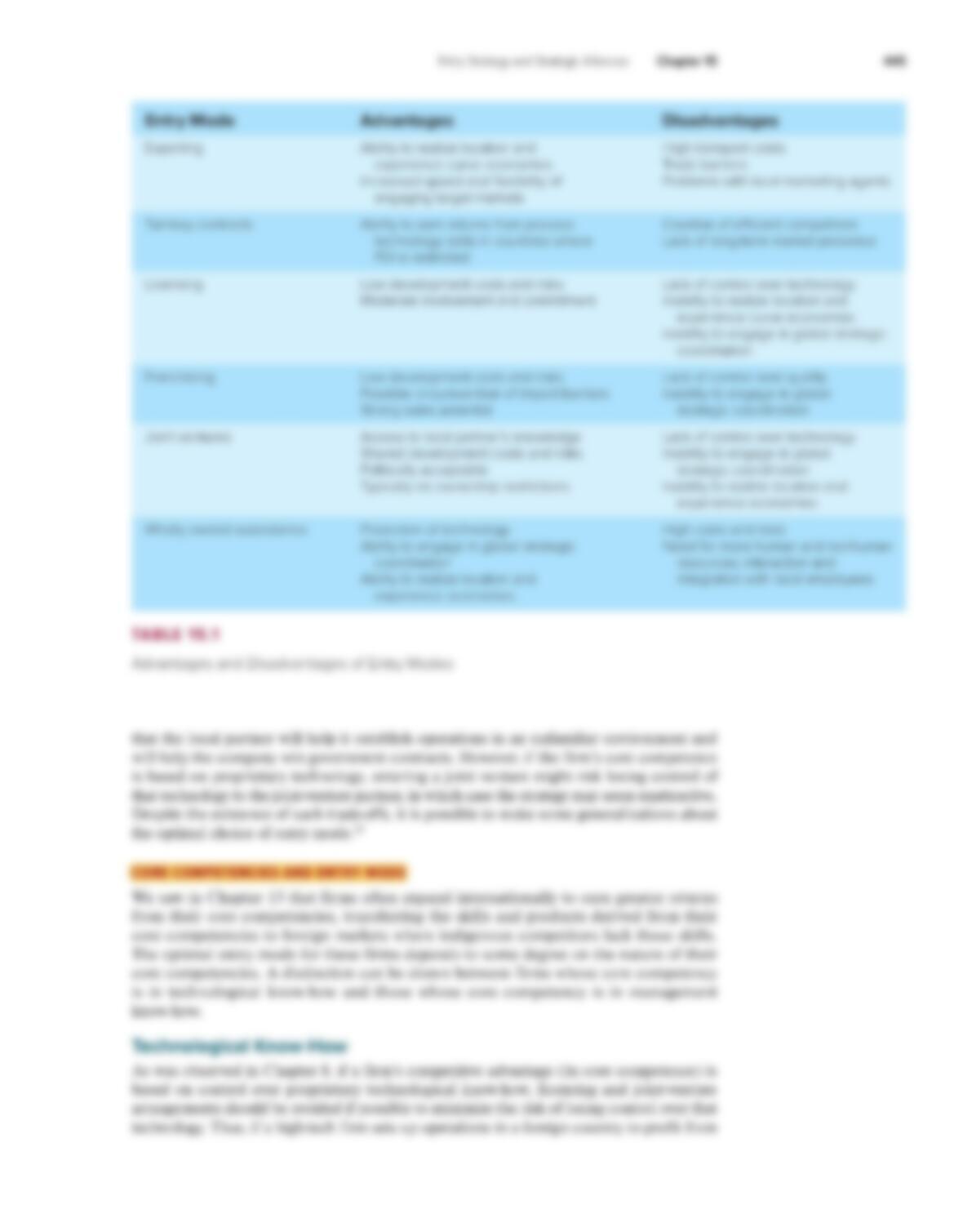
Entry Strategy and
Strategic Alliances
LEARNING OBJECTIVES
After reading this chapter, you will be able to:
LO15–1 Explain the three basic decisions firms must make when they decide on foreign expansion: which
markets to enter, when to enter those markets, and on what scale.
LO15-2 Compare the different modes firms use to enter foreign markets.
LO15-3 Identify the factors that influence a firm’s choice of entry mode.
LO15-4 Recognize the pros and cons of acquisitions versus greenfield ventures as an international market
entry strategy.
LO15-5 Evaluate the pros and cons of entering into strategic alliances when going international.

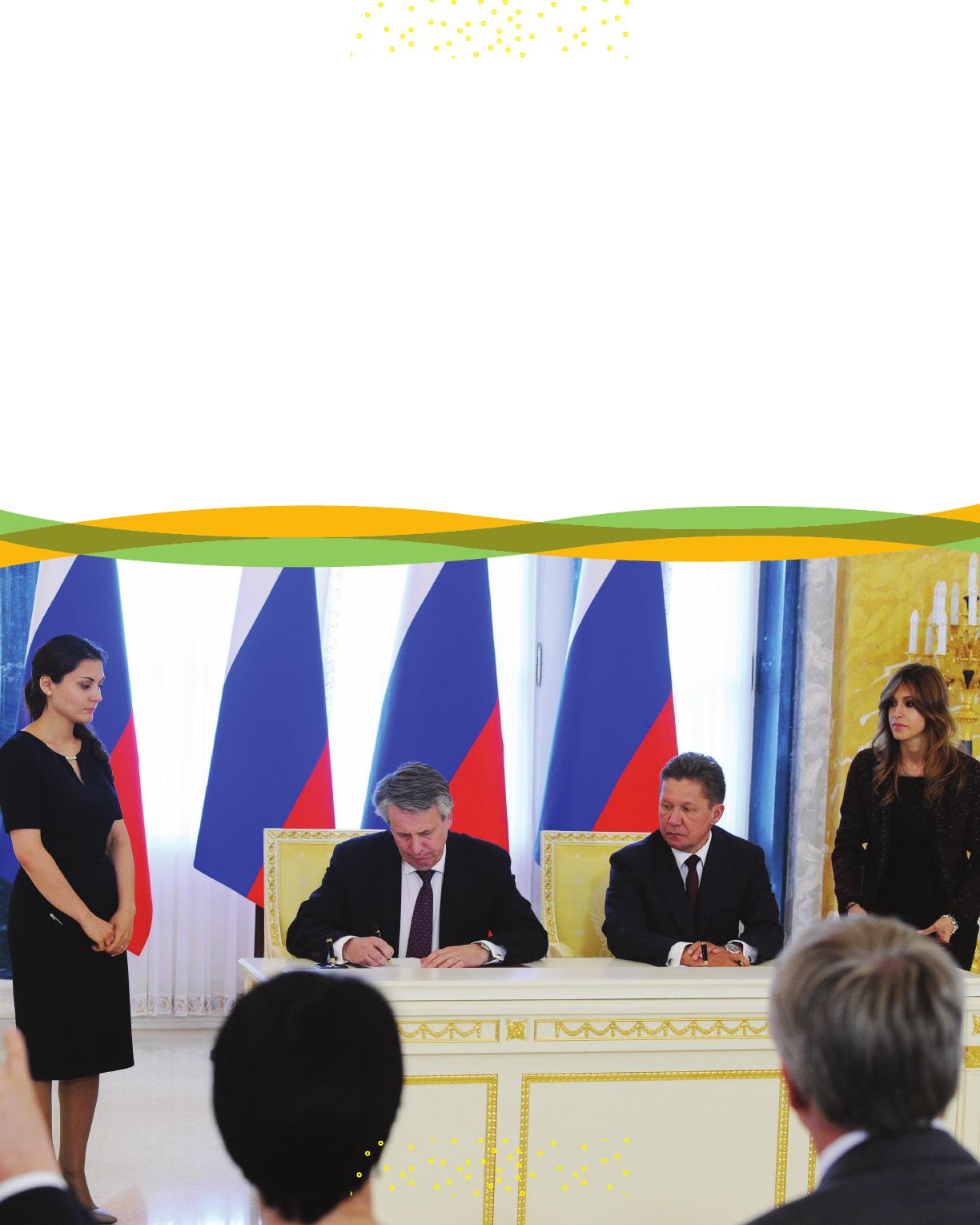
Gazprom and Global Strategic Alliances
credits to offset industrial activities, while Gazprom’s
trading arm in the United Kingdom could market any
excess credits.
Gazprom has also engaged in a strategic “arctic” alli–
ance with Lukoil, another Russian company. Lukoil is one
of Russia’s largest oil companies with about $150 billion
(U.S.) in annual sales. This alliance is more narrowly de–
fined than many others in that the two companies intend
to support each other in bids for offshore projects and,
by collaborating, counter the power of Rosneft. A key
part of the cooperation will unfold in the Barents Sea (a
sea of the Arctic Ocean, located off the northern coasts
of Norway and Russia). Interestingly, founded in 1993,
Rosneft is a $92 billion (U.S.) oil company that is also ma–
jority owned by the government of Russia. Gazprom and
Rosneft discussed a merger in 2005 that ultimately fell
through.
Gazprom has also entered into alliances with countries,
one such strategic alliance being with China. The Chinese
alliance came about as the Kremlin intensified efforts to
focus more on East Asia to offset some of the constraints
imposed on the company by Europe as a function of the
Ukrainian crisis, as well as its continued conflict with
Turkey. Consequently, Gazprom and China National Petro-
leum Corp (CNPC) signed an agreement on the
cross-border section of the Power of Siberia gas pipeline,
including the subwater link across the Amur River. The
deal also involves the “Eastern” gas pipeline route.
Sources: “Gazprom and Shell Committed to Broader Cooperation in
LNG Sector,” June 16, 2016, gazprom.com/press/news/2016/june/
article276698; Andrew E. Kramer, “Gazprom and Dow Chemical
Expand Emissions Alliance,” The New York Times, June 18, 2009; Atle
Staalesen, “Gazprom, Lukoil in Arctic Alliance,” Barents Observer,
May 20, 2015; Sergei Blagov, “Russia Seeks to Strengthen Energy
Alliance with China,” Asia Times, December 18, 2015.
OPENING CASE
Gazprom (gazprom.com) is a Russian company with head–
quarters in Moscow. It was founded in 1989 and is focused
on the business of extraction, production, and sale of petro–
leum, natural gas, and other petrochemicals. The company
name is a combination of the Russian words Gazovaya Pro–
myshlennost (Russian: газовая промышленность, mean–
ing “gas industry”). Gazprom has more than 400,000
employees, annual sales of ₽5.59 trillion rubles (roughly
$110 billion U.S. dollars), and with the Russian government
as the owner. However, Gazprom also has 55 subsidiaries in
which it has 100 percent ownership, 32 ventures with more
than 50 percent ownership, and 21 strategic alliances where
its share is less than 50 percent.
One of the strategic alliances that Gazprom has en–
gaged in is with Royal Dutch Shell—the $235 billion (U.S.)
company headquartered in The Hague, Netherlands, but
incorporated in the United Kingdom. From the vantage
point of Gazprom, the strategic alliance with Shell allows
the Russian gas giant to penetrate new markets. Addition-
ally, the Gazprom-Shell agreement makes the expansion
of the firms’ joint $20 billion liquefied natural gas plant on
the eastern island of Sakhalin (a Russian island in the
Pacific Ocean, north of Japan) come to fruition.
Another alliance in which Gazprom is involved is with
Dow Chemical Company—the $60 billion American
multinational chemical corporation headquartered in
Midland, Michigan, in the United States. The alliance
between Gazprom and Dow is to expand trading in car–
bon dioxide emission credits intended to slow climate
change. Gazprom agreed to look at opportunities where
Dow’s technologies could potentially be involved in
helping to reduce carbon emissions. The outcome would be
that Dow could then use some of the carbon emissions
431

432 Part 5 The Strategy and Structure of International Business
Introduction
This chapter is concerned with three closely related topics: (1) the decision of which for–
eign markets to enter, when to enter them, and on what scale; (2) the choice of entry
mode; and (3) the role of strategic alliances. Any firm contemplating foreign expansion
must first decide on which foreign market or markets to enter and the timing and scale of
entry. Oftentimes, small and medium-sized companies decide to enter one international
market at a time, while larger companies choose strategically one or more markets to
enter. For example, a large company could decide to enter all five Scandinavian countries
(Denmark, Finland, Iceland, Norway, and Sweden), or a subset of them, at the same time
since those countries are similar in makeup and customers’ needs and wants. Meanwhile,
most small and medium-sized enterprises (SMEs) would not undertake such an expansion
internationally due to cost constraints and market entry challenges.
For both large and SME companies, the choice of which international markets to enter
should be driven by an assessment of relative long-run growth and profit potential. Some
companies took this to mean that they needed to enter China, India, and other markets
with large populations. However, the entry decision is much deeper and should be thought
out more strategically with a focus on long-run growth and profit potential.
The choice of mode for entering a foreign market is another major issue with which interna–
tional businesses must wrestle. The various modes for serving foreign markets are exporting,
licensing, or franchising to host-country firms; establishing joint ventures with a host-country
firm; setting up a new wholly owned subsidiary in a host country to serve its market; and acquir–
ing an established enterprise in the host nation to serve that market. Each of these options has
advantages and disadvantages. The magnitude of the advantages and disadvantages associated
with each entry mode is determined by a number of factors, including logistics costs, trade bar–
riers, political risks, economic risks, business risks, costs, and firm strategy. The optimal entry
mode varies by situation, depending on these factors. Thus, whereas some firms may best serve
a given market by exporting, other firms may better serve the same market by setting up a new
wholly owned subsidiary or by acquiring an established enterprise.
The final topic of this chapter is strategic alliances. Strategic alliances are cooperative
agreements between potential or actual competitors. The term is often used to embrace a
variety of agreements between actual or potential competitors including cross-shareholding
deals, licensing arrangements, formal joint ventures, and informal cooperative arrangements.
The motives for entering strategic alliances are varied, but they often include market access,
hence the overlap with the topic of entry mode.
Gazprom, for example, has strategically put together a mixture of subsidiaries, joint ven–
tures, and strategic alliances to engage in the global marketplace. The Russian company, with
headquarters in Moscow, is focused on the business of extraction, production, and sale of
petroleum, natural gas, and other petrochemicals. In fulfilling its competitive objectives in
those areas, Gazprom engages in several of the mode of entry options that we discuss in this
chapter. For example, Gazprom has 55 subsidiaries in which it has 100 percent ownership,
32 ventures with more than 50 percent ownership, and 21 strategic alliances where their
share is less than 50 percent. This is a unique mixture of ownership and global engagement
to both manage and strategically leverage in the international marketplace. Some of the part–
nerships are with large and with very established companies such as Royal Dutch Shell (The
Netherlands) and Dow Chemical (United States) and others are with small and medium-
sized companies, including several companies from Gazprom’s home country of Russia.
Did You Know?
Did you know increasingly
more companies are “born
global”.
Visit your instructor’s
Connect® course and click on
your eBook or SmartBook®
to view a short video
explanation from the authors.
INTERACTIVE RANKINGS
Entering foreign markets is the focus ofChapter 15. The selection of country markets to
choose from is getting larger for many product categories as more countries see their popu–
lations’ growing purchasing power. With more than 200 countries in the world, the data are
overwhelming, and even the starting point for analysis is not always an easy decision. The

Entry Strategy and Strategic Alliances Chapter 15 433
Interactive Rankings on globalEDGE can serve as a great pictorial view of the world on some
50 important variables in categories covering the economy, energy, government,health,
infrastructure, labor, people, and trade and investment (globaledge.msu.edu/tools-and-
data/interactive-rankings). Active data maps such as the Interactive Rankings maps are a
good starting point for analysis to evaluate data for a specific country as well as the coun–
tries in a region. This allows for a focus on entry into one market now and a strategy for
expansion later on to nearby countries with similar characteristics. Which are the top three
countries for Internet users?
Basic Entry Decisions
A firm contemplating foreign expansion must make three basic decisions: which markets
to enter, when to enter those markets, and on what scale.1
WHICH FOREIGN MARKETS?
There are now 196 countries and more than 60 territories in the world, and they do not all
hold the same profit potential for a firm contemplating foreign expansion.2 Ultimately, the
choice must be based on an assessment of a nation’s long-run profit potential. This poten-
tial is a function of several factors, many of which we have studied in earlier chapters.
Chapters 2 and 3 looked in detail at the economic and political factors that influence the
potential attractiveness of a foreign market. The attractiveness of a country as a potential
market for an international business depends on balancing the benefits, costs, and risks
associated with doing business in that country.
Chapters 2 and 3 also noted that the long-run economic benefits of doing business in a
country are a function of factors such as the size of the market (in terms of demograph–
ics); the present wealth (purchasing power) of consumers in that market; and the likely
future wealth of consumers, which depends on economic growth rates. While some mar–
kets are very large when measured by number of consumers (the top six countries—all with
more than 200 million people—are China, India, the United States, Brazil, Indonesia, and
Pakistan), one must also look at living standards and economic growth. On this basis,
China and India, while relatively poor, are growing so rapidly that they are attractive tar–
gets for inward investment. Alternatively, weak growth in Indonesia implies that this popu–
lous nation is a far less attractive target for inward investment. And, while the economy of
Pakistan is the 25th largest in the world for purchasing power parity, many companies stay
away from Pakistan due to the political instability and risks.
As we saw in Chapters 2 and 3, likely future economic growth rates appear to be a func-
tion of a free market system and a country’s capacity for growth (which may be greater in
less developed nations). Also, the costs and risks associated with doing business in a for–
eign country are typically lower in economically advanced and politically stable demo–
cratic nations, and they are greater in less developed and politically unstable nations. That
said, the long-term stability in many developed European countries also means that they
have limited growth potential compared with higher-risk emerging countries. These issues
provide a confluence of factors that should be taken into account when deciding on which
foreign markets to enter.
The discussion in Chapters 2 and 3 suggests that, other things being equal, the benefit–
cost–risk trade-off is likely to be most favorable in politically stable developed and develop–
ing nations that have free market systems, and where there is not a dramatic upsurge in
either inflation rates or private-sector debt. The trade-off is likely to be least favorable in
politically unstable developing nations that operate with a mixed or command economy or
in developing nations where speculative financial bubbles have led to excess borrowing.
Another important factor is the value an international business can create in a foreign
market. This depends on the suitability of its products to that market and the nature of
indigenous competition.3 If the international business can offer a product that has not
LO 15–1
Explain the three basic
decisions firms must make
when they decide on foreign
expansion: which markets to
enter, when to enter those
markets, and on what scale.
MANAGEMENT FOCUS
stake in Global, a 43-store, state-owned grocery chain. By
2017, Tesco was the market leader in Hungary, with more
than 200 stores and additional openings planned, ac–
counting for 1 percent of the whole economy of Hungary!
A year after the Hungary expansion, Tesco acquired 31
stores in Poland from Stavia. The following year, in 1996,
Tesco added 13 stores that the company purchased from
Kmart in the Czech Republic and Slovakia; and the follow-
ing year it entered the Republic of Ireland. Tesco now has
more than 450 stores in Poland, some 80 stores in the
Tesco, founded in 1919 by Jack Cohen, is a British multina-
tional grocery and merchandise retailer. It is the largest
grocery retailer in the United Kingdom, with a 28 percent
share of the local market, and the second-largest retailer
in the world after Walmart measured by revenue. In 2017,
Tesco had sales of more than £62 billion ($70 billion U.S.
dollars), more than 480,000 employees, and 6,553 stores
in 13 countries.
In its home market of the United Kingdom (with a head-
quarters in Chestnut, Hertfordshire, England), the compa–
ny’s strengths are reputed to come from strong
competencies in marketing and store site selection, logis–
tics and inventory management, and its own label product
offerings. By the early 1990s, these competencies had al–
ready given the company a leading position in the United
Kingdom. Tesco was generating strong free cash flows,
and senior managers had to decide how to use that cash.
One strategy they settled on was overseas expansion.
As managers looked at international markets, they soon
concluded the best opportunities were not in established
markets, such as those in North America and western
Europe, where strong local competitors already existed,
but in the emerging markets of eastern Europe and Asia,
where there were few capable competitors but strong un-
derlying growth trends.Tesco’s first international foray was
into Hungary in 1995, when it acquired an initial 51 percent
Tesco’s International Growth Strategy
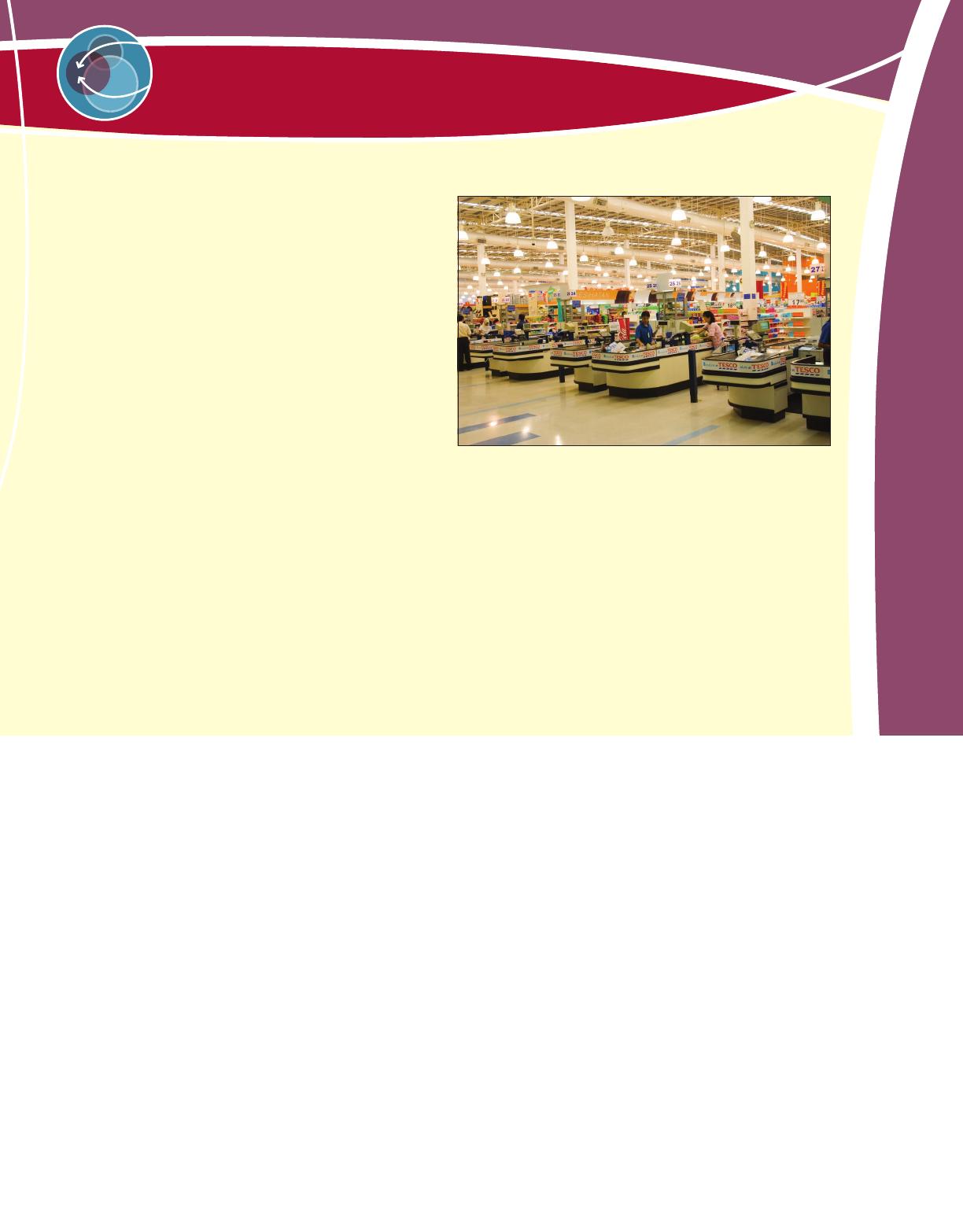
Checkout section of a large Tesco supermarket in Malaysia.
©Rob Walls/Alamy Stock Photo
been widely available in a market and that satisfies an unmet need, the value of that prod-
uct to consumers is likely to be much greater than if the international business simply of-
fers the same type of product that indigenous competitors and other foreign entrants are
already offering. Greater value translates into an ability to charge higher prices and/or to
build sales volume more rapidly. By considering such factors, a firm can rank countries in
terms of their attractiveness and long-run profit potential. Preference is then given to en–
tering markets that rank highly. For example, Tesco, the large British grocery chain, has
been aggressively expanding its foreign operations, primarily by focusing on emerging mar–
kets that lack strong indigenous competitors (see the accompanying Management Focus).
TIMING OF ENTRY
Once attractive markets have been identified, it is important to consider the timing of
entry. Entry is considered to be early when an international business enters a foreign mar–
ket before other foreign firms and late when it enters after other international businesses
have already established themselves in a market. The advantages frequently associated
with entering a market early are commonly known as first-mover advantages.4 One first-
mover advantage is the ability to preempt rivals and capture demand by establishing a
strong brand name and customer satisfaction. This desire has driven the rapid expansion
434

Czech Republic, more than 120 stores in Slovakia, and
more than 100 stores in Ireland.
Tesco’s Asian expansion began in 1998 in Thailand
when it purchased 75 percent of Lotus, a local food re–
tailer with 13 stores. Building on that base, Tesco had
more than 380 stores in Thailand by 2017. In 1999, the
company entered South Korea when it partnered with
Samsung to develop a chain of hypermarkets. This was
followed by entry into Taiwan in 2000, Malaysia in 2002,
Japan in 2003, and China in 2004. The move into China
came after three years of careful research and discus–
sions with potential partners. Like many other Western
companies, Tesco was attracted to the Chinese market by
its large size and rapid growth. In the end, Tesco settled
on a 50–50 joint venture with Hymall, a hypermarket
chain that is controlled by Ting Hsin, a Taiwanese group,
which had been operating in China for six years. In 2014,
Tesco combined its 131 stores in China in a joint venture
with the state-run China Resources Enterprise (CRE) and
its nearly 3,000 stores. Tesco owns 20 percent of the joint
venture.
As a result of these moves, by 2017 Tesco generated
sales of about $21 billion outside the United Kingdom (its
UK annual revenues were roughly $41 billion). The addition
of international stores has helped make Tesco the second-
largest company in the global grocery market behind only
Walmart (Tesco is also behind Carrefour of France if profits
are used). Of the three, however, Tesco may be the most
successful internationally. By 2017, all its foreign ventures
were making money.
In explaining the company’s success, Tesco’s managers
have detailed a number of important factors. First, the com–
pany devotes considerable attention to transferring its core
capabilities in retailing to its new ventures. At the same time, it
does not send in an army of expatriate managers to run local
operations, preferring to hire local managers and support
them with a few operational experts from the United Kingdom.
Second, the company believes that its partnering strategy in
Asia has been a great asset. Tesco has teamed up with good
companies that have a deep understanding of the markets in
which they are participating but that lack Tesco’s financial
strength and retailing capabilities. Consequently, both Tesco
and its partners have brought useful assets to the venture, in–
creasing the probability of success. As the venture becomes
established, Tesco has typically increased its ownership stake
in its partner. For example, by 2017 Tesco owned 100 percent
of Homeplus, its South Korean hypermarket chain, but when
the venture was established Tesco owned 51 percent. Third,
the company has focused on markets with good growth
potential but that lack strong indigenous competitors, which
provides Tesco with ripe ground for expansion.
Sources: Angela Monaghan, “Tesco Boss’s Bonus Cut Despite First
Sales Growth in Seven Years,” The Guardian, May 12, 2017; P. N. Child,
“Taking Tesco Global,” The McKenzie Quarterly3 (2002); H. Keers,
“Global Tesco Sets Out Its Stall in China,” Daily Telegraph, July 15,
2004, p. 31; K. Burgess, “Tesco Spends Pounds 140m on Chinese
Partnership,” Financial Times, July 15, 2004, p. 22; J. McTaggart,
“Industry Awaits Tesco Invasion,” Progressive Grocer, March 1, 2006,
pp. 8–10; Tesco’s annual reports, archived at www.tesco.com; “Tesco
Set to Push Ahead in the United States,” The Wall Street Journal,
October 6, 2010, p. 19.
435
by Tesco into developing nations (see the Management Focus). A second advantage is the
ability to build sales volume in that country and ride down the experience curve ahead of
rivals, giving the early entrant a cost advantage over later entrants. This cost advantage
may enable the early entrant to cut prices below that of later entrants, thereby driving
them out of the market. A third advantage is the ability of early entrants to create switch-
ing costs that tie customers into their products or services. Such switching costs make it
difficult for later entrants to win business.
There can also be disadvantages associated with entering a foreign market before other
international businesses. These are often referred to as first-mover disadvantages.5
These disadvantages may give rise to pioneering costs, costs that an early entrant has to
bear that a later entrant can avoid. Pioneering costs arise when the business system in a
foreign country is so different from that in a firm’s home market that the enterprise has to
devote considerable effort, time, and expense to learning the rules of the game. Pioneering
costs include the costs of business failure if the firm, due to its ignorance of the foreign
environment, makes major mistakes. A certain liability is associated with being a foreigner,
and this liability is greater for foreign firms that enter a national market early.6 Research
seems to confirm that the probability of survival increases if an international business
enters a national market after several other foreign firms have already done so.7 The late
entrant may benefit by observing and learning from the mistakes made by early entrants.
436 Part 5 The Strategy and Structure of International Business
Pioneering costs also include the costs of promoting and establishing a product offer–
ing, including the costs of educating customers. These can be significant when the product
being promoted is unfamiliar to local consumers. In contrast, later entrants may be able to
ride on an early entrant’s investments in learning and customer education by watching
how the early entrant proceeded in the market, by avoiding costly mistakes made by the
early entrant, and by exploiting the market potential created by the early entrant’s invest–
ments in customer education. For example, KFC introduced the Chinese to American-
style fast food, but a later entrant, McDonald’s, has capitalized on the market in China.
Similarly, FedEx had permits to operate in China some 10 years before it actually could
convince the Chinese customers its service was valuable relative to the shipping operations
already, at that time, available to them.
An early entrant may be put at a severe disadvantage, relative to a later entrant, if regula–
tions change in a way that diminishes the value of an early entrant’s investments. This is a
serious risk in many developing nations where the rules that govern business practices are
still evolving. Early entrants can find themselves at a disadvantage if a subsequent change
in regulations invalidates prior assumptions about the best business model for operating in
that country. Another potential disadvantage of being a pioneer in a country is the need to
educate customers about your company’s products, especially if those products have not
been available in that marketplace before (e.g., FedEx in China had no natural competitor
before UPS, DHL, and others joined the marketplace).
SCALE OF ENTRY AND STRATEGIC COMMITMENTS
Another issue that an international business needs to consider when contemplating market
entry is the scale of entry. Entering a market on a large scale involves the commitment of
significant resources and implies rapid entry. Consider the entry of the Dutch insurance
company ING into the U.S. insurance market. ING had to spend several billion dollars to
acquire its U.S. operations. Not all firms have the resources necessary to enter on a large