The Reindeer People 1
The Sami Culture
Daniel Bastos
Anthropology 1000
Professor Lee-Gorishiti
May 8, 2014

The Reindeer People 2
The Sami Culture
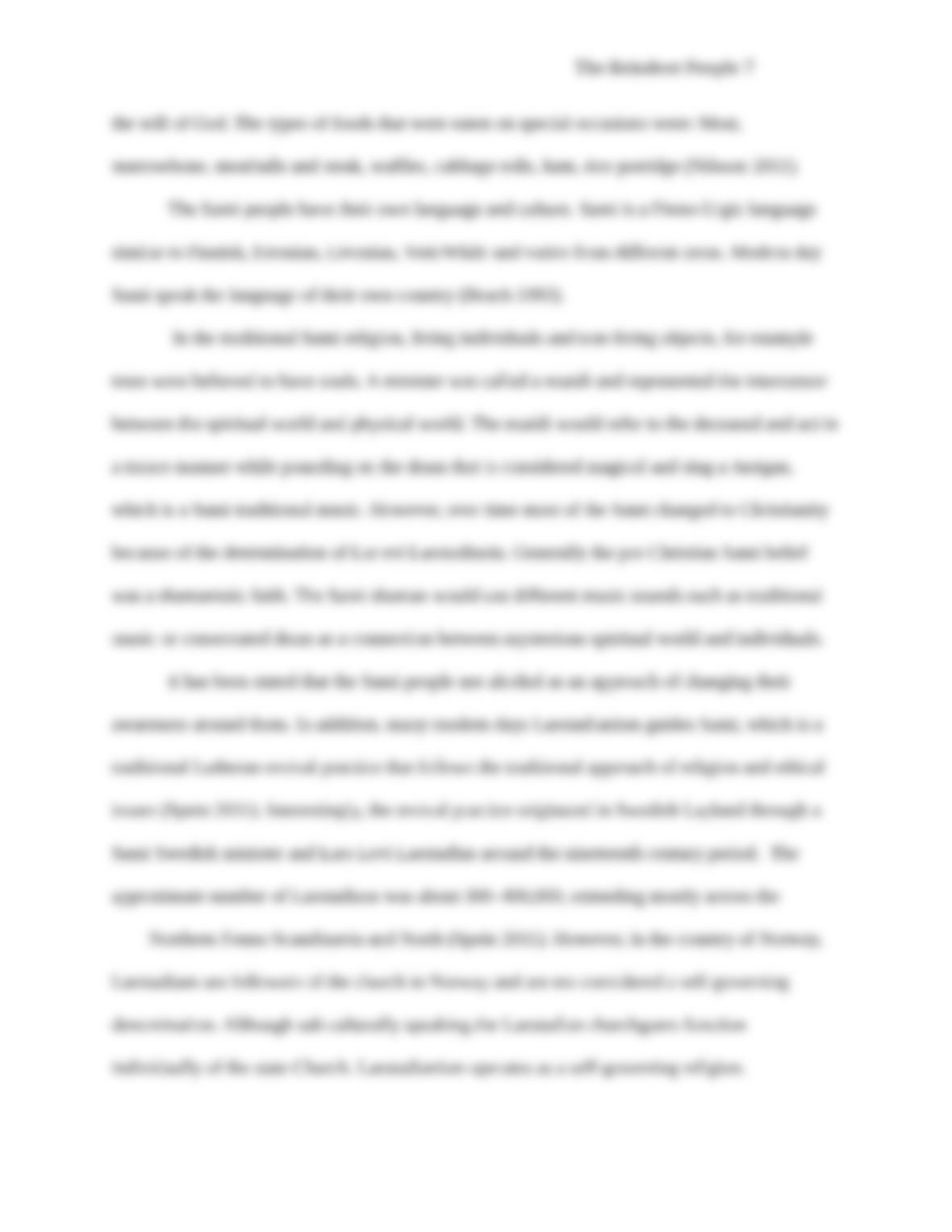
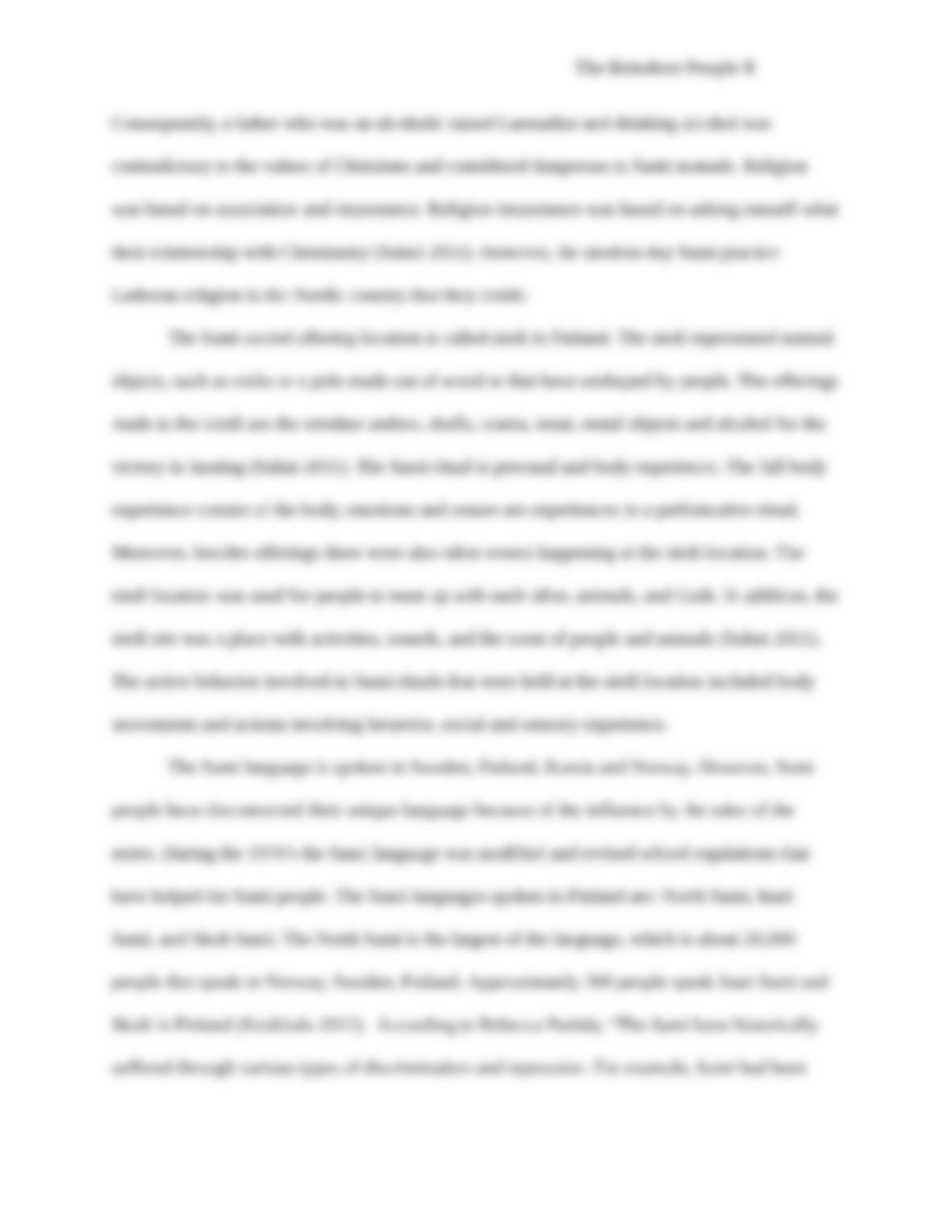
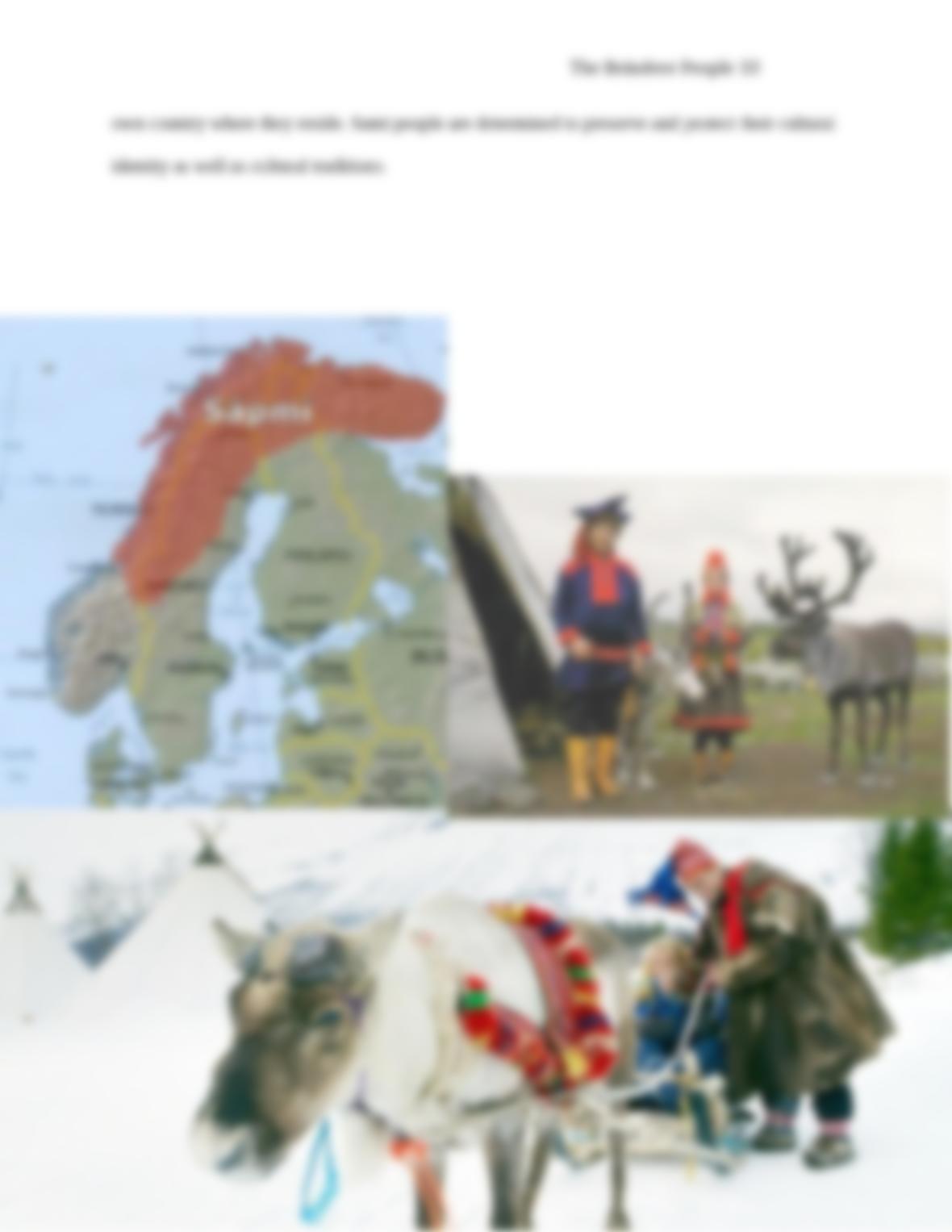
The Sami, commonly known as the “Reindeer people” are an indigenous group of people
living in northern Europe including Norway, Finland, Sweden, and Russia for at least 5,000
years. There are approximately 30,000 Sami people that live in Norway. However, this can be
double because of the uncertainty of the population due to cultural assimilation. Experts believe
the total population ranges from 80,000-100,000. The culture’s population is beginning to
dwindle because families are moving to different countries. The Sami descended from the
Komsa and trace as far as ten thousand years ago. The Sami are divided into three groups:
Coastal Sami, Mountain Sami, and Forest Sami. Throughout the years the Sami culture has
developed and expanded significantly. The culture’s food sources consisted of hunting, farming,
and gathering for thousands of years. Reindeer was the main target of the hunters, located in the
nearby land and fish, located in rivers. Sami people are a well-structured society, the siida being
the essential part. The siida was a community area that was near a river or lake. No more than
twelve families shared a siida and the seasons determined their different living areas. The
fishermen would permanently stay in an area that was near a river or lake and the hunters would
constantly move to different areas. The siida council made the decision of how the harvesting
would be for the year. The leader of the siida group was the eldest member and siida members
were able to speak to this person about problems as well. Today, many people from the Sami
culture do not live in siida groups since a lot of them aren’t reindeer herders and are living life as
normal Scandinavians.
After the Middle Ages, the supply of reindeer declined. Therefore, many families began
to hold the reindeers in their possession. There was no way that the siida had enough land for the
large group of herds. Every year the reindeer would travel from the inland plains to the end of the

The Reindeer People 3
coast. This caused the siida to diminish. Also, many countries such as Sweden, Norway, Finland,
and Russia played a major role in the decline of the siida. The Sami culture was pressured by
Norway in 1700. Norway attempted to “Norwegianize” the Sami people by utilizing school and
church (Norway Direct 2013).
The shift in climate of the Arctic affects the Sami reindeer herders because they rely on a
specific climate temperature. The affect of the climate change has an impact of the reindeer
because they eat lichen and the snow prevents the reindeer from eating their meals. The sun
causes sunburn in the beginning of the year. During the year, there are times of heavy rainfall
that last awhile. The extended summer bring many insects that can be a bother to the reindeer.
The harsh winter months are proven to be unsafe for Sami nomadic travel because the different
routes that are usually taken are covered with ice. A reindeer’s main source of food is typically
grazing, which is an herbivore that feeds on grass. The issue of reindeer eating is there are no
open areas for reindeers for graze because of the ice that covers the land. Therefore, the herders
need to transport the reindeer in a vehicle, which becomes costly. This is against the usual
traditions of Sami culture and is part of the reason for the population declining. The Sami herders
concerns are growing because some of the towns haven’t been able to migrate which can prevent
the younger generations from learning the skills needed to reindeer herd.
The Swedish government has shifted in changes towards the Sami culture. For example,
the policy of the government was to protect the Sami as being “primitive people” (Swedish
Institute 1999). An issue is the intention of protecting the Sami to adopt improving reindeer
breeding. “The Reindeer Husbandry Law,” imposed by the Swedish constitution, gives the Sami
people the right to independence to arrange their own cultures business. Only reindeer herders
have access to water and land as a result from this act. The Sami’s government is a parliament,

The Reindeer People 4
consisting of 39 representatives that are elected. The government meets four times during the
year for a weeklong at a time to discuss administrative work and planning. The government’s
main duty is to assure focus is on more employment for Sami culture, improving agriculture, and
fishing.
Sami culture has benefited from Monetary and trade systems. Trading in the Sami culture
can be traced back to the Viking Age, which was a popular era for trade. During the Viking Age,
the Sami people traded with Vikings and others from north western Europe. The contact that the
Sami culture had with people caused them to create a monetary system. The money was called
tjoervie. The cultural contact also impacted language. For instance, Sami borrowed words from
other countries and the countries were doing this as well to the people they were trading with.
The cultural contact that the Sami culture had allowed them to successfully trade. For example,
the Sami traded fur and many outside travelers were interested in their selling items. Effective
trading in the culture has allowed the Sami to be well-known merchants and craftsmen, for their
excellent work. However, trading would not have been possible if it wasn’t for the trade routes.
The open waters on the Norway coastline and the rivers in Finland and Sweden made trade
happen.
Stallo foundations, remains of houses, have been a popular topic that many scholars have
been arguing about. Excavations have discovered approximately 500 of these and the dwellings
occurred in the Scandinavian mountains. The huts fit about 2-5 people. The dispute is if they
belong to the Sami or the Norse. However, many scholars currently believe that they are from the
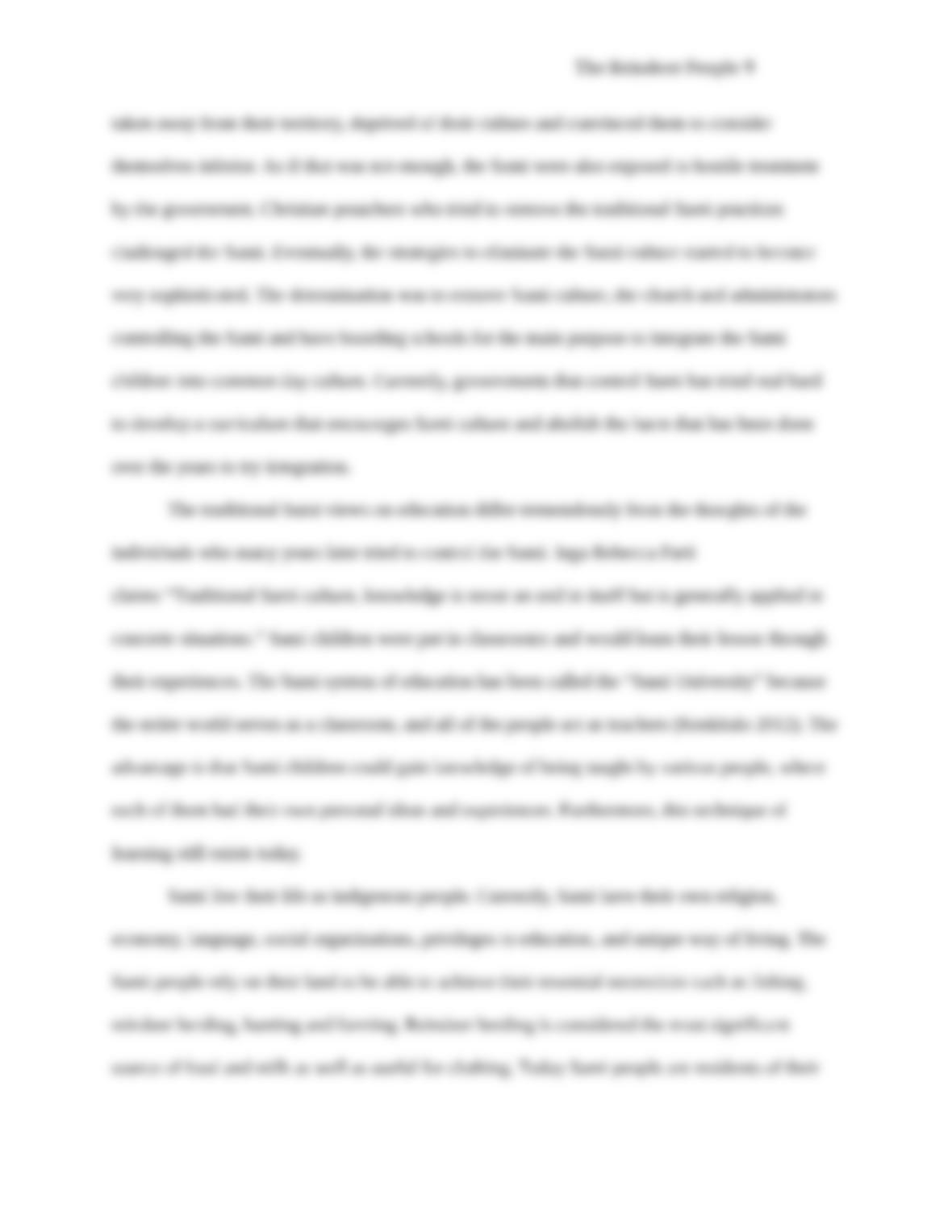
Sami. Today, Sami people mostly live in Lavvu, which is a simple house that can be moved at
any time. This type of dwelling is best for the reindeer herders since they can leave at any time.
Also, anyone can set it up since it requires not much effort. A benefit of using a Lavvu as a type

The Reindeer People 5
of home is its ability to handle strong winds. The traditional lavvu’s were built with a pine
framework for the summer months, and logs for the winter because of harsher conditions. During
the summer months, bark from a birch tree was used to cover the house and reindeer skin was
used in the winter since it was much colder.
Sami kinship is an important part of the culture. There is evidence that the Sami kept
track of their kinship and descent. The significance of age showing generations creates a mutual
and unique trait, however, age was not viewed as an important rank, and family relationships
mattered the most. The kinship system of the Sami pertained to two sides organized by
generations. There were particular kinship terms for each generation. The differences between
older and younger brothers, and eldest and younger sisters, were significant, as the distinction
between father and mother. These differences were linked to matrimonial responsibilities and it
is proven that levirate and sororate were practiced among the Sami. Levirate is when a brother is
expected to marry the widow and sororate is a man who has sexual relations with his wife’s
sister. Marriages were monogamous. Marriage through cousins occurred often and there were no
limitations as to whether first cousins could marry.
In the 1930s, women mainly did fishing and it later shifted to male only in 1950. “In one
interview, reflecting the 1950s, the mother did not fish at all” (Nilsson 2011). The Sami were
known for fishing and then selling it for profit. Gardening also played a role in Sami food
consumption. Campaigns encouraged people to garden and use the vegetables for cooking. Most
Sami people used farming and grew lettuce, carrots, and turnips. Potatoes were grown on small
islands to not be affected by frost. A Sami person remembers a time when his father invited
guests over one day for dinner and said, “Eat plenty of meat, we are short of potatoes” (Nilsson
2011).
The Reindeer People 6
The Sami people also pick berries and mushrooms as a food source. The wild berries that
they consume and store are cloudberries and lingonberries. The berries are stored in boxes and
the Sami would boil them with sugar before eating. On a good season the Sami would collect
about 60 kg and on not so good seasons they only collected 10 kg. Usually one parent is picking
the mushrooms. The parent has been trained to identify yellow chanters by the local hotel
manager (Nilsson 2011). It was common for women to prepare the meals since they remained at
home rather than men. A normal day schedule would be having coffee in the morning around 6