THE NEED FOR MICROFINANCE
Exercise
Suppose you are one of the households listed in the next slide. Create a poster with:
• A list of the household’s monthly inflows and outflows (with total inflows set equal to 100%).
• A list of probable extraordinary inflows and outflows.
• Which financial products do they need and/or use? Where do they find them?
Household 1
School‐teacher mother. Manager father. 2 children. Own their house
Inflows = father wage 60%, mother wage 35 %
Extraordinary inflows = airbnb 5%
Outflows = 15% taxes, 20% utilities, 30% groceries, oil/transport 15%, children 10%
Extraordinary outflows = house supplies, school supplies, car repairs 10%
Financial products = bank accounts or post office (to receive salary, money transfer), credit cards,
insurances, portfolio of investments
Household 2
Father: blue‐collar worker. Mother: housewife. 2 children. Home mortgage.
Inflows = father wage 70%, social income for family 10%, reddito di cittadinanza 20%
Extraordinary inflows = lotter win, increase in income
Outflows = home mortgage, groceries, taxes, children expenses
Extraordinary income = home mantainance, car accident
Financial products = bank account, car insurance, savings plan
The cost of living varies across countries and market exchange rates (used by banks) do not adequately
capture this fact. The UN created a conversion tool known as purchasing power parity (PPP) exchange
rates which tries to better account for the greater purchasing power in the industrialized countries than
market rates would imply. In 2005, PPP-adjusted dollars for Bangladesh was 2,88 meaning that with 1$
Bangladesh households could buy what it would take $2,88 to buy in the US.
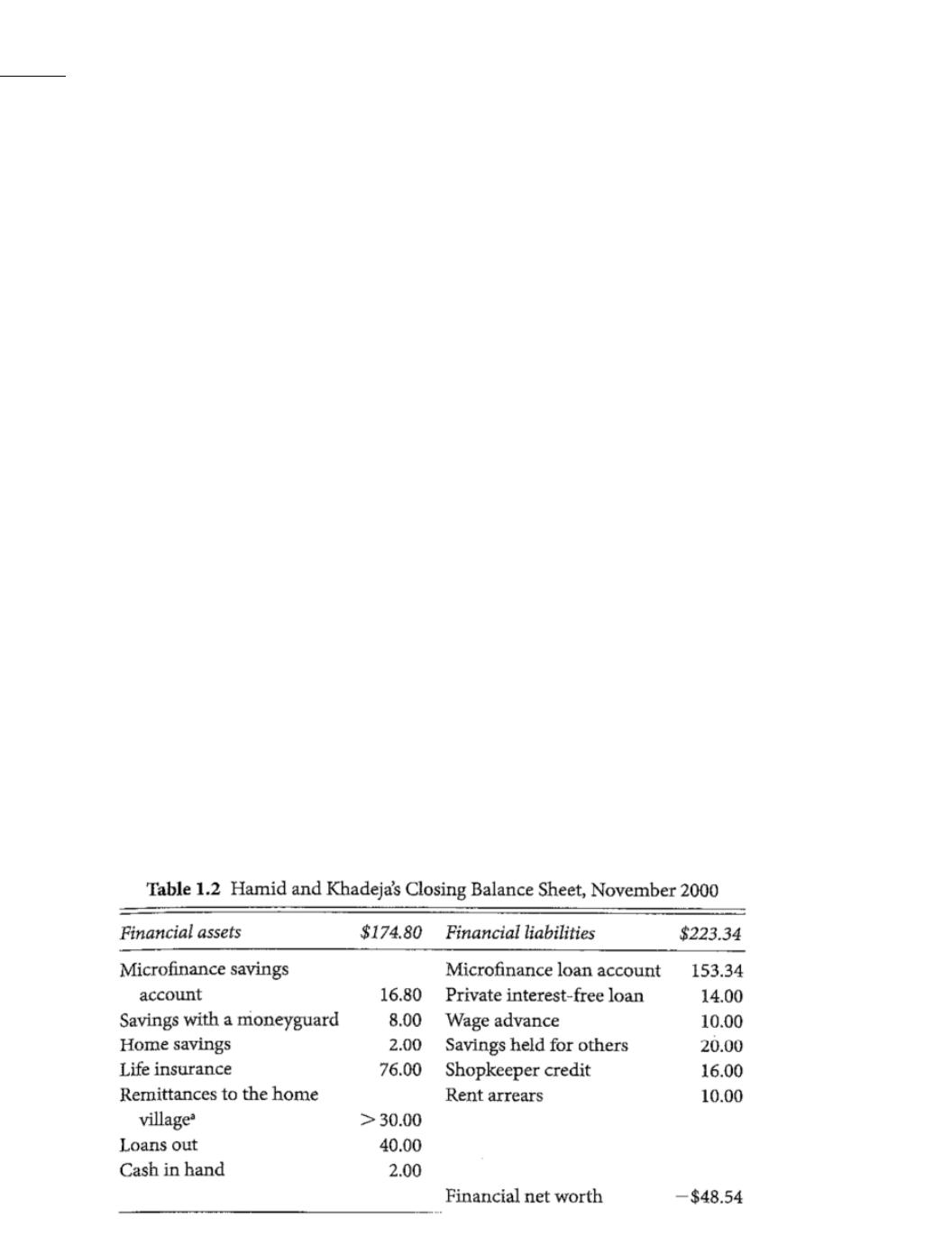
EXAMPLE OF A HOUSEHOLD BALANCE SHEET
Balance sheet of a Bangladeshi couple living with $70 monthly. This shows how low-income people manage
money.
Such balance sheet is quite varied since it comprises both formal financial instruments (transactions with
microfinance institutions) and informal financial instruments (transactions to other people like friends,
relatives, shopkeeper).
The idea is to understand how poor household deals with low income, showing that poor households did
not need only credit but also a series of other financial services.
Looking at liabilities, these are greater than assets. So, we have a negative financial net worth. Notice that
only the 3% of households studied in South Africa were in this position, so we do not have to assume that
poor households are always in debt.
– Microfinance loan account is the small-scale loan provided to low income households.
– A private interest-free loan must be a loan from a relative.
– Wage advance are short-term loans given to employees that are deducted later from future
salaries.
– Savings held for others is a debt coming from keeping your money safe at somebody’s else home
(a kind of bank deposit but not at a bank, it is common among low income people).
– Shopkeeper credit comes from delaying payments.
– Rent arrears are the money rent that is owed and should have been paid earlier.
Looking at assets, we can notice they are quite varied.
– A microfinance savings account corresponds to savings deposited at a microfinance institution.
– Remittances to the home village are sums of money sent by someone working abroad to his or her
family back home (remittances represent one of the largest sources of income for people in low-
income and developing nations).
– Loans out come from the fact that if a party takes out a loan (obtaining money from a microfinance
institution), they receive cash, which is a current asset.
We learn that income can be large/small (amount), regular/irregular (frequency), certain or uncertain.
If your income is small, irregular and uncertain, “just getting food on the table is hard to manage out of the
current income”. Managing other expenses out of current income is next to impossible. Either you do
without it, or you sell assets (provided you have assets and there is someone willing to buy from you), or
you use past income, savings, or future income, borrow a sum and pay it with future income.
You can fund these expenses with the help of a microfinance institutions. The uncertainty of income makes
the need for financial services even stronger. The need of holding reserves or to borrow is greater if there
are more chances that the income fails to arrive → VULNERABILITY
This is why poor households have a collection of relationships and transactions with family, friends and a
set of informal financial providers described as portfolio.
There are 3 needs driving financial activity of the poor households:
1. Managing basics: cash‐flow management to transform irregular income flows into a dependable
resource to meet daily needs, to do regular expenses; households want to smooth consumption to
be able to consume every week or every month regardless of monthly, daily or year income
➢ Daily expenses
2. Coping with risk: dealing with the emergencies that can derail families with little in reserve.
Poor households live uncertain lives: the security in their towns might be weak and swings in supply
and demand might be recurrent. Think of Bangladesh, where slums can be cleared out or India,
where a short or late rainy season might make crops fail.
➢ Emergencies
3. Raising lump sums: need to accumulate usefully large sums of money to seize opportunities, such
as buying a house, having a child, making children going to school. Save to improve life conditions.
➢ Life-cycle needs
➢ Opportunities
FINANCE AND VULNERABILITY
In addition to daily expenses, the low-income households need to spend large sums of money for:
➢ Life‐cycle needs ‐ marriage, funerals, childbirth, education, home‐building, widowhood and old‐age
generally
➢ Opportunities – to invest in an existing or new business, to buy land or other productive assets, a
bribe to get a permanent job (often in government service), items that make life more comfortable
(better roofing, better furniture, a fan, a TV).
➢ Emergencies ‐ they are vulnerable to shocks (physical, economic, and natural) making them suffer
the sudden and unpredictable need for more cash to solve this shocks.
Some assets help reduce vulnerability to shocks: human (personal attitudes, health, skills),
physical, social and financial assets (loans, savings, insurance). Clearly, the more money you have,
the more the opportunities to cope with economic shocks.
However, low-income people are subject to FINANCIAL EXCLUSION.
DIMINISHING RETURNS PRINCIPLE AND RISK OF INVESTMENT
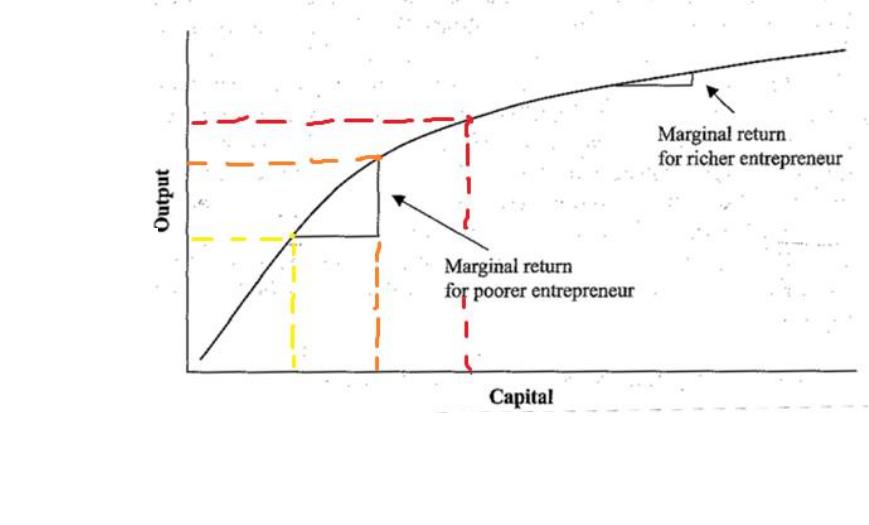
A certain amount of capital invested (x) results in a certain amount of output (y) (higher the capital, the
bigger the enterprise) . Looking at the returns, we have that the function is concave: the incremental
output for every unit of output is smaller and smaller as the investment in productive activity increases.
Where the amount of capital is very high, every additional dollar invested generates a smaller and smaller
marginal return.
The right-end side situation refers to richer entrepreneur, relatively larger enterprisers generate relatively
smaller incremental outputs (marginal return for richer entrepreneur)
The left-end side situation corresponds to what happens to low income entrepreneurs: they hold small
capital which results in a great output (marginal return for smaller entrepreneur). The increasing output
allow them to pay back loans: in the example, if the sewing machine and electric scissors were bought
through a loan, the resulting output would allow the entrepreneur to pay back it. The poorer entrepreneur
would be willing to pay a higher interest rate than the richer because his return is higher for each dollar
invested. Following this reasoning the capital should flow from rich to poor borrowers and from rich to
1 dresses/week
+2 dresses/week
+1 dress/week
+100$
investment
(sewing
machine)
+100$
investment
(electric
scissors)
100$
investment

poor countries since poorer borrowers are more able to repay loans according to incremental gains than
rich entrepreneurs.
In the reality this does not happen (capital does not flow to poor countries or poor borrowers although
they would be able to repay their loans) because of barriers that affect financial markets.
Because banks have incomplete information about poor borrowers (no balance sheet, no registered
business, no credit history) and thus cannot assess the additional quantity of output that will be
produced/they cannot assess whether the borrower is running a good or bad business. Conversely, banks
need to estimate future cash flows and determine which customers are likely to be more risky or more
profitable than others. In this situation, where there is the need to evaluate unformal information on a
large number of small borrowers, gathering this information would require high transaction costs →
problem of SCREENING/SELECTION EX ANTE
Together with this, since these borrowers are low-income and requires small investments (small loans), also
the interest rate they should pay will be low and this won’t repay banks of the high transaction costs. This
imply that banks might accept to give a loan but at a very high interest rate which could cover the
transaction costs and the potential risks. Such a high interest rate drives safe customers out of the credit
markets and banks find themselves to make loans only to risky borrowers → ADVERSE SELECTION
→ Banks are aware of this phenomenon, they cannot monitor the borrower after making the loan (other
costs), so they are not willing to lend to informal small borrowers → MARKET FAILURE
→ Mainstream market banks propose small borrowers to offer a collateral (asset as a security for the
loan), but poor borrowers do not have any → AGAIN MARKET FAILURE
Everything depends on the lack of information. Information would avoid the market failure!!
→FINANCIAL EXCLUSION
The lack of formal information for low-income people and the consequent adverse selection and market
failure lead to financial exclusion: the poor entrepreneur is excluded from the mainstream financial system.
DEFINITIONS
In-out approach: Financial exclusion involves the “processes that serve to prevent certain social groups
and individuals from gaining access to the financial system”.
European Commission: Financial exclusion refers to a process whereby people encounter difficulties
accessing and/or using financial services and products in the mainstream market that are appropriate to
their needs and enable them to lead a normal life in the society in which they belong.
Widest approach: Financial exclusion is defined as the process whereby people face such financial
difficulties of access or use that they cannot lead a normal life in the society to which they belong.
The Global Findex survey, conducted every three years, measures financial exclusion according to the
number of people having an account.
CAUSES
A number of dimensions (causes) of financial exclusion can be identified:
➢ geographical exclusion: when the potential customer (they might access) lives far from financial
institutions and/or find it difficult to reach them, problem particularly prominent in rural areas;
➢ access exclusion: restricted access via the processes of risk assessment (failing because of lack of
info or because risk is considered high);
➢ condition exclusion: where the conditions attached to financial products make them unsuitable for
the needs of some people; for example, some banks might require a minimum balance to start a

deposit; another example regards borrowers doing seasonal activities, if the loan does not allow a
seasonal repayment, that financial product can’t be accessed
➢ price exclusion: where some people can only access financial products at prices (fees and interest
rates) they cannot afford;
➢ marketing exclusion: where some people are effectively excluded by targeted marketing and sales;
➢ self‐exclusion: people decide that there is no point in applying for a financial product because they
believe that they would be refused. These beliefs can arise from many experiences and
perceptions.
This form of exclusion is spread also in high-income countries, where financial products and
institutions are very spread, but these people believe services do not meet their needs.
SOLUTIONS TO MARKET FAILURES (developing countries)
Poor borrowers without assets as collateral do not access the traditional credit market.
Poor borrowers need funds to run small businesses and to cope with their daily needs. What alternatives?
➢ Moneylenders (private people that lend money to other private people)
➢ Neighbours, relatives, local traders…
➢ Government‐led development banks
➢ Microfinance institutions (NGOs, non-banking financial institutions, credit unions, specialize banks)
Microfinance institutions are relatively new. Government-led development banks were the first attempt to
give credit to low-income people.
Financial assets are very important and there have been several attempts to solve the problem. What
microfinance is today depends on what didn’t work in the past. For example, after the second world war, in
countries such India and the Philippines, there was an attempt to solve the problem with state agricultural
banks: helping rural areas by giving their responsibility for allocating funds to small farmers in rural areas.
STATE-OWNED AGRICULTURAL BANKS
In the 1960s,70s the main government targeted sector was agriculture. To this purpose, agricultural banks
were created to provide funds to invest in new techniques, fertilizers etc. in agricultural and rural areas,
areas which were difficult to reach by commercial banks.
Loans made to farmers are really risky due to the fact that the output is uncertain. High transaction costs
due to the fact that they are difficult to risk →THE FAILURE OF STATE OWNED DEVELOPMENT BANKS
The problem with state agricultural banks was that being state banks, they were heavily subsidized by the
government: subsidy is a benefit given to an individual, business, or institution, usually by the government,
typically given to remove some type of burden, and it is often considered to be in the overall interest of the
public, given to promote a social good or an economic policy.
In this case, subsides to banks were government funds (parts of loans cost were paid by the government)
to compensate for high risk and high transaction costs related to loans. In rural areas operations are very
expensive: if the aim of these rural banks was to reach all the potential borrowers, the need was that of
setting several branches in different rural areas → Setting all those branches was very expensive, as well as
agricultural loans (it is difficult, risky, thus expensive, to assess the activity, seasonality, future cash flows
etc).
Subsidies necessary because loans to low-income people are risky and expensive, but subsidies create
distortions:
➢ Subsidized credit to borrowers: credit provided on terms below normal market rates (low interest
rate, negative real interest rate), credit that may be granted to encourage particular forms of
activity, including the growth of entrepreneurship among minority groups.

To understand, interest rates were at 16%, but inflation rate at 20%, so the real interest rate was
negative (not enough to compensate for the inflation) → high demand by borrowers for these
loans due to the low interest rates → subsides were supposed to repay where interest rate income
was not enough to cover expenses → Disadvantage for banks since banks receive 16% interest rate
while inflation rate was at 20% → if the interest received is lower than the rate of inflation, the
value of an investment will diminish over time
➢ Credit often allocated on the basis of politics or social concerns (no problem for banks with low
repayment rates) → credit not allocated to the most efficient entrepreneurs
To understand, when elections were approaching there was the tendency to incorrectly allocate
funds: the banks tended to save on some residents or some subjects to forgive loans (if a loan is not
repaid there is no consequence; the loan can be rescheduled) → the aim of state banks was that of
fostering the rural development but this could not happen if you do not lend to the most efficient
entrepreneurs
➢ Banks received subsides so they were not pressed to achieve efficiency
➢ Negative real interest rates on deposits (e.g. 6% against 20% inflation) → no incentive for farmers
to deposit in this banks → if the interest received is lower than the rate of inflation, the value of an
investment will diminish over time → As such, storing cash might incur a fee rather than earning
interest, which means that consumers have to pay interest in order to deposit money into an
account.
Some questions arise from the experience of state development banks (no right answers):
What is the role of subsidies in microfinance?
1. Which is the “right” interest rate? A rate lower than the market rate? A higher rate? The rate that
covers the costs of the institution? The rate affordable for the poorest clients?
2. Is there a trade‐off between efficiency of the financial institution and its social impact?
Obviously, if a financial institution targets the poorest, these are less profitable, riskier, they involve
more transaction costs. In the meantime, targeting the poorest is committing to improve social impact.
So, shall we target the poorest even with more subsides and less efficiency or shall we prefer less
subsides, more efficiency but less social impacts?
THE FIRST MICROFINANCE INSTITUTION
Grameen Bank is the first example of microfinance institution.
Prof. Muhammad Yunus found out, through a concave production function, that low-income entrepreneurs
only need the starting capital to set up their business and then they would be able to repay the loan
although they cannot give any collateral to the loan. At that time, 80% of the population in Bangladesh was
living in poverty, so it was a huge problem.
So, in 1976 he started a pilot program in Bangladesh. He started lending his own money. Then convinced
the Bangladesh Bank to set up a special branch to lend to poor borrowers (beginning of Grameen Bank).
The original idea was:
➢ Group lending (no individual) → five poor borrowers who were guarantor for each other, that is
joint liability: if one of the people of the group defaults, not able to repay, other people of the
group pay on his behalf (he replaced collateral with joint liability) → group lending to overcome
the problem of collateral and guarantees, monitoring problem etc
➢ Dynamic incentives, meaning increasing loan size → the loan was given and repaid weekly and
every time the amount of the loan increased so that people are incentivized to repay; repayments
were made in public and focused on women
But this lending mechanism did not work so well, so it evolved. Today Grameen Bank makes essentially
individual loans, the group still exist but just to foster discipline, not for joint liability.
Some questions arise from the example of Grameen Bank:
1. Are there different types of group lending? What are the advantages and the disadvantages of group
lending?
2. How can microfinance mechanisms enforce repayment? How to measure the repayment rate?
3. Who are the target clients of microfinance institutions? Why does gender matter?
4. Are financial institutions viable? What is the role of subsidies?