Pellkofer 1
Molly Pellkofer
Prof. Braman
GEW 101
12/816
Industrial Disaster
The priorities of the food industry has shifted over the past century by putting profit first,
and consumers last. Although there are many moving parts connected to the food industry, the
meat industry has become the most corrupt. When McDonalds first started business in the
1940’s, it had a big influence on how the meat industry would operate. McDonalds and other fast
food companies are the largest consumers in meat, which means they control how the meat is
produced. Big corporations have bought out other companies, which allows them to control the
whole meat industry. In fact, the meat industry is controlled by about four or five companies.
Today consumers often don’t know what is in their food, or how it is produced. They are
deceived by labels that say “Farm Fresh” and “All Natural”. Our definition of a farm is grazing
animals on an open range of green grass, but this is quite the opposite in terms of the food
industry. Animals are raised in CAFO’s (concentrated animal feeding operation) where they
never see open ranges of green grass, and may never even see sunlight. CAFO’s are not only
harmful to animals, they are harmful to the environment as well. The waste from the animals
sometimes runs off into local rivers contaminating the water, and putting the local residents at
risk. The government is highly at fault as well. There are constantly new laws put into place
preventing the big corporations that control the food industry from being regulated, and the
people who put these laws in place used to be at the head of those corporations. There is a lot of
change that needs to happen in the food industry, and the best solution is to go back to the
original way of farming. Logic agrees, but the reality is this won’t happen because corporations
Pellkofer 2
put profit before health. In Michael Pollan’s book In Defense of Food, he states that “Our Food
System has long devoted its energies to increasing yields and selling food as cheaply as possible”
(118). The mentally of the food industry has shifted from selling healthy food for consumers, to
making food in the cheapest way possible and selling it at a cheaper price. In order to improve
the conditions and priorities of the meat industry, consumers must become more aware of what is
going on and become more responsible about the ways they consume food.
One thing most consumers aren’t aware of is how McDonald’s changed the way the food
industry operated. They conducted business known as the food assembly line, teaching its
employees how to make the same item the same way for every person who orders it. As
McDonald’s started to grow it became the leading purchaser in meat, lettuce, tomatoes, and
potatoes. Because they purchased the most meat, they began to control how the meat was
produced. According to Dr. Drew Leder, philosophy professor at Loyola College, they wanted to
“monopolize the supply, and wanted a uniform product” (“Old McDonald’s Had a Farm: The
Metaphysics of Factory Farming” 74). They wanted a hamburger to taste the same whether it
was made in California or New York. In order to achieve a more uniform hamburger they made
one farm/farmer their sole provider of meat so all the meat would be the same. Since McDonalds
required such a large amount of meat, the farm they got their meat from started to buy out other
farms in order to meet McDonald’s mass quota. Other fast food restaurants such as Burger King,
Wendy’s, and Jack in the Box started to follow suit. This is why today there are only about four
or five big companies that control the industry, thus, resulting in a monopolization of the meat
industry. If only four or five companies control the whole market, it is easier for them to control
what laws and regulations are put in place, and other farms/farmers. McDonalds also had an
impact on the amount of meat consumers began to eat.
Pellkofer 3
During the 1970’s the consumption and production of meat by Americans had
skyrocketed compared to what was previously consumed. According to Paul Solotaroff’s article
featured in the Rolling Stones, “Animal Cruelty Is the Price We Pay for Cheap Meat”, the U.S.’s
total consumption of meat had risen from about 15 billion pounds in 1940 to about 45 billion
pounds in 1970. And our consumption still continues to grow today. Because of the growing
numbers of meat consumption, the original farming methods were unable to supply the needed
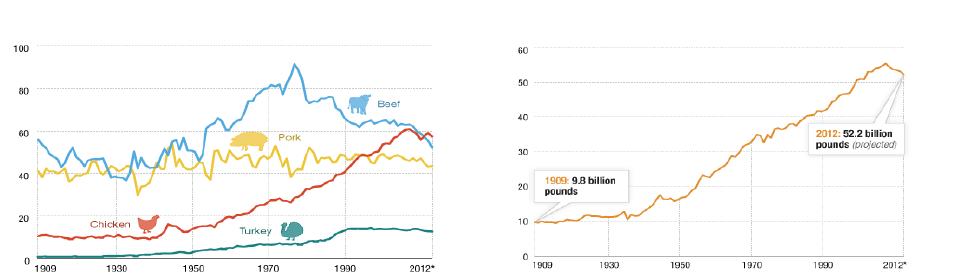
demand for consumers. In 1950 the average person ate around 50 pounds of beef, and in 1970
that number rose to 80 pounds of beef per person. Today the average person eats around 270
pounds of beef (Solotaroff). The graph below on the left shows the U.S.’s total meat
consumption per person over the past 100 years. As you can see, the consumption of meat,
mostly beef and chicken, didn’t start to increase until about the 1950’s, around the time when
McDonald’s started to monopolize the industry. Before the consumption of meat started to
increase in the 1950’s, meat was only eaten as a side dish. Today it is used as the main course,
and the portions are much larger than they used. The average piece of meat used to be about the
size of ones fist, but today the normal size of a piece of meat is generally about the size on your
plate. The graph below on the right shows the U.S.’s total meat consumption in pounds. Like the
graph on the left, meat consumption didn’t start to increase until about the 1950’s, and has
continued to increase every year until about 2010, where you can see a slight decrease in
consumption. Today we are consuming far more meat than is necessary for a healthy diet. Just
because meat has become cheaper and more accessible doesn’t mean we should be consuming
more than is necessary.
U.S. Total Meat Consumption, in billion pounds
U.S. Total Meat Consumption per Person, in pounds
Pellkofer 4
The rise in meat consumption caused a transition in the way it was produced. The typical
“original farming” was replaced with a new type of farming which is known as “factory
farming”. Dr. Drew defines factory farming by stating “Factory farms operate to join and swing
together farm and factory: agrarian and industrial; human, animal, architectural, and mechanical;
they are designed to maximize large-scale, efficient, and highly profitable food production.”
(“Old McDonald’s Had a Farm: The Metaphysics of Factory Farming” 74). The high demand in
meat needed by fast food restaurants such as McDonald’s is precisely why factory farms
originated. Although factory farms may be more efficient there are many risks and downsides to
industrialized farming that has been adopted by the food industry.
Factory farming has had a significant, negative effect on animals, the environment, and
the workers. The lives of animals have shifted to grazing in open fields to being held in