Introduction
In Malaysia, education is one of the most important roles to fulfill the vision of every Malaysian
citizen. From here, through education, it can produce positive outcomes for children and
contribute to the development of the whole country. In October 2011, the Ministry of Education
launched the Malaysian Education Blueprint to prepare Malaysian children for the demands of
an information-rich country in the 21st century. Malaysia has released its first work, Education
Blueprint for Malaysia 2013-2025, which is dedicated to education reform in Malaysia.
For the Malaysian Education Blueprint, Malaysia was built on a number of studies and
collaborations with local and international agencies and parents. From here, the Blueprints
represent the short- and long-term goals for restructuring education in Malaysia, providing a
vision for the education system and students that Malaysia both wants and deserves, and
proposing 11 strategic and operational transformations that will be necessary to achieve the
national education goals.
In this assignment, we will discuss the 3 shifts that are the shift two, to ensure that each child
is proficient in Malay and English and is encouraged to learn an additional language. Shift
three, the development of values-driven Malaysians. The shift four is to transform teaching into
a career choice (Moe, 2013).
Shift (2): Ensure every child is proficient in Bahasa Malaysia and English Language
and is encouraged to learn an additional language.
Under Malaysia Education Blueprint 2013-2025, the Ministry of Education is striving
to strengthen the language proficiency in Malaysia. This is because multilingualism is a
precious asset of Malaysia. Different languages are not only used for cultural identity, but also
play a role in the contribution of economic growth.
Under the Malaysia Education Blueprint, the Ministry rolled out a new KSSR Bahasa
Malaysia curriculum in 2011 for Year 1 and will complete the full rollout to all years by 2016
to improve the standard of Bahasa Malaysia proficiency in National type schools (KPM
2013). This is because Bahasa Malaysia (also known as Malay) is the 9th most spoken
language in the world, with a native language of 77 million and a second language of 173
million (Ethnologue 2020). Besides, Malay is the national language of Singapore, Indonesia
(as Bahasa Indonesia) and Brunei. Other than these, Malay spoken widely in Cocos Island,
Christmas Island, Southern Thailand, and Palawan Islands (University of Delaware 2020).
Moreover, the speakers of Malay and Indonesian can easily understand each other. Thus, based
on the widespread Malay at the international level, it shows the importance of Malay in
international communication, particularly in the Asian region. The service industry is vital to
Malaysia’s economic growth as it is the main contributor to GDP, accounting for 58.4% of
Malaysia’s GDP in 2020 (DOSM 2020). Moreover, a large portion of Malaysia’s services
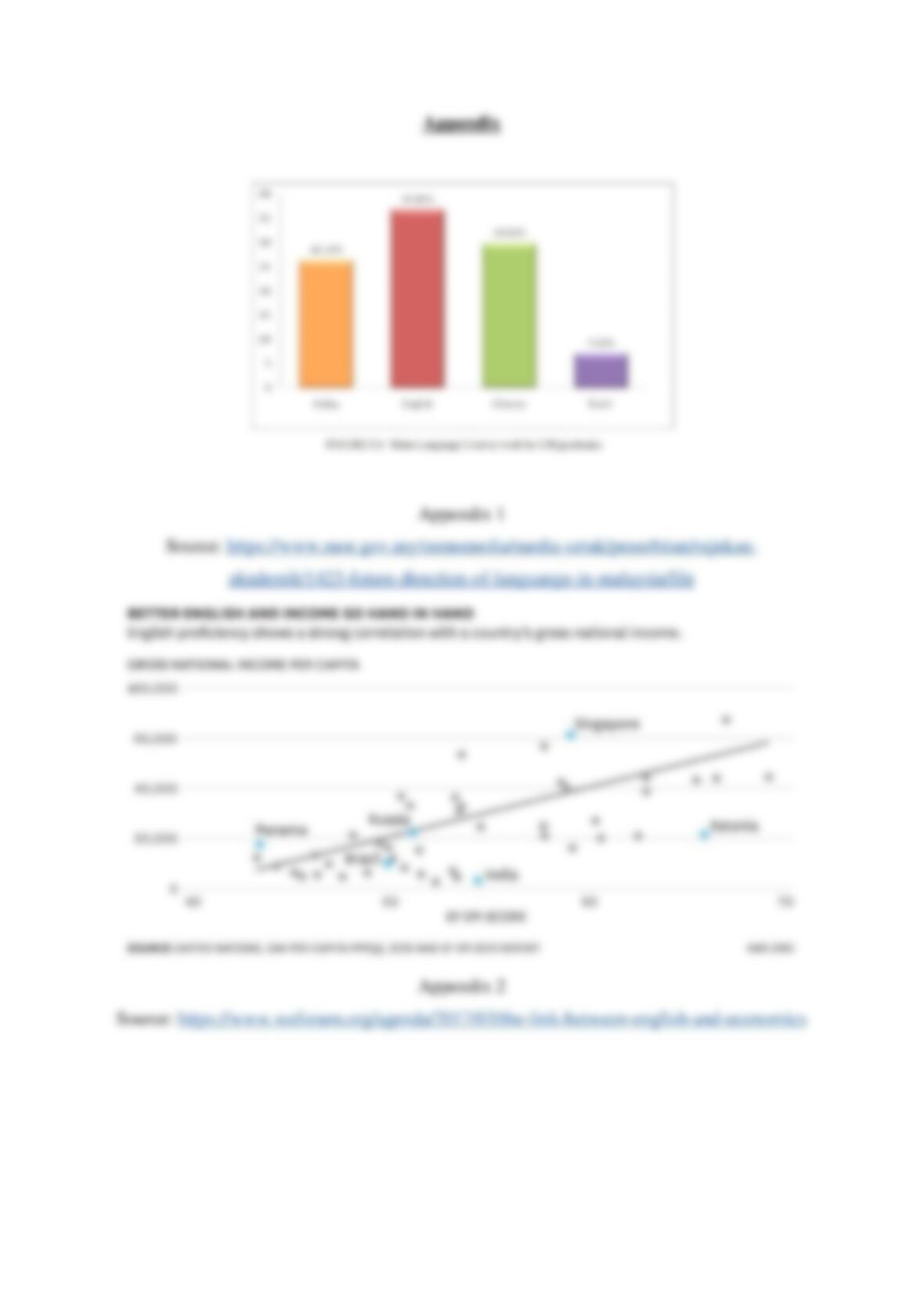
sector is using Malay that is 26.3% (KPM 2020) (Appendix 1). Besides, Malay’s speaker have
shown an upward trend from 159 million speakers in 2015 to 250 million speakers in 2020
(Visual Capitalist 2020). Thus, Bahasa Malaysia is playing a significant role in Malaysia’s
service sector and has an excellent trend to improve further in the future.
Furthermore, the ministry also introduces the LINUS2.0 to address English language
literacy, enhancing English language lessons delivery through Oral Proficiency in the English
language for Secondary School (OPS English) Programme and upskilling all the English
language subject teacher based on the Cambridge Placement Test and the Aptis Test (KPM
2013). This is because billions of people all over the world are studying English desperately
not only for self-improvement, but also for market needs. According to research by the United
Nations, there is a direct link between the population’s English skills and the country’s
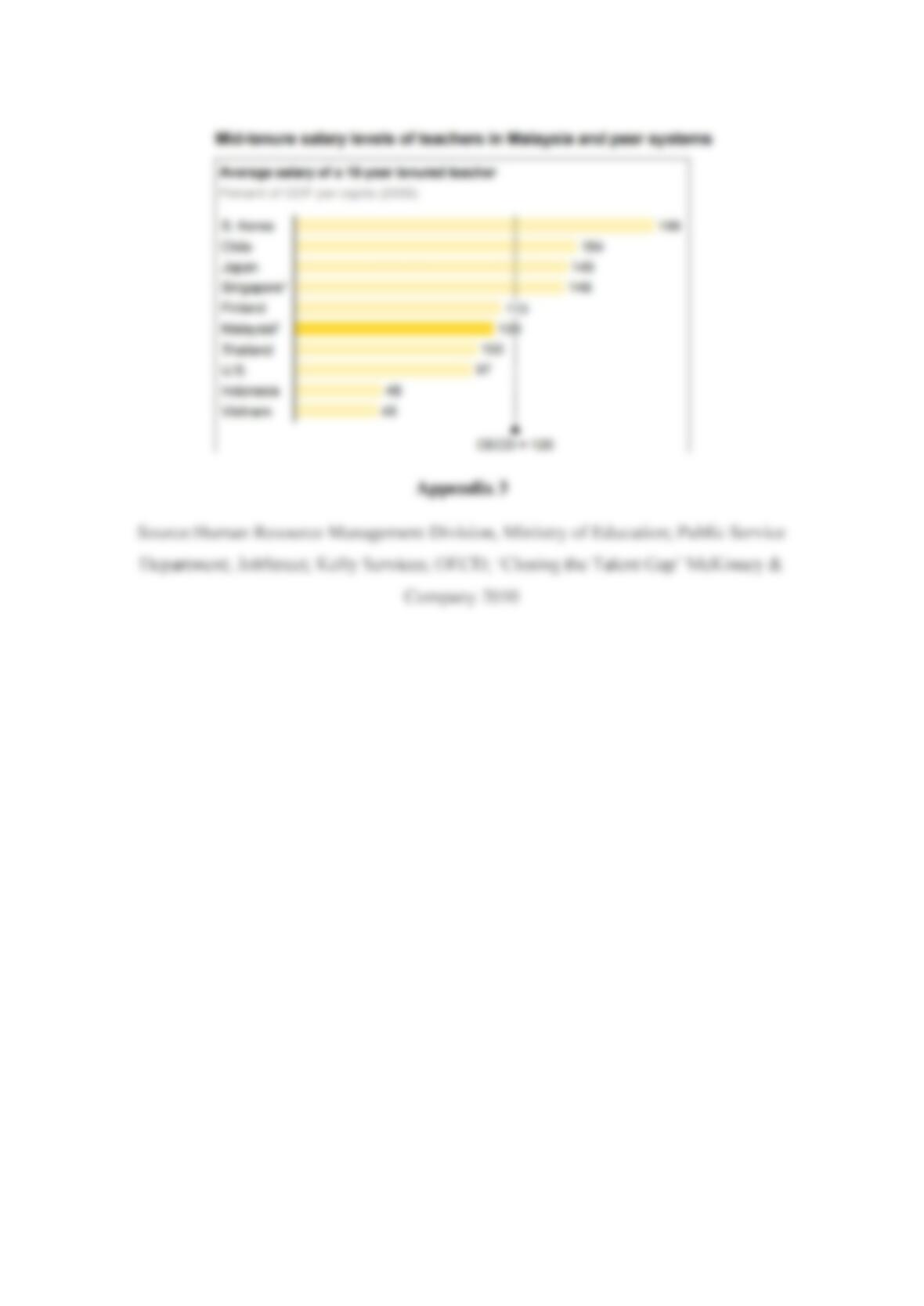
economic performance (Christopher 2017). In the latest version of the EF English Proficiency
Index (EF EPI), researchers found that in the 60 countries and regions surveyed, the
improvement in English proficiency in almost every country is related to the increase in per
capita income (Appendix 2). For example, from 2011 to 2017, Malaysia’s EF performance rose
from 55.54 to 61.07, while Malaysia’s per capita income rose from US$3726.07 to
US$5,273.72 (CEIC 2020). Because the recruiter and the HR manager worldwide will offer
30-50% higher salaries to job applicants with exceptional English (Cambridge English 2020).
Therefore, it shows that English proficiency has a good connection with country GNI and GDP,
with improving English skills drive up salaries, which in turn give the government more money
to invest in the country’s economic development.
Furthermore, English also plays a significant role in developing the field of STEM that
can move Malaysia up the value chain. Based on research, Malaysia would need 60% of
students major in STEM to cope with the Fourth Industrial Revolution’s challenges. However,
Malaysia only has 44% of students who chose STEM streams in 2020 (Malaymail 2020). This
is because most scientific papers are written in English, the ratio is surprisingly 40:1(ADAM
2020). Moreover, it is also true that 52% of internet content related to STEM is delivered in
English (Debatur 2019). Therefore, if the student did not have good English, it will affect the
accessibility of scientific information for STEM that can produce workers who can meet the
growing science- and technology-based innovation that lies at the core of modern economic
growth.
Under the Malaysia Education Blueprint 2013-2025, the Ministry also opens up the
opportunity for students to access and learn an additional language at primary and secondary
level (KPM 2013). This is because there are a lot of economic benefits to encourage the child
to learn an additional language especially Mandarin. Because China has become the second
largest economic power in the world and simultaneously brought huge economic value to
Mandarin. Thus, it will be good for the country’s economic growth if more Malaysians are
trained to be multilingual to make further inroads in trade with Mandarin-speaking nations.
Besides, Malaysia can also take advantage of its Chinese-speaking populace to strengthen
communication and business links with China. Based on research, Malaysia has 20% of the
total trade with Mandarin-speaking nations (The Star 2020). If we need to bolster the figures
and make more inroads, we need to train more Malaysians to be multilingual. Therefore,
learning Mandarin is not only for cultural reasons, but also because of its huge economic
potential.
In my opinion, the Malaysia government should not only open the English for Science
and Mathematics. There are still 55% of the subject using Malay, such as geographic, Account
Principle, Basic Economic, etc (Chong 2020). The government should open more subjects to
be taught in English. It does not mean abandoning the other languages since they can still be
offered as separate subjects. It is necessary to ensure that all students are taught in English from
an early age, which will help them have a good grasp of the language and ensure that Malaysia
will not fall behind in this rapidly globalizing world.
Shift (3): Develop values-driven Malaysians.
Under the Blueprint, the government plans to enhance the Islamic Education and Moral
Education with a greater spotlight on solidarity and encouraging solid bonds among
understudies. Malaysia is a multi-ethnic country where public primary education includes of
the Malay, Chinese and Tamil language schools, so the government is focused on unifying
Malaysia’s primary education system. In Malaysia, Muslim understudies study Islamic
Education and non-Muslim understudies study Moral Education (NewsDesk, 2020). Therefore,
the updated KSSR and KSSM educational program will require each essential and auxiliary