sustainability
Article
The Influence of Green Supply Chain Integration on
Firm Performance: A Contingency and
Configuration Perspective
Yongtao Song 1, Junya Cai 2and Taiwen Feng 3,4,*
1Institute of Management Science and Engineering, Henan University, Kaifeng 475004, China;
ytshnu@126.com
2School of Economic and Management, Xi’an University of Technology, Xi’an 710054, China;
junyacai@126.com
3Business School, Shandong University (Weihai), Weihai 264209, China
4School of Management, Northwestern Polytechnical University, Xi’an 710072, China
*Correspondence: typhoonfeng@gmail.com; Tel.: +86-135-7219-0964
Academic Editors: Fabio Carlucci and Giuseppe Ioppolo
Received: 3 April 2017; Accepted: 2 May 2017; Published: 6 May 2017
Abstract: This study investigates the impacts of three dimensions of green supply chain integration
(GSCI) on operational and financial performance, from both a contingency and a configuration
perspective. From the contingency perspective, we used hierarchical regression to determine the
impacts of individual GSCI dimensions (green internal, customer and supplier integration) and their
interactions on firm performance. From the configuration perspective, we used cluster analysis to
develop patterns of GSCI, which were analyzed in terms of GSCI strength and balance. Analysis of
variance was used to examine the relationship between GSCI pattern and firm performance. We used
data collected from manufacturing firms in Shanxi, Shandong, Beijing, Guangdong and Jiangsu to test
hypotheses. The findings from both the contingency and configuration perspective indicate that GSCI
was related to both operational and financial performance. Furthermore, the interaction between
green internal integration and green customer integration was positively related to both operational
and financial performance, while the interaction between green internal integration and green
supplier integration was negatively related to financial performance. The interaction between green
customer integration and green supplier integration was positively related to financial performance.
Keywords: green supply chain integration; pattern; performance; China
1. Introduction
Facing increasingly serious environmental pollution, sustainable development is becoming an
important challenge for firms [
1
–
3
]. However, it may be difficult for an individual firm to deal with
the challenges of environmental issues [
4
]. Firms need to integrate the resources and information
possessed by different supply chain partners into its green practices to achieve environmental goals [
5
].
Although the importance of green supply chain integration (GSCI) has long been recognized, our
understanding on its impact on firm performance is mixed. While some scholars found GSCI has
positive influence on firm performance [
6
–
8
], others argued that GSCI may be detrimental to firm
performance [9].
Thus, how GSCI influences firm performance should be well addressed to advance our
understanding. In this study, we attribute the inconsistent previous findings to incomplete and
evolving definitions and dimensions of GSCI. While some research focuses on the individual
dimensions of GSCI [
5
,
6
], others use various synthetic definitions [
10
], examining GSCI as a
Sustainability 2017,9, 763; doi:10.3390/su9050763 www.mdpi.com/journal/sustainability
Sustainability 2017,9, 763 2 of 18
unidimensional construct. In addition, many conceptualizations of GSCI are incomplete, leaving
out the important role of green internal integration in implementing GSCI. This study will define GSCI
systematically and divide it into three dimensions: green internal, customer and supplier integration.
Furthermore, findings from a contingency perspective and a configuration perspective may be
complementary, which is likely to help us interpret the inconsistency in existing literature. To fully
understand GSCI and its performance effect, there is a need to investigate GSCI from both a contingency
and a configuration perspective. In specific, this study aims to examine both how individual
dimensions of GSCI are related to different types of firm performance, as well as how patterns
of GSCI are related to different types of firm performance. It is particularly important to integrate
both perspectives within a single study, in order to determine whether the findings are due to the
relationship between GSCI and firm performance or are an artifact of the data collection and survey
design. To examine these relationships, we collected survey data from manufacturing firms in Shaanxi,
Shandong, Beijing, Guangdong and Jiangsu.
From a contingency perspective, we examine the impacts of three dimensions of GSCI (green
internal, customer and supplier integration) on operational and financial performance. We propose that
green customer and supplier integration moderate the relationship between green internal integration
and firm performance. The findings from a contingency perspective may contribute to both theory
and practice by drawing more nuanced conclusions.
From a configuration perspective, we explore how different dimensions of GSCI work together
to better understand how various GSCI patterns are linked with both operational and financial
performance. This allows us to consider whether GSCI patterns that are either strong or balanced
are more strongly related to specific performance measures, or whether organizations that have
value creation processes that are well involved (strength) across the board (balance) will have better
performance on all dimensions. These questions are important to decision makers because they provide
insights about strategies for implementing GSCI.
The remainder of this study is structured as follows. Section 2defines GSCI and develops
research hypotheses from both a contingency and a configuration perspective. Section 3describes the
research method, and the analysis results are presented in Section 4. Following this, research findings
are discussed in Section 5. Finally, theoretical contributions, managerial implications, and research
limitations are presented in Section 6.
2. Theoretical Foundations and Hypotheses
2.1. Definition and Dimensions of GSCI
Previous research on GSCI has offered numerous definitions characterizing the concept. Although
these studies touch many of the critical elements of GSCI, they are broad in focus. In addition, most fail
to consider the strategic nature of GSCI. Consideration of the dimensionality of GSCI is also important
for understanding the way that the individual dimensions operate, as well as how they function
jointly. Building upon the existing literature on GSCI [
3
–
5
], we conceptualize GSCI as consisting of
the three dimensions of green customer, supplier and internal integration. Thus, GSCI involves both
inter-organizational (green customer and supplier integration) and intra-organizational (green internal
integration) interfaces that integrating flows of products/services, information, capital and decisions,
with the ultimate goal of providing maximum value to multiple stakeholders of the manufacturer.
Green customer and supplier integration are commonly referred to as green external integration.
Green customer integration is defined as the environmental collaboration, information sharing and
jointly environmental problem solving activities with major customers that provide the firm with
rich information and knowledge related to green practices [
3
,
4
]. Green supplier integration involves
environmental collaboration, information sharing and jointly environmental problem solving activities
with major suppliers that provide the firm with core information and resources related to green
practices [
3
,
4
]. In contrast, green internal integration is defined as the degree of interaction and
Sustainability 2017,9, 763 3 of 18
communication, the extent of information and resource sharing, and the level of coordination across
different functions and departments in the environmental management practices [3,4].
Green internal integration and green external integration may play different roles within a firm.
While green internal integration recognizes that the departments and functions within a manufacturer
should communicate, coordinate and share information with each other, green external integration
recognizes the importance of establishing close and interactive relationships with major customers and
suppliers. Both perspectives are important in allowing supply chain members to solve environmental
problems jointly and co-create value, to maximize the value of different stakeholders.
2.2. Contingency Perspective of GSCI
Contingency theory is often employed to understand organizational issues from a contextual
perspective [
11
]. Contingency theory suggests that organizations should align their structures and
processes with environment to enhance performance [
12
]. In a supply chain, customers and suppliers
can be deemed as important parts of a firm’s environment. According to structural contingency theory,
the performance of an organization is influenced by how its practices are aligned [
11
]. Suggested
by structural contingency theory, the individual dimensions of GSCI should be aligned to enhance
firm performance.
2.2.1. Performance Effect of Green Internal Integration
The importance of green internal integration has been increasingly emphasized in improving
firm performance. Green internal integration breaks down the hierarchical and spatial barriers and
improves the linkages among different functions [
4
,
13
]. The improvement of horizontal linkages allows
for information and resource sharing and cooperation among employees from different departments
within the firm [
14
]. Green internal integration also increases the amount and variety of information
available to the manufacturer [
5
]. These advantages from green internal integration provide the basis
for sound decision making when dealing with environmental issues. In addition, frequent interactions
and confrontation with different perspectives may reduce mistakes and wastes, acquire opportunities
for simplification and achieve concurrent engineering [
15
]. In this sense, green internal integration is
the base for GSCI and will be positively related to operational and financial performance.
Furthermore, green internal integration can help firms acquire knowledge related to
environmental issues and achieve a balance between environmental protection and economic
profits [
5
]. Previous studies have found that the components of green internal integration, such
as cross-functional collaboration and environmental management systems have positive impacts on
firm performance [3–5,16]. Thus, we propose:
H1a:
Green internal integration is positively related to operational performance of the manufacturer
within a supply chain.
H1b:
Green internal integration is positively related to financial performance of the manufacturer
within a supply chain.
2.2.2. Performance Effect of Green Customer and Supplier Integration
From the contingency perspective, manufacturers need to achieve the fit between green internal
and external integration. This is consistent with the concept of “fit” between information processing
capabilities and needs in information processing theory [
16
,
17
]. We can consider green internal
integration as information processing capacities and consider green external integration as information
processing needs [
18
]. To gain better performance, green internal integration should be appropriately
fit with green external integration. Thus, green internal integration serves as a base for implementing
green customer and supplier integration.
Since value is realized in the customer usage process rather than in the supplier value chain, green
customer integration contributes to the process of marketing, consumption and delivery of products
Sustainability 2017,9, 763 4 of 18
and services [
19
]. Green customer integration also offers opportunities for enabling manufacturers
to develop environmentally friendly products in a more effective and efficient way. Moreover, green
customer integration helps to build mutual understanding between a manufacturer and its customers.
Thus, the manufacturer and its customers can establish international problem-solving routines to deal
with environmental issues [5].
Considering suppliers sit at the intersection of many firms, they maintain extensive social ties and
networks. Integrating suppliers into green practices provides manufacturers with opportunities for
accessing valuable information, core resources and green technologies, which can improve their
responsiveness, flexibility and customer service [
5
,
15
]. Furthermore, green supplier integration
allows manufacturers to be more efficient in quality and cost management, which, in turn, helps
the manufacturers improve their financial performance [20].
Green internal integration is important for effective green customer and supplier integration [
21
].
To implement green customer and supplier integration successfully, manufacturers need to be well
internally integrated because green internal integration functions as coordination and learning
mechanisms for green customer and supplier integration [
22
]. Green customer and supplier
integration extend green internal integration by establishing a cross-functional team integrating
external organizations. Accordingly, we propose:
H2a:
Green customer and supplier integration are positively related to operational performance of the
manufacturer within a supply chain, given the relationship between green internal integration
and operational performance.
H2b:
Green customer and supplier integration are positively related to financial performance of the
manufacturer within a supply chain, given the relationship between green internal integration
and financial performance.
2.2.3. Interaction Effects
Contingency theory also suggests that individual dimensions of GSCI will interact to influence
firm performance. Suggested by the work of [
22
], there are four different relationships between green
internal and external integration: (1) Green internal integration serves as a coordination capability
for facilitating green external integration; (2) Green internal integration norms are similar to green
external integration norms; (3) Green external integration may stimulate green internal integration;
(4) Green internal integration represents an organizational capability for learning from external partners.
Luo et al. [
23
] found that internal coordination capability moderates the relationship between supplier
involvement and product development performance. Feng et al. [
24
] addressed that the interaction
between customer involvement and internal integration is related to time to market of new products.
According to the above arguments, we hypothesize:
H3a:
The two- and three-way interactions between green internal, customer and supplier integration
are positively related to operational performance of the manufacturer within a supply chain.
H3b:
The two- and three-way interactions between green internal, customer and supplier integration
are positively related to financial performance of the manufacturer within a supply chain.
2.3. Configuration Perspective of GSCI
Since contingency perspective views GSCI in a reductionist way, the complicated relationships
among three dimensions of GSCI are not explored holistically. To complement the findings of
contingency perspective, we also investigate GSCI from configuration perspective. Configuration
theory argues that organizational elements tend to cluster together to form distinct configurations [
25
].
Thus, in a large sample of firms, a relatively small number of configurations will arise, where various
green supply chain practices are aligned. Performance results from the co-alignment or fit among
organizational elements [
26
]. This implies that to be maximally effective, organizations must have
configurations that are consistent with each other among multiple GSCI dimensions. A configuration
Sustainability 2017,9, 763 5 of 18
perspective might provide an opportunity to gain a deeper understanding of the link between GSCI
and firm performance.
2.3.1. Configurations of GSCI
Suggested by configuration theory, the alignment of strategies and/or practices for an organization
is reflected in the patterns of different practices [
27
]. Thus, there is a need to empirically develop an
emergent taxonomy of GSCI. A taxonomy study of GSCI contributes to both theory and practice by
providing strategic choices from the operational perspective for manufacturers. Although research from
the configuration perspective has been widely conducted in the domain of strategy management [
28
,
29
],
research in the field of GSCI is still lacking.
Since firm may face differing levels of resource constraints and business environments, few firms
treat all three dimensions of GSCI equally. Firms tend to place different degrees of emphasis on the
individual dimensions of GSCI according to their actual situations [
3
,
30
]. Thus, various configurations
of GSCI may exist. With reference to the work of supply chain integration by Flynn et al. [
27
], these
patterns can be described in terms of GSCI strength and balance. SCI strength refers to the extent
to which GSCI activities are carried out. In contrast, GSCI balance refers to the extent to which a
company pays equal attention to all three dimensions of GSCI. The existing literature suggested that
manufacturers may not place equal emphasis on each dimension of GSCI. Thus, an organization may
take several steps to implement GSCI [
31
]. While some firms may have well implemented green
internal integration, these firms may not have integrated their customers and suppliers into green
practices. Other firms may be strong in green customer or supplier integration, but weaker in their
green internal integration.
To have better insights about the relationship between GSCI patterns and performance, there is
clusters into those with high GSCI (High Uniform), medium GSCI (High Green Internal Integration
and Medium Uniform) and low GSCI (Medium Green Internal Integration). Thus, Function 1
represents GSCI strength, and it was the greatest differentiator between the patterns.
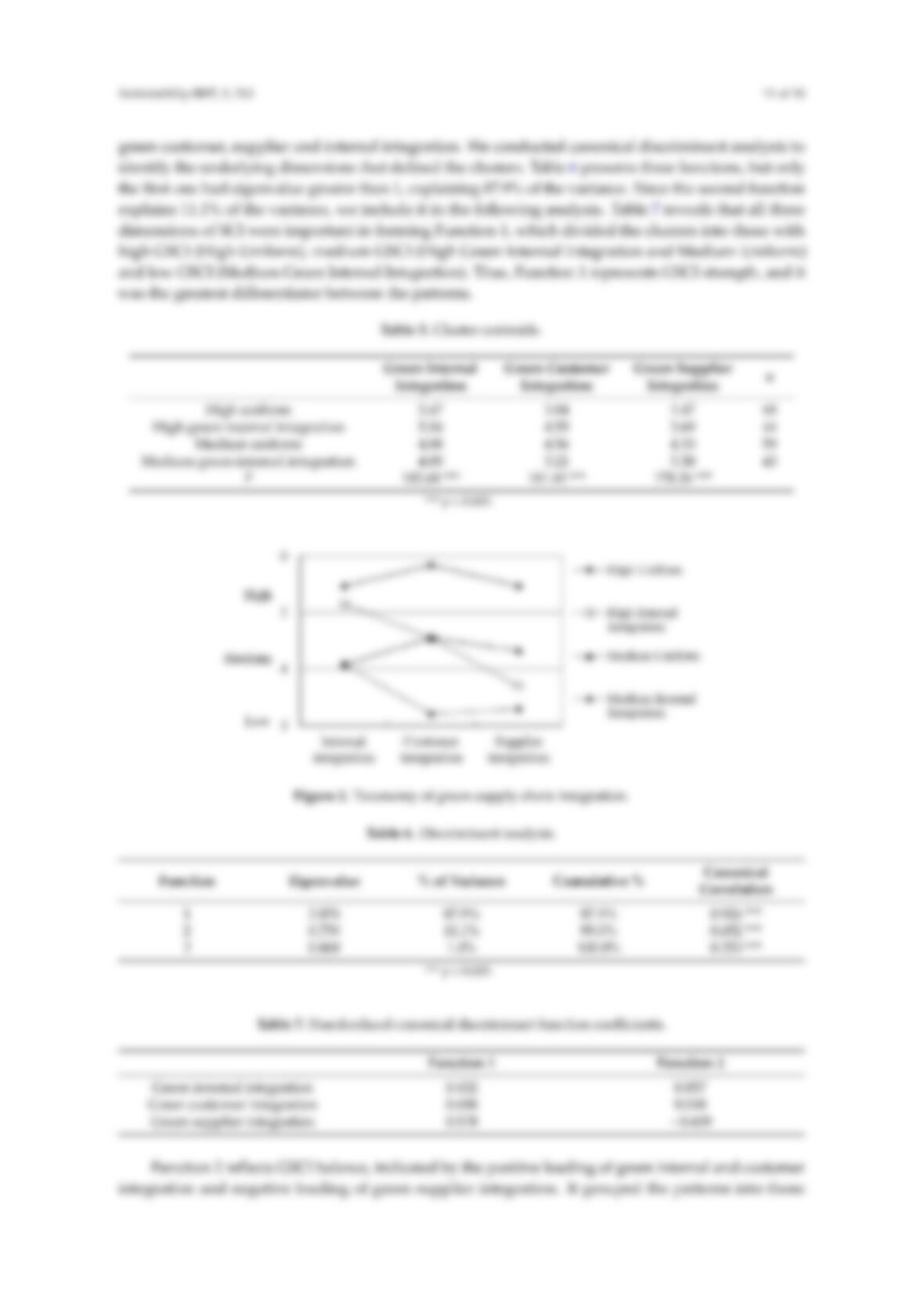
Function 2 reflects GSCI balance, indicated by the positive loading of green internal and
customer integration and negative loading of green supplier integration. It grouped the patterns into
those with greater (High Uniform and Medium Uniform) and less (High Green Internal Integration
and Medium Green Internal Integration) GSCI balance. However, these differences between the
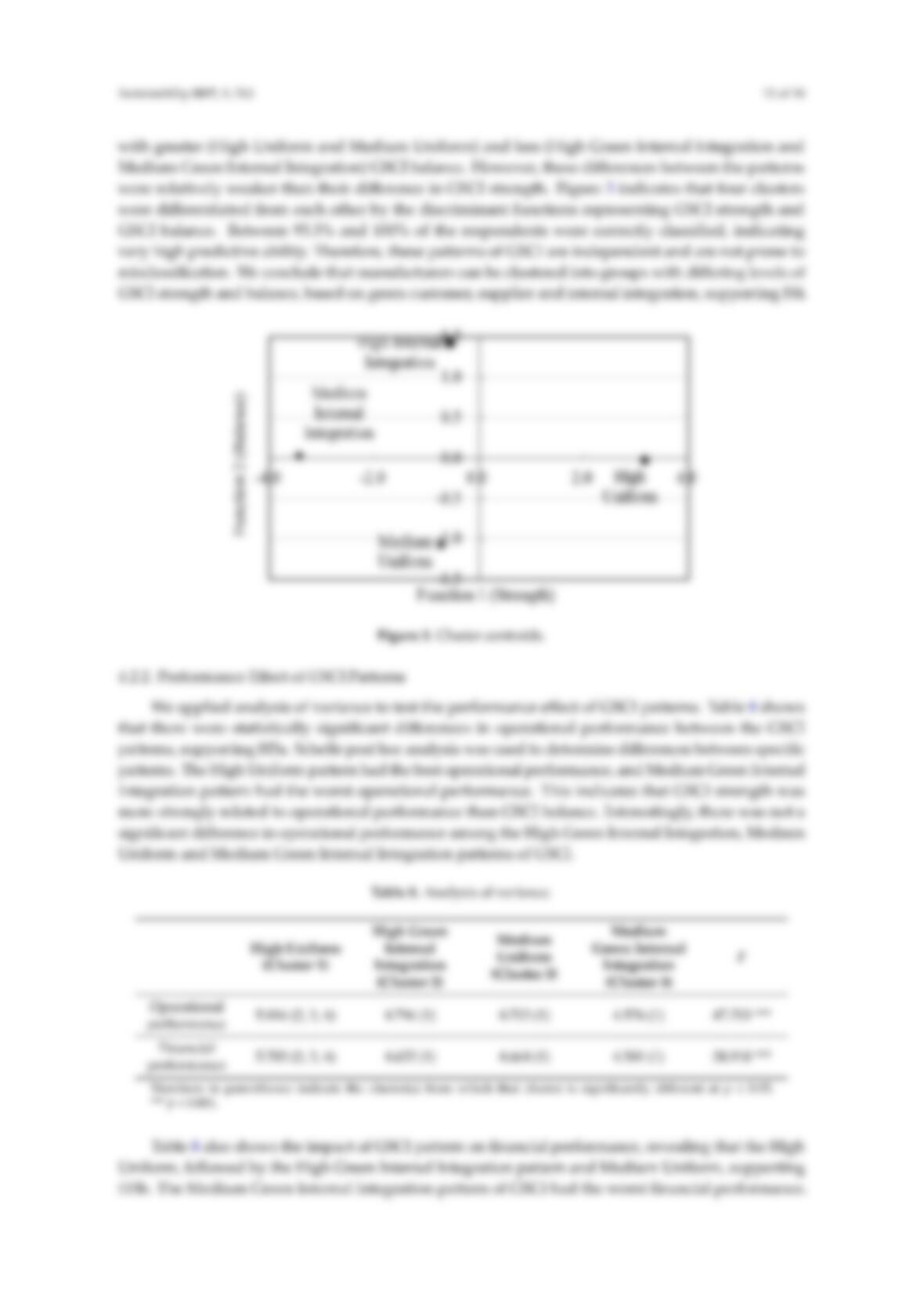
patterns were relatively weaker than their difference in GSCI strength. Figure 3 indicates that four
clusters were differentiated from each other by the discriminant functions representing GSCI strength
and GSCI balance. Between 95.3% and 100% of the respondents were correctly classified, indicating
very high predictive ability. Therefore, these patterns of GSCI are independent and are not prone to
misclassification. We conclude that manufacturers can be clustered into groups with differing levels of
GSCI strength and balance, based on green customer, supplier and internal integration, supporting H4.
and indirectly. Specifically, green internal, customer and supplier integration were directly related to
both financial and operational performance. In addition, the interaction between green internal
integration and green customer integration was positively related to both operational and financial
performance, while the interaction between green internal integration and green supplier integration
was negatively related to financial performance. Although the interaction between green customer