The Hertz Corporation Analysis
The oldest American car rental company Hertz (The Hertz Corporation) is bankrupt.
Despite the fact that it survived the crisis of 2008, it filed for bankruptcy on May 22, 2020,
having accumulated over $ 17 billion of debts on its accounts. However, experts believe that
Hertz went into bankruptcy for several years, having failed to rebuild the business model in
accordance with the realities and yielding to other rental services, car sharing and taxis. I will
study and analyze these and other factors that contributed to the deteriorating financial
condition of the company in this work.
Now the pandemic is the official cause of bankruptcy on the American continent – in
the United States and Canada. This blocked the work of the rental service and deprived the
company’s employees of earnings. Branches in other countries continue to operate, and
experts believe that the company may return to the market after some time.
Key success factors of success for Hertz are cost-effective franchises in North
America, Europe, Latin America, Africa, the Middle East, Asia, Australia, and New Zealand.
The company can also improve its financial performance, if it takes into account the
preferences of customers – it needs to adapt faster in a dynamic market. One of the most
promising areas for the company is the development of the car-sharing industry for corporate
clients for long-term use, as this advantage distinguishes the company from its competitors. It
is also worth thinking about assigning part of the fleet to car sharing for individuals.
For a deeper understanding of the brand’s position in the market, I will consider the
major global competitors of Hertz: Avis, Europcar and Sixt. Competitor companies also incur
losses, but they were able to continue working with the help of bank loans. For example, the
German company Sixt attracted a loan of 1.6 billion euros, the French Europcar lent 220
million euros from banks.
Europcar has grown significantly in recent years, mainly due to the rental of cars for
private and legal entities. The company’s turnover includes 3,300 rental points around the
world and this is enough for stable demand and a stable position of the company. You can
also draw an analogy with Avis Rent a Car System. This company provides car rental
services. It is represented by more than 5750 rental locations in 170 countries worldwide,
serving more than 10 million customers annually with a relatively small fleet of vehicles; it is
cost-effective and promising.
To evaluate the position of Hertz and its competitors, I compiled a Positioning
Matrix:
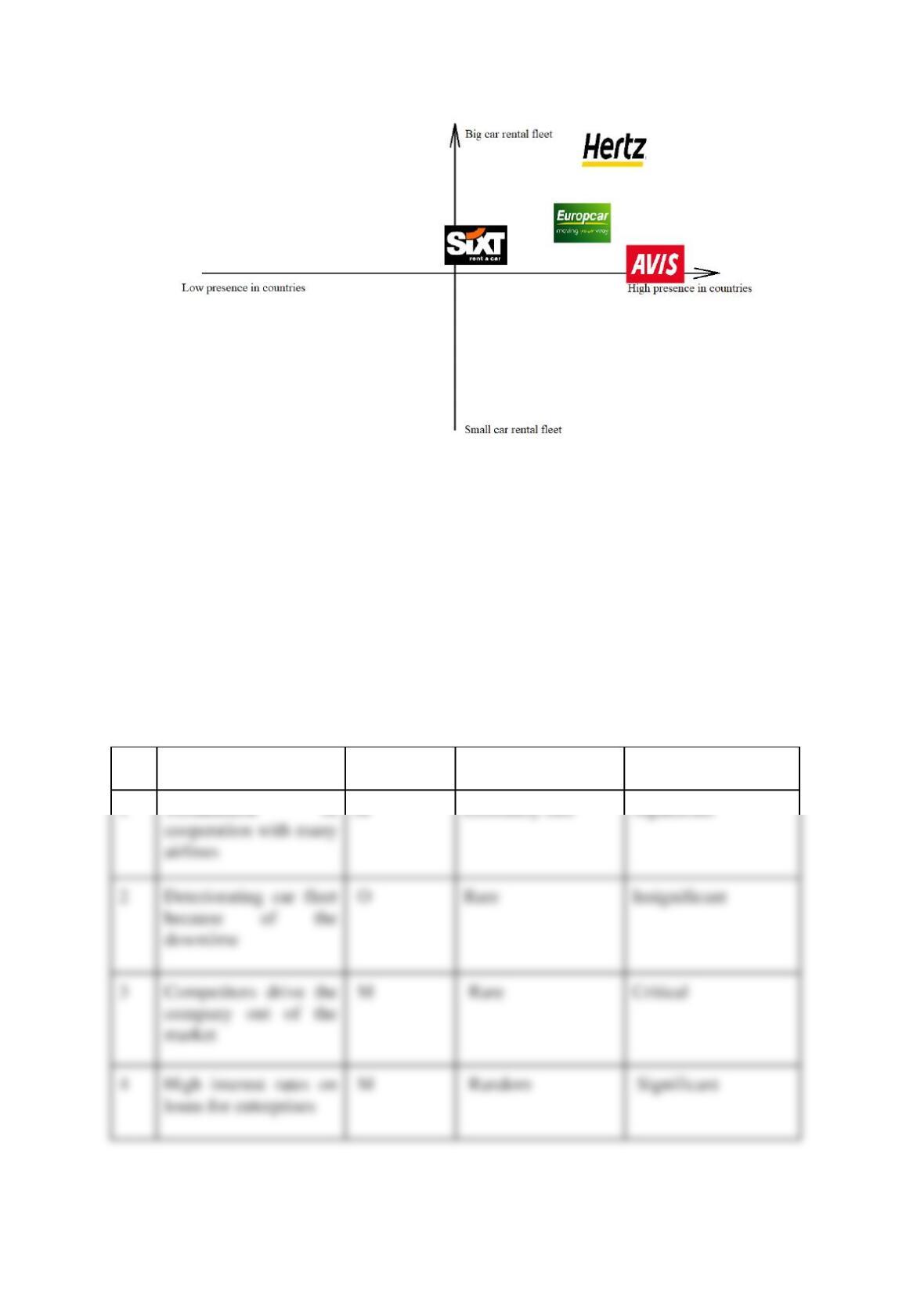
Based on the resulting matrix, one can easily notice that Hertz still has a large fleet of
vehicles (568,000 cars) compared to its competitors, when Sixt has about 180,000 cars,
Europcar – 200,000 cars, and Avis – 120,000 cars. Hertz is represented in 150 countries, Sixt –
in 105 countries, Europcar – in 145 countries, Avis – in 170 countries. This suggests the
conclusion that Hertz loses to competitors due to the company’s illiterate policy. Having such
a large fleet of vehicles, it is much more difficult to properly manage sufficient demand so
that there is no downtime. This is exactly what the company could not handle.
In addition, an important part of the analysis is the Risk Matrix. It is very important to
correctly assess the risks in order to take the necessary measures to prevent them or reduce
their impact.
Risk name
Category
Probability
Potential damage