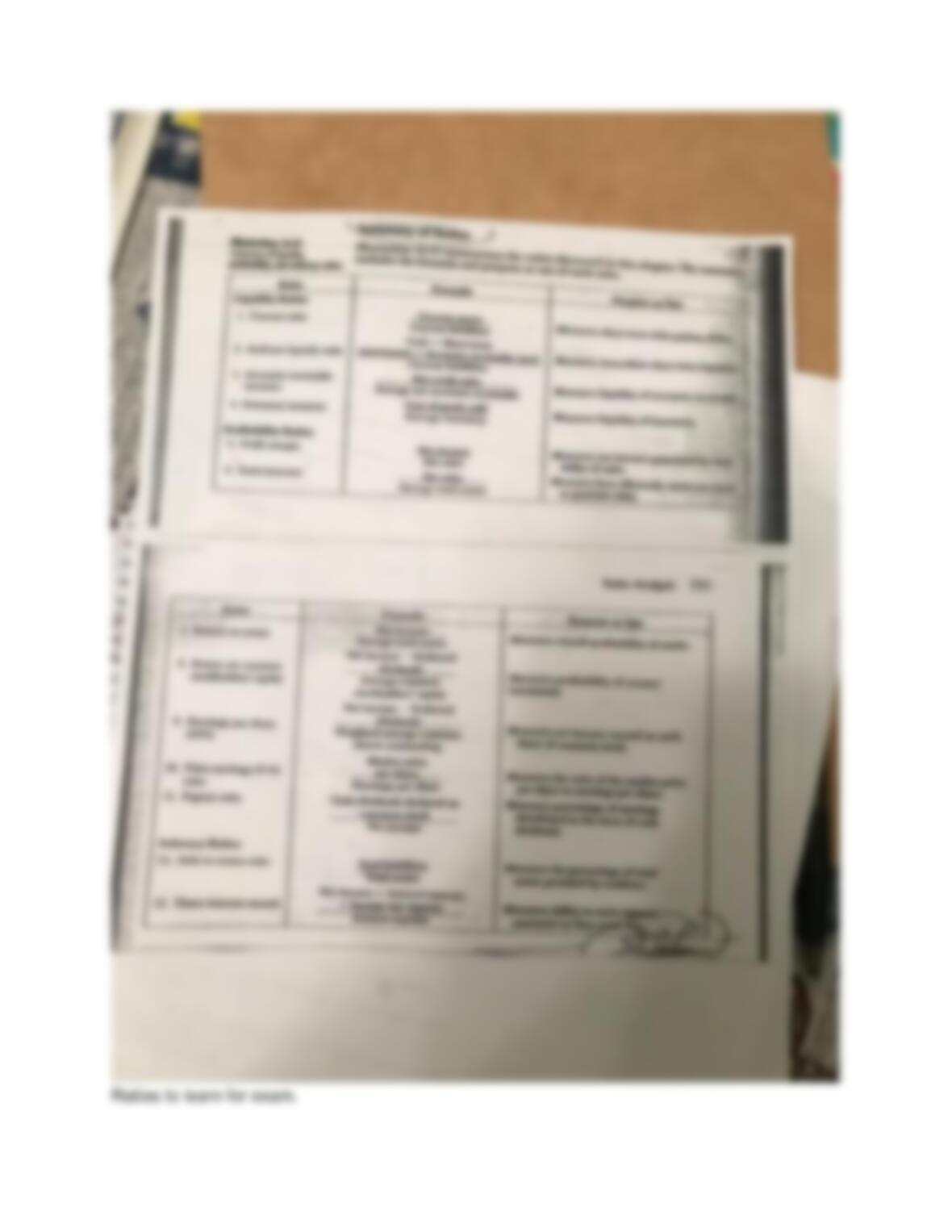
ACC Final exam study guide
Chapter 8
1. Accounts receivable: The amount customers owe on account.
2. Notes Receivable: A written promise (as evidence by formal instrument) for amounts
received.
3. What two methods are used to account for uncollected accounts:
(A) Direct Write Off Method
(B) Allowance Method
4. What two bases can be used to calculate the Allowance for Doubtful Accounts:
(A) Percentage of sales basis
(B) Percentage of receivable basis
5. Factor: It is a factor of the sale of accounts receivable: A factor is a finance company or bank
that buys receivables and then collects the payments directly from customers.
Chapter 9
1. Plant Asset: They’re fixed assets such as land, building & equipment.
Three characteristics of plant assets:
(A) They have physical substance (a definite shape & size)
(B) are used in the operations of a business
© are not intended to be sold to a customer.
2. Depreciation: The process of allocating to expense the cost of a plant asset over its useful
(service) life in a rational & systematic manner.
3. Book Value: It’s the difference between the cost of any depreciable asset & its related
accumulated depreciation.
How to calculate book value: cost – accumulated depreciation
4. Straight-Line method: Companies expense the same amount of depreciation for each year of
the assets useful life.
How to calculate depreciation using the straight line method:
Step 1: Cost – Salvage Value = Depreciation cost
Step 2: Depreciable cost Divided by useful life = Annual Depreciation expense
5. Units of Activity Method: Useful life is expressed in terms of the total units of production or
use expected from asset, rather than time.
How to calculate depreciation by using Units of Activity Method:
Step 1: Depreciable cost Divided by Total units of activity = Depreciable cost per unit
Step 2: Depreciable cost per unit X Units of activity during the year = Annual Depreciation
expense
6. Double Declining Balance Method: A common declining balance rate that is double of the
straight line method.
How to calculate depreciation by using the Double Declining Method:
Step 1: (2 X the straight line rate) (so say rate is 20%, double declining would be 40%)
Step 2: Book value at beginning of year X declining balance rate = Annual Expense
7. Gain / Loss on the disposal of plant equipment: Example (Loss is done exact same way.
Cost of office Furniture:———————————–—- $60,000
Less: Accumulated Depreciation ($41,000+ $8,000):-$49,000 (subtract number)
Book Value at Disposal:———-——————————$11,000 (60,000-49,000)