Many economists face the constant agitation of the global current account never reaching
its expected turnout. In order to avoid complications in the future, economists urge countries to
bring their current account surplus or deficit to zero. In 2004 the global current account puzzled
many economists due to the fact that the consistent deficits became surpluses in the years
moving forward. This discrepancy baffled many economists and pointed towards a systematic
misreporting of investments by individuals in order to avoid taxations. Prior to 2004, the current
account deficit was explained by incomplete reporting of international investment income. As
international trade in services increased, the current account surplus followed suit and surged as
well. This is likely due to errors in reporting purchases that escaped government detections as
well as shadow economies in developing countries. In order to resolve these current account
discrepancies, it is crucial for countries with deficits or surpluses to bring their current accounts
to zero, and for governments to accurately report all their sales and purchases.
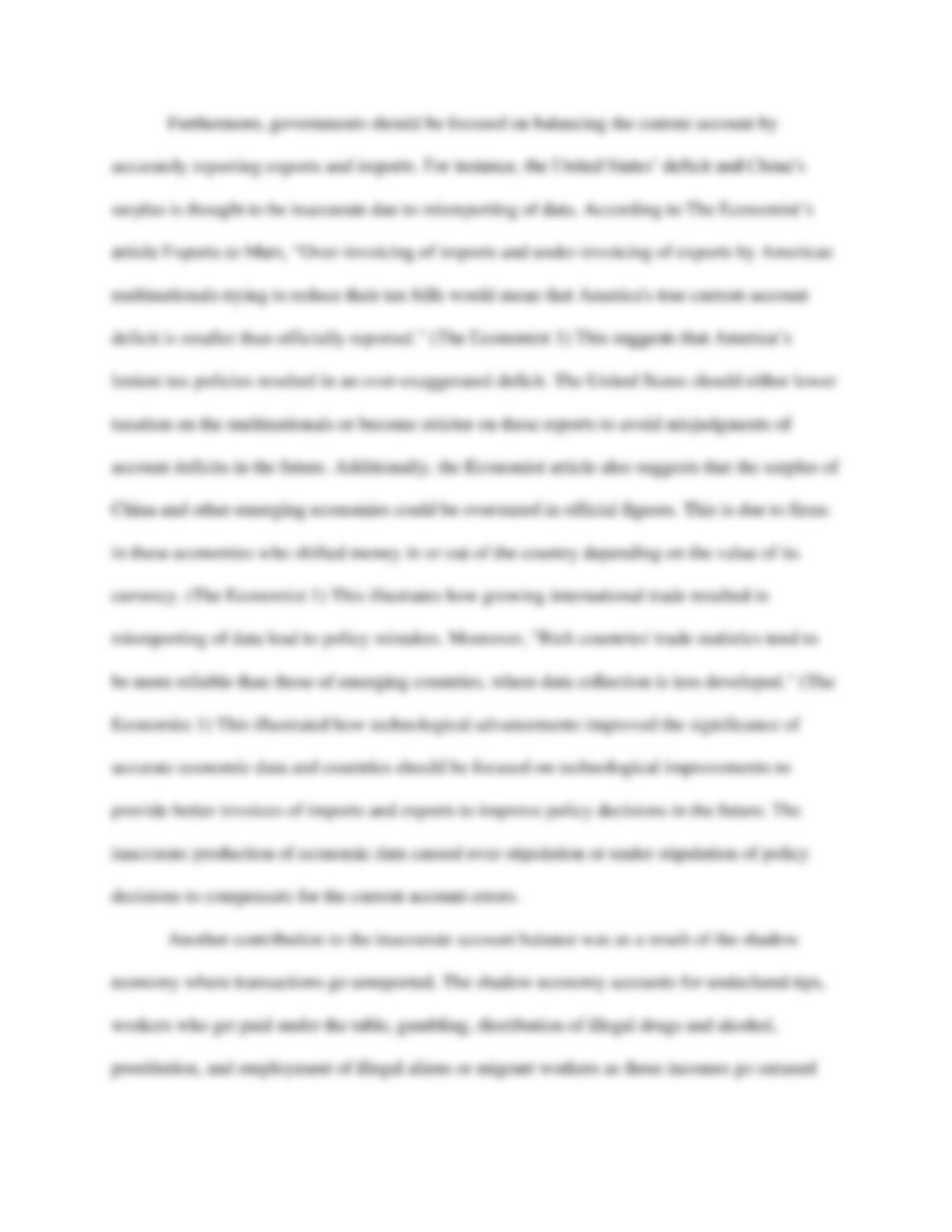
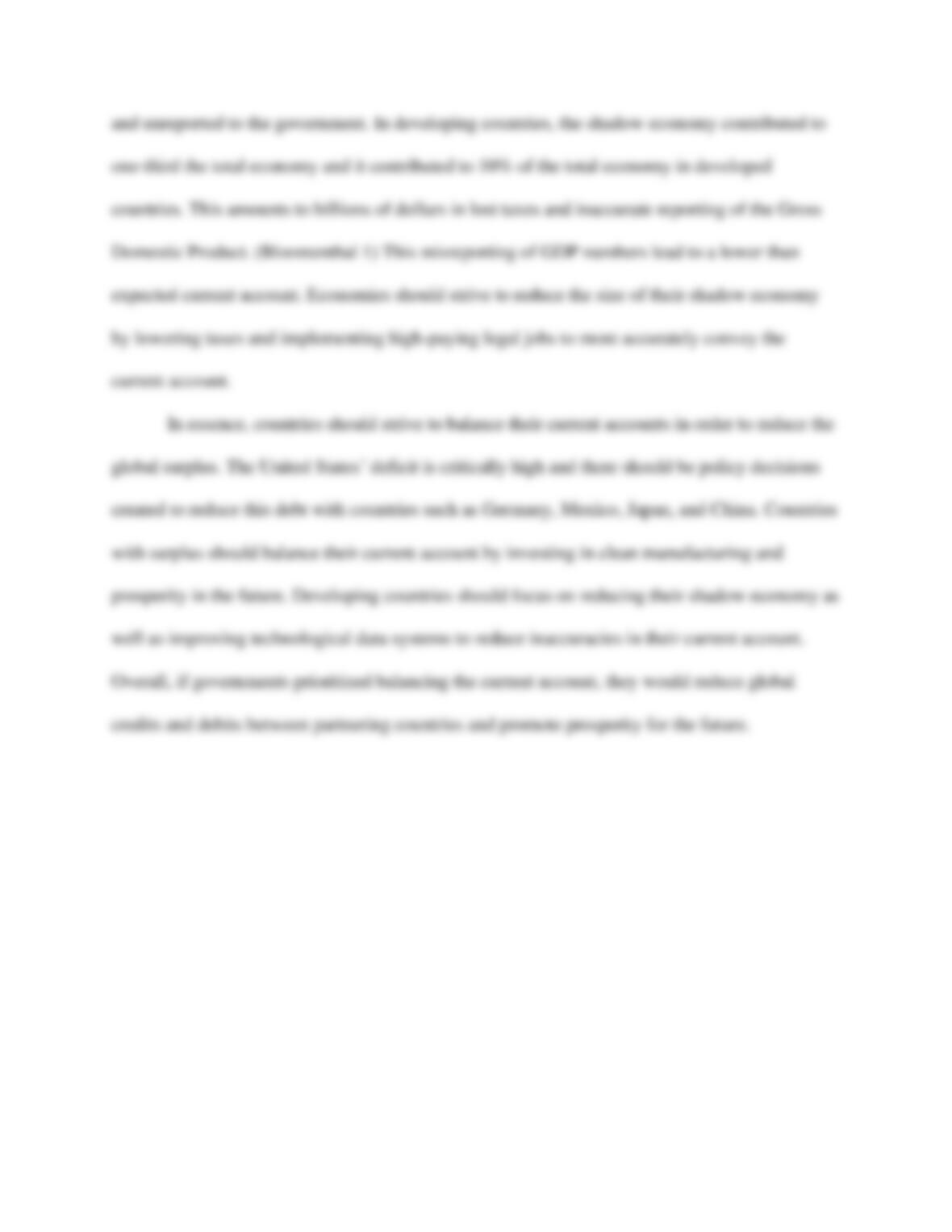
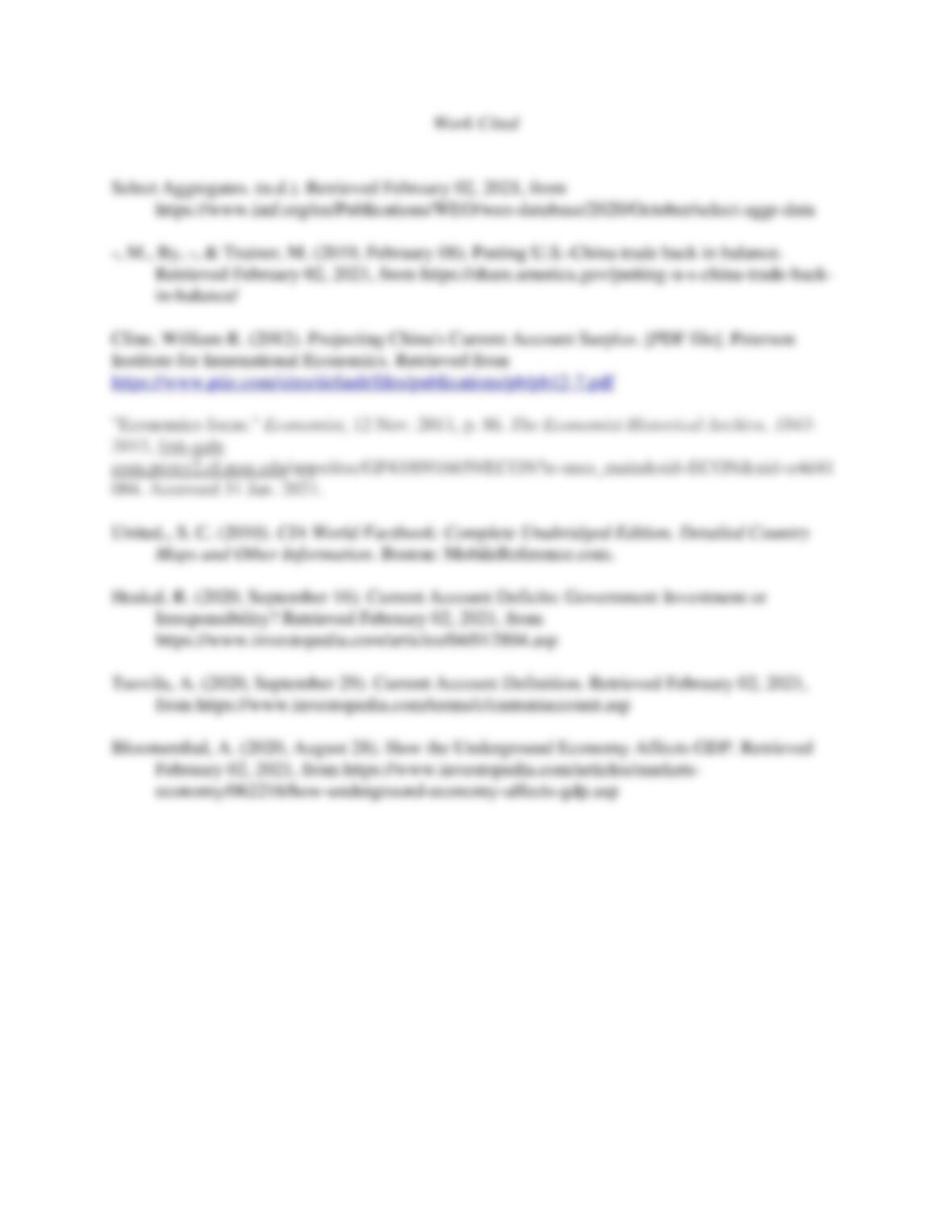
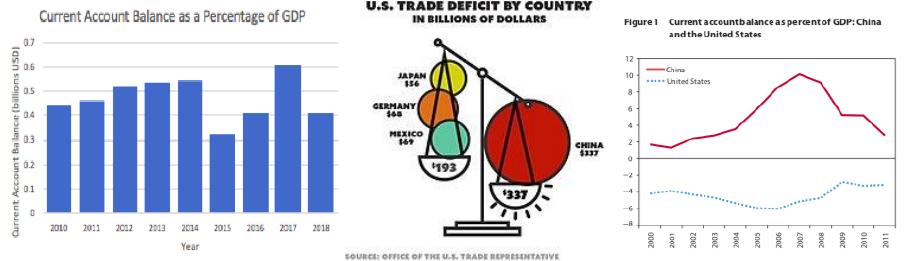
Figure 1.1 Figure 1.2. Figure 1.3
The current account should always balance out to zero to ensure each country has no
credit or debit with one another. The bar graph in Figure 1.1 illustrates that many countries did
not achieve the proper current account balance which resulted in the global current account to
produce a surplus from the years 2010 to 2018. This surplus could be resolved if governments
balanced out their deficits and surpluses. This is why economists urge governments such as
America and China to adopt policies to balance their current accounts. (The Economist 1) The
United States has the highest current account deficit in the world with a balance of negative
$466,200 billion. (CIA World Factbook 1) America should take strides to reduce this deficit to
ensure it doesn’t cause problems in the future. A deficit is not always a bad thing as it could
mean the country is investing more abroad than it is saving at home. (Heakal 1) These
investments could lead to economic growth and prosperity in the future. However, if a country
uses its debts for consumption rather than investments, this could lead to future inhibitions. For
instance, nations with a high deficit could come under investor scrutiny during recessional
periods when money is scarce. Additionally, this could lead to a depreciation in the nation’s
currency. (Tuovila 1) Thus, it would be wise for the United States to decrease its deficits with the