Assignment on
The Evolution of Management Thoughts and Management Theories: Study
Course Title: Development of Management Thought
Course Code: MGT-401
Submitted to
Md. Kazi Raihan Uddin
Assistant Professor
Department of Management
University of Dhaka
Submitted by
Shahida Parvin Jothy
Id No: 024-071
BBA Program (23rd Batch), 2016-2017
Section: A
Department of Management
Faculty of Business Studies
University of Dhaka
Submission Date: 29th August, 2020
Table of Contents
Introduction ……………………………………………………………………………………………………………….. 1
Definition of Management …………………………………………………………………………………………… 2
The Evolution of Management thoughts and Management Theories …………………………………. 3
Evolution of Management Thoughts ………………………………………………………………………….. 3
Early Management Thoughts / Pre- Scientific Management Thoughts ……………………. 4
The Classical Approach …………………………………………………………………………………………. 4
The Neo-Classical Theory ……………………………………………………………………………………… 4
Modern Management Approaches …………………………………………………………………………. 4
The Evolution of Management Theories…………………………………………………………………….. 5
Early Writings on Management …………………………………………………………………………….. 5
Effect of the Industrial Revolution on Management ……………………………………………….. 6
Different school of management thoughts ………………………………………………………………. 7
1. The Scientific Management School …………………………………………………………………. 7
2. Classical Organization Theory School …………………………………………………………….. 9
3. The Behavioral School:…………………………………………………………………………………. 11
Efficiency and the Factory ……………………………………………………………………………….. 14
The Human Relations Movement ……………………………………………………………………… 15
The Hawthorne Experiments ……………………………………………………………………………. 15
Theory X and Theory Y …………………………………………………………………………………… 16
From Human Relations to the Behavioural Science Approach …………………………… 17
4. Quantitative Approach or Mathematical Approach: ……………………………………… 18
Recent Developments in Management Theory…………………………………………………… 19
Organizational Environment Theory ………………………………………………………………… 19
Conclusion ……………………………………………………………………………………………………………… 22
References ……………………………………………………………………………………………………………….. 23
1
Introduction
Despites the inexactness and relative crudity of management theory and science, the
development of thought on management dates back to the days when people first attempted to
accomplish goals by working together in groups. Although modern operational management
theory dates primarily from the twentieth century there was serious thinking and theorizing
about managing many years before. We can see that the many different contributions of writers
and practitioners have resulted in different contributions of writers and practitioners have
resulted in different approaches to management, and these make up a man management theory
jungle.
Management is a vital subject in business academics from the early period of time, and it is
viewed as an essential part of getting an understanding of business operations. Individuals have
been transforming plus redesigning organizations for many years. Many studies indicate that
Management theory progressed with “bureaucratic” and “scientific” management that made
use of procedures, measurements, plus routines as the foundation for operations. Firms
established hierarchies for applying standardized rules in the place of work and punished labor
when they violated rules. When the “human relations” movement begun, companies started
putting stress on individual workers. Today, modern management theories that include chaos
theory, contingency theory, and system theory concentrate on the entire organization and views
employees as an essential part of the whole system.
Organizations have been shaped and through the writings of several writers. Their write-up
consisted of governance of kingdoms and management of humans. And these formed the
literature that helped in the development of management theories. And these management
models were also offered by the military, political and religious organizations.
For instance, Sun Tzu’s book “The Art of War” was written in the 16th century BC. Sun was
also a Chinese army general. However, the writings in Sun’s book were also used for
managerial purposes.
The book highlights that it’s possible to achieve success by using the strength of the
organization to exploit the weakness of rivals. Another great book was Chanakya’s
Arthashastra. It was written in the third century BC and focused on the governance of the
kingdom concerning the formulation of policies of governance and management of people.
(The Evolution of Management Thought and Evolution of Management Theories, n.d.)

2
Definition of Management
Management is a word that is quite wide spread and cannot ever have a precise and concise
definition. There have been lot of definitions to it in the past that have tried to define the
meaning, objective and scope of management in our lives but none of them has been able to
precisely and completely define the scope and meaning of management. Many eminent authors
on the subject have defined the term “management”.
In the words of Koontz and O’Donnel; “Management is defined as the creation and
maintenance of an internal environment in an enterprise where individuals working together in
groups can perform efficiently and effectively towards the attainment of group goals”.
According To James A.E. Stone; “Management is the process of planning, organizing, leading
and controlling the efforts of organization members and using all other organizational resources
to achieve stated organizational goals.”
According to Stanley Vance; “Management is simply the process of decision-making and
control over the actions of human beings for the express purpose of attaining predetermined
goals”. (Definition of Management Eminent Authors, 2010)
Management is the process of designing and maintaining an environment in which individuals,
working together in groups, efficiently accomplish selected aims (Koontz and Weihrich 1990,
p. 4). In its expanded form, this basic definition means several things. First, as managers, people
carry out the managerial functions of planning, organizing, staffing, leading, and controlling.
Second, management applies to any kind of organization. Third, management applies to
managers at all organizational levels. Fourth, the aim of all managers is the same to create
surplus. Finally, managing is concerned with productivity this implies effectiveness and
efficiency. Thus, management refers to the development of bureaucracy that derives its
importance from the need for strategic planning, co-ordination, directing and controlling of
large and complex decision-making process. Essentially, therefore, management entails the
acquisition of managerial competence, and effectiveness in the following key areas: problem
solving, administration, human resource management, and organizational leadership.
First and foremost, management is about solving problems that keep emerging all the time in
the course of an organization struggling to achieve its goals and objectives. Problem solving
should be accompanied by problem identification, analysis and the implementation of remedies
to managerial problems. Second, administration involves following laid down procedures
(although procedures or rules should not be seen as ends in themselves) for the execution,
control, communication, delegation and crisis management. Third, human resource
management should be based on strategic integration of human resource, assessment of
workers, and exchange of ideas between shareholders and workers. Finally, organizational
leadership should be developed a long lines of interpersonal relationship, teamwork, self-
motivation to perform, emotional strength and maturity to handle situations, personal integrity,
and general management skills.
3
The Evolution of Management thoughts and Management Theories
Evolution of Management Thoughts
The evolution of management thought is a process that started in the early days of man. It began
since the period man saw the need to live in groups. Mighty men were able to organize the
masses, share them into various groups. The sharing was done accord to the masses’ strength,
mental capacities, and intelligence.
The point is that management has been practiced in one way or the other since civilization
began. If we want a good example where advance management principles where applied,
consider the organization of the olden days Roman Catholic Church, military forces as well as
ancient Greece. These are all excellent examples. But the industrial revolution brought drastic
change. And suddenly, the need to develop a more holistic and formal management theory
became a necessity. (Evolution of Management Thought, n.d.)
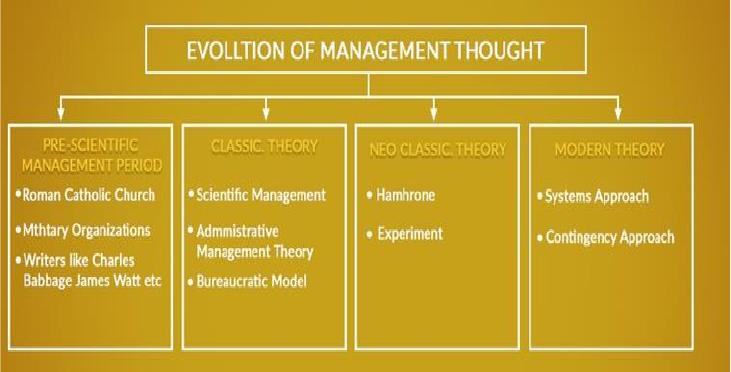
Evolution of Management Thought can be classed into different parts like:
• Pre-Scientific Management Period, before 1880
• Classical Management Period (1880-1930)
• Neo-Classical Management Period (1930-1950)
• Modern Management Period (1950-onwards)
Classical Management comprises Administration Management School, Bureaucracy
Management, and Scientific Management School. The Neo-classical Management
encompasses Behavioural Management School and Human Relation School. The Modern
Management involves Decision theory school, Social system school, Quantitative Management
School, and Contingency Management School.
4
Early Management Thoughts / Pre- Scientific Management Thoughts
The era of 1700-1800 stressed the industrial revolt and the factory system highlights the
industrial revolt besides the significance of direction in the form of a managerial purpose.
Therefore, the development of Management theory is recognized as the process through which
people have writhed with relationships at specific times during the previous periods. There are
many economic theorists who described this idea of management. The industrial revolution
that took place in the 18th century had a significant impact on management as a whole. It
changed how businesses, as well as individuals, raised capitals; organize labor and the
production of goods. Entrepreneurs had access to all the factors of production such as land,
labor, and capital. Theirs was to make an effort to combine these factors to achieve a targeted
goal successfully.
However, the new dimension that management took following the industrial revolution cannot
be discussed without mentioning notable personalities who contributed their quarter. They
were able to introduce useful ideas and approaches to give management a precise and
universally acceptable direction.
The Classical Approach
This approach is viewed as the oldest thoughts of management, and it was linked with the
processes to manage work plus organizations more effectually. The classical approach can be
classed into three groups, such as scientific management, bureaucratic management, and
administrative management. Prof Babbage, Robert Owens, and other names earlier mentioned
can be regarded as the pioneers of management. But their contribution to the evolution of
management is little. The beginning of what is known as the science of management started in
the last decade of the 19th century. Names like Emerson, F.W. Taylor, H.L. Grant, and others,
paved the way for the establishment of what is called scientific management.
During the classical period, management thoughts was focused on job content, standardization,
the division of labor, and a scientific approach towards the organization. It also was closely
related to the industrial revolution as well as the rise of large-scale enterprises.
The Neo-Classical Theory
This period of evolution of management thoughts is an improvement of the classical theory. In
other words, it modified and improved upon the classical theory. For instance, Classical theory
focused more on the area of job content, including the management of physical resources, while
the neo-classical theory gave more profound emphasis on employee relationships in the work
environment.
Modern Management Approaches
Behavioural Approach – Countless theorists established the behavioral approach to
management thoughts because they noticed weaknesses in the norms of the classical approach.
The classical approach put stress on process, efficiency, and principles. Again, some
management scholars hold this view that this thoughts has ignored some vital aspects of
organizational life, as it is linked to human behavior. The different theorists who contributed
to developing principles of management are Abraham Maslow, Douglas Mc Gregor, Rensis
Likert, Mary Porker, and Curt Levin.
The Evolution of Management Theories
The first know management idea were recorded in 500B.C when Sumerian traders develop
written records for government and commercial use. The application of management is also
evident in the Egyptian civilization as early as 4000-3000 B.C. The pyramid of Egypt built
with millions of stone blocks by utilising the services of people are the testimonials of a
coordinated effort on an extremely large scale .Creation of such huge structure would have
certainly required extensive planning ,decision-making, organising men and materials and
supervision.
Roman also made significant contribution to management, which is reflected in western
military hierarchy and public administration systems. It would not possible to manage the large
roman empire without application of sound management principle. Techniques were developed
by army commander to motivate their army and slaves to perform the assigned task in
accordance with their actual potential.
Management and organization are products of their historical and social times and places. Thus,
we can understand the evolution of Management theory in terms of how people have wrestled
with matters of relationships at particular times in history.