Running head: EFFECTS OF GOV SPENDING IN AMERICA FROM 2000 TO 2015 1
The Effects on the Economy of Government Spending in America from 2000 to 2015
Filip D. Crabbs
Houston Community College
Author Note
Filip D. Crabbs, Department of Business Management, class of Econ 2301,
Macroeconomics, Houston Community College.
Special thanks to Professor Phillip Tussing for approval and guidance on the subject
matter.
Correspondence concerning this research paper should be addressed to Filip D. Crabbs,
Student of Business Management, class of Econ 2301, Macroeconomics, 3100 Main Street
Houston, TX 77002. 281-248-3535 Email Filip.Crabbs@me.com
EFFECTS OF GOV SPENDING IN AMERICA FROM 2000 TO 2015 2
Abstract
A budget deficit has been examined each year from 2000 to 2015. With this deficit, the Federal
Reserve has been supplying more money to the US economy. The effects of this heavy
government spending equates to printing more money, creating inflation, depreciating the dollar,
and having a negative public savings. As public savings becomes largely negative, it can crowd
out the private sector, and raise up the interest rate on loanable funds. These are all issues
observed from a macroeconomists viewpoint on the US government’s spending.
Keywords: budget deficit, budget surplus, inflation, deflation, Federal Reserve, nominal
interest rate, real interest rate, appreciation, depreciation, GDP, consumption, investment,
government expenditures, net exports, private savings, public savings, national savings,
crowding out, sequester, capital flight, loanable funds, unemployment
EFFECTS OF GOV SPENDING IN AMERICA FROM 2000 TO 2015 3
The Effects on the Economy of Government Spending in America from 2000 to 2015
In order for an economy to exist, there must be some form of government. This
government is in place to protect and serve the people. Without security from the government,
the very fabric of a society can be ripped apart by foreign and domestic influence. When the
integrity of a society is being compromised, capital flight can occur when investments in that
country are too dangerous, so the investments, or loanable funds move to a safer and more secure
location. This panic can cause a major slow down in a country, which results in a recession and
possible depression. War breaking out in a country is an example of this. All of this is linked to
government spending.
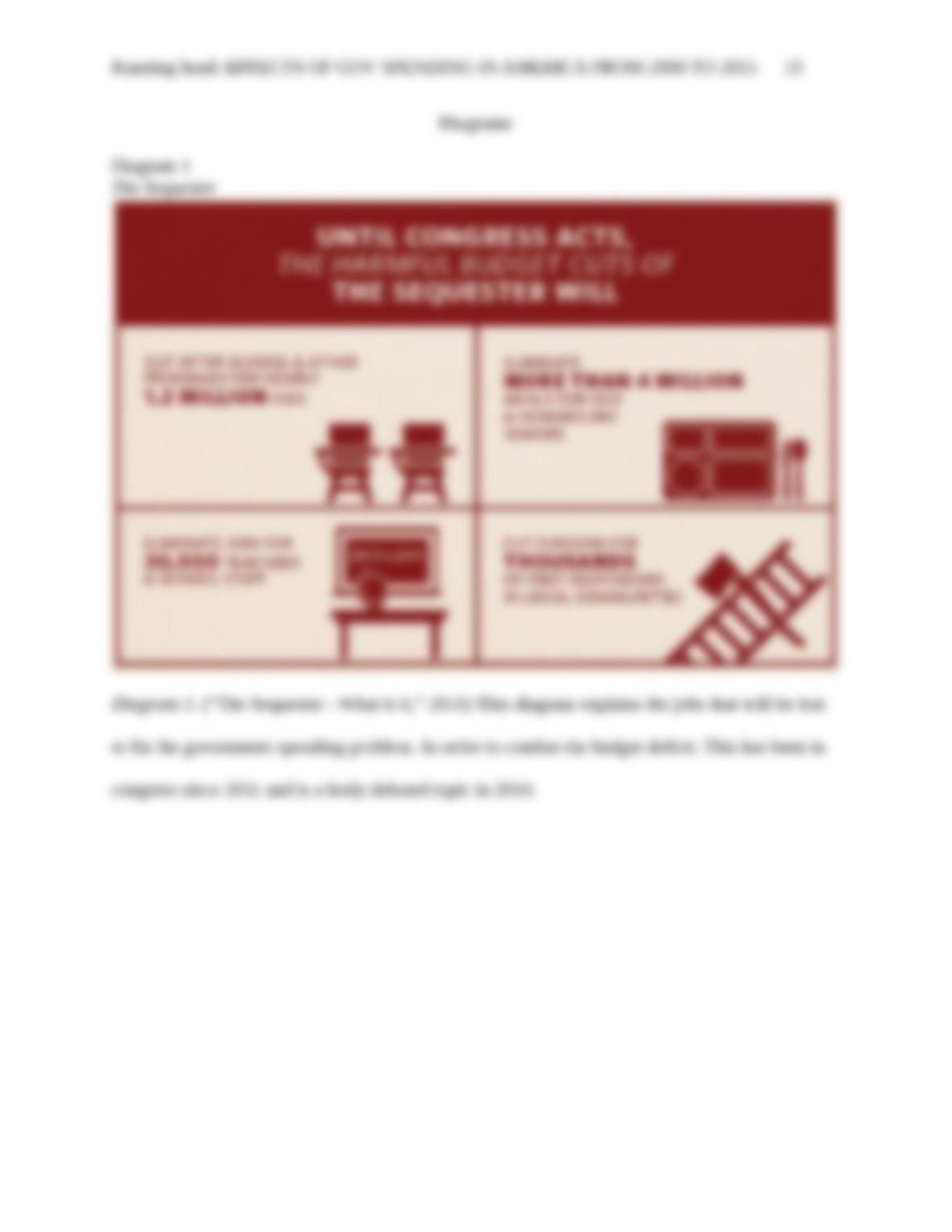
Currently a hot topic of debate is the sequester. The sequester described in diagram 1, is a
budget cut of over 1.2 million after school activities for kids, 30,000 teacher jobs, more than 4
million meals for sick and homebound seniors, and a cut in funding for 1,000’s of first