1
The Effect of NAFTA On Tomatoes Trade
Between the United States and Mexico
Econ 4431W FINAL DRAFT
ZUOCANG FAN
5117492
12/6/2016
2
Abstract:
This paper looks at the effects of NAFTA on tomatoes trade between the United States and
Mexico during 1991-2013. More specifically, the paper examines how the trade prices, trade
volume, productivity as well as agricultural land had changed by testing the theory of
comparative advantage. The theory of comparative advantage predicts that Mexico, which
has a lower relative pre-trade price on tomatoes should specialized in tomatoes production
and export the abundant amount. When NAFTA came into effect, the tomatoes price in
Mexico, relative productivity of Mexico-U.S., agricultural land in Mexico, total trade volume
between two countries are expected to increase. After done the regression analysis, the
results showed NAFTA has limited effects on those parameters, which means the key factors
in the bilateral trade like changes in relative productivity, Mexico export volume cannot be
explained by the implementation of NAFTA. Besides, as for the comparative advantage
theory, it did hold in that industry, but only changes in the U.S. import volume can be
explained by the theory. However, although the comparative advantage was not significant
explain the changes of the other variables, I did find those changes followed the trend of
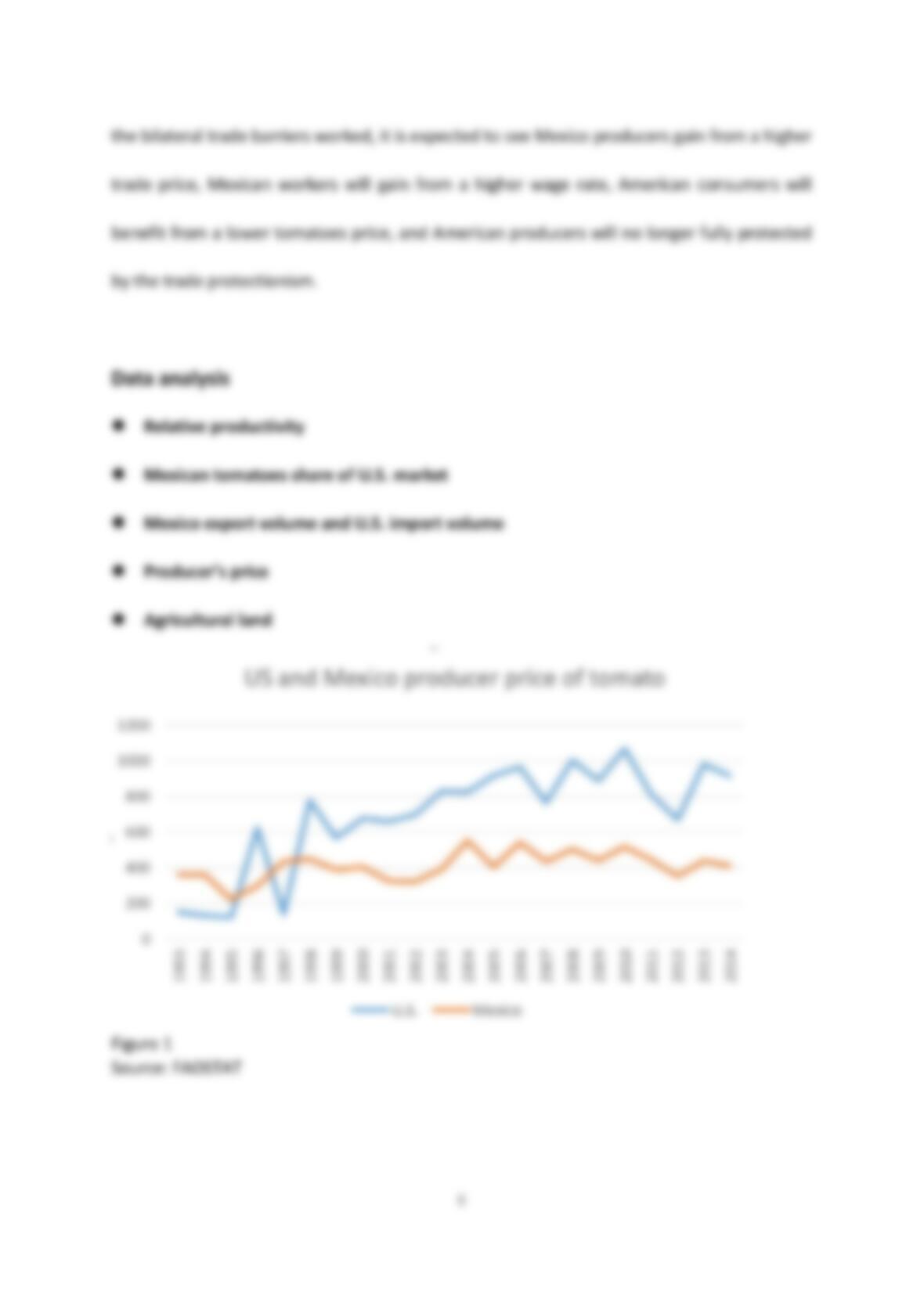
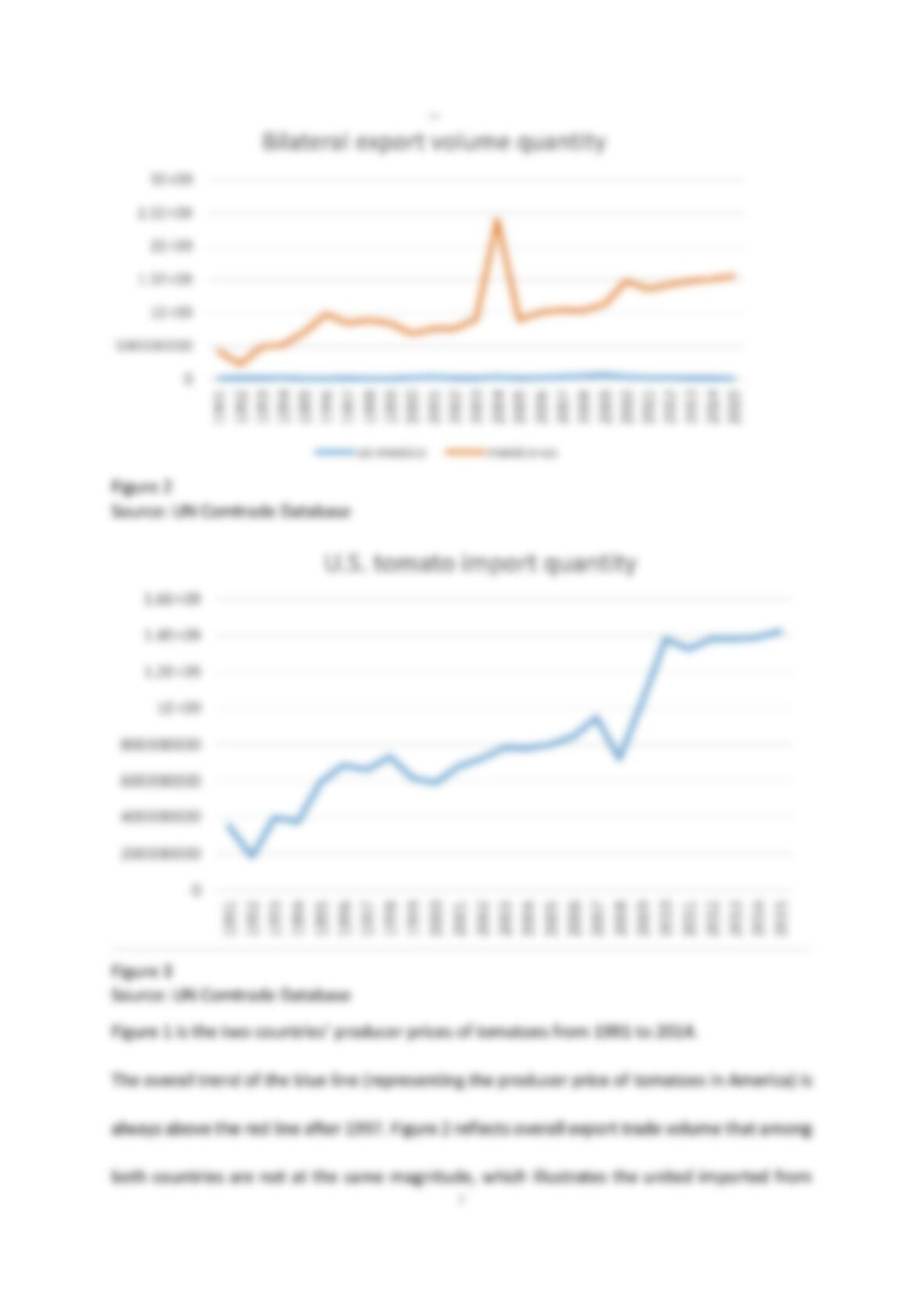
that theory predicted: Mexico-U.S. export trade volume increased, the producers price of
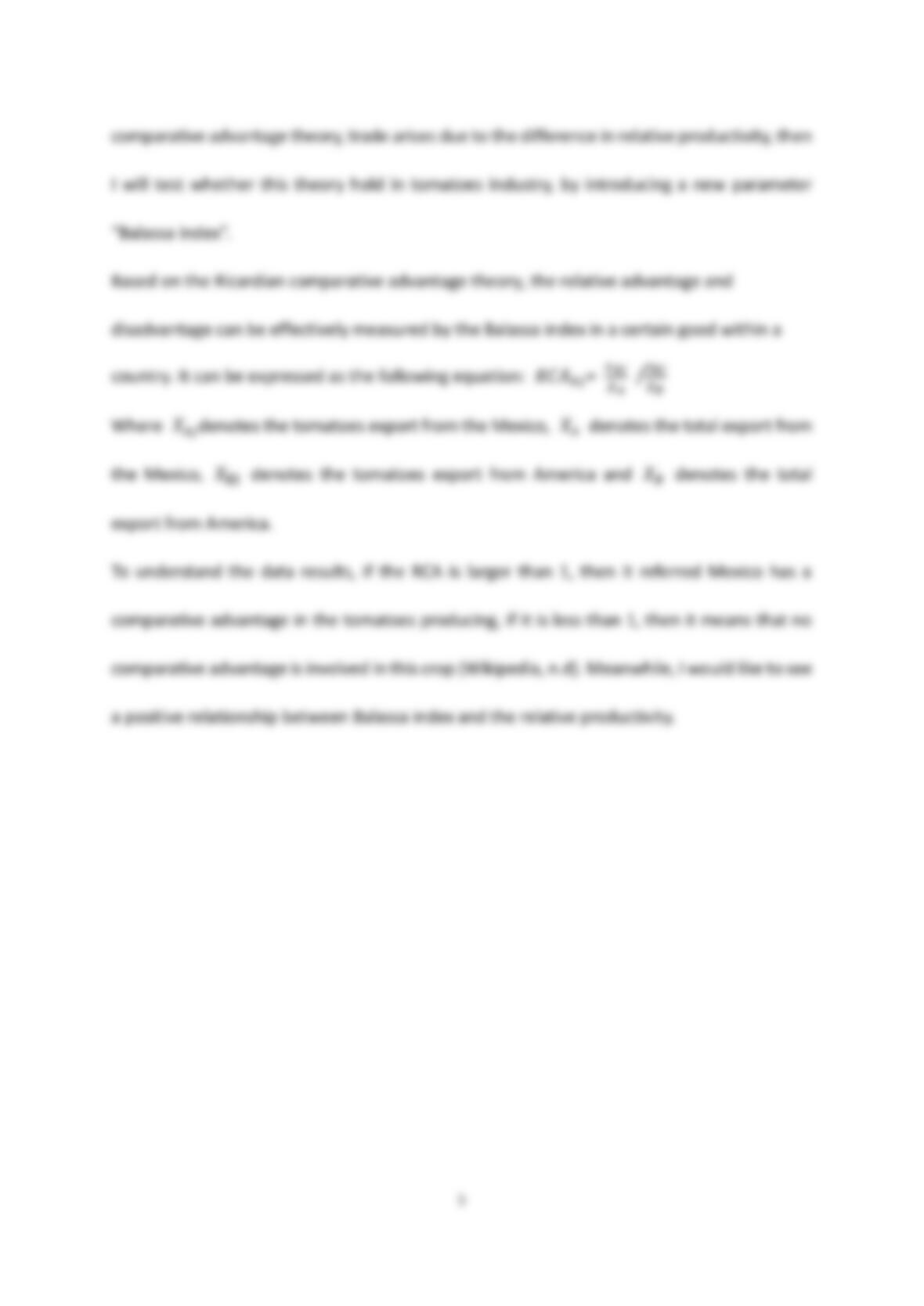
tomatoes in U.S. and Mexico decreased and increased respectively, relative productivity
increased, agricultural land accounts for total land increased.
3
Introduction
On January 1, 1994, the North American Free Trade Agreement (NAFTA) which was signed by
the United States, Mexico and Canada came into effect. Basically, the agreement removed the
trade barriers include both tariff and non-tariff trade barriers, but at first, the agriculture
sector was not included in the NAFTA, after finished the follow up negotiation, the removal of
trade barrier on agriculture sector were finally achieved. The U.S. has one tariff rate for two
different season periods, from March to mid of July, and from September to November, a tariff
of $0.039/lb will be levied. With the implementation of NAFTA, the tariffs from mid of July to
August, September through mid of November were phased out at the end of 1999 and
remaining tariffs were finally disappeared in 2004. Also, the import quota of 210,000 metric
tons on Mexican tomatoes was terminated in 2003 (Brunke,2002). Until now, due to the
contribution of NAFTA on trade barriers removal of agriculture, the overall trade volume has
increased dramatically over the last two decades. This paper will explore the bilateral impacts
that NAFTA had on tomatoes trade between US and Mexico by testing the comparative
advantage theory. Specifically, this paper will examine whether the trade price, trade volume,
relative productivity level as well as agricultural land in the tomatoes industry were affected
by NAFTA. In reality, the empirical test results turned out the effects of NAFTA on tomatoes
industry are limited and theory of comparative advantage did hold in this industry, but only
the change in U.S. import volume can be explained by this theory.
Historical background of US& Mexican tomatoes production and the role of NAFTA
Traditionally, Mexico dominates the production of tomatoes which is more than 50% among
three NAFTA members, and it is also the largest tomatoes import partner to America,
4
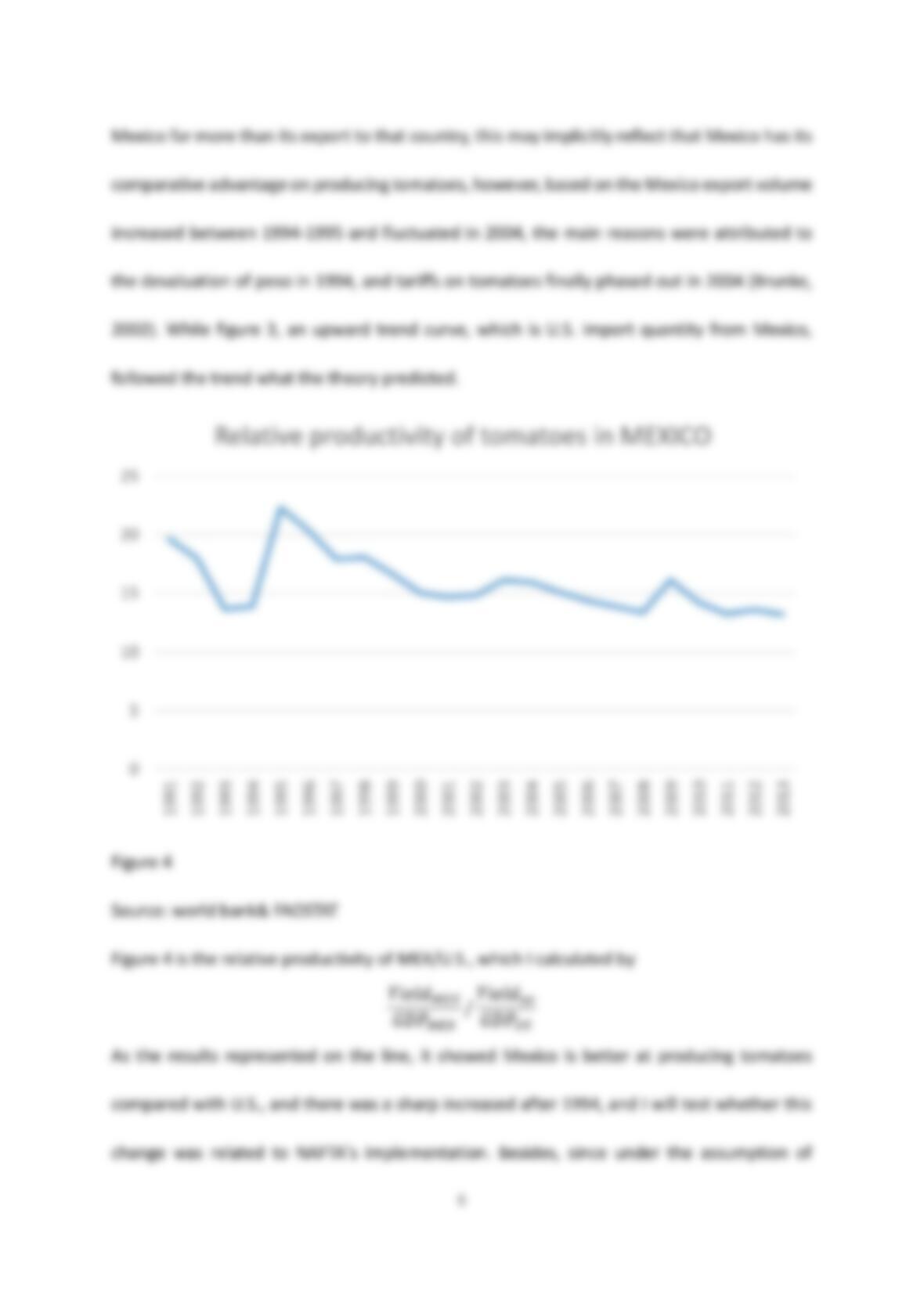
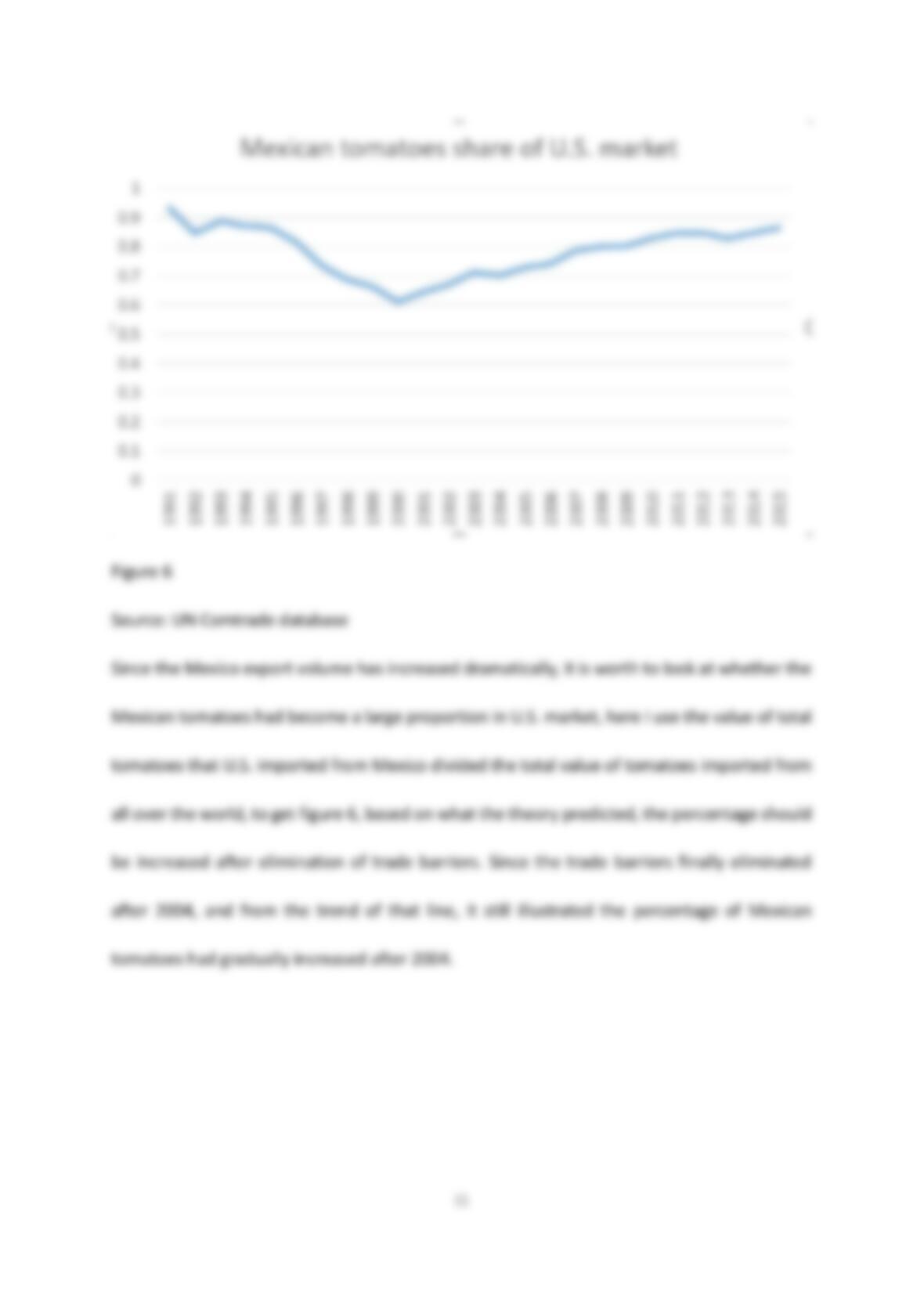
accounted 95% of import market share in U.S. Since the implementation of NAFTA in 1994,
Mexican exports tomatoes to U.S. have grown 5.5% annually (Gary 2004). In the United States,
tomato imports are made up of 20% in total fruit and vegetable imports from Mexico. After
NAFTA came into effect, the percentage doubled (USDA, 2003). NAFTA played its role in
eliminating tariff definitely will be the main reason to prompt bilateral trade in tomatoes
industry. It is necessary to figure how much contribution did NAFTA made to change the
tomatoes bilateral trade, the following analysis will base on the parameters mentioned above.
Theoretical analysis
This paper will use the comparative advantage theory to tomatoes industry to explore
whether NAFTA changed its trade pattern. The comparative advantage was first introduced by
David Ricardo, and it is an expansion of the absolute advantage raised by Adam Smith. This is
2*2 model (two-good and two-country) used to explain the effect of free trade, the
assumptions under this theory are: market is perfect competition, only one production factor,
same technology used in both countries, under no trade barriers, production factor is
immobile between two countries, apply labor theory of value, no transportation costs,
constant opportunity cost. Although these assumptions are not realizable in the real world,
this theory is still important in predicting the outcome of trade liberalization.
However, since only one good is introduced in the model, it is not feasible to analyze the
comparative advantage other than arguing the absolute advantage. As a result, with
introducing a second good makes it possible to predict that even a country with a lower
productivity on one good still probably having a comparative advantage on that. For the
purpose of analysis, the theoretical model is based on trade in tomatoes and wheat, both
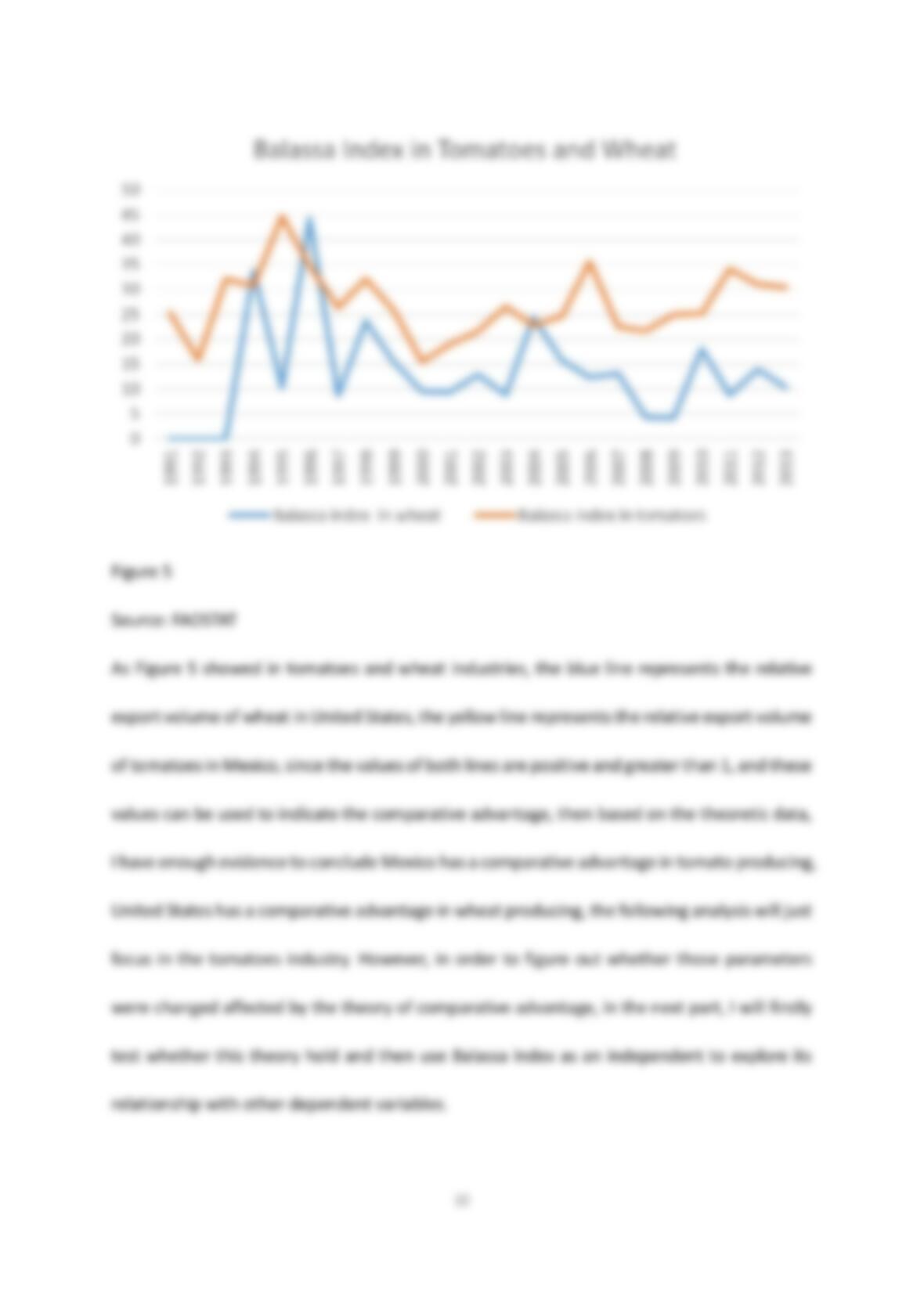
goods are efficiently producing by the United States. The figure 5 showed the Balassa index,
an indicator of the comparative advantage, the detail explanation will represent in the data
analysis part, as the values appeared on each line, since they are all larger than 1, I can
conclude Mexico has a comparative advantage in producing tomatoes and U.S. has a
comparative advantage in producing wheat, in other words, Mexico is relatively more
productive in producing tomatoes and the United States produce wheat relatively more
efficiently than Mexico. In this paper, I will just focus on the comparative advantage in
tomatoes industry. As a result, the theory of comparative advantage predicts that Mexico will
produce more and export more tomatoes to the United States when trade liberalization
happened.