Chapter 6
The ecological dimension of
globalization
Although we have examined the economic, political, and cultural aspects of
globalization separately, it is important to remember that each of these
dimensions impacts on and has consequences for the other domains.
Nowhere is this more clearly demonstrated than in the ecological dimension
of globalization. In recent years, global environmental issues such as global
climate change and transboundary pollution have received enormous
attention from research institutes, the media, politicians, economists, and
the public in general. Unsustainable forms of ecological globalization are
now recognized as threatening all life on our planet. The worldwide impacts
of natural and man-made disasters—such as the horrifying 1986 nuclear
plant accidents at Chernobyl, Ukraine, and Fukushima, Japan, in 2011, or
the massive 2010 Deepwater Horizon oil spill in the Gulf of Mexico—
clearly show that the formidable environmental problems of our time can
only be tackled by a global alliance of states and civil society actors.
In the 21st century, it has become virtually impossible to ignore the fact that
people everywhere on our planet are inextricably linked to each other
through the air they breathe, the climate they depend upon, the food they
eat, and the water they drink. In spite of this obvious lesson of
interdependence, our planet’s ecosystems are subjected to continuous
human assault in order to maintain wasteful lifestyles. Indeed, cultural
values greatly influence how people view their natural environment. For
example, cultures steeped in Taoist, Buddhist, and various animist religions

often emphasize the interdependence of all living beings—even if their
adapted capitalist practices do not always live up to their cultural imperative
of maintaining a delicate balance between human wants and ecological
needs. Judaeo-Christian humanism contains deeply dualistic values that put
humans in control of nature. In Western modernity, the environment has
thus come to be considered as a ‘resource’ to be used instrumentally to
fulfil human needs and desires. Consider, for example, the clear-cutting of
rainforests around the world in the name of ‘harvesting resources’. It
threatens the livelihood and cultures of indigenous people, not to speak of
the countless animal and plant species that have been wiped out merely to
serve oversized human demands.
As we noted in Chapter 5, the most extreme manifestation of this
anthropocentric paradigm is reflected in the dominant values and beliefs of
consumerism. The capitalist culture industry seeks to convince its global
audience that the meaning and chief value of life can be found in the
limitless accumulation of material goods. Recently, researchers capable of
linking natural and social history have suggested that the damaging impact
of human activity on our planet justifies the naming of a new current
geological period: the Anthropocene—the age when human activity has
become the dominant influence on Earth’s climate and environment.
In the last few decades, the scale, speed, and depth of Earth’s ecological
decline have been unprecedented. Consider, for example some of the most
dangerous manifestations of the globalization of environmental degradation
depicted in Figure F.
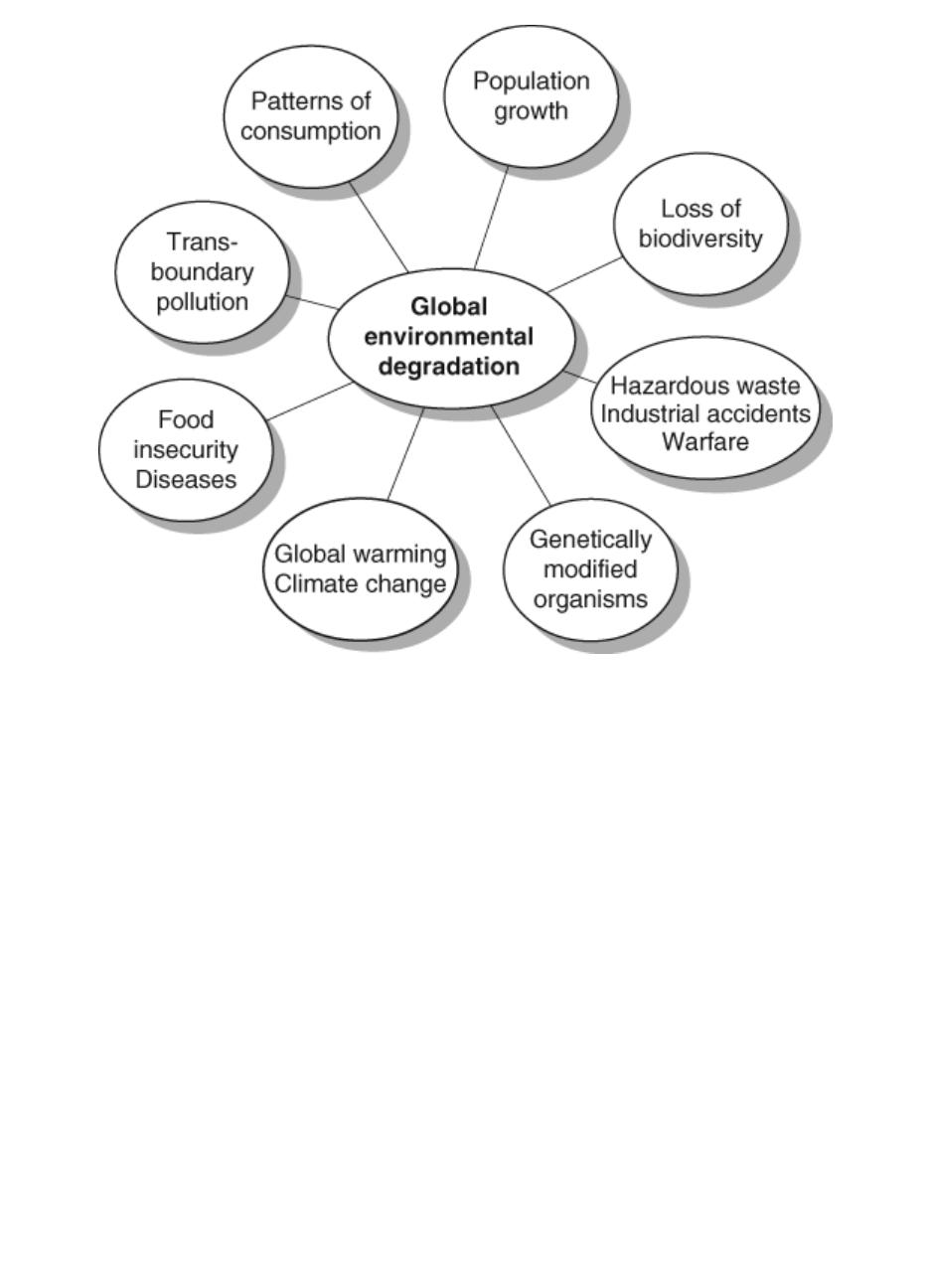
F. Major manifestations and consequences of global environmental degradation.
Two major concerns relate to still uncontrolled population growth in parts
of the global South and the lavish consumption patterns in the global North.
Since farming economies first came into existence about 480 generations
ago, the world population has exploded a thousand-fold to reach nearly 7.7
billion in 2019. Half of this increase has occurred in the last thirty years.
With the possible exception of rats and mice, humans are now the most
numerous mammals on earth. Vastly increased demands for food, timber,
and fibre have put severe pressure on the planet’s ecosystems.
Large areas of the Earth’s surface, especially in arid and semi-arid regions,
have been used for agricultural production for millennia, yielding crops for
ever-increasing numbers of people. Concerns about the relationship
between population growth and environmental degradation are frequently
focused rather narrowly on aggregate population levels. Yet, the global
impact of humans on the environment is as much a function of per capita
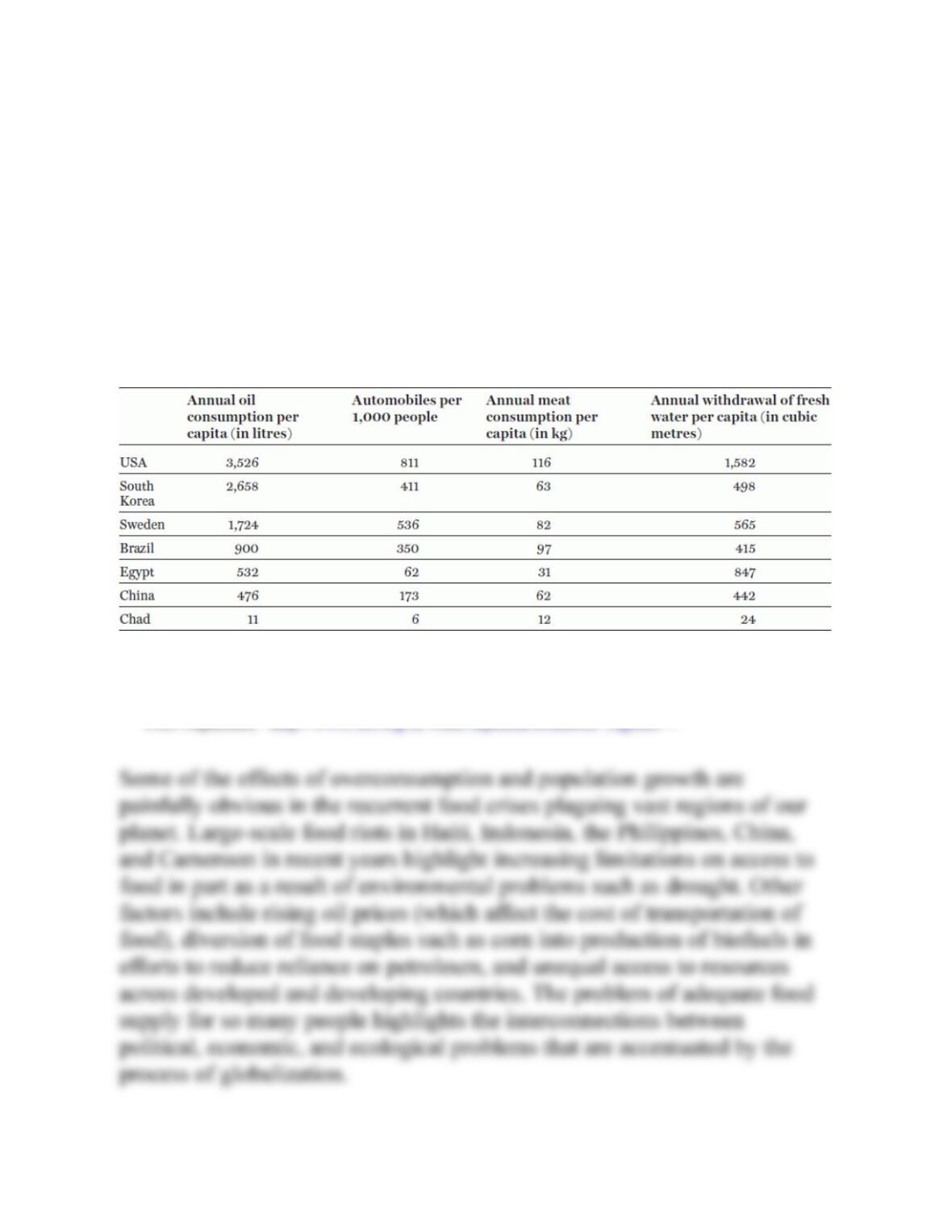
consumption as it is of overall population size (see Table 4). For example,
the United States comprises only 6 per cent of the world’s population, yet it
consumes 30–40 per cent of our planet’s natural resources. Together,
regional overconsumption and uncontrolled population growth present a
serious problem to the health of our planet. Unless we are willing to rethink
the relentless drive for profits-at-all-cost that sustains these ominous
dynamics, the health of Mother Earth is likely to deteriorate further.
Table 4. Annual consumption patterns (per capita) in selected
countries, 2015–2019
Source: Oil: World by Map, <http://world.bymap.org/OilConsumption.html>; Cars: Wikipedia,
<https://en.wikipedia.org/wiki/List_of_countries_by_vehicles_per_capita>; Meat: Our World in
Data, <https://ourworldindata.org/meat-and-seafood-production-consumption>; Water: Statista, <
https://www.statista.com/statistics/263156/water-consumption-in-selected-countries/> and UN