Running head: THE CASE OF ONLINE GROCER WEBVAN 1
The Case of Online Grocer Webvan: A Poor Business Decision
Nov 24, 2014

THE CASE OF ONLINE GROCER WEBVAN
2
The Case of Online Grocer Webvan: A Poor Business Decision
How would you define a poor business decision?
A poor business decision could be a poor investment decision, a holdup problem, a missed price
discrimination opportunity, failure to adapt to market changes, an asymmetric information
problem, a poor vertical relationship etc.
Google+ launched by Google, Investment in Surface tablet by Microsoft, IPO of Facebook,
Investment in iPhone 5C by apple – these events can be classified among the poor business
decisions in history. Every business person, company or organizations in their career makes
mistakes related to investments. Important is how they address that investment mistake and
bounce back for the benefit of their company.
Either one or a combination of them can result into a poor investment decision:
Relevant Facts – Relevant details or facts not collected before investment is made by the
decision makers
Assumptions – Investment decision made on the assumptions of few decision makers
Target Audience – The decision makers target the wrong market audience, segmentation
and pricing
First Market Entrant – You are the first entrant. You do not follow the strategy of
‘observe and make a move’
Business Model – The model designed for the business is very complex
Market Data – Decision makers made the decision based on the market and sales data of
a substitute or a completely different product
Expansion Strategy – Wrong or poor expansion strategy

THE CASE OF ONLINE GROCER WEBVAN
3
One such Poor Investment Decision which captured my attention and interest is “The Case of
Online Grocer Webvan”. I chose this for my case study since this case highlights some of the
most important marketing and economic decisions which resulted in company closing down or
going bankrupt. CNET had published a list of top 10 Dot-Com failures ever in 2008 – Online
Grocer Webvan had topped the list. During the dot-com boom many investors believed that
internet companies are immune to sound business practice or basic laws of economics. Such
investment decisions results in waste of investment, time, resource, research and development,
basically high opportunity cost – the same could have been put to a better use. It may also
undermine the name of the company or brand to such an extent that it would be impossible to
grab a foot hold again. This may also harm their future or other successful products in the
process.
Why was this investment made?
Louis Borders was a successful entrepreneur in book retailing. He formed a firm named
Intelligent Systems for Retail in 1996, which had a computerized inventory system that
customized the stock in each of their local bookstore. This idea was a major factor in their
bookstore success. This had convinced him that intelligent inventory management and delivery
could open up many new business avenues. The concept of online grocery market was still new
during that period, so he forecasted that even if 5% of US households shop grocery online in few
years, by 2000-2003 the market would reach to $3.5 billion to $6.5 billion respectively. In 1997,
he wanted to take advantage of people shopping online and thought this was an opportunity to
revolutionize grocery retailing in United States. He wanted customers to go online and order
groceries at their convenience. The groceries would then be delivered at their doorstep at a cost
no more than what they would have incurred if they had picked it up from the supermarket. He
believed that this could be achieved by computerized scheduling and automated warehouses.
THE CASE OF ONLINE GROCER WEBVAN
4
His previous successful venture enabled him to attract capital investment from first-class
investors – Sequoia Capital, Benchmark Capital, Goldman Sachs, Amazon and others –
including some of this own fortune. The company’s IPO enabled them to raise $375 million.
Finally, the company acquired $1.2 billion in capital using various efforts.
Introduction
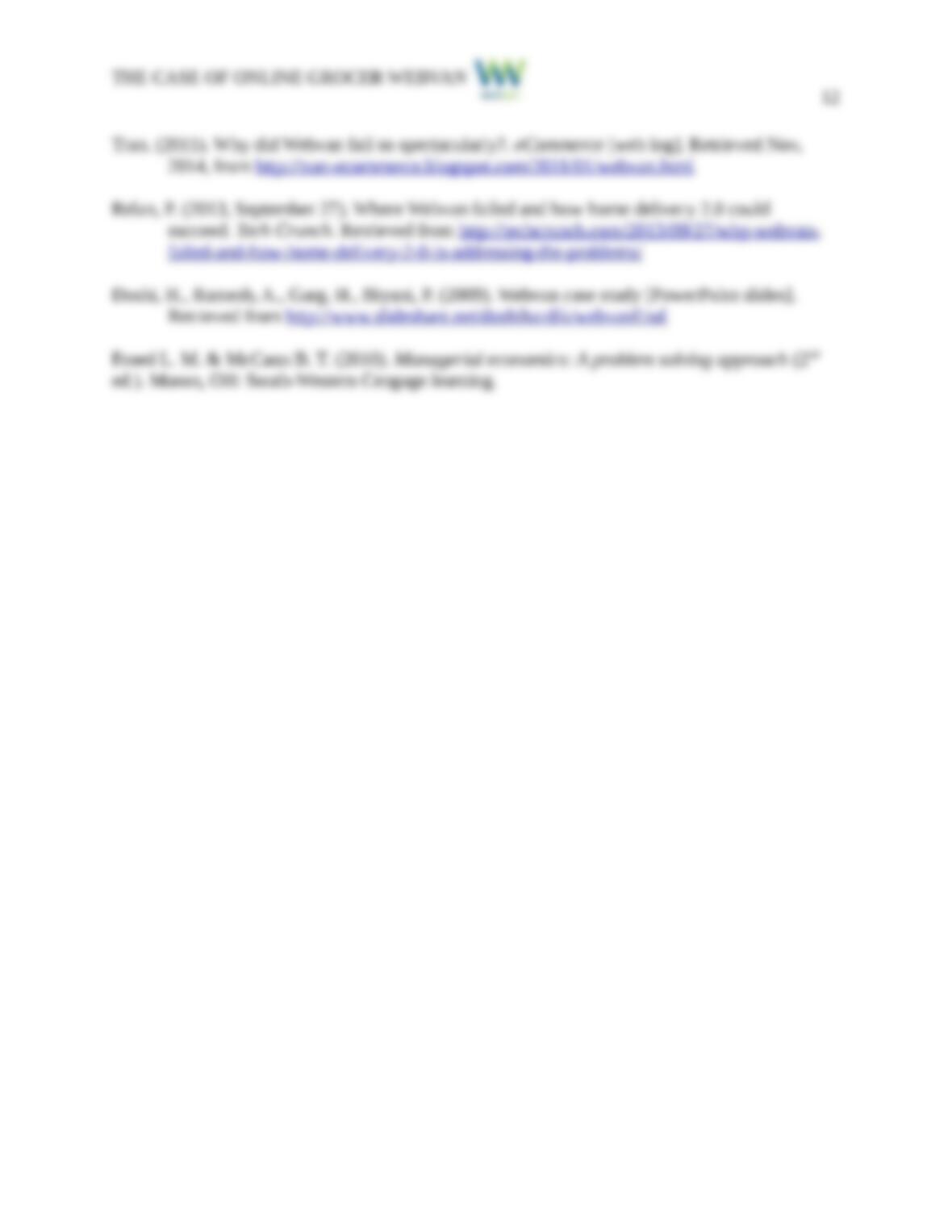
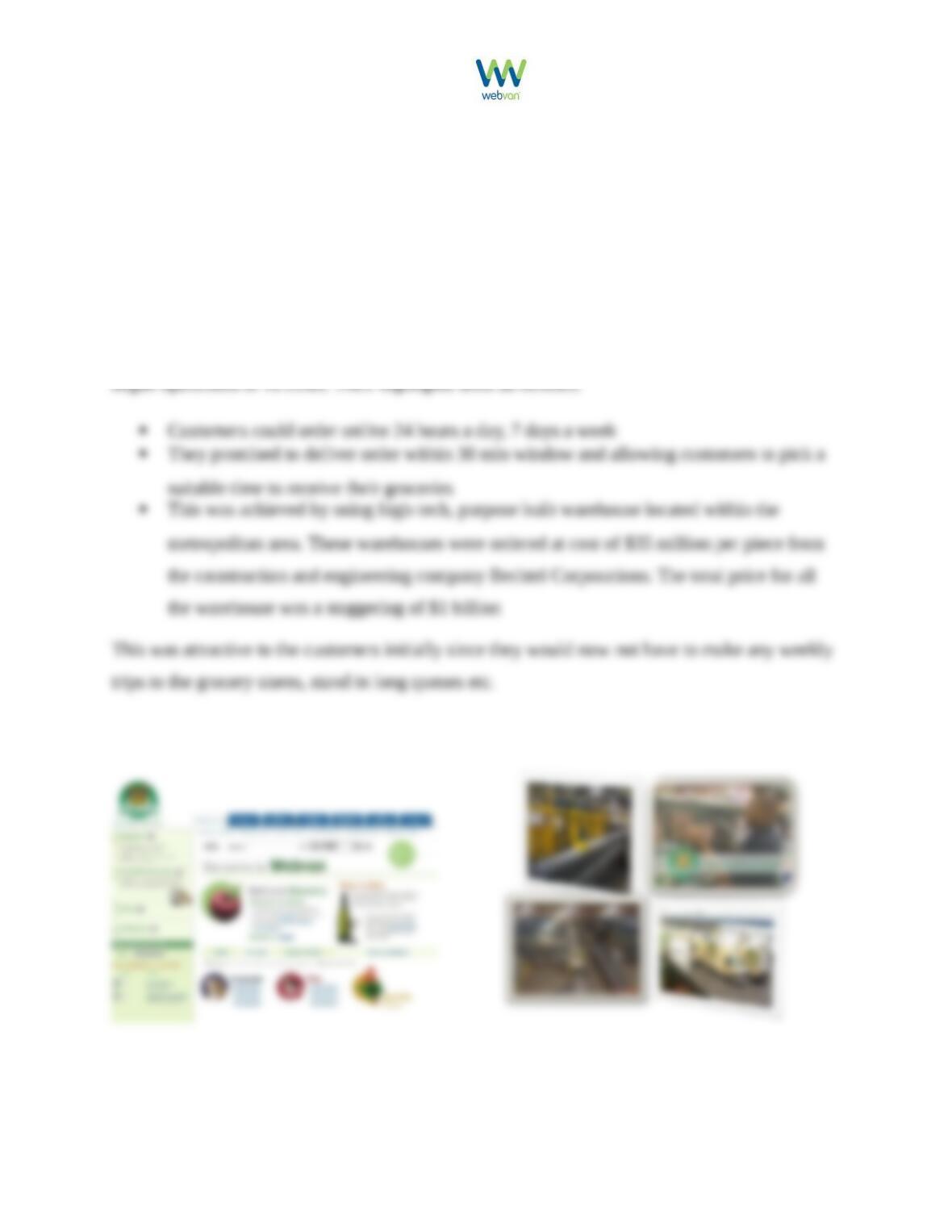
Their initial plan was to open Webvan’s operations in 26 metropolitan areas in America. Webvan
took its first grocery order in San Francisco Bay area in June 1999 and by end of 2000 they