Final Report:
The Brexit Eect on Multinational Corporations
Monday December 5, 2016
Table of Content
Introduction……………………………………………………………………………………………………………………………….3
Foreign Direct Investment Versus Por,olio Investment………………………………………………………………3
Multinational Company 1: Toyota……………………………………………………………………………………………..4
Recommendation for FDI Allocation…………………………………………………………………………………………..5
Multinational Company 2: Heineken………………………………………………………………………………………….6
Recommendation for FDI Allocation…………………………………………………………………………………………..9

Multinational Company 3: Royal Philips NV
(Philips)…………………………………………………………..9
Recommendation for FDI Allocation…………………………………………………………….……………………………
12
Conclusion………………………………………………………………………………………………………………..………………
13
Appendices……………………………………………………………………………………………….………………………………
14
Introducon
The United Kingdom`s recent decision of withdrawing from the European Union, commonly
known as Brexit, has le7 many multinational corporations and countries with the challenge of
making the right decision in an environment full of uncertainty. Brexit has impacted three of
the many in8uential global companies: Toyota, Heineken NV, and Philips NV. These companies
are subject to operational, <nancial, strategic, and hazard risks while conducting business in the
European market therefore it is essential to identify them and minimize them. Throughout this
report, we will compare the measures companies should take to protect themselves for the
future such as relocating their FDI, maintaining it or considering other options in their best
interest.
Foreign Direct Investment Versus Por#olio Investment
In brief, it is important that one knows the dierence between Foreign Direct Investment
(abbreviated as FDI) and Por,olio Investment. Foreign Direct Investment is de<ned as an
investment made by an individual or company from outside a country with the aim of
expanding business interests in the foreign partnering country for long- term pro<ts by creating
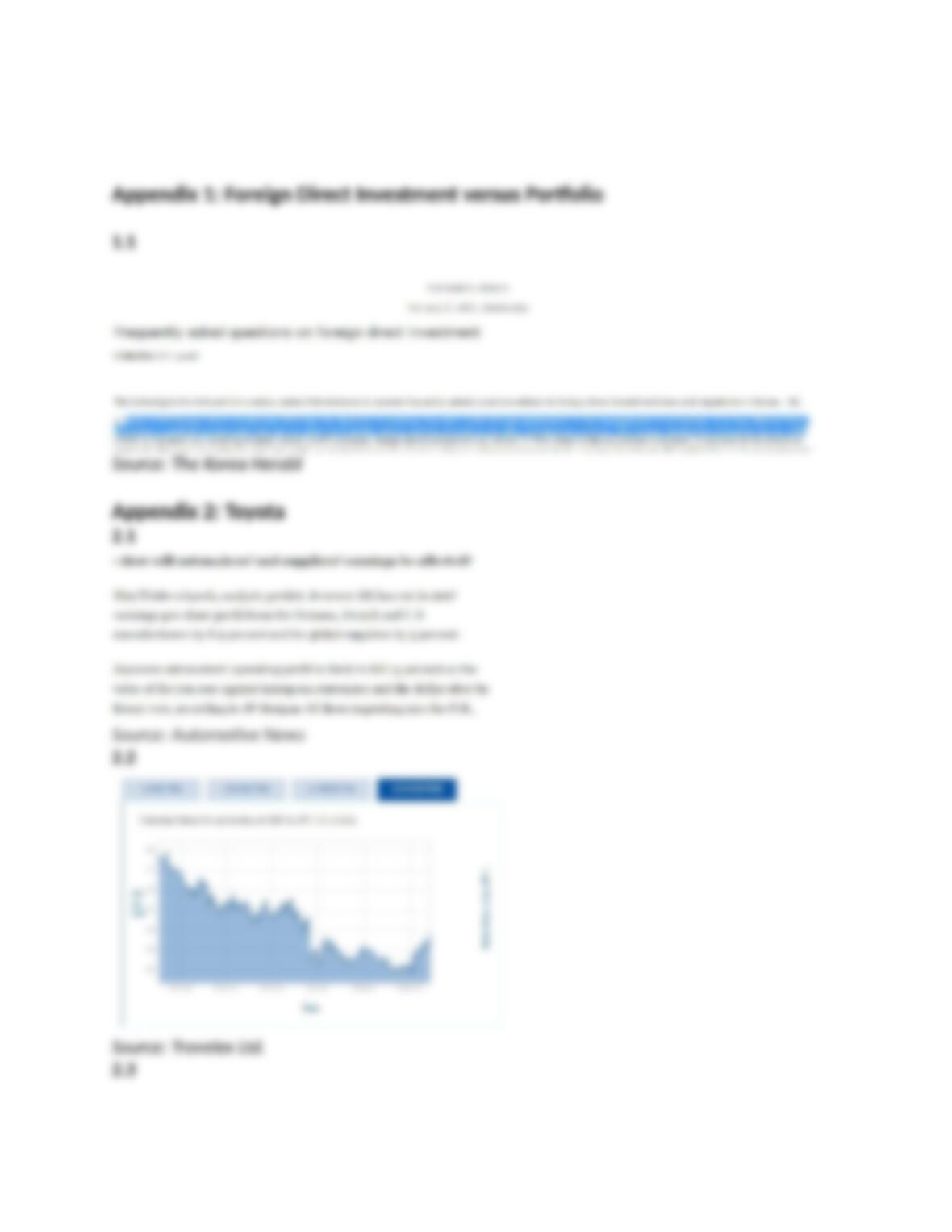
business operations and managing the companies. (View 1.1) On the contrary, Por,olio
Investment aims for short-term pro<ts without geBng involved with daily managements of the
company but rather directly by the investor. It involves grouping of equity securities, bonds, and
cash equivalents with the expectation of a return. An example of FDI would be if an American
automotive <rm expanded its business in France in order to be able to market to French
residents. FDI would bene<t both the French economy and American economy. The home
country would generate revenue from the expansion of the business and pro<t however the
host country, France would receive revenue through equipment/service taxes as well as

employee tax income as a result of employing French labour. FDI also allows the transfer of
technology and expertise between the partnering countries. An example of por,olio
investment would include a regular individual looking to acquire some <nancial assets such as
stocks from the company Tesla, which would generate pro<t speci<cally to them. Overall,
Foreign Direct Investment is a relatively bigger risk, aecting more stakeholders rather than
Por,olio Investment, which generally involves the individual but even that can be avoided with
the advice of a <nancial advisor.
Mulnaonal Company 1: Toyota
Toyota is a known Japanese multinational company for automotive manufacturers and it is
the market leader for hybrid electric cars. Considering its large market, they have foreign direct
investments worldwide with one of them being situated in the UK. The types of risks Toyota will
encounter are <nancial risks, operational and hazard risks. The most common risk circulating the
company is <nancial risk, especially involving FDI; therefore they need to analyze internal factors
such as company cash 8ow as well as external driven factors such as foreign exchange and credit
in order to minimize risk. Toyota’s operations are subject to currency and interest rate
8uctuations in each foreign country. In relations to internal risk, the Japanese automaker’s
operating pro<ts is likely to fall by 15 percent as the value of yen rose against the declining
British currency. (View 2.1) In the beginning of the year (January 2016), the exchange rate was
177.7 Japanese yen to 100 British Sterling pound, however in November, the value of the
sterling pound decreased and the rate was 136.67 JPY to 100 GBP. (View 2.2) This inconsistent
8uctuation over the year has aected their pro<ts and prices for vehicles. It is not bene<cial for
Japanese exporters who will lose value on exports on if the yen is closer to the value of the
pound. Determining price increases on vehicles to maintain pro<t will be a challenge to the
executive team operating in the UK. In addition, they are exposed to operational risks due to
the change in trade regulations. The Derbyshire factory made 172,288 vehicles in 2014, which
contributed more than 10 percent of total UK auto production. (View 2.3) Most of this output is
exported from the UK therefore they primarily rely on an easy access to the European markets
which could be threatened by taris or trade barriers resulting from the exist of the European
Union that provided them a free trade agreement for all member countries. A Pre-Brexit
analysis by the Society of Motor Manufacturers and Traders stated that a 10 percent tax on
vehicles exported from the UK would be deducted from each sale. This means that the plant
must <nd a way to compensate the 10 percent loss of pro<t, which wasn’t part of the pro<t
margin, especially since demand for recent car models have slowed down in April. (View 2.4)
Recommendaon for FDI Allocaon
Toyota shouldn’t relocate their FDI in Europe because it doesn’t pose as a high risk for their
<rm that has been in the UK (speci<cally England) for over 50 years. Japanese companies are
very cautious in decision-making; they always plan investments for long-term impacts. Due to
Brexit a7ermath, the sterling pound has depreciated therefore Japanese export-operations in
the UK are more pro<table, provided that they export to the EU and other countries that have
Free Trade Agreements. (View 2.5) Toyota’s FDI was allocated in the UK for over 50 years thus
the referendum is nothing out of the ordinary considering they have a long history of being in
ambiguous situations when it comes to economic and political decisions. The UK had a
referendum in 1975 with 67 percent of the population voting to stay in the European Economic
Community and they later opted out of Maastricht Treaty. (View 2.6) The UK also signed the
Lisbon Treaty in 2008 allowing them to opt-out of any policies that wouldn’t bene<t them. They
refused the Euro currency in fear of economic damage since their British pound is strong. The
reason the current referendum happened was because too much transfer of wealth from the UK
to the EU countries and no control over government spending. (View 2.7) The culture of the
British people is that uncertainty is normal which explains their weak uncertainty avoidance of
35 therefore any changes impacted by Brexit will not be heavily resistant. (View 2.8)
Mulnaonal Company 2: Heineken
Heineken NV is the operational arm of Dutch Multinational Corporation, Heineken
International. It is one of the largest brewing companies in the world both by production,
measured in million hectoliters, and sales. Founded in Amsterdam as a small family owned
brewery in 1864, Heineken Group has grown to own and maintain the production, distribution,
and sale of over 250 unique beverages in more than 70 countries around the world, including
their 8agship product of which the company gets its name, Heineken. Heineken NV and its
subsidiaries, including Heineken UK, engage in the operational activities of the company in
dierent regions around the globe. Heineken UK employs over 2000 people for the production