Notre Dame University-Louaize
Faculty of Business Administraon &
Economics
The Balanced Scorecard
Aco 620 Final Project
Prepared by:
Armand Chekherdemian
Stephanie Akiki
Presented to:
Dr. Elie Menassa
General Background:
Success in the business world is all about constant development. There isn’t a business entity in
the world that is able to, or can in the future, survive by just relying on its current state. Even the
biggest of business can fall due to a lack of good planning.
Taking a look at examples such as Marks & Spencer (in the 1990s, it had lost its market position
and customer base), or Manchester United during David Moyes’ reign in 2014(replacing a living
legend who served the club for 27 years) which cost them a reported 38 million pound fall in
profits in that year alone, we can definitely back the claim that businesses need proper planning
and control procedures to succeed in this current business environment.
Hence, businesses nowadays need to find proper control procedures and sustainable systems to
not only survive the current market but also to plan for future survival in a volatile business
world where a firm can be top on one day, and disappear on the next.
These procedures and systems are not only restricted to pure financial and quantitative data.
After all, financial data does not tell us the entire story. Other, none quantitative data should also
be processed and formulated into understandable information that management should use to
assess and improve its firm.
This is where the balance scorecard comes into play. Developed by Drs Robert Kaplan and
David Norton, it is a strategic planning and management system used to evaluate performance
and improve the aspects of the business as a whole. It also provides feedback and helps with the
external and internal communication process. It essentially combines the non-financial key
elements of success to the financial metrics directly related to succeeding business.
Nowadays, any business entity with any structure uses the balanced scorecard to assess
performance. It is essentially the most up to date base to measure success. It can also be adjusted
to reflect the metrics and variable performance tools used in distinguished industries. The
balanced scorecard also reflects a balance between short term and long term company goals and
objectives.
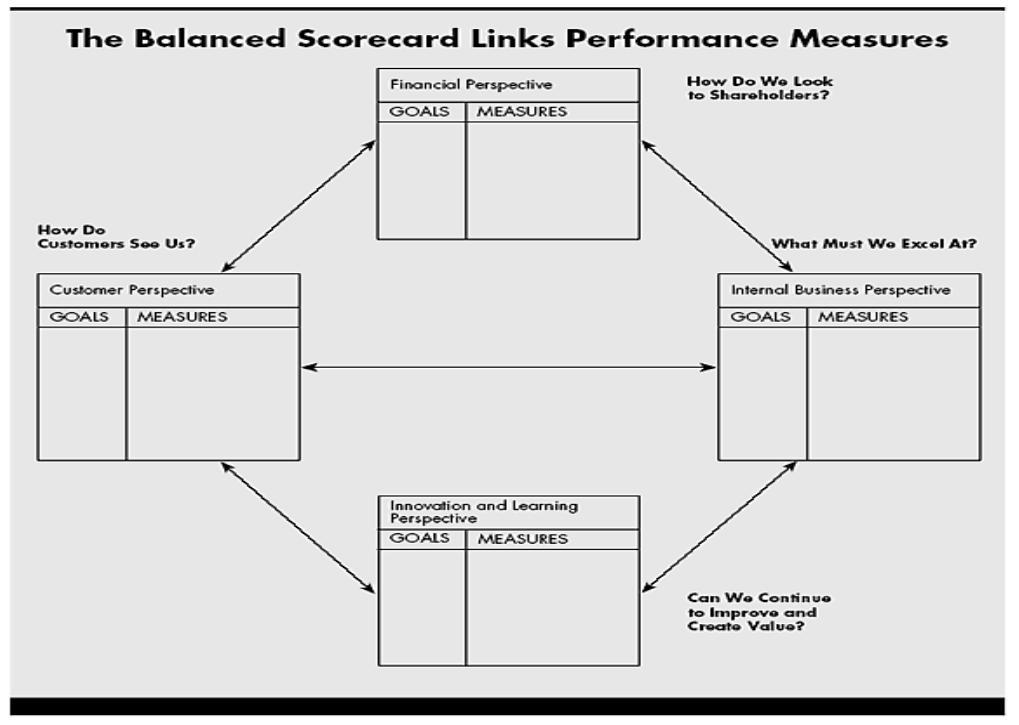
The basic balanced scorecard contains 4 main components:
Customer Perspective (How Customers see the business)
Financial Perspective (How Shareholders see the business)
Internal Business Perspective (What must the business excel at)
Innovation and Learning Perspective (Ways to improve and create added value)
Literature:
There are many research studies conducted the concept of the balanced scorecard. One
researched studied the effect of the balanced scorecard on the Chinese government and its
performance. Daokui Jiang and Zuankuo Liu of Shandong University Business School
performed the necessary research needed and deduced several conclusions utilizing the concept
of the balance scorecard to evaluate the government’s performance and general success rate.
They appraised the performance of their government using the balanced scorecard system in the
following ways:
1- Financial Perspective:
The researchers determined that although the government’s financial performance had an
important role, it should not be the only reviewed performance tool to determine the “score”
the government should get. Re-iterating what the researchers said, one of the most common
mistakes that most firms commit is focusing and stressing too much on financial indicators
and in the same totally ignoring other perspectives.
Seeing as though the government is essentially the major representative for the public sector,
it mainly belongs to the service industry sector. Therefore, its main interest is to make the
lives of its citizens better and show good value for money spent, which has been collected
through collecting taxes. Therefore, in this case, the main financial perspective indicator is
administrative expenditure in the total expenditure scope as well as the value for spending
scope.
2- Customer Perspective:
Most businesses need significant financial leverage to get established, but without a customer
base, even the biggest of businesses will definitely fall. In this case study, the main customer
base is the citizens of the government being appraised (China). Therefore, customer
satisfaction in this case is the satisfaction Chinese citizens have regarding their government
in issues such as expenditure, taxes, performance, service, and image.
3- Learning and Growth Perspective:
In the case study, the researchers focused on the employees employed by the government to
complete their duties. They stressed on the importance of training and developing employees
to lower re-hiring and re-training costs of new employees in case existing employees were let
go. Moreover, if an employee is properly trained and is constantly undergoing training