6/15/2016
1
People
Make the Difference
Copyright © 2014 John Wiley & Sons, Inc.
What is organizational behavior and why is it
important?
How do we learn about organizational behavior?
What is the context of organizational behavior?
What are the challenges of management in
organizations?
What are the challenges of leadership in
organizations?
Copyright © 2014 John Wiley & Sons, Inc.
1-2
Organizational behavior
•
Study of human behavior in organizations.
•
An interdisciplinary field devoted to understanding
individual and group behavior, interpersonal
processes, and organizational dynamics.
Copyright © 2014 John Wiley & Sons, Inc.
1-3
6/15/2016
2
Importance of Organizational Behavior
OB relevance test – fashion forward titles
like these:
Relationship champion, Logistic ringmaster,
Innovation game changer, Collaboration
pioneer, Market trends virtuoso
Smart workforce – common foundations
with similar behaviors drive job titles, such
as networking, connecting, collaborating,
helping, linking, supporting, seeking and
performing.
Copyright © 2014 John Wiley & Sons, Inc.
1-4
Trends with human behavior in
organizations
Commitment to ethical behavior
Broader view of leadership
Emphasis on human capital and teamwork
Demise of command-and-control
Importance of connections and networks
Influence of information technology
Respect for new workforce expectations
Changing concept of careers
Concern of sustainability
Copyright © 2014 John Wiley & Sons, Inc.
1-5
What are the scientific foundations of
organizational behavior?
Interdisciplinary Body of Knowledge
Use of Scientific Methods
Models – simplified views of reality that
attempt to explain real-world phenomena
Independent variables – presumed
causes that influence dependent
variables
Dependent variables – outcomes of
practical value and interest that are
influenced by independent variables
Copyright © 2014 John Wiley & Sons, Inc.
1-6
6/15/2016
3
Copyright © 2014 John Wiley & Sons, Inc.
1-7
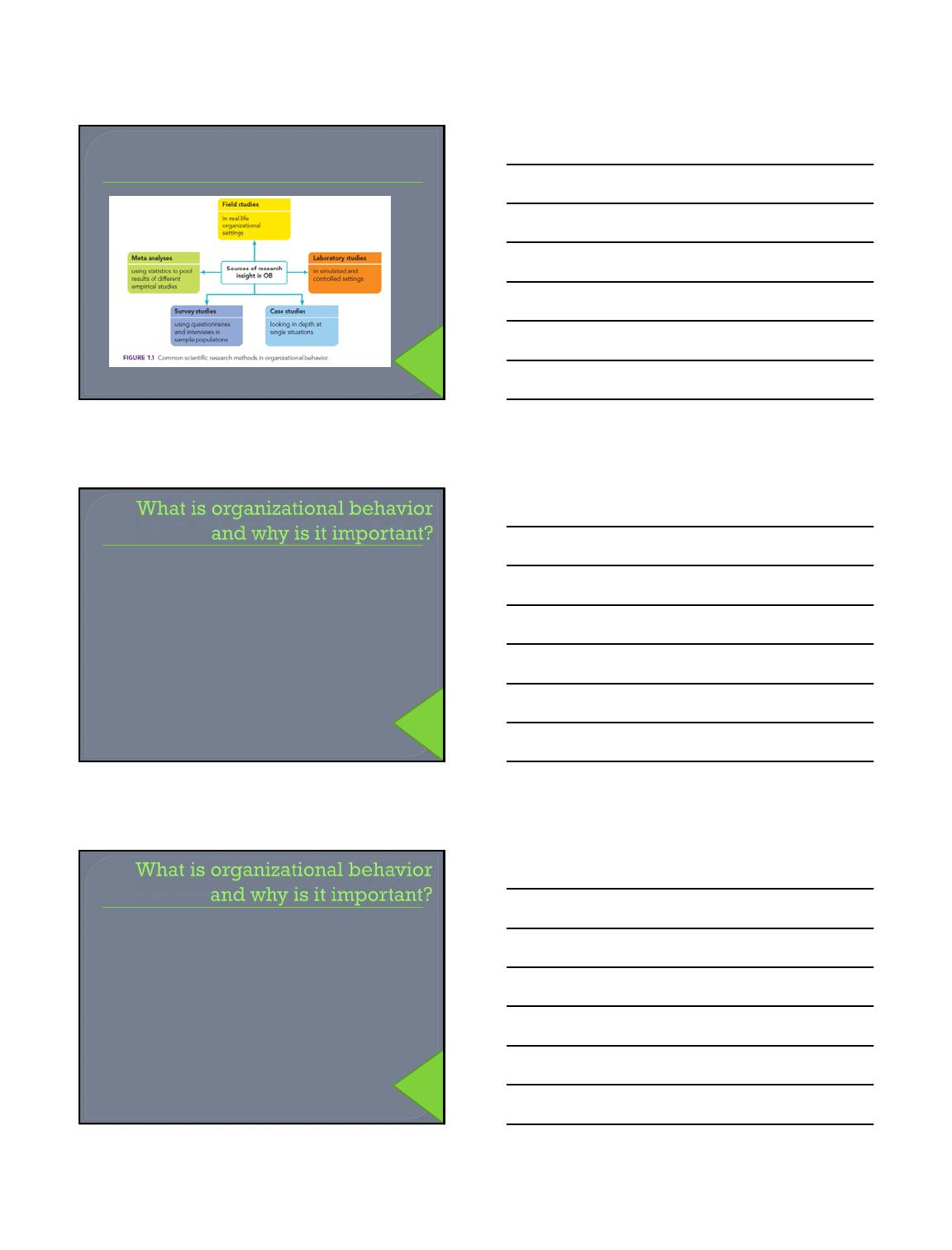
Figure 1.1Common Scientific Research
Methods in Organizational Behavior
Scientific thinking is important to OB:
•
The process of data collection is controlled and
systematic.
•
Proposed explanations are carefully tested.
•
Only explanations that can be rigorously verified are
accepted.
Copyright © 2014 John Wiley & Sons, Inc.
1-8
Contingency thinking
•
Seeks ways to meet the needs of different
management situations.
•
Recognizes responses to solutions must be crafted to
best fit the circumstances and people involved.
Copyright © 2014 John Wiley & Sons, Inc.
1-9

6/15/2016
Evidenced-based management
•
Uses hard facts and empirical evidence to make
decisions.
•
Evidence-based thinking manifests itself through a
contingency approach which researchers identify
how different situations can best be understood and
handled.
Copyright © 2014 John Wiley & Sons, Inc.
1-
10
Cross-Cultural Awareness
•
Understanding from managers, employees to