1
Copyright © 2012 Pearson Education, Inc.
Cost Accounting, 14e (Horngren/Datar/Rajan)
Chapter 13 Strategy, Balanced Scorecard, and Strategic Profitability Analysis
Objective 13.1
1) ________ describes how an organization matches its own capabilities with the opportunities in the
marketplace to accomplish its overall objectives.
A) Strategy
B) Planning
C) Learning and growth perspective
D) Customer perspective
Answer: A
Diff: 1
Terms: total quality management (TQM)
Objective: 1
AACSB: Reflective thinking
2) In general, profit potential ________ with greater competition, stronger potential entrants, products
that are similar, and more–demanding customers and suppliers.
A) increases
B) stays constant
C) decreases
D) increases exponentially
Answer: C
Diff: 1
Terms: five force industry analysis
Objective: 1
AACSB: Reflective thinking
3) Which of the following is NOT a force that shapes an organization‘s profit potential?
A) Competitors
B) Equivalent products
C) Bargaining power of input suppliers
D) All of these answers are correct.
Answer: D
Diff: 2
Terms: five force industry analysis
Objective: 1
AACSB: Reflective thinking
2
Copyright © 2012 Pearson Education, Inc.
4) Which of the following is a force that shapes an organization‘s profit potential?
A) Investors
B) Potential entrants into the market
C) Creditors
D) Research and development
Answer: B
Diff: 2
Terms: five force industry analysis
Objective: 1
AACSB: Reflective thinking
5) ________ is an organization‘s ability to offer products or services that are perceived by its customers
as being superior and unique relative to those of its competitors.
A) Strategy
B) Product differentiation
C) Cost leadership
D) The balanced scorecard
Answer: B
Diff: 1
Terms: product differentiation
Objective: 1
AACSB: Reflective thinking
6) ________ is an organization‘s ability to achieve low costs relative to competitors through productivity
and efficiency improvements, elimination of waste, and tight cost control.
A) Strategy
B) Product differentiation
C) Cost leadership
D) The balanced scorecard
Answer: C
Diff: 1
Terms: cost leadership
Objective: 1
AACSB: Reflective thinking
7) An organization that is using the product differentiation approach would:
A) focus on tight cost control
B) carefully cultivate their brands
C) provide products that are similar to competitors
D) offer products at a lower cost than competitors
Answer: B
Diff: 2
Terms: product differentiation
Objective: 1
AACSB: Reflective thinking
3
Copyright © 2012 Pearson Education, Inc.
8) An organization that is using the cost leadership approach would:
A) incur costs for innovative R&D
B) provide products at a higher cost than competitors
C) focus on productivity through efficiency improvements
D) bring products to market rapidly
Answer: C
Diff: 2
Terms: cost leadership
Objective: 1
AACSB: Reflective thinking
Answer the following questions using the information below:
Stewart Corporation plans to grow by offering a sound system, the SS3000, that is superior and unique
from the competition. Stewart believes that putting additional resources into R&D and staying ahead of
the competition with technological innovations is critical to implementing its strategy.
9) Stewart‘s strategy is:
A) product differentiation
B) downsizing
C) reengineering
D) cost leadership
Answer: A
Diff: 2
Terms: product differentiation
Objective: 1
AACSB: Reflective thinking
Answer the following questions using the information below:
Riter Corporation manufactures water toys. It plans to grow by producing high–quality water toys at a
low cost that are delivered in a timely manner. There are a number of other manufacturers who produce
similar water toys. Riter believes that continuously improving its manufacturing processes and having
satisfied employees are critical to implementing its strategy.
10) Riter‘s strategy is:
A) product differentiation
B) downsizing
C) reengineering
D) cost leadership
Answer: D
Diff: 2
Terms: cost leadership
Objective: 1
AACSB: Ethical reasoning

4
Copyright © 2012 Pearson Education, Inc.
Answer the following questions using the information below:
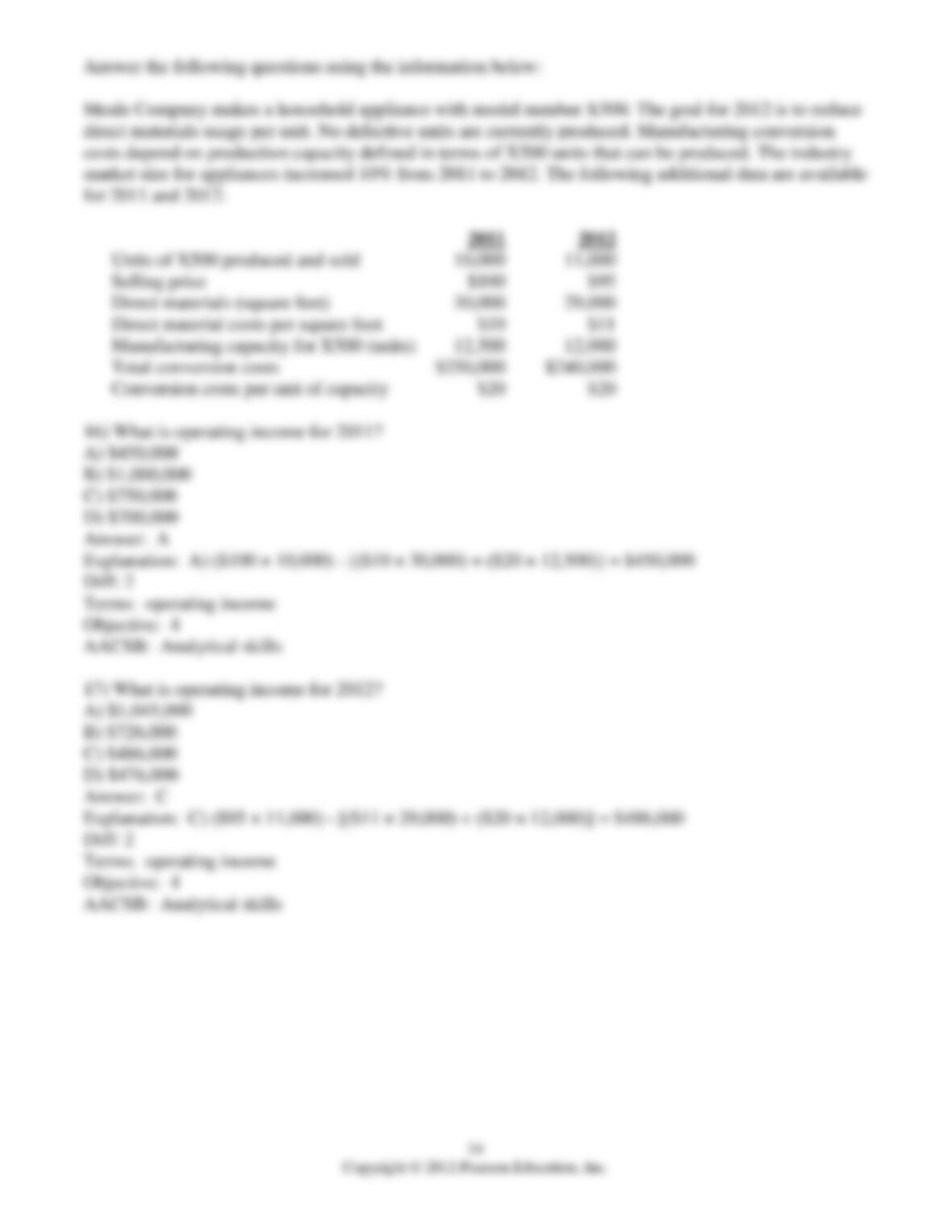
Meale Company makes a household appliance with model number X500. The goal for 2012 is to reduce
direct materials usage per unit. No defective units are currently produced. Manufacturing conversion
costs depend on production capacity defined in terms of X500 units that can be produced. The industry
market size for appliances increased 10% from 2011 to 2012. The following additional data are available
for 2011 and 2012:
2011 2012
Units of X500 produced and sold 10,000 11,000
Selling price $100 $95
Direct materials (square feet) 30,000 29,000
Direct material costs per square foot $10 $11
Manufacturing capacity for X500 (units) 12,500 12,000
Total conversion costs $250,000 $240,000
Conversion costs per unit of capacity $20 $20
11) Which strategy is Meale‘s Corporation pursuing?
A) Product differentiation, because the units produced and sold increased.
B) Product differentiation, because total conversion costs decreased.
C) Cost leadership, because direct material costs per square foot increased.
D) Cost leadership, because the selling price decreased.
Answer: D
Diff: 2
Terms: cost leadership
Objective: 1
AACSB: Analytical skills
12) Strategy describes how an organization matches its own capabilities with the opportunities in the
marketplace to accomplish its overall objectives.
Answer: TRUE
Diff: 1
Terms: total quality management (TQM)
Objective: 1
AACSB: Reflective thinking
13) One of the five forces of industry analysis is understanding the bargaining power of your input
suppliers.
Answer: TRUE
Diff: 1
Terms: five force industry analysis
Objective: 1
AACSB: Reflective thinking
5
Copyright © 2012 Pearson Education, Inc.
14) Product differentiation is an organization’’s ability to achieve lower costs relative to competitors
through productivity and efficiency improvements, elimination of waste, and tight cost control.
Answer: FALSE
Explanation: Cost leadership is an organization‘s ability to achieve lower costs relative to competitors
through productivity and efficiency improvements, elimination of waste, and tight cost control.
Diff: 1
Terms: cost leadership
Objective: 1
AACSB: Reflective thinking
15) Product differentiation is an organization’’s ability to offer products or services perceived by its
customers to be superior and unique relative to the products or services of its competitors.
Answer: TRUE
Diff: 1
Terms: product differentiation
Objective: 1
AACSB: Reflective thinking
16) The cost leadership strategy is for products and services that are similar to competitor‘s products and
services.
Answer: TRUE
Diff: 1
Terms: cost leadership
Objective: 1
AACSB: Reflective thinking
17) The product differentiation strategy is probably best for a company if the engineering staff is more
skilled at making process improvements than at creatively designing new products.
Answer: FALSE
Explanation: The cost leadership strategy is probably best for a company if the engineering staff is
more skilled at making process improvements than at creatively designing new products.
Diff: 2
Terms: product differentiation
Objective: 1
AACSB: Reflective thinking
18) In general, profit potential increases with greater competition, stronger potential entrants, products
that are similar, and tougher customers and suppliers.
Answer: FALSE
Explanation: In general, profit potential decreases with greater competition, stronger potential entrants,
products that are similar, and tougher customers and suppliers.
Diff: 1
Terms: five force industry analysis
Objective: 1
AACSB: Reflective thinking
6
Copyright © 2012 Pearson Education, Inc.
19) Bosely Corporation is reviewing its business strategy. The first step for Bosely is to perform an
industry analysis. You have been hired to help the company go through the strategy formulation process.
Required:
To perform the industry analysis, what areas should Bosely focus on and give at least one example of
how Bosely can effectively deal with each area.
Answer: The industry analysis is composed of five areas:
1. Competitors – How competitive is the industry for Bosely‘s particular product ? They can
differentiate the product to reduce competition.
2. Potential entrants to the market – How easy is it for new competitors to join the market? Create
barriers to entry, such as high capital requirements.
3. Equivalent products – Is there a substitute product available? Make continuous product
improvements to reduce likelihood of equivalent products.
4. Bargaining power of customers – How many suppliers can customers access? Try to negotiate long–
term purchase agreements.
5. Bargaining power of input suppliers – How many raw material vendors are there? Try to find
alternative suppliers and negotiate the best price for raw materials.
Diff: 3
Terms: five force industry analysis
Objective: 1
AACSB: Reflective thinking
20) Explain the product differentiation and the cost leadership strategies.
Answer: Product differentiation is an organization‘s ability to offer products or services perceived by its
customers to be superior and unique relative to the products or services of its competitors.
Cost leadership is an organization‘s ability to achieve lower costs relative to competitors through
productivity and efficiency improvements, elimination of waste, and tight cost control.
Diff: 3
Terms: cost leadership, product differentiation
Objective: 1
AACSB: Reflective thinking
Objective 13.2
1) ________ is the fundamental rethinking and redesign of business processes to achieve improvements
in critical measures of performance such as cost, quality, service, speed, and customer satisfaction.
A) Strategy
B) Customer perspective
C) Learning and growth perspective
D) Reengineering
Answer: D
Diff: 1
Terms: reengineering
Objective: 2
AACSB: Reflective thinking
7
Copyright © 2012 Pearson Education, Inc.
2) Successful reengineering involves:
A) cutting across functional lines to focus on the entire business process
B) redefining the roles and responsibilities of employees
C) using information technology
D) All of these answers are correct.
Answer: D
Diff: 2
Terms: reengineering
Objective: 2
AACSB: Reflective thinking
3) The balanced scorecard measures an organization‘s performance from all of the following
perspectives EXCEPT:
A) financial
B) government
C) customer
D) learning and growth
Answer: B
Diff: 2
Terms: Balanced Scorecard
Objective: 2
AACSB: Reflective thinking
4) Reengineering is the fundamental rethinking and redesign of business processes to achieve
improvements in critical measures of performance such as cost, quality, service, speed, and customer
satisfaction.
Answer: TRUE
Diff: 1
Terms: reengineering
Objective: 2
AACSB: Reflective thinking
5) Reengineering benefits are most significant when they focus on one business function rather than
crossing functional lines of the business process.
Answer: FALSE
Explanation: Reengineering benefits are most significant when they cut across functional lines to focus
on the entire business process.
Diff: 2
Terms: reengineering
Objective: 2
AACSB: Reflective thinking
6) Successful reengineering efforts generally involve changing the roles and responsibilities of
employees.
Answer: TRUE
Diff: 2
Terms: reengineering
Objective: 2
AACSB: Reflective thinking
8
Copyright © 2012 Pearson Education, Inc.
7) What is reengineering. Can you contrast a reengineering approach to change with a kaizen approach
to change?
Answer: Reengineering is the rethinking of business processes, such as the order delivery process, to
improve critical performance measures such as cost, quality, or customer satisfaction. It can be
contrasted to a kaizen approach to change in that reengineering is most often a sudden, drastic change,
while a kaizen approach involves small, incremental but continual improvements.
Diff: 2
Terms: reengineering
Objective: 2
AACSB: Analytical skills
Objective 13.3
1) ________ translates an organization‘s mission and strategy into a comprehensive set of performance
measures that provide the framework for implementing its strategy.
A) Productivity component
B) Product differentiation
C) Cost leadership
D) The balanced scorecard
Answer: D
Diff: 1
Terms: Balanced Scorecard
Objective: 3
AACSB: Reflective thinking
2) The purpose of the balanced scorecard is best described as helping an organization:
A) develop customer relations
B) mobilize employee skills for continuous improvements in processing capabilities, quality, and
response times
C) introduce innovative products and services desired by target customers
D) translate an organization‘s mission and strategy into a set of performance measures that help to
implement the strategy
Answer: D
Diff: 3
Terms: Balanced Scorecard
Objective: 3
AACSB: Reflective thinking
3) The first step to successful balanced scorecard implementation is clarifying the:
A) organization‘s vision and strategy
B) elements that pertain to value–added aspects of the business
C) owner‘s expectations about return on investment
D) objectives of all four balanced scorecard measurement perspectives
Answer: A
Diff: 3
Terms: Balanced Scorecard
Objective: 3
AACSB: Reflective thinking
9
Copyright © 2012 Pearson Education, Inc.
4) The balanced scorecard is said to be “balanced” because it measures:
A) short–term and long–term objectives
B) financial and nonfinancial objectives
C) internal and external objectives
D) All of these answers are correct.
Answer: D
Diff: 2
Terms: Balanced Scorecard
Objective: 3
AACSB: Reflective thinking
5) Balanced scorecard objectives are in balance when:
A) debits equal credits
B) financial performance measurements are less than the majority of measurements
C) the measurements are fair
D) the measurements reflect an improvement over the previous year
Answer: B
Diff: 3
Terms: Balanced Scorecard
Objective: 3
AACSB: Reflective thinking
6) The internal business processes perspective of the balanced scorecard comprises three subprocesses
that address all of the following EXCEPT:
A) innovative processes used to create new products, services, and processes
B) motivating current employees
C) providing service and support to the customer after the sale
D) delivering existing products and services to best meet the needs of customers
Answer: B
Diff: 3
Terms: Balanced Scorecard
Objective: 3
AACSB: Reflective thinking
7) Identify the best description of the balanced scorecard‘s financial perspective. To achieve our firm‘s
vision and strategy:
A) how can we obtain greater profits for the current year?
B) how can we increase shareholder value?
C) how will we obtain continuous improvements?
D) how can we secure greater customer satisfaction?
Answer: B
Diff: 2
Terms: Balanced Scorecard
Objective: 3
AACSB: Reflective thinking
10
Copyright © 2012 Pearson Education, Inc.
8) Identify the best description of the balanced scorecard‘s internal business processes perspective. To
achieve our firm‘s vision and strategy:
A) how do we lower costs?
B) how do we motivate employees?
C) how can we obtain greater profits?
D) what processes will increase value to customers?
Answer: D
Diff: 3
Terms: Balanced Scorecard
Objective: 3
AACSB: Reflective thinking
9) All of the following relate to the balanced scorecard‘s learning and growth perspective EXCEPT:
A) How do we achieve greater employee satisfaction?
B) What new products do we create?
C) How do we provide information systems with updated technology?
D) How will we motivate and empower our employees?
Answer: B
Diff: 3
Terms: Balanced Scorecard
Objective: 3
AACSB: Reflective thinking
10) Measures of the balanced scorecard‘s financial perspective include:
A) information system availability
B) number of new patents
C) revenue growth
D) defect rates
Answer: C
Diff: 3
Terms: Balanced Scorecard
Objective: 3
AACSB: Reflective thinking
11) Measures of the balanced scorecard‘s financial perspective include all of the following EXCEPT:
A) operating income
B) customer satisfaction
C) gross profit percentage
D) cost reductions
Answer: B
Diff: 3
Terms: Balanced Scorecard
Objective: 3
AACSB: Reflective thinking
11
Copyright © 2012 Pearson Education, Inc.
12) Measures of the balanced scorecard‘s customer perspective include:
A) market share
B) number of on–time deliveries
C) number of process improvements
D) revenue growth
Answer: A
Diff: 3
Terms: Balanced Scorecard
Objective: 3
AACSB: Reflective thinking
13) Measures of the balanced scorecard‘s customer perspective include all of the following EXCEPT:
A) market share
B) customer satisfaction
C) number of new customers
D) customer training on new products
Answer: D
Diff: 3
Terms: Balanced Scorecard
Objective: 3
AACSB: Reflective thinking
14) Measures of the balanced scorecard‘s internal–business–process perspective include:
A) market share
B) new product development time
C) employee education
D) return on investment
Answer: B
Diff: 3
Terms: Balanced Scorecard
Objective: 3
AACSB: Reflective thinking
15) Measures of the balanced scorecard‘s internal–business–process perspective include all of the
following EXCEPT:
A) operating capabilities
B) number of new products
C) employee turnover rates
D) defect rates
Answer: C
Diff: 3
Terms: Balanced Scorecard
Objective: 3
AACSB: Reflective thinking
16) Measures of the balanced scorecard‘s learning–and–growth perspective include:
A) employee satisfaction ratings
B) economic value added
C) time taken to deliver product to customers
D) customer–retention percentage
Answer: A
Diff: 3
Terms: Balanced Scorecard
Objective: 3
AACSB: Reflective thinking
17) Measures of the balanced scorecard‘s learning–and–growth perspective include all of the following
EXCEPT:
A) employee education and skill level
B) percentage of processes with advanced controls
C) employee–satisfaction ratings
D) time taken to replace defective products
Answer: D
Diff: 3
Terms: Balanced Scorecard
Objective: 3
AACSB: Reflective thinking