1
Copyright © 2012 Pearson Education, Inc.
Cost Accounting, 14e (Horngren/Datar/Rajan)
Chapter 12 Pricing Decisions and Cost Management
Objective 12.1
1) Companies should only produce and sell units as long as:
A) there is customer demand for the product
B) the competition allows it
C) the revenue from an additional unit exceeds the cost of producing it
D) there is a generous supply of low–cost direct materials
Answer: C
Diff: 2
Terms: target price
Objective: 1
AACSB: Ethical reasoning
2) Too high a price may:
A) deter a customer from purchasing a product
B) increase demand for the product
C) indicate supply is too plentiful
D) decrease a competitor’s market share
Answer: A
Diff: 1
Terms: target price
Objective: 1
AACSB: Reflective thinking
3) Companies must always examine their pricing:
A) based on the supply of the product
B) based on the cost of producing the product
C) through the eyes of their customers
D) through the eyes of their competitors
Answer: C
Diff: 3
Terms: target price
Objective: 1
AACSB: Ethical reasoning
4) Competitors:
A) with alternative products can force a company to lower its prices
B) can gain a competitive pricing advantage with knowledge of your costs and operating policies
C) may span international borders
D) All of these answers are correct.
Answer: D
Diff: 2
Terms: target price
Objective: 1
AACSB: Reflective thinking
2
Copyright © 2012 Pearson Education, Inc.
5) Fluctuations in exchange rates between different currencies can influence the:
A) cost of products using foreign suppliers
B) pricing of alternative products offered by foreign competitors
C) demand for products of foreign competitors
D) All of these answers are correct.
Answer: D
Diff: 2
Terms: target price
Objective: 1
AACSB: Multiculturalism and diversity
6) The cost of producing a product:
A) in highly competitive markets controls pricing
B) affects the willingness of a company to supply a product
C) for pricing decisions includes manufacturing costs, but not product design costs
D) None of these answers are correct.
Answer: B
Diff: 3
Terms: cost incurrence
Objective: 1
AACSB: Reflective thinking
7) In a noncompetitive environment, the key factor affecting pricing decisions is the:
A) customer‘s willingness to pay
B) price charged for alternative products
C) cost of producing and delivering the product
D) All of these answers are correct.
Answer: A
Diff: 3
Terms: target price
Objective: 1
AACSB: Reflective thinking
8) In a competitive market with differentiated products like cameras, the key factor(s) affecting pricing
decisions is/are the:
A) customer‘s willingness to pay
B) price charged for alternative products
C) cost of producing and delivering the product
D) All of these answers are correct.
Answer: D
Diff: 2
Terms: target price
Objective: 1
AACSB: Reflective thinking
3
Copyright © 2012 Pearson Education, Inc.
9) Three major influences on pricing decisions are:
A) competition, costs, and customers
B) competition, demand, and production efficiency
C) continuous improvement, customer satisfaction, and supply
D) variable costs, fixed costs, and mixed costs
Answer: A
Diff: 1
Terms: target price
Objective: 1
AACSB: Reflective thinking
10) Companies must always examine pricing decisions through the eyes of their customers.
Answer: TRUE
Diff: 2
Terms: target price
Objective: 1
AACSB: Ethical reasoning
11) Companies that produce high quality products do NOT have to pay attention to the actions of their
competitors.
Answer: FALSE
Explanation: No business operates in a vacuum. Companies must always be aware of the actions of
their competitors.
Diff: 2
Terms: target price
Objective: 1
AACSB: Reflective thinking
12) Relevant costs for pricing decisions include manufacturing costs, but NOT costs from other value–
chain functions.
Answer: FALSE
Explanation: Relevant costs for pricing decisions include costs from all value–chain functions, from
R&D to customer service.
Diff: 2
Terms: value–added cost
Objective: 1
AACSB: Reflective thinking
13) Prices are decreased when demand is weak and competition is strong and increased when demand is
strong and competition is weak.
Answer: TRUE
Diff: 3
Terms: cost
Objective: 1
AACSB: Reflective thinking
4
Copyright © 2012 Pearson Education, Inc.
14) In markets with little or no competition, the key factor affecting price is the customers‘ willingness
to pay, not costs or competitors.
Answer: TRUE
Diff: 2
Terms: value–added cost
Objective: 1
AACSB: Reflective thinking
15) When prices are set in a competitive marketplace, product costs are the most important influence on
pricing decisions.
Answer: FALSE
Explanation: When prices are set in a competitive marketplace, companies have no control over setting
prices and must accept the price determined by the market.
Diff: 2
Terms: target price
Objective: 1
AACSB: Reflective thinking
16) The only competition a firm must be concerned about when setting prices are those in the local
market.
Answer: FALSE
Explanation: A firm must be concerned with local, national and even international competition when
setting a price.
Diff: 2
Terms: target price
Objective: 1
AACSB: Reflective thinking
17) Claudia Geer, controller, discusses the pricing of a new product with the sales manager, James
Nolan. What major influences must Claudia and James consider in pricing the new product? Discuss
each briefly.
Answer: The major influences are customers, competitors, and costs.
Customers: Managers must always examine pricing problems through the eyes of their customers. A
price increase may cause customers to reject a company‘s product and choose a competing or substitute
product.
Competitors: Competitors‘ reactions influence pricing decisions. At one extreme, a rival‘s prices and
products may force a business to lower its prices to be competitive. At the other extreme, a business
without a rival in a given situation can set higher prices. A business with knowledge of its rivals‘
technology, plant capacity, and operating policies is able to estimate its rivals‘ costs, which is valuable
information in setting competitive prices.
Costs: Companies price products to exceed the costs of making them. The study of cost–behavior
patterns gives insight into the income that results from different combinations of price and output
quantities sold for a particular product.
Diff: 2
Terms: target price
Objective: 1
AACSB: Reflective thinking
5
Copyright © 2012 Pearson Education, Inc.
Objective 12.2
1) Short–term pricing decisions:
A) use costs that may be irrelevant for long–term pricing decisions
B) are more opportunistic
C) tend to decrease prices when demand is strong
D) have a time horizon of more than one year
Answer: B
Diff: 3
Terms: target price
Objective: 2
AACSB: Reflective thinking
2) Relevant costs for pricing a special order include:
A) existing fixed manufacturing overhead
B) nonmanufacturing costs that will not change even if the special order is accepted
C) additional setup costs for the special order
D) All of these answers are correct.
Answer: C
Diff: 2
Terms: cost incurrence
Objective: 2
AACSB: Reflective thinking
3) Which of the following factors should NOT be considered when pricing a special order?
A) the likely bids of competitors
B) the incremental cost of one unit of product
C) revenues that will be lost on existing sales if prices are lowered
D) stable pricing to earn the desired long–run return
Answer: D
Diff: 3
Terms: target price
Objective: 2
AACSB: Reflective thinking
4) A price–bidding decision for a one–time–only special order includes an analysis of all:
A) manufacturing costs
B) cost drivers related to the product
C) direct and indirect variable costs of each function in the value chain
D) fixed manufacturing costs
Answer: C
Diff: 2
Terms: cost incurrence
Objective: 2
AACSB: Reflective thinking
6
Copyright © 2012 Pearson Education, Inc.
5) For pricing decisions, full product costs:
A) include all costs that are traceable to the product
B) include all manufacturing and selling costs
C) include all direct costs plus an appropriate allocation of the indirect costs of all business functions
D) allow for the highest possible product prices
Answer: C
Diff: 2
Terms: cost incurrence
Objective: 2
AACSB: Reflective thinking
Answer the following questions using the information below:
Black Forrest manufactures rustic furniture. The cost accounting system estimates manufacturing costs
to be $240 per table, consisting of 60% variable costs and 40% fixed costs. The company has surplus
capacity available. It is Black Forrest policy to add a 50% markup to full costs.
6) Black Forrest is invited to bid on a one–time–only special order to supply 200 rustic tables. What is
the lowest price Black Forrest should bid on this special order?
A) $43,200
B) $14,400
C) $24,000
D) $28,800
Answer: D
Explanation: D) $240 × 60% × 200 tables = $28,800
Diff: 2
Terms: cost incurrence
Objective: 2
AACSB: Analytical skills
Answer the following questions using the information below:
Caruso Cool manufactures single room sized air conditioners. The cost accounting system estimates
manufacturing costs to be $190 per air conditioner, consisting of 75% variable costs and 25% fixed
costs. The company has surplus capacity available. It is Caruso Cool‘s policy to add a 30% markup to
full costs.
7) Caruso is invited to bid on a one–time–only special order to supply 50 air conditioners. What is the
lowest price Caruso should bid on this special order?
A) $9,500
B) $7,125
C) $12,500
D) $12,350
Answer: B
Explanation: B) $190 × 75% × 50 air conditioners = $7,125
Diff: 2
Terms: cost incurrence
Objective: 2
AACSB: Analytical skills

7
Copyright © 2012 Pearson Education, Inc.
8) A medium sized motel chain is currently expanding and has decided to create more rooms and air
condition all of its rooms, which are currently not air conditioned. Caruso Cool is invited to submit a bid
to the motel chain. What per unit price will Caruso Cool MOST likely bid for this special order of 50
units?
A) $190.00 per unit
B) $142.50 per unit
C) $247.00 per unit
D) $250.00 per unit
Answer: C
Explanation: C) $190+ ($190 × 30%) = $247
Diff: 2
Terms: cost incurrence
Objective: 2
AACSB: Analytical skills
Answer the following questions using the information below:
Rogers‘ Heaters is approached by Ms. Sushi, a new customer, to fulfill a large one–time–only special
order for a product similar to one offered to regular customers. Rogers‘ Heaters has excess capacity. The
following per unit data apply for sales to regular customers:
Direct materials $400
Direct manufacturing labor 120
Variable manufacturing support 60
Fixed manufacturing support 200
Total manufacturing costs 780
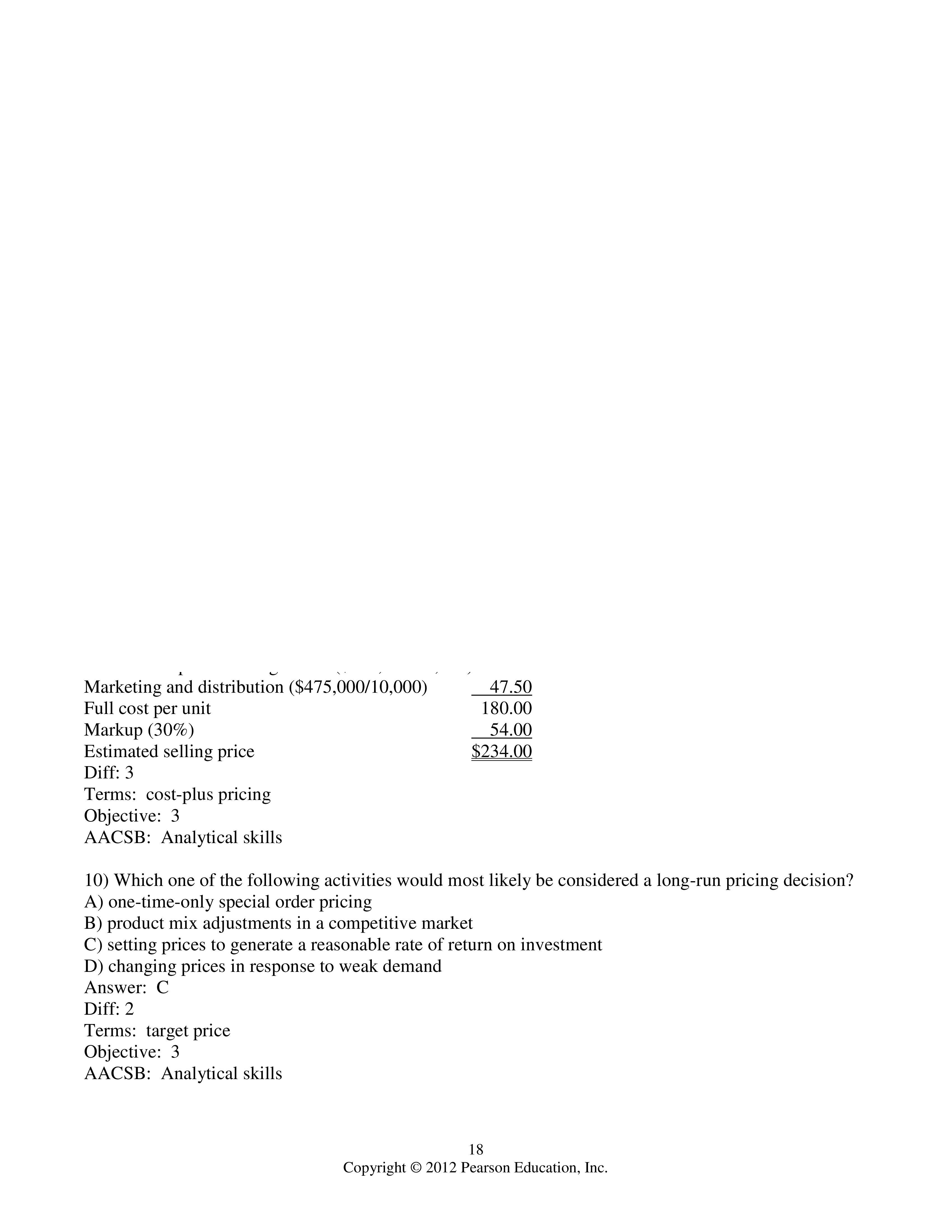
Markup (30%) 234
Estimated selling price $1,014
9) For Rogers‘ Heaters, what is the minimum acceptable price of this one–time–only special order?
A) $580
B) $780
C) $520
D) $1,014
Answer: A
Explanation: A) $400 + $120 + $60 = $580
Diff: 2
Terms: target price
Objective: 2
AACSB: Analytical skills

8
Copyright © 2012 Pearson Education, Inc.
10) Before accepting this one–time–only special order, Rogers‘ Heaters should consider the impact on:
A) current plant capacity
B) long–term customers
C) competitors
D) All of these answers are correct.
Answer: D
Diff: 2
Terms: target price
Objective: 2
AACSB: Analytical skills
Answer the following questions using the information below:
Gerry‘s Generator Supply is approached by Mr. Sandman, a new customer, to fulfill a large one–time–
only special order for a product similar to one offered to regular customers. Gerry‘s Generator Supply
has excess capacity. The following per unit data apply for sales to regular customers:
Direct materials $1,700.00
Direct manufacturing labor 100.00
Variable manufacturing support 200.00
Fixed manufacturing support 150.00
Total manufacturing costs 2,150.00
Markup (20%) 430.00
Estimated selling price $2,580.00
11) For Gerry‘s Generators, what is the minimum acceptable price of this one–time–only special order?
A) $1,800
B) $2,000
C) $2,150
D) $2,580
Answer: B
Explanation: B) $1,700 + $100 + $200 = $2,000
Diff: 2
Terms: target price
Objective: 2
AACSB: Analytical skills
12) Before accepting this one–time–only special order, Gerry‘s Generators wants to know how much
profit would be made on the order:
A) $2,000
B) Loss of $150
C) $0
D) $430
Answer: C
Diff: 2
Terms: target price
Objective: 2
AACSB: Analytical skills

9
Copyright © 2012 Pearson Education, Inc.
Answer the following questions using the information below:
Marcia Manufacturing is approached by a European customer to fulfill a one–time–only special order for
a product similar to one offered to domestic customers. Marcia Manufacturing has a policy of adding a
20% markup to full costs and currently has excess capacity. The following per unit data apply for sales
to regular customers:
Variable costs:
Direct materials $30
Direct labor 10
Manufacturing overhead 15
Marketing costs 5
Fixed costs:
Manufacturing overhead 100
Marketing costs 20
Total costs 180
Markup (10%) 36
Estimated selling price $216
13) For Marcia Manufacturing, what is the minimum acceptable price of this one–time–only special
order?
A) $40
B) $55
C) $60
D) $66
Answer: C
Explanation: C) $30 + $10 + $15 + $5 = $60
Diff: 2
Terms: cost–plus pricing
Objective: 2
AACSB: Multiculturalism and diversity
14) What is the full cost of the product per unit?
A) $60
B) $180
C) $198
D) $66
Answer: B
Explanation: B) $30 + $10 + $15 + $5 + $100 + $20 = $180
Diff: 1
Terms: cost–plus pricing
Objective: 2
AACSB: Analytical skills

10
Copyright © 2012 Pearson Education, Inc.
Answer the following questions using the information below:
Ferryman Products manufactures coffee tables. Ferryman Products has a policy of adding a 20% markup
to full costs and currently has excess capacity. The following information pertains to the company‘s
normal operations per month:
Output units 30,000 tables
Machine–hours 8,000 hours
Direct manufacturing labor–hours 10,000 hours
Direct materials per unit $100
Direct manufacturing labor per hour $12
Variable manufacturing overhead costs $322,500
Fixed manufacturing overhead costs $1,200,000
Product and process design costs $900,000
Marketing and distribution costs $1,125,000
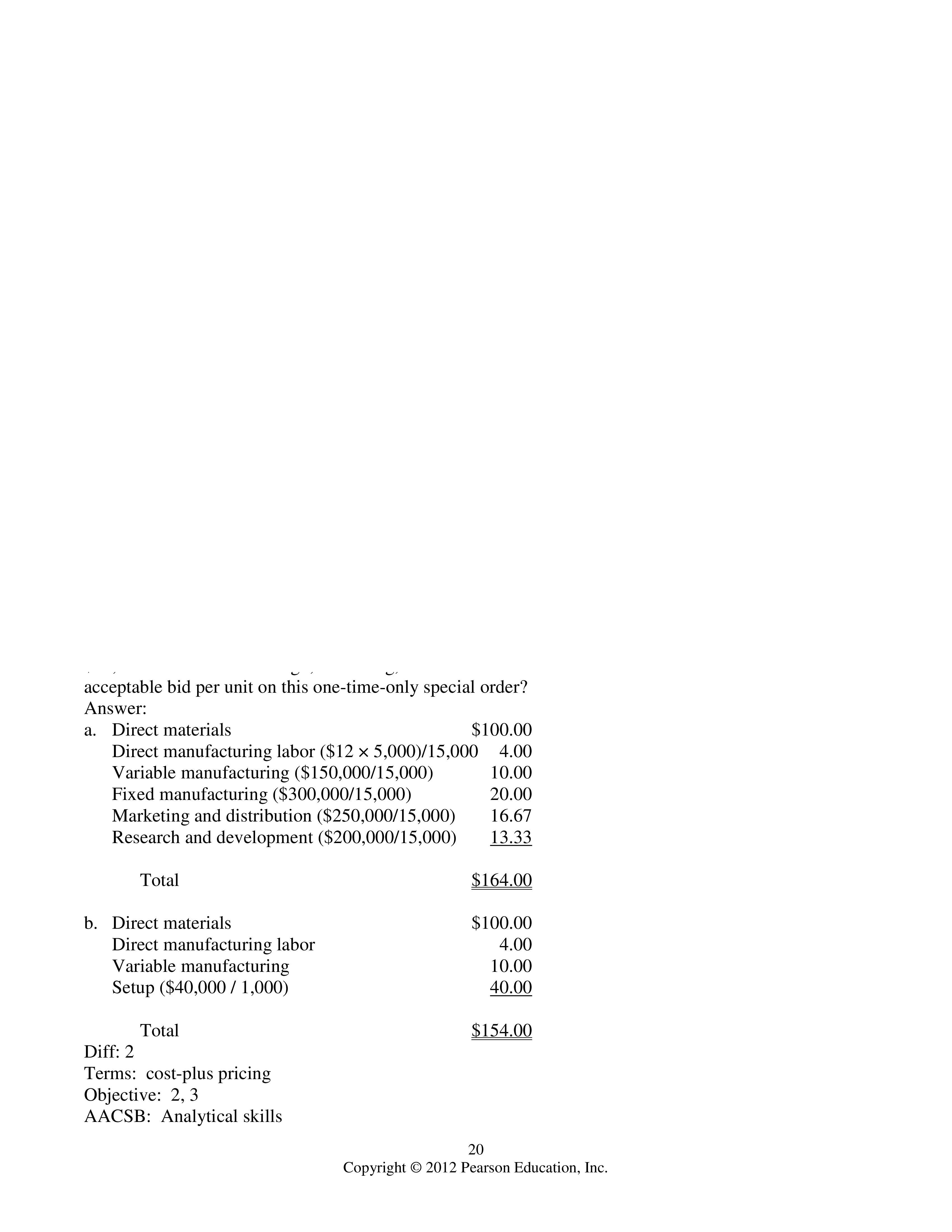
15) Ferryman Products is approached by an overseas customer to fulfill a one–time–only special order
for 1,000 units. All cost relationships remain the same except for a one–time setup charge of $20,000.
No additional design, marketing, or distribution costs will be incurred. What is the minimum acceptable
bid per unit on this one–time-only special order?
A) $134.75
B) $154.76
C) $222.25
D) $161.70
Answer: A
Explanation:
A) Direct materials ($100 x 1,000) $100,000
Direct manufacturing labor $12 × (10,000 / 30,000) x 1,000 4,000
Variable manufacturing ($322,500 /30,000 x 1,000 10,750
Setup (one time charge $20,000) 20,000
Minimum acceptable bid $134,750
$134,750/1,000 = 134.75
Diff: 3
Terms: cost–plus pricing
Objective: 2
AACSB: Analytical skills

11
Copyright © 2012 Pearson Education, Inc.
Answer the following questions using the information below:
Delgreco Products manufactures high–tech cell phones. Delgreco Products has a policy of adding a 30%
markup to full costs and currently has excess capacity. The following information pertains to the
company‘s normal operations per month:
Output units 10,000 phones
Machine–hours 8,000 hours
Direct manufacturing labor–hours 5,000 hours
Direct materials per unit $25
Direct manufacturing labor per hour $15
Variable manufacturing overhead costs $175,000
Fixed manufacturing overhead costs $425,000
Product and process design costs $400,000
Marketing and distribution costs $475,000
16) Delgreco Products is approached by an overseas customer to fulfill a one–time–only special order for
1,000 units. All cost relationships remain the same except for a one–time setup charge of $15,000. No
additional design, marketing, or distribution costs will be incurred. What is the minimum acceptable bid
per unit on this one–time–only special order?
A) $180.00
B) $92.50
C) $65.00
D) $234.00
Answer: C
Explanation:
C) Direct materials $25.00
Direct manufacturing labor (5,000/10,000) × $15 7.50
Variable manufacturing ($175,000/10,000) 17.50
Setup ($15,000/1000) 15.00
Minimum acceptable bid $65.00
Diff: 3
Terms: cost–plus pricing
Objective: 2
AACSB: Analytical skills
17) A short–run pricing decision typically has a time horizon of less than:
A) one year
B) two years
C) five years
D) None of these answers is correct.
Answer: A
Diff: 1
Terms: target price
Objective: 2
AACSB: Reflective thinking
18) Short–run pricing decisions include adjusting product mix in a competitive environment.
Answer: TRUE
Diff: 2
Terms: target price
Objective: 2
AACSB: Reflective thinking
19) Profit margins are often set to earn a reasonable return on investment for short–term pricing
decisions, but NOT long–term pricing decisions.
Answer: FALSE
Explanation: Profit margins are often set to earn a reasonable return on investment for long–term pricing
decisions, but not short–term pricing decision.
Diff: 2
Terms: target operating income per unit
Objective: 2
AACSB: Reflective thinking
20) In a one–time–only special order, variable manufacturing costs are irrelevant.
Answer: FALSE
Explanation: In a one–time–only special order, existing fixed manufacturing costs are irrelevant.
Diff: 2
Terms: value–added cost