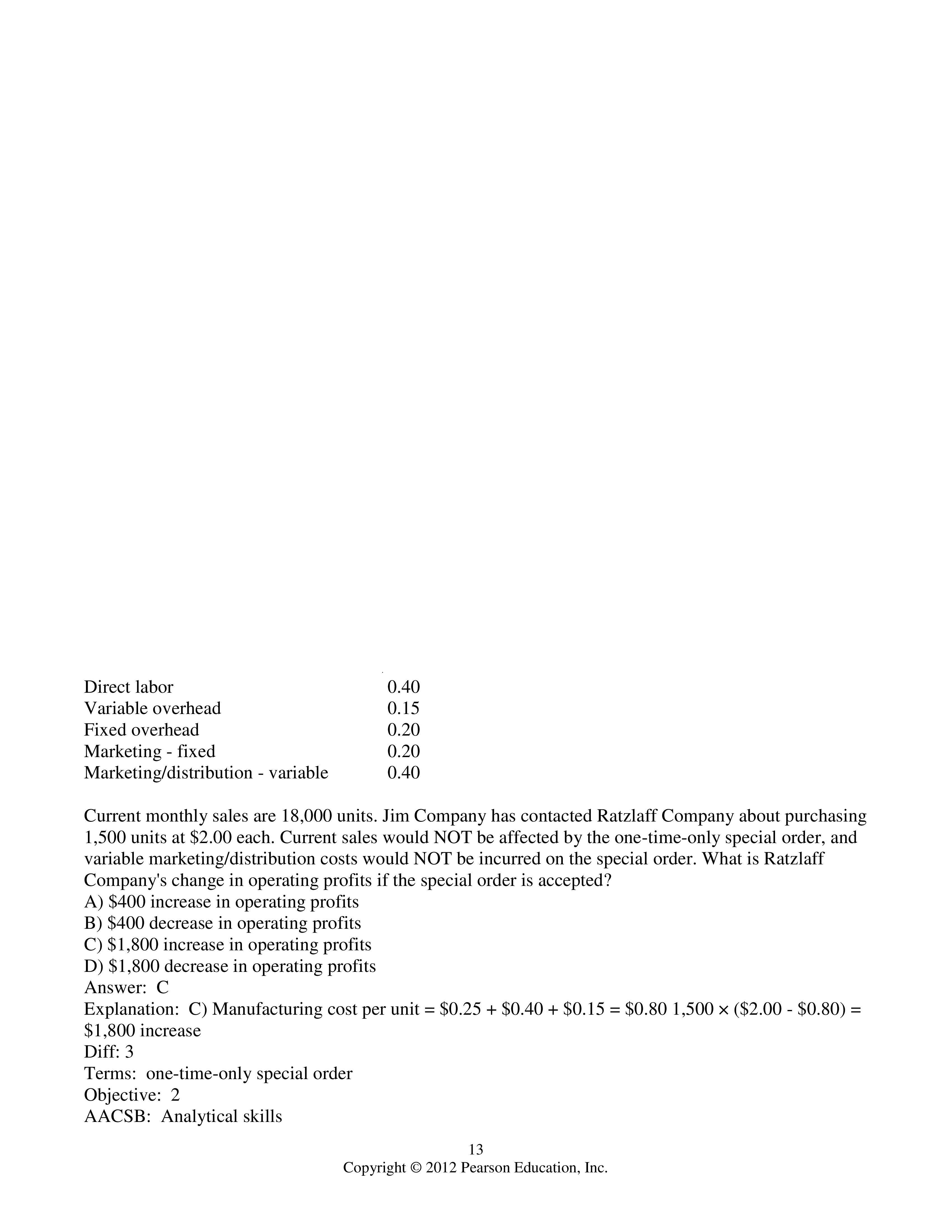
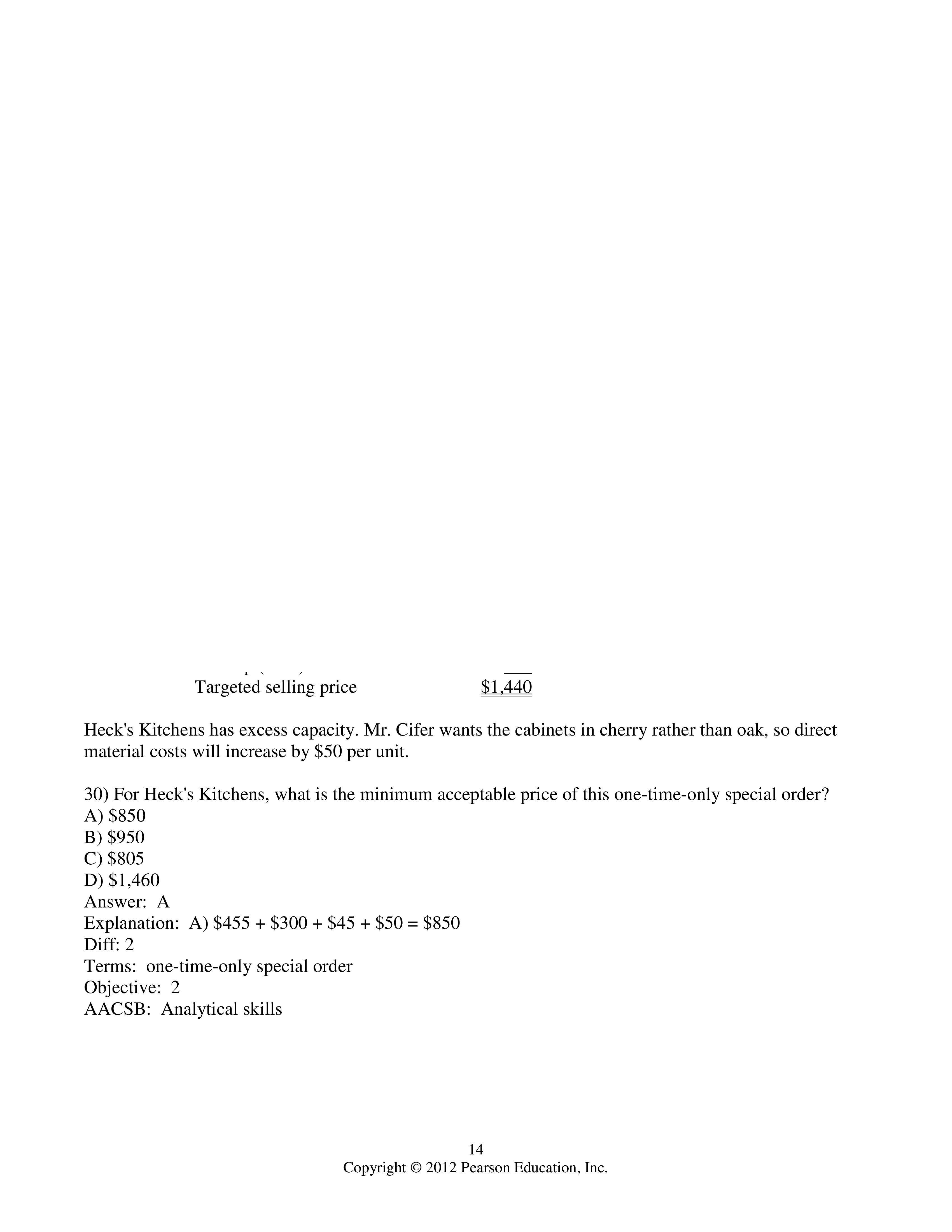
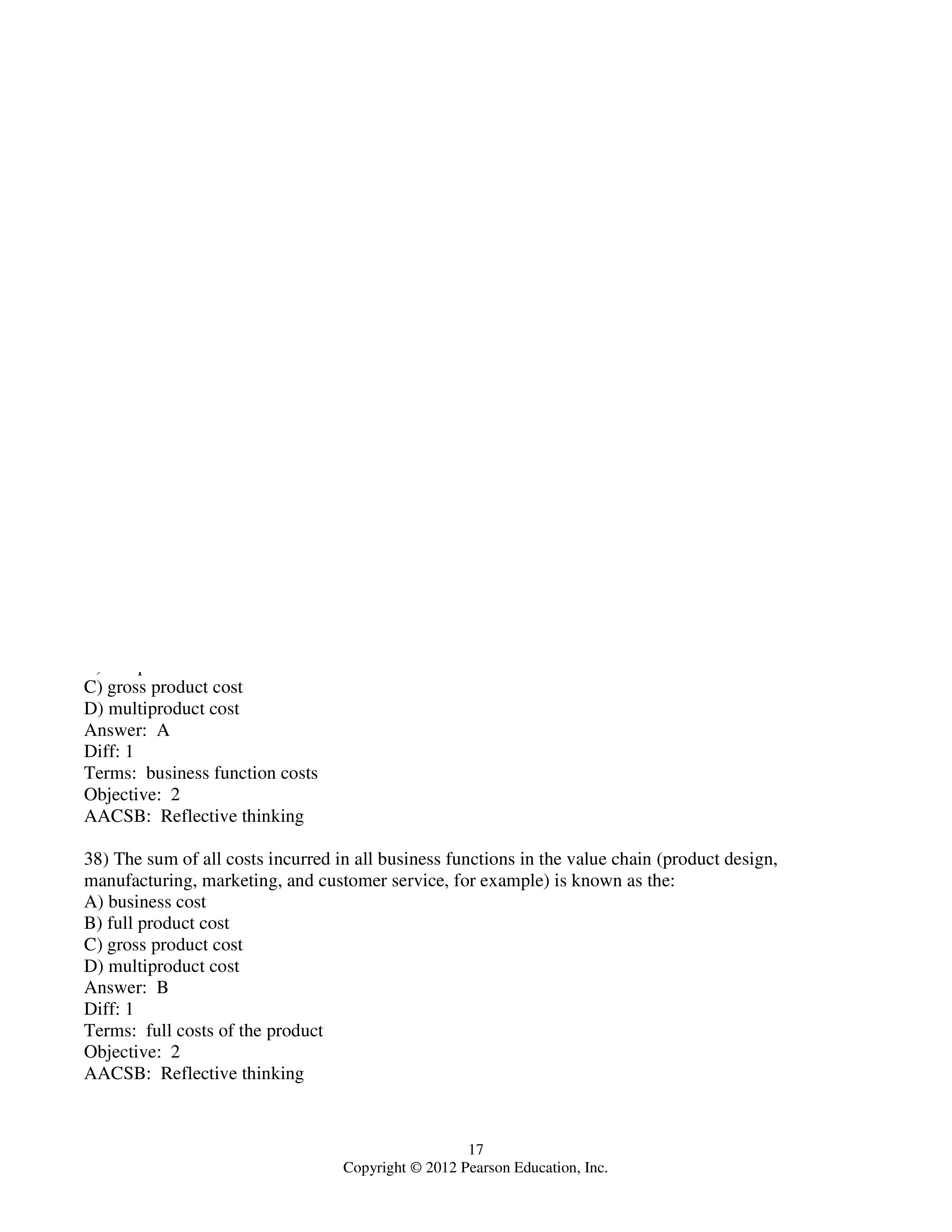
1
Copyright © 2012 Pearson Education, Inc.
Cost Accounting, 14e (Horngren/Datar/Rajan)
Chapter 11 Decision Making and Relevant Information
Objective 11.1
1) A decision model involves:
A) only quantitative analyses
B) both quantitative and qualitative analyses
C) only qualitative analyses
D) a manager‘s instinct
Answer: B
Diff: 1
Terms: decision model
Objective: 1
AACSB: Reflective thinking
2) Feedback regarding previous actions may affect:
A) future predictions
B) implementation of the decision
C) the decision model
D) All of these answers are correct.
Answer: D
Diff: 2
Terms: decision model
Objective: 1
AACSB: Reflective thinking
3) Place the following steps from the five–step decision process in order:
A = Make predictions about future costs
B = Evaluate performance to provide feedback
C = Implement the decision
D = Choose an alternative
A) A D B C
B) C D A B
C) A D C B
D) D C B A
Answer: C
Diff: 2
Terms: decision model
Objective: 1
AACSB: Reflective thinking

2
Copyright © 2012 Pearson Education, Inc.
4) The formal process of choosing between alternatives is known as a(n):
A) relevant model
B) decision model
C) alternative model
D) prediction model
Answer: B
Diff: 1
Terms: decision model
Objective: 1
AACSB: Reflective thinking
5) Ruttles Circuit Company manufactures circuit boards for other firms. Management is attempting to
search for ways to reduce manufacturing labor costs and has received a proposal from a consulting
company to rearrange the production floor next year. Using the information below regarding current
operations and the new proposal, which of the following decisions should management accept?
Currently Proposed
Required machine operators 4 3
Materials–handling workers 1.50 1.50
Employee average pay $10 per hour $12 per hour
Hours worked per employee 2,100 2,000
A) Do not change the production floor.
B) Rearrange the production floor.
C) Either, because it makes no difference to the employees.
D) It doesn‘t matter because the costs incurred will remain the same.
Answer: B
Explanation: B) Current operations: 4 workers × 2,100 hours × $10.00 = $84,000
Proposal: 3 workers × 2,000 hours × $12.00 = $72,000
Diff: 2
Terms: decision model
Objective: 1
AACSB: Analytical skills

3
Copyright © 2012 Pearson Education, Inc.
Answer the following questions using the information below:
Schwimmer Lighting manufactures small flashlights and is considering raising the price by 50 cents a
unit for the coming year. With a 50–cent price increase, demand is expected to fall by 6,000 units.
Currently Projected
Demand 40,000 units 34,000 units
Selling price $4.50 $5.00
Incremental cost per unit $3.00 $3.00
6) If the price increase is implemented, operating profit is projected to:
A) increase by $8,000
B) decrease by $8,000
C) increase by $12,000
D) decrease by $9,000
Answer: A
Explanation: A) [34,000 × ($5 – $3)] – [40,000 × ($4.50 – $3.00)] = increase of $8,000
Diff: 2
Terms: decision model
Objective: 1
AACSB: Analytical skills
7) Would you recommend the 50–cent price increase?
A) No, because demand decreased.
B) No, because the selling price increases.
C) Yes, because contribution margin per unit increases.
D) Yes, because operating profits increase.
Answer: D
Diff: 2
Terms: decision model
Objective: 1
AACSB: Analytical skills
8) When using the five–step decision process, which one of the following steps should be done last?
A) Obtain information
B) Choose an alternative
C) Evaluation and feedback
D) Implementing the decision
Answer: C
Diff: 2
Terms: decision model
Objective: 1
AACSB: Reflective thinking
4
Copyright © 2012 Pearson Education, Inc.
9) When using the five–step decision process, which one of the following steps should be done first?
A) Obtain information
B) Choose an alternative
C) Evaluation and feedback
D) Implementing the decision
Answer: A
Diff: 2
Terms: decision model
Objective: 1
AACSB: Reflective thinking
10) A decision model is a formal method for making a choice, frequently involving both quantitative
and qualitative analyses.
Answer: TRUE
Diff: 1
Terms: decision model, quantitative factors, qualitative factors
Objective: 1
AACSB: Reflective thinking
11) Feedback from previous decisions uses historical information and, therefore, is irrelevant for making
future predictions.
Answer: FALSE
Explanation: Historical costs may be helpful in making future predictions, but are not relevant costs for
decision making.
Diff: 2
Terms: relevant costs
Objective: 1
AACSB: Communication
5
Copyright © 2012 Pearson Education, Inc.
12) The textbook discusses a five–step decision process. Briefly explain each of the five steps.
Answer: The five step decision process is (a) obtain information, (b) make predictions, (c) choose an
alternative, (d) implement the decision, and (e) evaluate performance to provide feedback.
Obtaining information involves collecting all data pertinent to the decision situation, both quantitative
and qualitative, and determining which information is relevant to the decision, and determining which
alternatives are being considered.
Making predictions involves using the information obtained above and attempting to predict what the
future costs and benefits will be for each of the various alternatives.
Choosing an alternative involves comparing the predicted benefits of each alternative with each of the
predicted costs (as well as other non–quantitative factors), and selecting an alternative that maximizes
the difference between the expected benefits and the expected costs.
Implementing the decision involves actually doing the alternative selected above and making all the
necessary changes in operations to support the decision.
Evaluating the performance of the decision involves learning from the results of the decision and seeing
which predictions were accurate and determining how to avoid any difficulties encountered in either the
decision–process or the implementation.
Diff: 2
Terms: decision model
Objective: 1
AACSB: Reflective thinking
Objective 11.2
1) For decision making, a listing of the relevant costs:
A) will help the decision maker concentrate on the pertinent data
B) will only include future costs
C) will only include costs that differ among alternatives
D) All of these answers are correct.
Answer: D
Diff: 2
Terms: relevant costs
Objective: 2
AACSB: Reflective thinking
2) Sunk costs:
A) are historical costs
B) cannot be changed
C) are never relevant
D) all of the above
Answer: D
Diff: 2
Terms: sunk costs
Objective: 2
AACSB: Reflective thinking
6
Copyright © 2012 Pearson Education, Inc.
3) Sunk costs:
A) are relevant
B) are differential
C) have future implications
D) are ignored when evaluating alternatives
Answer: D
Diff: 1
Terms: relevant costs, sunk costs
Objective: 2
AACSB: Reflective thinking
4) A car purchased last year is an example of a(n):
A) sunk cost
B) relevant cost
C) differential cost
D) avoidable cost
Answer: A
Diff: 1
Terms: sunk costs
Objective: 2
AACSB: Use of Information Technology
5) Costs that CANNOT be changed by any decision made now or in the future are:
A) fixed costs
B) indirect costs
C) avoidable costs
D) sunk costs
Answer: D
Diff: 1
Terms: sunk costs
Objective: 2
AACSB: Reflective thinking
6) In evaluating different alternatives, it is useful to concentrate on:
A) variable costs
B) fixed costs
C) total costs
D) relevant costs
Answer: D
Diff: 1
Terms: relevant costs
Objective: 2
AACSB: Reflective thinking

7
Copyright © 2012 Pearson Education, Inc.
7) Which of the following costs always differ among future alternatives?
A) fixed costs
B) historical costs
C) relevant costs
D) variable costs
Answer: C
Diff: 1
Terms: relevant costs
Objective: 2
AACSB: Reflective thinking
8) Which of the following costs are NEVER relevant in the decision–making process?
A) fixed costs
B) historical costs
C) relevant costs
D) variable costs
Answer: B
Diff: 1
Terms: relevant costs
Objective: 2
AACSB: Reflective thinking
Answer the following questions using the information below:
John‘s 8–year–old Chevrolet Trail Blazer requires repairs estimated at $6,000 to make it roadworthy
again. His wife, Sherry, suggested that he should buy a 5–year–old used Jeep Grand Cherokee instead for
$6,000 cash. Sherry estimated the following costs for the two cars:
Trail Blazer Grand Cherokee
Acquisition cost $25,000 $6,000
Repairs $ 6,000
Annual operating costs
(Gas, maintenance, insurance) $ 2,280 $2,100
9) The cost NOT relevant for this decision is the:
A) acquisition cost of the Trail Blazer
B) acquisition cost of the Grand Cherokee
C) repairs to the Trail Blazer
D) annual operating costs of the Grand Cherokee
Answer: A
Diff: 2
Terms: relevant costs
Objective: 2
AACSB: Analytical skills
8
Copyright © 2012 Pearson Education, Inc.
10) What should John do? What are his savings in the first year?
A) Buy the Grand Cherokee; $8,100
B) Fix the Trail Blazer; $3,180
C) Buy the Grand Cherokee; $180
D) Fix the Trail Blazer; $6,280
Answer: C
Explanation: C) Trail Blazer ($6,000 + $2,280) – Grand Cherokee ($6,000 + $2,100) = $180 cost
savings with the Grand Cherokee option
Diff: 2
Terms: relevant costs
Objective: 2
AACSB: Analytical skills
11) A relevant revenue is a revenue that is a(n):
A) past revenue
B) future revenue
C) in–hand revenue
D) earned revenue
Answer: B
Diff: 2
Terms: relevant revenues
Objective: 2
AACSB: Reflective thinking
12) A relevant cost is a cost that is a (n):
A) future cost
B) past cost
C) sunk cost
D) non–cash expense
Answer: A
Diff: 2
Terms: relevant costs
Objective: 2
AACSB: Reflective thinking
13) Relevant information has all of these characteristics EXCEPT:
A) past costs are irrelevant
B) all future revenues and expenses are relevant
C) different alternatives can be compared by examining differences in total revenue and expenses
D) qualitative factors should be considered
Answer: B
Diff: 2
Terms: relevant revenues, relevant costs
Objective: 2
AACSB: Reflective thinking
9
Copyright © 2012 Pearson Education, Inc.
14) Quantitative factors:
A) include financial information, but not nonfinancial information
B) can be expressed in monetary terms
C) are always relevant when making decisions
D) include employee morale
Answer: B
Diff: 2
Terms: quantitative factors
Objective: 2
AACSB: Reflective thinking
15) Qualitative factors:
A) generally are easily measured in quantitative terms
B) are generally irrelevant for decision making
C) may include either financial or nonfinancial information
D) include customer satisfaction
Answer: D
Diff: 2
Terms: qualitative factors
Objective: 2
AACSB: Reflective thinking
16) Historical costs are helpful:
A) for making future predictions
B) for decision making
C) because they are quantitative
D) None of these answers is correct.
Answer: A
Diff: 2
Terms: relevant costs
Objective: 2
AACSB: Reflective thinking
17) When making decisions:
A) quantitative factors are the most important
B) qualitative factors are the most important
C) appropriate weight must be given to both quantitative and qualitative factors
D) both quantitative and qualitative factors are unimportant
Answer: C
Diff: 2
Terms: qualitative factors, quantitative factors
Objective: 2
AACSB: Ethical reasoning
10
Copyright © 2012 Pearson Education, Inc.
18) Employee morale at Dos Santos, Inc., is very high. This type of information is known as a:
A) qualitative factor
B) quantitative factor
C) nonmeasurable factor
D) financial factor
Answer: A
Diff: 1
Terms: qualitative factors
Objective: 2
AACSB: Reflective thinking
19) Roberto owns a small body shop. His major costs include labor, parts, and rent. In the decision–
making process, these costs are considered to be:
A) fixed
B) qualitative factors
C) quantitative factors
D) variable
Answer: C
Diff: 1
Terms: qualitative factors
Objective: 2
AACSB: Reflective thinking
20) One–time–only special orders should only be accepted if:
A) incremental revenues exceed incremental costs
B) differential revenues exceed variable costs
C) incremental revenues exceed fixed costs
D) total revenues exceed total costs
Answer: A
Diff: 3
Terms: one–time–only special order, incremental revenue
Objective: 2
AACSB: Reflective thinking
21) When deciding to accept a one–time–only special order from a wholesaler, management should do all
of the following EXCEPT:
A) analyze product costs
B) consider the special order‘s impact on future prices of their products
C) determine whether excess capacity is available
D) verify past design costs for the product
Answer: D
Diff: 3
Terms: one–time–only special order
Objective: 2
AACSB: Reflective thinking
11
Copyright © 2012 Pearson Education, Inc.
22) When there is excess capacity, it makes sense to accept a one–time–only special order for less than
the current selling price when:
A) incremental revenues exceed incremental costs
B) additional fixed costs must be incurred to accommodate the order
C) the company placing the order is in the same market segment as your current customers
D) it never makes sense
Answer: A
Diff: 3
Terms: one–time–only special order, incremental cost, incremental revenue
Objective: 2
AACSB: Reflective thinking
23) Full cost of the product is:
A) the sum of fixed costs in all the business functions of the value chain
B) the sum of variable costs in all the business functions of the value chain
C) the sum of all variable and fixed costs in all the business functions of the value chain
D) the sum of all costs in the value chain minus marketing costs
Answer: C
Diff: 3
Terms: full costs of the product
Objective: 2
AACSB: Reflective thinking

Answer the following questions using the information below:
Kolar Manufacturing is approached by a European customer to fulfill a one–time–only special order for a
product similar to one offered to domestic customers. Kolar Manufacturing has excess capacity. The
following per unit data apply for sales to regular customers:
Variable costs:
Direct materials $80
Direct labor 40
Manufacturing support 70
Marketing costs 30
Fixed costs:
Manufacturing support 90
Marketing costs 30
Total costs 340
Markup (50%) 170
Targeted selling price $510
24) What is the full cost of the product per unit?
A) $220
B) $340
C) $510