1
Copyright © 2015 Pearson Education, Inc.
Macroeconomics: Policy and Practice, 2e (Mishkin)
Chapter 2 Measuring Macroeconomic Data
2.1 Measuring Economic Activity: National Income Accounting
1) The fundamental identity of national income accounting implies ________.
A) Expenditure = Production + Income
B) Expenditure = Production = Income
C) Income = Expenditure – Production
D) Income = Expenditure / Production
E) None of the above
Answer: B
Topic: 2.1 Measuring Economic Activity: National Income Accounting
2) Who helps calculate GDP in the United States?
A) the Bureau of Economic Analysis
B) the Census Bureau
C) the Bureau of Labor Statistics
D) all of the above
E) none of the above
Answer: D
Topic: 2.1 Measuring Economic Activity: National Income Accounting
3) Which government entity calculates GDP in the United States on a quarterly basis?
A) the Treasury Department
B) the Commerce Department
C) the Federal Reserve
D) all of the above
E) none of the above
Answer: B
Topic: 2.1 Measuring Economic Activity: National Income Accounting
4) The statistic most often used by economists to measure the value of economic activity is
________.
A) GDP
B) the CPI
C) labor-force participation rate
D) the nominal interest rate
E) the real interest rate
Answer: A
Topic: 2.1 Measuring Economic Activity: National Income Accounting
2
Copyright © 2015 Pearson Education, Inc.
2.2 Measuring GDP: The Production Approach
1) The production approach to measuring GDP requires ________.
A) that the market value of a given good is a reasonable approximation of its economic value
B) that all goods and services be added up before assigning a market value
C) that no good or service rendered outside the market be included in GDP
D) all of the above
E) none of the above
Answer: A
Topic: 2.2 Measuring GDP: The Production Approach
AACSB: Reflective Thinking
2) Which of the following is typically not counted in GDP?
A) any nonmarket good and services
B) income generated from apartment rentals
C) illegal drug sales
D) all of the above
E) none of the above
Answer: C
Topic: 2.2 Measuring GDP: The Production Approach
3) The reason only newly produced goods and services are counted in GDP is that ________.
A) it is very difficult to impute a value to used goods
B) most expenditures on used goods and services take place outside the market
C) it does not help economists make better economic predictions because second-hand goods
rarely have any residual value
D) it allows economists to avoid double counting the production of goods and services
E) none of the above
Answer: D
Topic: 2.2 Measuring GDP: The Production Approach
AACSB: Analytical Thinking
4) To avoid double counting in the calculation of GDP, which types of goods are typically
excluded from the calculation?
A) intermediate goods
B) capital goods
C) inventory goods
D) nonmarket goods
E) value-added goods
Answer: A
Topic: 2.2 Measuring GDP: The Production Approach
3
Copyright © 2015 Pearson Education, Inc.
5) Capital goods are typically purchased to ________. They get included in GDP ________.
A) replace raw materials; in the year they are produced
B) enable the investor to produce other goods and services; in each year they are utilized
C) enable the investor to consume less in the current period; as they are used up in the stages of
production
D) enable the investor to produce other goods and services; in the year they are produced
E) none of the above
Answer: D
Topic: 2.2 Measuring GDP: The Production Approach
AACSB: Analytical Thinking
6) The difference between inventories and inventory investment is that typically ________.
A) the first one is a stock of unfinished or unsold goods; the second one is a flow that indicates
productive activity
B) the first one denotes the change in holdings of capital; the second one includes most final
goods
C) the first one is measured at the beginning of the year; the second one is measured at the end of
the year
D) all of the above
E) none of the above
Answer: A
Topic: 2.2 Measuring GDP: The Production Approach
AACSB: Analytical Thinking
7) In a two-good economy, the price of video games is $40 and the price of energy drinks is $2.
If the annual output of this economy is 100 video games and 500 drinks, the GDP is ________.
A) $50,080
B) $25,200
C) $5,000
D) $20,200
E) none of the above
Answer: C
Topic: 2.2 Measuring GDP: The Production Approach
AACSB: Analytical Thinking
4
Copyright © 2015 Pearson Education, Inc.
8) Consider a firm whose final output (and sales) in a particular year has a value of $1,200. To
produce these goods, the firm used $500 worth of intermediate goods it had purchased in
previous years plus $200 worth of newly-purchased intermediate goods. In the subsequent year,
this same firm again sells $1,200 worth of final goods, but in this year has purchased $700 worth
of intermediate goods, of which $100 is not used in current production but, rather, added to the
firm’s inventory. For each of these two years, calculate the value added by this firm. For each of
these two years, calculate the contribution of this firm to the economy‘s GDP.
Answer: Value added in year one equals $1,200 final goods minus $200 purchased
intermediates equals $1,000. Value added in year two equals $1,200 final goods minus $700
purchased intermediates equals $500. Contribution to GDP in year one equals $1,000 value
added minus $500 decrease in inventory equals $500. Contribution to GDP in year two equals
$500 value added plus $100 inventory increase equals $600.
Topic: 2.2 Measuring GDP: The Production Approach
AACSB: Analytical Thinking
9) State the fundamental identity of national income accounting. Why is it not possible for this
identity to be violated?
Answer: Total production = Total expenditure = Total income. The national income accounts
measure economic activity. Any way it’s measured, it‘s the same thing: economic activity. Each
specific activity is a good or service that has been produced, has a market value (actual or
imputed), and generates income for someone. An individual who produces ten dollars of market
value does so in order to receive ten dollars of income, which arrives as the customer’s ten dollar
expenditure.
Topic: 2.2 Measuring GDP: The Production Approach
AACSB: Reflective Thinking
5
Copyright © 2015 Pearson Education, Inc.
2.3 Measuring GDP: The Expenditure Approach
1) If C is consumption, I is investment, G is government purchases and NX is net exports,
according to the expenditure approach, Y would stand for ________; and the national income
identity could be written as ________.
A) transfers; Y = C + I + G – NX
B) CPI; Y = C + I + G + NX
C) GDP; Y – C – I = G + NX
D) income; Y = C – I – G + NX
E) the real interest rate; Y = C + I + G + NX
Answer: C
Topic: 2.3 Measuring GDP: The Expenditure Approach
AACSB: Analytical Thinking
2) Which of the following will be counted as an expenditure in the measurement of GDP?
(Assume that none of the transactions is concealed from the relevant authorities.)
A) the value of a used automobile that remains unsold on the dealer’s lot
B) purchase of a lamp at a neighborhood garage sale
C) purchase, using foodstamps, of a loaf of bread
D) payment by a parent to her child for doing household laundry
E) purchase of flour by a bakery
Answer: C
Topic: 2.3 Measuring GDP: The Expenditure Approach
AACSB: Analytical Thinking
3) Which of the following will be counted as an investment expenditure in the measurement of
GDP?
A) purchase of a tractor by a farmer from his neighbor
B) purchase of preferred stock in ABC Corporation
C) purchase of a newly built tractor by a college fraternity for hay rides at their charity fair
D) purchase of an apartment in a newly-built building
E) purchase of newly built computers by a municipal government
Answer: D
Topic: 2.3 Measuring GDP: The Expenditure Approach
AACSB: Analytical Thinking
6
Copyright © 2015 Pearson Education, Inc.
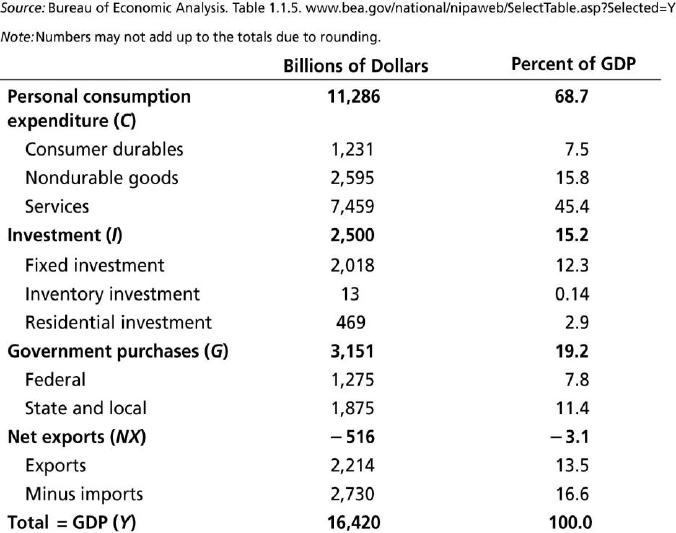
Table 2.1 GDP and its components, 2012
4) Assuming that the GDP breakdown shown in Table 2.1 is typical of a given year in the U.S.
we can say that ________.
A) we spend twice as much on goods consumption as we do on services
B) consumption of durable goods is twice that of nondurables
C) government purchases is the largest main component of GDP
D) all of the above
E) none of the above
Answer: E
Topic: 2.3 Measuring GDP: The Expenditure Approach
AACSB: Analytical Thinking
5) Assuming that the GDP breakdown shown in Table 2.1 is typical of a given year in the U.S.
we can say that ________.
A) we spend twice as much on services as we do on goods consumption
B) consumption of nondurable goods is twice that of durables
C) private investment is the smallest of the main domestic components of GDP
D) all of the above
E) none of the above
Answer: D
Topic: 2.3 Measuring GDP: The Expenditure Approach
AACSB: Analytical Thinking

6) Assuming that the GDP breakdown shown in Table 2.1 is typical of a given year in the U.S.
we can say that ________.
A) federal defense spending is twice that of non-defense spending
B) federal spending is twice as large as that of the states and local governments
C) government spending constitutes about 40% of GDP
D) all of the above
E) none of the above
Answer: E
Topic: 2.3 Measuring GDP: The Expenditure Approach
AACSB: Analytical Thinking
7) Which of the following is a valid characteristic of the U.S. economy over the last sixty years?
A) Investment is more volatile than other components of GDP.
B) Government spending has remained around 20% of GDP over much of the postwar period.
C) The U.S. has, for the most part, been running a trade deficit which has trended upward to over
5% of GDP.
D) all of the above
E) none of the above
Answer: D
Topic: 2.3 Measuring GDP: The Expenditure Approach
AACSB: Reflective Thinking
8) Which of the following is a valid characteristic of the U.S. economy over the last sixty years?