CSUMB BUS 603-31: Macro-economics
CSU Monterey Bay
M4: Monetary Analysis Paper
Great Depression of 1930s*
Chad D. Wessendorf
9-16-2018

M4: MONETARY ANALYSIS PAPER 2
Historical Background
The Great Depression was a wide-reaching economic decline that commenced in 1929
and continued until about 1939. To date, this is the longest and most devastating depression ever
experienced by the western world. This event sparked numerous fundamental economic changes
in institutions, macroeconomic policy, and economic theory. Even though this event occurred in
the United States, it had a massive ripple effect throughout the world economy. There were
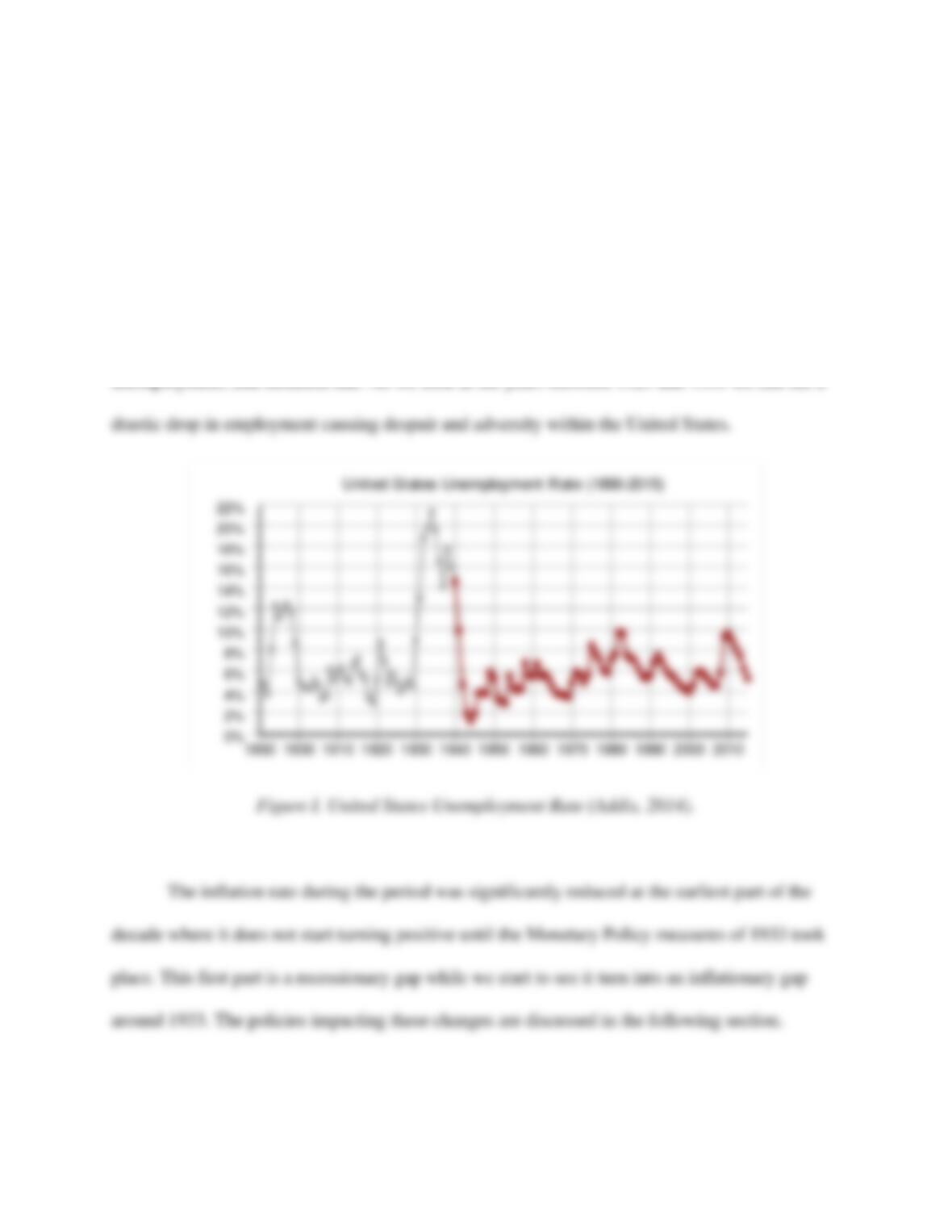
immense declines in output, excessive unemployment, and deep deflation is almost every
country in the world. Aside from this, there were also social and cultural effects that brought
hardship to the population that has not been this intense since the Civil War (Pells and Romer,
2018).
This tragic event was an economic crisis that impacted 13 million people with
unemployment and nearly collapsed the entire American banking system. This would have
included over 5,000 banks going out of business. In terms of the actual causes of the Great
Depression they are still part of a great on-going debate among economists today.
There were declines in consumer demand, financial fears, and ill-advised government
policies that caused the economic output to fall in the United States. During this time the gold
standard that was connected with many other counties fixed currency exchange rates played a
major role in carrying the American downturn overseas. Towards the end of the decade, the
recovery from the Great Depression was initiated primarily by abolishing the gold standard and
the upcoming monetary expansion. The economic impact of the Great Depression was
tremendous, including both human suffering and changes in economic policy (Pells and Romer,

M4: MONETARY ANALYSIS PAPER 3
2018). Some of the possible and most notable causes of the Great Depression include the
following by History on the Net (Wheeler, n.d.).
• Property and land prices collapsing after a property boom, causing investors to lose
money.
• Too many people speculating on the stock market to try and make money quickly.
• Black Tuesday – the stock market crash that happened on October 29, 1929, is one of the
main causes of the depression. Stockholders lost over 40 billion dollars, which had a
devastating effect on the world economy.
• Unbalanced distribution of wealth: wealthy Americans owned more than a third of all the
American assets. When the economy started to struggle, these people started to hoard the
money that caused industries to struggle even more.
• An overabundance of small banks that didn’t have enough funds to pay out all the
people’s savings at once after the stock market crash. In the 1920s, bank deposits were
not insured and when a bank would fail, all the people who banked there lost their
savings.
• Reduction in spending. As mentioned before, people stopped spending money after the
stock market crash. This meant there were more products that were produced than people
were buying, forcing factories to reduce their workforce. With the unemployment rising,
spending decreased, even more, putting more people out of work, creating a downward
spiral.
• America recalling debt from European countries caused the economies of countries that
were already struggling financially after the war to collapse.
M4: MONETARY ANALYSIS PAPER 4
• There are many factors that came to play and that may have contributed to the Great
Depression. What is certain is that there was one big domino effect that caused the one
economy after the other to struggle, leaving thousands of people without income.
Effect on the Country
The Great Depression had many severe negative effects on the Countries’ GDP,