Journal of Accounting and Investment Vol. 21 No. 3, September 2020
Article Type: Persuasive Paper
Public Accounting and Business Accounting:
Two Different Upstream
Irwan Taufiq Ritonga1*
Abstract:
Research aims: This article is a persuasive essay, written with motivation to
change readers’ perceptions of accounting for public organizations, especially
government organizations. This article aims to provide arguments following
detailed explanations that accounting of public organization and accounting of
business organization stand on two different accounting-world.
Design/Methodology/Approach: This article is a persuasive essay.
Research findings: The differences between the two have started since the
beginning of the formation of each organization, namely differences in motives
and backgrounds of the formation of the organization, goals of the organization’s
establishment and how to achieve organizational goals, as well as the source and
nature of organizational funding.
Theoretical contribution/ Originality: These differences in the upstream give
consequences differences in downstream, which are significant dissimilarities
between the two accounting worlds on planning and budgeting aspects, financial
reporting systems (financial accounting), managerial accounting, and auditing.
Practitioner/Policy implication: This significant difference in accounting
education implies that the curriculum of accounting education must be
reconsidered by separating the public accounting curriculum and the business
accounting curriculum.
Keywords: Public Accounting; Governmental Accounting; Business Accounting
Introduction
To the time of this writing, accounting that focused on a not-for-profit
organization is named Public Sector Accounting. The word “sector” that
put in that name places accounting for the not-for-profit oriented
organization as if it is a subordinate or a branch of “a big” accounting, in
this case accounting for business organizations. This fact is reflected in the
curricula of the department of accounting/school of accounting all around
the world, where the number of courses that cover accounting for a not-
for-profit organization is very limited in number. For example, in the
Accounting Department of the Faculty of Economics and Business
Universitas Gadjah Mada, students only get two compulsory courses
related to public accounting (FEB UGM, 2020). Most of the mandatory
courses that must be taken by students are accounting courses for a
business organization. As a consequence of this bias, accounting students
have insufficient knowledge and competence in public accounting.
AFFILIATION:
1 Department of Accounting,
Universitas Gadjah Mada,
Yogyakarta, Indonesia.
*CORRESPONDENCE:
irwanritonga@ugm.ac.id
THIS ARTICLE IS AVAILABLE IN:
http://journal.umy.ac.id/index.php/ai
DOI: 10.18196/jai.2103156
CITATION:
Ritonga, I. T. (2020). Public
Accounting and Business
Accounting: Two Different
Upstream. Journal of Accounting
and Investment, 21(3), 401-416.
ARTICLE HISTORY
Received:
16 June 2020
Reviewed:
25 June 2020
Revised:
1 July 2020
Accepted:
15 Aug 2020

Ritonga
Public Accounting and Business Accounting: Two Different Upstream
Journal of Accounting and Investment, 2020 | 402
To author’s experience when asking senior accounting students why government
entities implement budgetary accounting while it does not exist in business entities,
most students cannot explain well. In turn, when they graduate from university, they are
not ready to work in public organizations, such as central and local government offices,
the supreme audit board offices, etc. For example, they do not understand how to
journal budget realization transactions and do not adequately understand government
financial statement accounts. As a result, the government must incur additional costs to
educate and train them.
On the other side, in terms of “market size”, public organizations are as big as business
organizations. Using Indonesia pictures, Table 1 below shows the comparison between
the market size of business organizations and public organizations. In this case, public
organizations
1
are represented by government entities because government
organization is a public organization that has been established in terms of accounting
infrastructure, regulation, complete, reliable database, and has a significant economic
impact on the national economy.
Table 1 Comparison of Market Size between Business Organization and Public
Organization
No
Aspects
Government Organizations
Business Organizations
1.
Large Scale
Entity
608 entities consist of 60 entities of
central government (33 ministries, 27
state institutions) (Kementerian
Komunikasi dan Informatika, 2020), 548
entities of local government (34
provinces, 416 regencies, 98 cities)
(Kompas, 2020)
688 companies listed in
Indonesia Stock Exchange
(BEI, 2020)
2.
Middle Scale
Entity
74,953 Village Government (Republik
Indonesia, 2019b)
60,702 medium business
units (Kementerian
Komunikasi dan Informatika,
2020)
From Table 1, it can be seen that of the large-scale entities, there were more business
entities than government entities. However, the “losing” of the number of government
entities on a large scale was compensated by the higher number of village government
entities than business entities in the medium-scale group. This fact indicates that the
world of public accounting is no less broad compared to business accounting.
The size of the world of government accounting can also be reflected in the amount of
labor needed. In the central government environment, there were around 21,700
working units (KSAP, 2008), which means it required 21,700 accounting personnel. This
amount did not include the need for accounting personnel for supervisory functions at
The Financial and Development Supervisory Agency and every inspectorate general of
1
Public organizations refer to every organization that the main objective is to serve the public for not-for–
profit orientation. Public organizations include governments, houses of worship (mosque, church, etc.),
foundations, political parties, and so on.
Ritonga
Public Accounting and Business Accounting: Two Different Upstream
Journal of Accounting and Investment, 2020 | 403
ministries/agencies; also, in the Audit Board as a function of state financial audit. In the
local government, assuming that each local government consists of 53 working units,
there is approximately 29,000 accounting staff (548 local governments x 53 working
units). Besides, there are also two working units, The Inspectorate and The Financial
Management Agency, which must be filled by accounting personnel. If the two working
units each need ten accounting staff, it takes around 10,960 people (548 local
governments x 10 persons x 2 working units). For the village government, assuming one
accountant for one village, at least 74,953 people are needed.
If added together, then for government organizations alone, there are at least 136,600
more positions for accounting staff. If it is assumed that every year there are 5% of
accounting staff who retire, die, or other causes, every year, there will always be needed
at least around 6,850 new accounting personnel. This number is undoubtedly a vast
number that must be supplied by universities. A large amount of accounting personnel
required, as described above, provides compelling evidence that the world of public
accounting is vast.
Why do not accounting for business organizations named as Business Sector
Accounting? The author suspects that most academics believe that Business Accounting
is the “parent” of all accounting “children,” then the word “sector” would unnecessary.
It is indeed undeniable because Business Accounting more rapidly develops than
accounting for other organizations. As a result, if there is accounting for another
organization growing and developing, it is called the accounting sector of the developing
organization. For example, in Indonesia, reformations in local government with the
implementation of regional autonomy resulted in the emergence of the need for
accounting as a tool to account for local government financial management for more
accountable and transparent. The growth and development of accounting in this
government organization then gave rise to the term of Public Sector Accounting. In
Indonesia, because government organizations dominate not-for-profit oriented
organizations, the term Public Sector Accounting becomes identical with the term of
Governmental (Sector) Accounting.
Again, the use of the word “sector” in Public Sector Accounting or Governmental Sector
Accounting understate accounting for this organization. This phenomenon signifies as if
public accounting is a branch of a larger “world” of accounting. The author argues that
the most appropriate term should be Public Accounting rather than Public Sector
Accounting by removing the word sector. Public Accounting is accounting, which has its
own upstream that is different from Business Accounting. The author would present the
arguments in the following section to support the above statements. In developing an
explanation, the author used government entities in the context of Indonesia to
represent the public organization. It is because government entities are the most well–
organized public entities and have the most significant influence on the national
economy. Therefore, the author would employ the term public entities or government
entities interchangeably. The arguments presented in this paper can be used as a
reference in future studies, among others, in terms of explanations in constructing
hypotheses, explaining phenomena that occur in public organizations, and so forth.
Ritonga
Public Accounting and Business Accounting: Two Different Upstream
Journal of Accounting and Investment, 2020 | 404
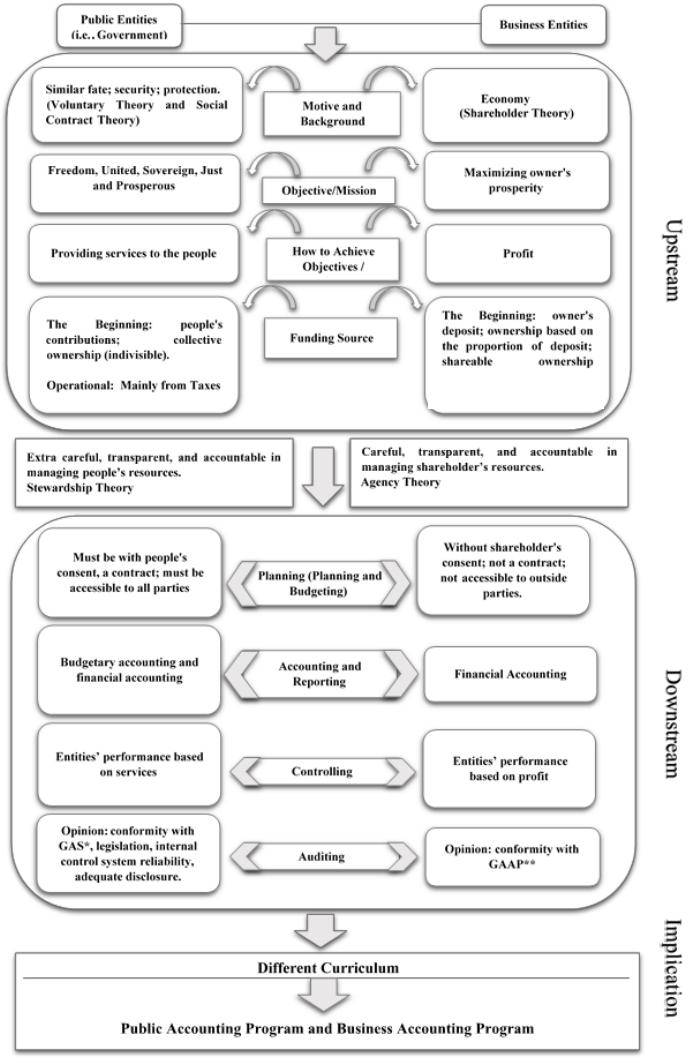
The structure of this article is illustrated in the following figure. The structure also shows
the thought framework in developing argumentation.
Figure 1 Thought Framework of Contrasting Public Accounting and Business Accounting
*GAS= Governmental Accounting Standards
**GAAP= Generally Accepted Accounting Principles
Operational: selling product
Ritonga
Public Accounting and Business Accounting: Two Different Upstream
Public Accounting and Business Accounting: Two Different Upstream
What meant by upstream here include motive and background of entities
establishment, the purpose of entities establishment and how to achieve it, and entities’
source of funding and ownership.
Motive and Background of Entities Establishment
Motive and Background of State Establishment
Several theories suggest the motivation of a state establishment. Among these theories
are Voluntary Theory and Social Contract Theory. Voluntary Theory states that groups of
communities establish a country because of rational common interests (Carneiro, 1970).
Communities establish a group in the form of a state based on common interests. These
interests could be aimed to gain prosperity, fight colonialism, or glory actualization.
Meanwhile, the Social Contract Theory states that a state could be established through
an agreement among community groups that have agreed to establish an organization
that protects and guarantees the community’s survival. This theory is embraced by
Thomas Hobbes, John Locke, J.J. Rousseau, and Montesquieu.
In Indonesia’s context, the process of establishment of The Unitary State of the Republic
of Indonesia is closely related to the long history of struggles of the nations that inhabit
the archipelago. The long history began from the Sriwijaya Kingdom, the Majapahit
Kingdom, to Youth Pledge in 1928. Based on similarities on historical background and
the feeling of being in the same boat, the founders of the Republic of Indonesia put