TECHNICAL REPORT
ALEXANDRA RANGEL
PROFESSOR ALYSSA KRAUSS
DECEMBER 11, 2020
MATH 120
Introduction
The purpose of this project was to help Laura achieve financial success with her soybean
business by determining her price, quantity, and profit optimization. Using the price function
p(q) = 10 – (q/800), and the cost function C(q) = 5q + 1200, one attempted to find the optimal
profit of a company in order to obtain the largest successful profit and the smallest loss. Key
findings from this project focused majorly on the derivative of the profit function, which helped
determine the maximization of profit, price, and quantity by finding the absolute maximum. Yet,
the total profit function could have not existed without the functions of total revenue and total
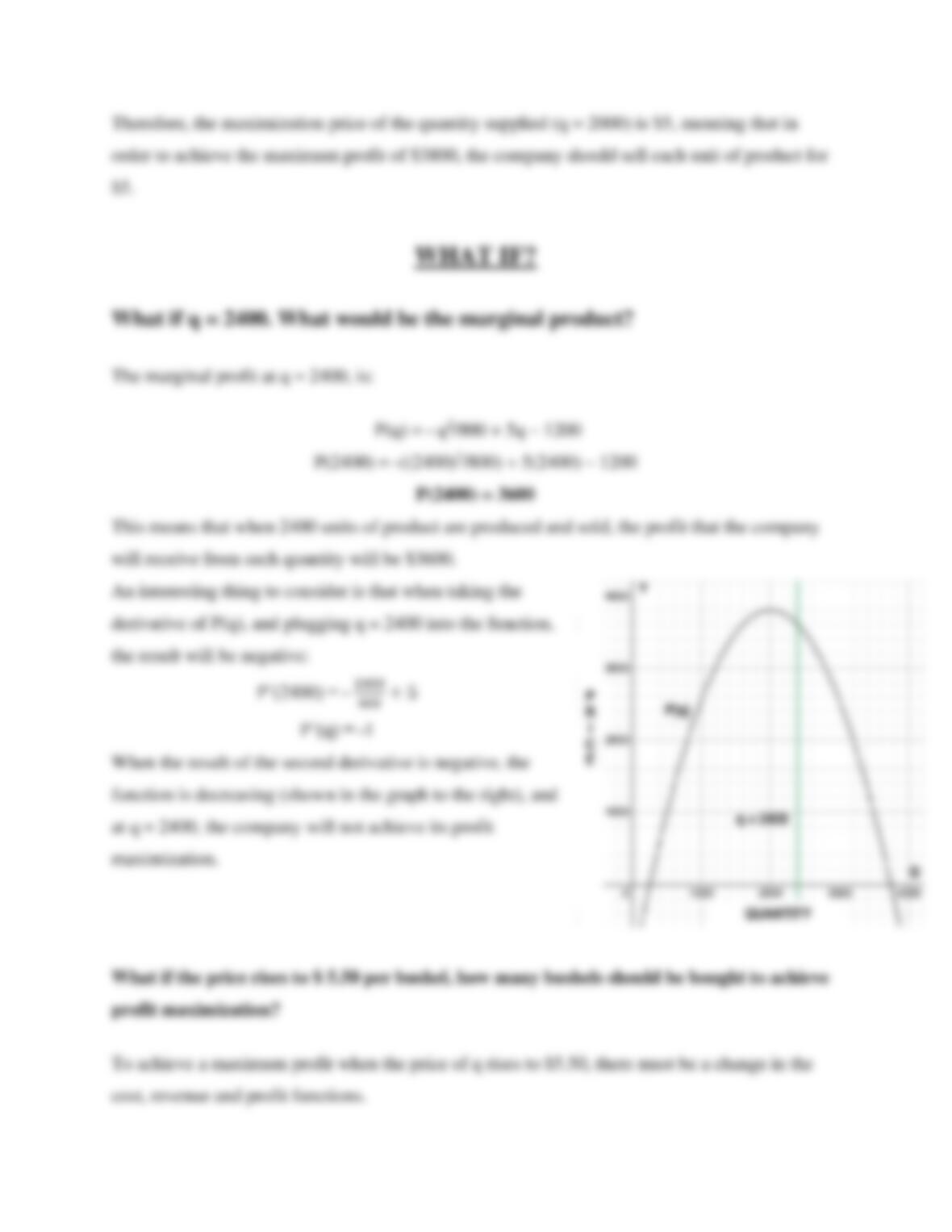
cost. It was interesting to apply the second derivative to one of the examples to see what the
outcome would be. The result was that the sign of the second derivative at q = 2400 was
negative. Thus, the graph was decreasing at the given quantity meaning that there is not an
absolute maximum value after q = 2400, since the graph kept decreasing after such values. All in
all, the quantity that allows Laura’s profit to be maximized results in 2000 bushels of soybeans
and selling each bushel at $5 will achieve a profit optimization of $3800.
;
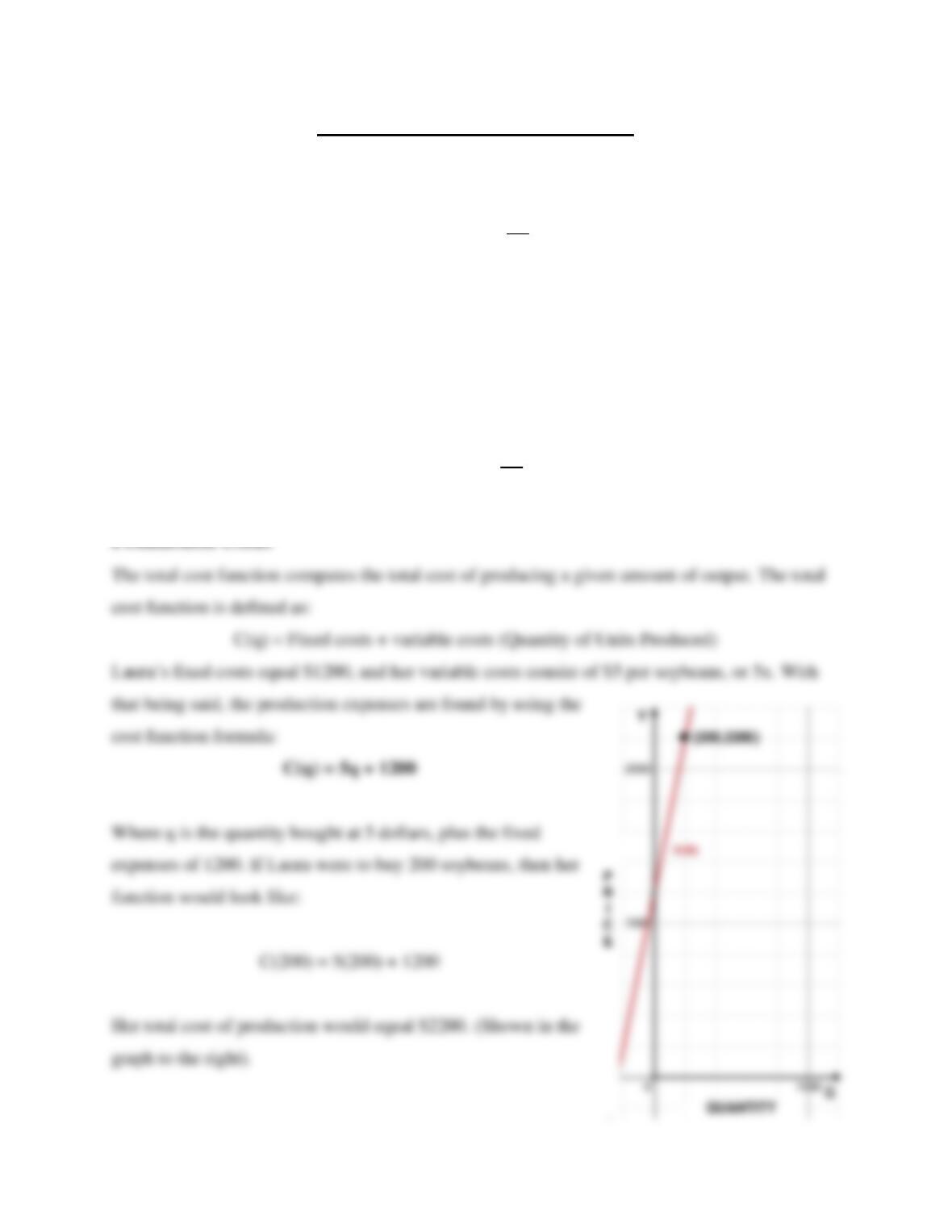
REVENUE, COST AND PROFIT
Revenue
The price function of a company is defined as:
p(q) = 10 – 𝑞
800
Where q is the number of units produced and p is the price per unit. Revenue is the
amount of money a company receives when selling q amounts of product, and can be determined
by using the following formula:
R(q) = q * p(q)
Where q is the product of the price per unit times the price function. Thus, the company’s
revenue R(q) is as follows:
R(q) = q (10 – 𝑞
800)
R(q) = 10q – (q2/800)