Problem – John Smith
Learning Objectives
This is another complex problem looking at the difference between testamentary gifts to a spouse
and a son on death and involves planning. (See discussion re Planning and CPA Competency
Map in Problem 2)
The taxpayer dies owning QSBC shares (inherited at FMV from spouse because of election out of
rollover!), a Canadian mutual fund (with an accrued CL) and bonds. He also has some rights and
things (pay and bonus for a completed pay period and an unclipped bond coupon). He has a
$25K net CL from prior years which you know will be restricted to TCG only because of the huge
QSBC exemption claimed (in the past and in the year of death).
The problem requires you to look at
(a) tax consequences to the deceased and tax planning.
Remember to do the easy planning first (rights and things and RRSPs). The tax planning is
– the RRSP contribution (spousal for the deceased; refund of premiums for the spouse)
possible because they have not missed the RRSP contribution deadline.
– The rights or things return and why (you need to explain to clients)
– The CG planning is similar to part (e) of Problem 2: calculating the election out of the
rollover to the spouse that will trigger ACL to offset TCG minus the net CL already
available. This is what CPAs do!
1. Use the information and look at the automatic consequences (many students miss the
election on the QSBC shares on the first wife’s death and get the ACB wrong)
2. Do planning to improve the tax consequences. The planning is to realize as much
ACL as possible to reduce the TCG… because of the unsheltered TCG on death: 375K–
250K –25K= 100K, you would like to trigger a 100K ACL! …but you can only do 10K.
Again, because of the huge CGE claimed in the past and in the year of death, you
are claiming Net CL and ACL only against TCGs… not against other sources of
income.
(Electing out of the spousal rollover to maximize the deceased’s lifetime QSBC
exemption is not an issue because it is more than used on the gift to the son.)
(b) the deadlines for the returns for the year of death and the prior year (John Smith died before
the prior year deadline!) and penalties for late filing the prior year return (you need to pay
attention to dates)
(c) RRSP amounts and deadlines for the spousal contribution in the year of death (s. 60(i)) and
the refund of premiums by the spouse (s. 60(l)).
2
John Smith died on January 15, 2017 at the age of 63. He was married to Holly, age
62, and he had a 27-year old son Harry, who is healthy and lives alone.
John was a senior executive of Pubco Ltd., a Canadian public corporation. John
received a salary of $20,000 per month, payable at the end of each month. He also
had a bonus of $30,000 for 2016, declared on December 31, 2016 and paid on
January 30, 2017. His T4 for 2017 shows total of $40,000: $10,000 salary and
$30,000 bonus.
John owned 150,000 common shares in a qualified small business corporation
(QSBC). A non-eligible dividend of $0.10 per share was declared on January 3, 2017
and paid on January 23, 2017.
John inherited the 150,000 QSBC shares from his first wife upon her death in 2008.
Her cost of the shares was $4 per share, they were worth $3 per share at the time of
her death, and her executor elected out of subsection 70(6) of the Income Tax Act in
her final tax return. The fair market value of the shares at the time of John’s death was
$13 per share. Half of the QSBC shares were left to his wife Holly and the other half
were left to his son Harry.
John owned units in a Canadian mutual fund worth $200,000 at the time of his death.
His cost of the units was $220,000. The mutual fund units were left to his wife Holly.
John owned some long-term bonds. Interest of $1,000 on the bonds is payable each
June 30 and December 31. At the time of his death, John had an unclipped bond
coupon for the interest payable on December 31, 2016.
In years prior to his death, John had used a total of $167,858 of his lifetime capital
gains deduction ($335,716 of his lifetime capital gains exemption).
John had a net capital loss carry forward from 2010 of $25,000 which had not been
used at the time of his death.
In 2017, Holly had $8,000 of income and taxable income.
John had prepared a draft of his 2016 tax return prior to death but it was never filed.
The return shows a small balance due and you have used the numbers from this return
to determine that his 2016 earned income for RRSP purposes is $250,000. You have
also noted that John had no unused RRSP carryforward room from 2016 and no 2016
Pension Adjustment. The beneficiary of John’s RRSP, which was worth $950,000 at
the time of his death, was Holly. John did not make any RRSP contributions for the

3
2017 year prior to his death and no contributions have been made by his executor to
date.
REQUIRED:
It is now January 20, 2018 (more than a year after the death of death).
(a) Now that the 2017 T1 software is available, you have been asked to compute
John’s 2017 federal taxable income, recommending the maximum available deductions
and elections for John, keeping in mind that you wish to minimize his tax for the year.
Show your calculations. Also show the maximum 2017 tax credits that are available to
John based on the above information, although you do not have to compute his tax
payable for the year. Explain why you made any elections.
(b) Indicate the filing due dates for John’s 2016 and 2017 returns and whether any
interest or penalties are owing at the present time.
(c) Indicate the amounts of any 2017 RRSP contributions that John’s executor and/or
Holly should make to her RRSP to save taxes for John and/or Holly and the deadline
for making these 2017 contributions.
4
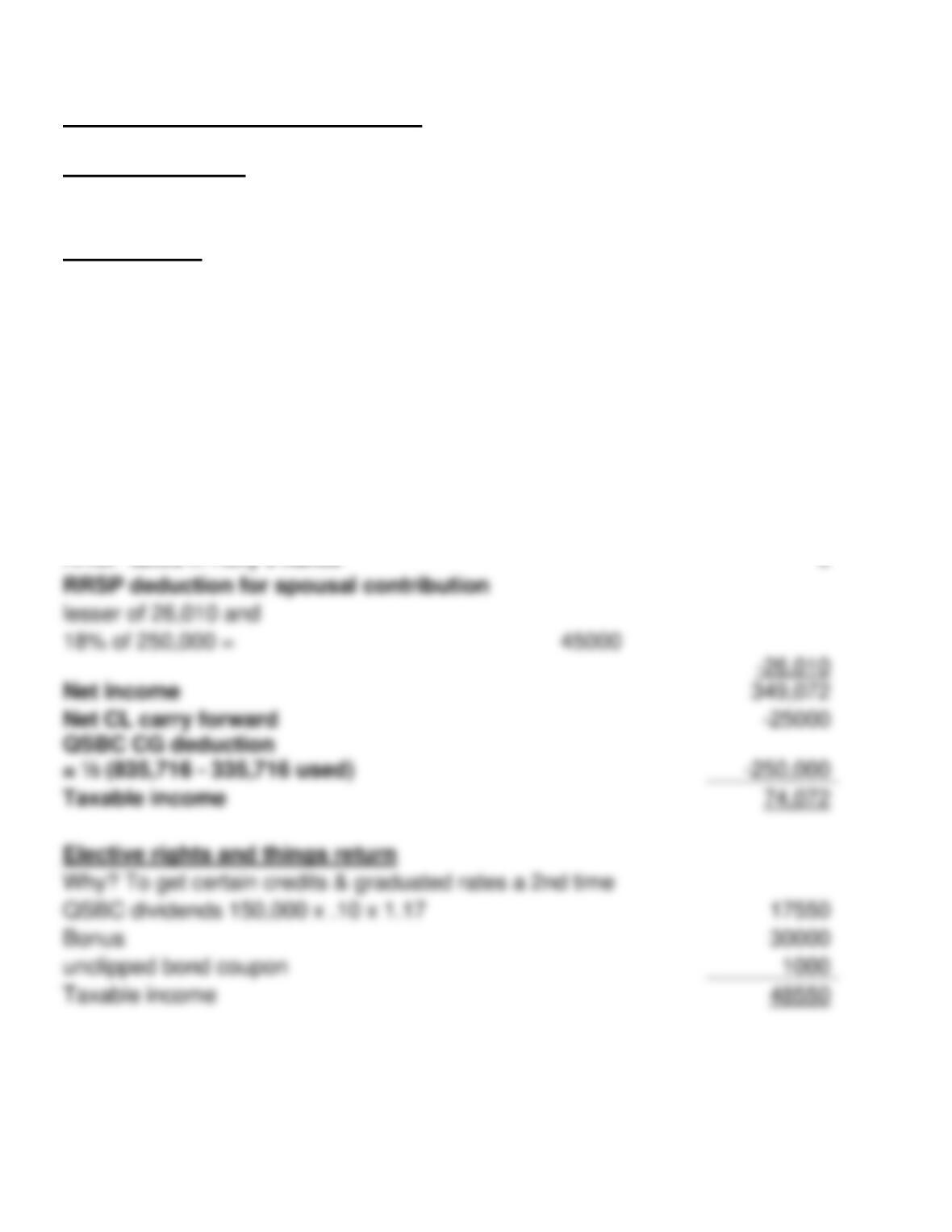
Answer to Problem 3 – John Smith
(a) Regular return
Salary to Jan 15
10,000
QSBC shares
rollover on John’s death, i.e.
75,000 x ((3-3) = nil
0
Note: no benefit to elect out of rollover, since rest of
QSBC shares will use up capital gains exemption (below)
cost is 3 per share as per 70(5) on first wife’s death
QSBC shares to son deemed disposition at FMV
50% x 75,000 x (13-3)
375000
Mutual fund elect out of rollover to access loss
– 1/2 x (200,000-220,000)
-10,000
Interest accrued to death 1,000 x 15/182
82
0
RRSP deduction for spousal contribution
lesser of 26,010 and
18% of 250,000 =
Taxable income