STRATEGY INDIVIDUAL ASSIGNMENT – TATA NANO
1.
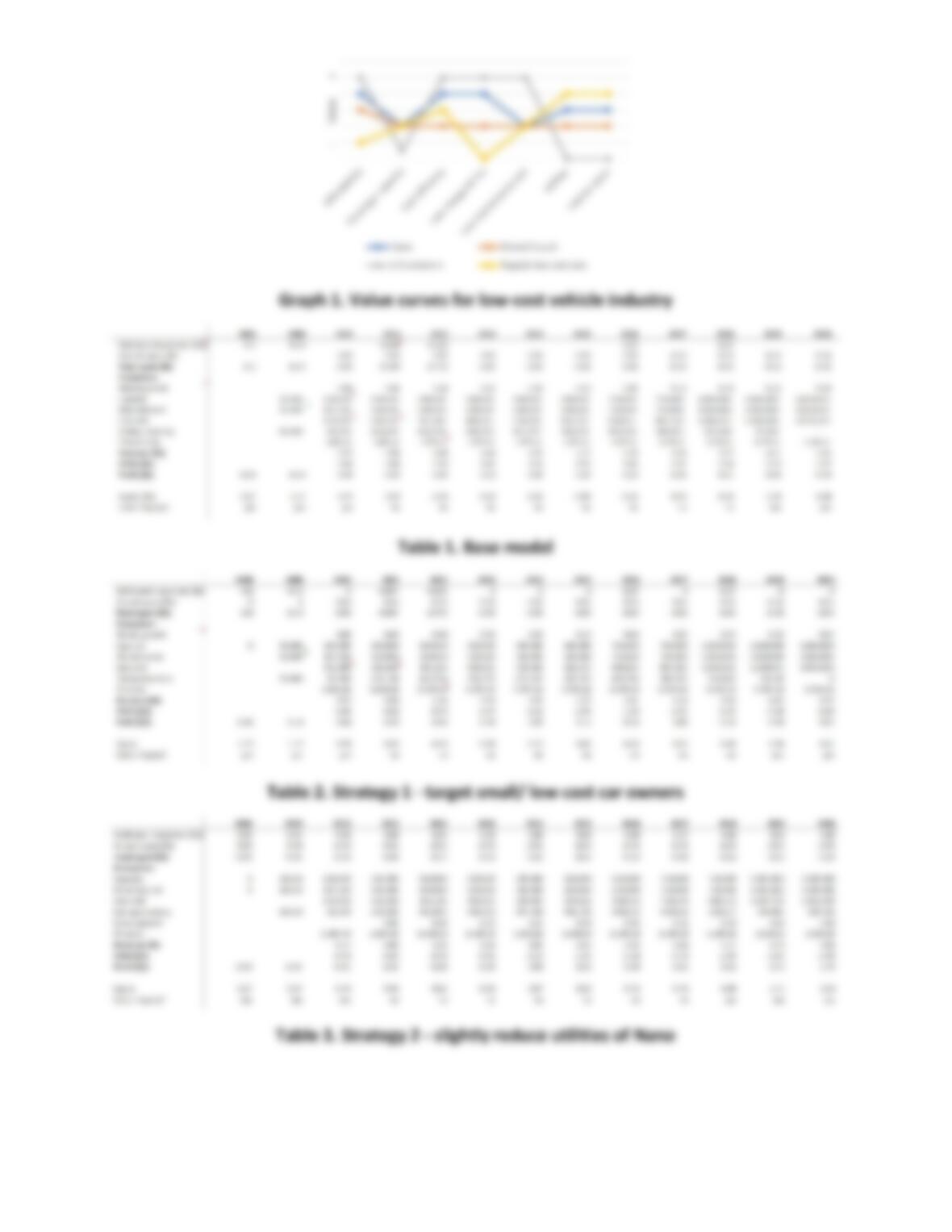
In Graph 1, I have drawn the value curve for Nano, its most direct competitor Maruti Suzuki,
other regular low-cost cars and 2-3 wheelers. The criteria were chosen based on exhibit 8, 9 and
other parts in the case. Within this market, Nano was having the lowest price, best fuel efficiency,
and lowest charges and taxes for car owners – such values were only behind 2-3 wheelers, which
could not at all offer utilities, interior space. Nano’s capacity (4) and maintenance cost (5,000 Rs)
were equivalent to other low-cost car lines, while utilities and interior space actually
outperformed Maruti Suzuki’s (exhibit 8). Clearly, Nano disrupted the ULC market, with suitable
price and comfort to capture customers who were buyers of 2-3 wheelers, Maruti Suzuki or those
who wanted an additional car.
2.
Based on the value curves, I would recommend that Tata follows its production commitment
and not be too conservative, as the market could have a 17.3% CAGR 2009 – 2020 (Exhibit 11)
and the firm was having a unique offering that the customers wanted.
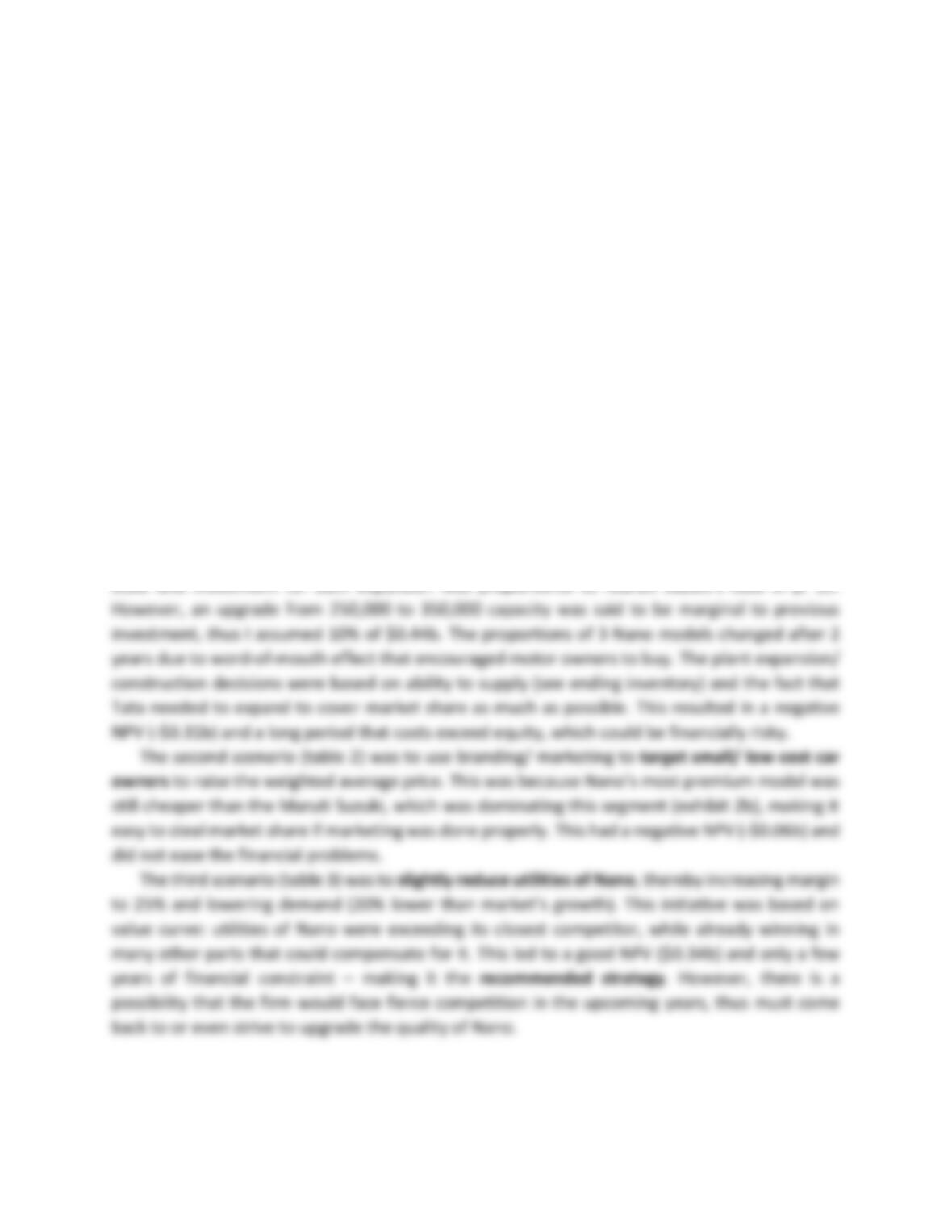
I have built a base model for 2008 – 2020 (table 1), in which Nano’s demand grew at market’s
growth (from exhibit 11), assuming that margin was 20% (historically the lowest margin in exhibit
3), discount rate was 3% (could be 1% as per p. 10, but chose 3% for prudence). Also, each time
the plant was expanded (not newly built), margin was assumed to grow 5% due to economies of