Cultural Audit Report-Tata Chemicals Limited
Submitted by: Group 1
Abhinav Kaushal (1806001)
Amit Kumar Agarwal (1806003)
Iris Gohain (1806007)
JimleeBorboruah (1806008)
Kaushal Kishore (1806009)
Puneet Pandey (1806013)
Sai Krishna Jayakumar (1806014)
Sajal Raj (1806015)
Yashowardhan Kothari (1806020)
Indian Institute of Management, Udaipur

Cultural Audit Report-Tata Chemicals Limited
2
Acknowledgment
We would like to acknowledge the support rendered to us by Mr.Sarabhvir Singh, Deputy
Manager-Human Resource and Mr. Manoj Nair, Senior Manager,Human Resource, Tata
Chemicals Limited-Mithapur for his valuable insight regarding the various organizational
practices at the company. We would also like to thank Mr. Dinesh Shukla, General Manager,
Human Resource, Tata Chemicals Limited for his enthusiastic conversation throughout the
project. We are indeed grateful to a group of young engineers led by Ishita Brahmbhatt, Assistant
Manager, Projects and Gaurav Gupta, Assistant Manager, Soda Ash production for their insights
on employee attrition in the company. Last but not the least, we would like to thank Mr.N
Kamath, Assistant Vice President-Production and Maintenance for his provoking insights on
attrition faced by the company and how the management is striving hard to mitigate them.
Cultural Audit Report-Tata Chemicals Limited
3
Table of Content
Serial Number
Contents
Page Numbers
Acknowledgment
2
Abstract
4
1
Introduction
5
1.1
Defining the problem statement
5
1.2
Objective
7
1.3
Methodology
7
2
Solutions to reduce employee attrition
7
3
Feasibility study
20
References
23
List of figures
Figure Number
Figure description
Page Number
1.1
Employee attrition rate from 2012 through 2015
6

Cultural Audit Report-Tata Chemicals Limited
4
Abstract
During the cultural audit, we identified employee attrition as one of the potential problems atTata
Chemicals Ltd. This report includes defining the problem statement identified and providing
solutions to lower the attrition rate by realigning it‘s existing cultural norms.It also provides an
implementation strategy for the identified solutions and presents feasibility analysis of the same.
Finally, after the successful implementation of the suggested solutions, the attrition rate is
expected to reach below 8% which will beneficial for the organization.
1. Introduction

Cultural Audit Report-Tata Chemicals Limited
5
Tata Chemicals Limited, a Tata Group Company focused on LIFE-Living, Industry and Farm
Essentials has its business operations in isolated locations across the nation.Existing government
regulations do not permit manufacturing units to be set up at locations with high population
density thereby forcing the company to operate from lonesome corners such as Mithapur in
Gujarat. This results in less number of people willing to join the company. This also increases
the attrition rate of existing employees resulting in a dual problem of low entry-level hires and
high lateral exits.
1.1 Defining the problem statement
The world today has become more connected and transparent. Technology has redefined the
ways in which people interact with one another and acquire information. From the perspective of
the human resources function of an organization, this translates into employees having far more
knowledge about the culture of other organizations. Essentially, they know what they are
missing. Millennials play a crucial role in the workforce of the 21st century. They are tech-savvy,
aware and need instant gratification. In essence, these factors constitute a change in the nature of
today’s workforce. Today, it is against this backdrop that an organization has to combat attrition.
At one end of the organizational spectrum, we have organizations such as Google with their
flexible working hours and all the ‘modern’ perks. On the other end, we have conventional
manufacturing facilities which are constrained by the very nature of their operations and facing
huge challenges in reducing attrition in today’s context explained above. Tata Chemicals Limited
is an organization of the latter type. The company recruits fresh graduates from India’s premier
institutes as engineers. These millennials are posted at the company’s facility at Mithapur – a
rural area in Gujarat – where they have to make with a life devoid of sophistication, shopping
Cultural Audit Report-Tata Chemicals Limited
6
malls and glamorous food hubs. Not just millennial youngsters – as any person grows in career
and in life, it is only natural that he/she looks for opportunities to grow. Today’s technology and
communication have made information readily-available and transition very convenient.In this
situation, it is pertinent to analyze the factors driving employee engagement and establish
standards within the organization. In order to reduce attrition, the company must create an
environment that fosters inclusion, diversity, security and growth. In this report, we present
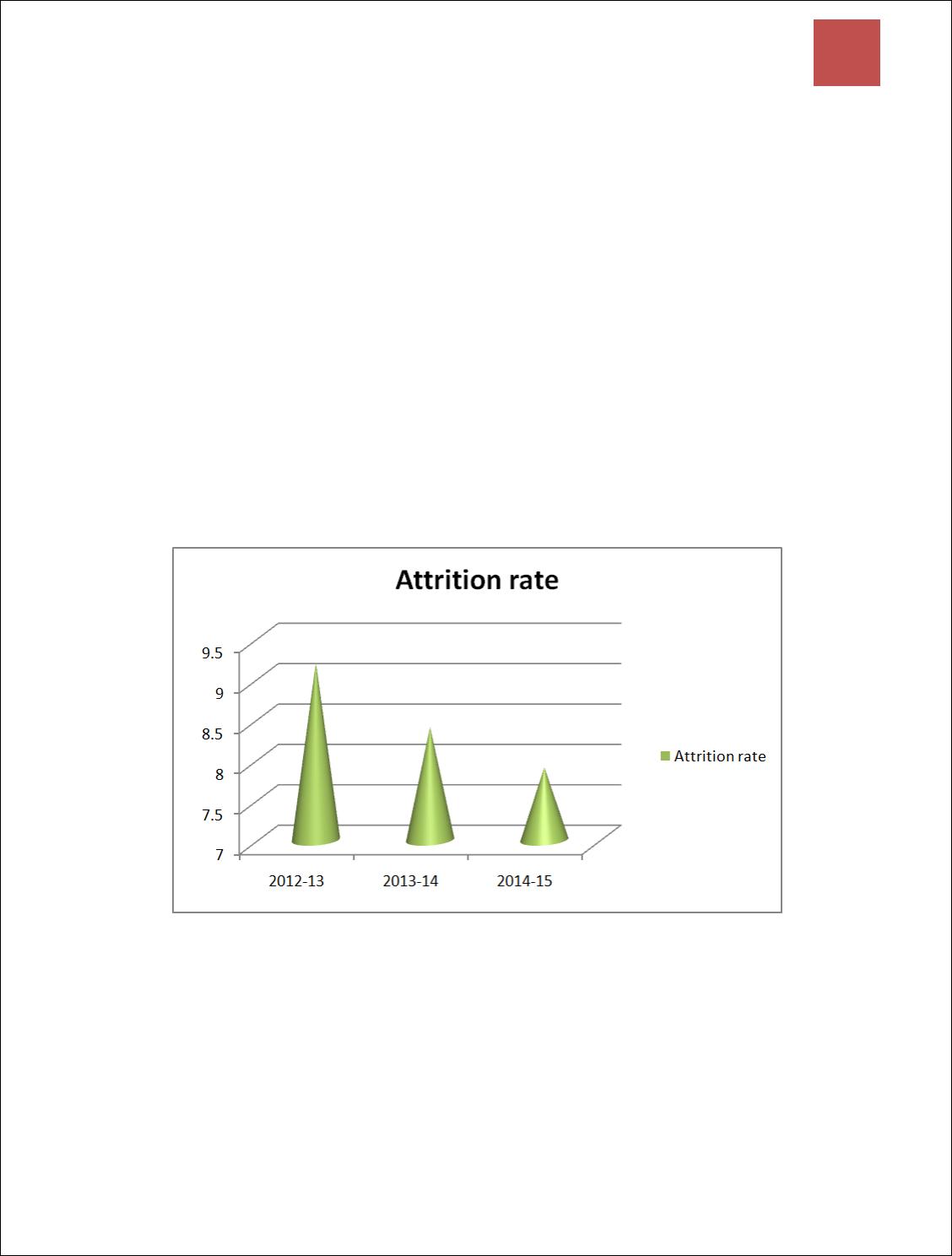
options that Tata Chemicals can consider in order to reduce attrition. As illustrated in figure 1.1,
the employee attrition rate in 2014-15 has decreased to 8% from 9% in 2012-13. Further steps
have to be taken to mitigate this problem.
Fig 1.1 Employee attrition rate from 2012 through 2015
1.2 Objective
Cultural Audit Report-Tata Chemicals Limited
7
To understand the factors central to high attrition rate in the organization and suggest steps to
improve the current scenario.
1.3 Methodology
Information collection: Interviews and focus groups
Area: Tata Chemicals Limited, Mithapur
Duration: 16thApril 2018 – 24thApril 2018
Information design: Exploratory and descriptive
Sample details: Young employees within the age group of 22-30 years