Tablet Inc– Case Company Description
The US Department of Justice ordered the boards of directors of the major tablet computer manufacturers to dismiss
and replace their top management due to years of cartel-like behaviour. Investigations found that the companies’
directors had agreed amongst themselves in secret banquets on issues such as deliberately stagnating technology
development plans, pricing the devices artificially high, and other key matters that had both reduced the competition
and limited the choices for the consumers. The boards of directors have understood the seriousness of the situation and
hired you to compete against the other restructured companies.
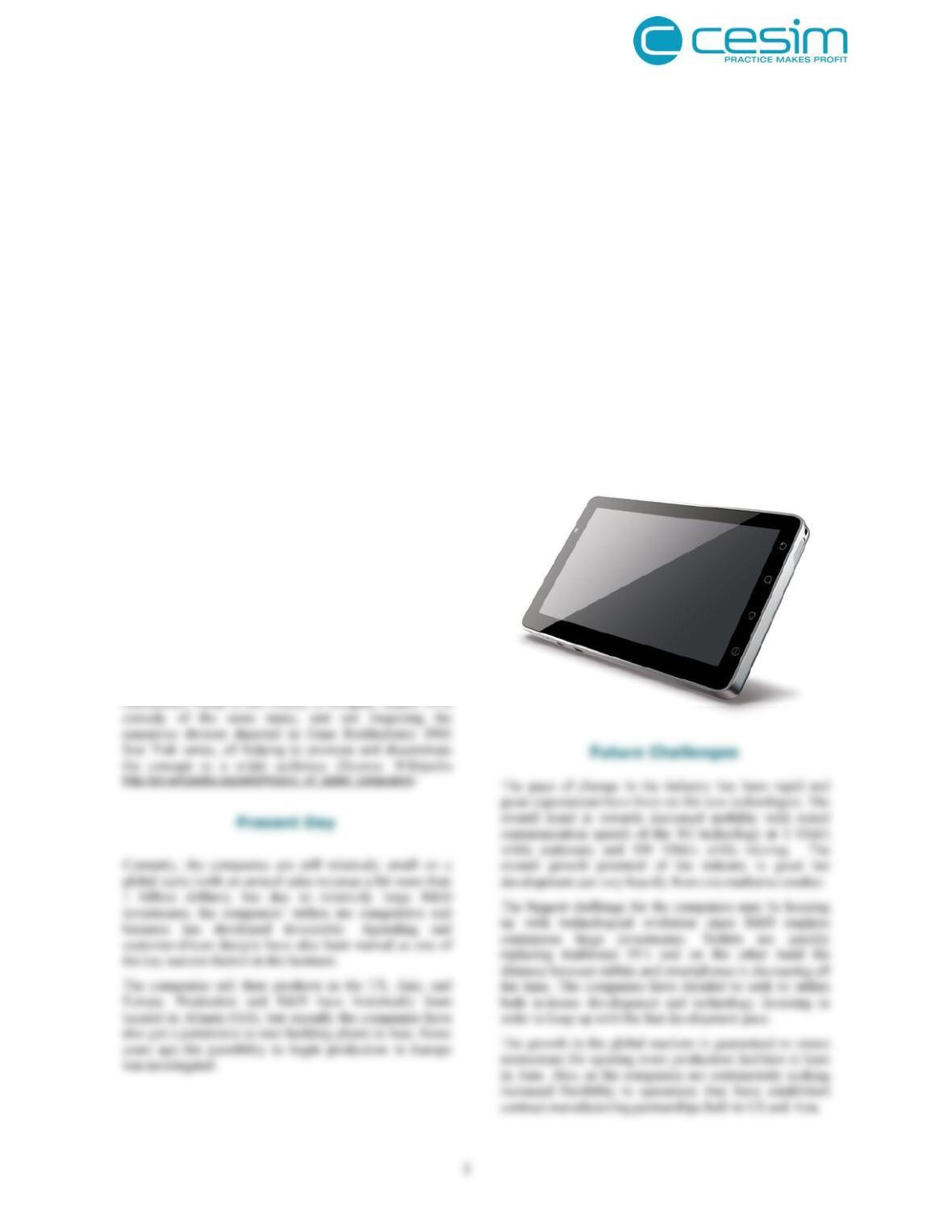
The core operations of the companies operating in the tablet computer industry consist of research and development,
marketing, production and outsourcing, logistics, and finance. Sales revenues in the previous financial year were
around 1,2 billion dollars. Profitability has been decent and the companies are also generating plenty of cash. This is a
good starting point since it is likely that the increased competition and rapid technological evolution over the next years
will tax both profitability and cash.
History of the industry
The tablet computer and the associated special operating
software is an example of pen computing technology, and
thus the development of tablets has deep historical roots.
For example, the first patent for an electronic tablet used
for handwriting was for the telautograph, with a patent
granted in 1888. The first patent for a system that
recognized handwritten characters by analyzing the
handwriting motion was granted in 1915. The first
publicly demonstrated system using a tablet and
handwriting text recognition instead of a keyboard for
working with a modern digital computer dates to 1956.
Tablet computers appeared in a number of works of
Science Fiction in the second half of the 20th century, with
the depiction of Arthur C. Clarke’s NewsPad, in Stanley
Kubrick’s 1968 film 2001: A Space Odyssey, the
description of Calculator Pad in the 1951 novel
Foundation, by Isaac Asimov, the Opton in the 1961 novel
“Return from the Stars”, by Stanislaw Lem, The
as well. It became clear that the complicated and
inflexible labour laws in Europe would make the
operations difficult and expensive.
To ensure flexibility in R&D and production, the
companies have also actively negotiated agreements for
subcontracting parts of their production and R&D.