SYSTEMS INETGRATION & ARCHITECTURE – LECTURE NOTE 3
Computer Science & Information Technology Department Page 1
CHAPTER 3
ENTERPRISE SYSTEMS ARCHITECTURE
Once ERP systems are integrated and implemented in a company, they become the cornerstone of the
organization. With a successful implementation, every single transaction will now be processed through
this system.
In addition to systems integration, it is also necessary to focus on business process architecture,
business requirements, budget, project management, commitments from top management, and
continuous communication with employees informing them about future changes.
COURSE LEANING OUTCOME
At the end of the module, the students are expected to:
Examine in detail the enterprise systems modules and architecture.
Identify the various types of ERP architectures and the related benefits and drawbacks of each
architecture.
Understand the effects of a well-designed architecture on ERP implementation.
Know the Service Oriented Architecture and its impact on ERP systems.
Discover cloud architecture and its impact on ERP systems.
CONTENTS OF THE MODULE
This module contains the following lessons:
Lesson 1: ERP Modules
Lesson 2: ERP Architecture
Lesson 1: ERP Modules
Why Study Enterprise Systems Architecture?
• Help management and the implementation teams understand in detail the features and
components of the enterprise system.
• Provide a visual representation of the complex system interfaces among the ERP application and
databases, operating systems, legacy applications, and networking.
• Management can develop a better IT plan if the requirements for system infrastructure,
training, change management, and business process reengineering are clarified.
Components of the Enterprise Systems Architecture
• Functional
– Defines the ERP modules that support the various business functions of the organization.
Examples include:
• Accounting
• Human Resources
• Procurement
• Fulfillment
• Etc.
• System
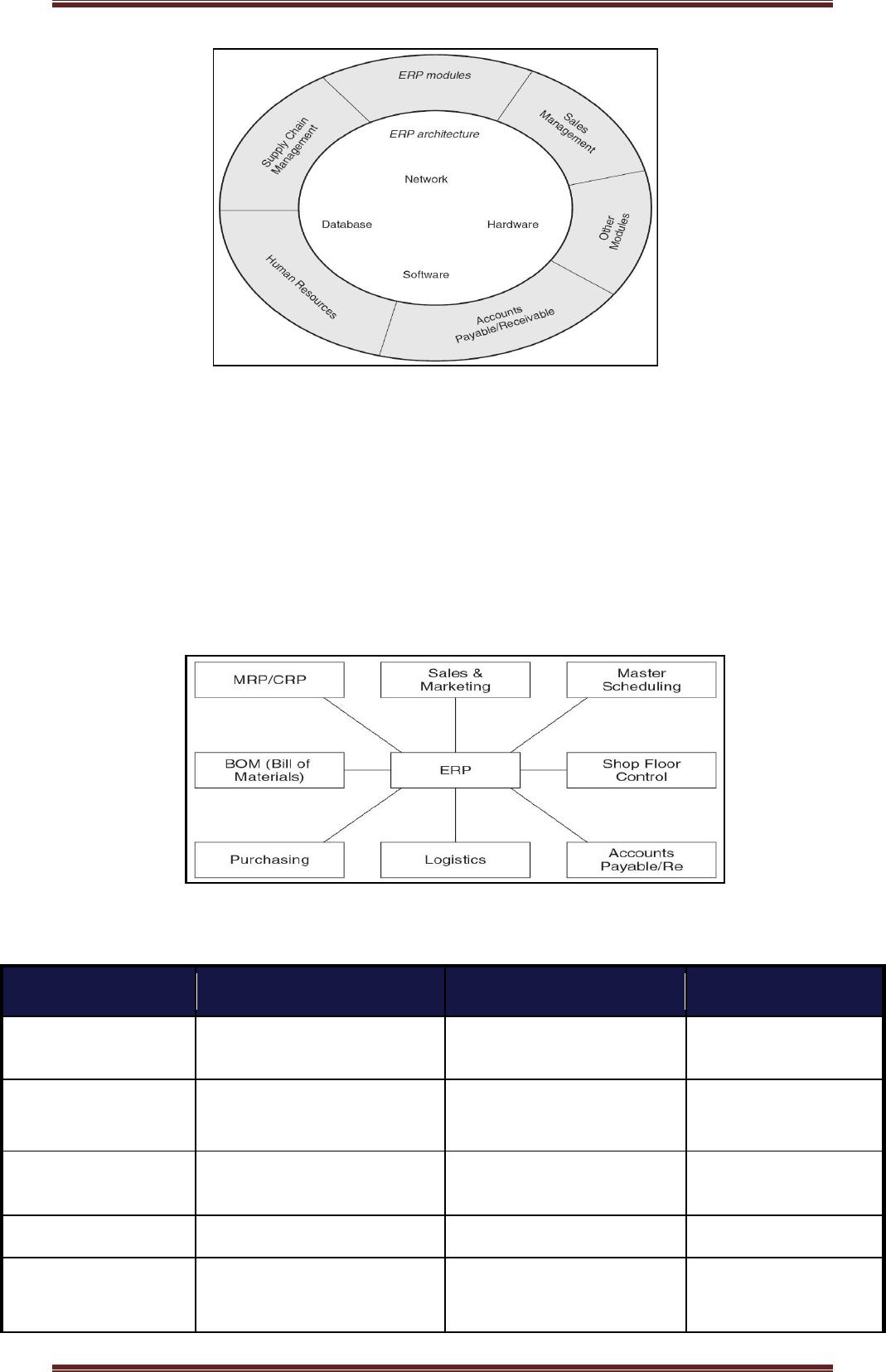
– Defines the ERP architecture through the physical components of hardware, software,
and networking angle.
SYSTEMS INETGRATION & ARCHITECTURE – LECTURE NOTE 3
Computer Science & Information Technology Department Page 2
Figure 3-1 Enterprise Systems Architecture (ESA) Model
ERP Modules
• The key role of an ERP system is to provide support for such business functions as accounting,
sales, inventory control, and production.
• ERP vendors, including SAP, Oracle, and Microsoft, etc. provide modules that support the major
functional areas of a business.
• The ERP software embeds best business practices that implement the organization’s policy and
procedure via business rules.
Figure 3-2 Typical ERP Modules
ERP Modules From Three Vendors
Function
SAP
Oracle/ PeopleSoft
Microsoft Dynamics
Sales
Sales and Distribution, Sales
Opportunity
Marketing and Sales, Supply
Chain Management
Retail POS, Field
Service Management
Procurement
Purchasing, Supplier
Relationship Management
Procurement and Supplier
Relationship Management
Supply Chain
Management
Production
MRP, Product Life Cycle
Management
Manufacturing
Manufacturing
Accounting
Financial Accounting
Financial Management
Financial Management
Distribution
Warehouse Management
Supply Chain Management
Distribution
Management
SYSTEMS INETGRATION & ARCHITECTURE – LECTURE NOTE 3
Customer Service
CRM
CRM
CRM
Corporate
Performance &
Governance
Governance, Risk, and
Compliance Management
Corporate Performance
Management
Analytics
Human Resources
Human Capital Management
Human Capital Management
HR Management
Miscellaneous
Banking
Campus Solutions
E-commerce, Portals
Overview of Modules
• Production
– Helps in the planning and optimizing of the manufacturing capacity, parts, components,
and material resources using historical production data and sales forecasting.
• Purchasing
– Streamlines the procurement process of required raw materials and other supplies.
• Inventory Management
– Facilitates the processes of maintaining the appropriate level of stock in a warehouse.
• Sales and Marketing
– Implements functions of order placement, order scheduling, shipping, and invoicing.
• Finance
– Can gather financial data from various functional departments and generate valuable
financial reports.
• Human Resource