SYSTEMS INETGRATION & ARCHITECTURE – LECTURE NOTE 2
Computer Science & Information Technology Department Page 1
CHAPTER 2
SYSTEMS INTEGRATION
Systems integration means that you allow a heterogeneous (hodgepodge) IS to communicate or
integrate and share information (or data) seamlessly with one another. Systems integration is a key
issue for an organization for its growth – Management needs to pay close attention to this issue.
ERP systems are a major kind of enterprise information system allowing organizations to integrate
different systems into one organization-wide application with an integrated database management
system.
COURSE LEANING OUTCOME
At the end of the module, the students are expected to:
Value the impact of organizational structure on information systems.
Adapt about the evolution of information systems technology generations and architectures and
its influence on silo environment.
Understand the role of Enterprise Resource Planning (ERP) systems in systems integration.
Evaluate what systems integration is and why it is important for organizations.
CONTENTS OF THE MODULE
This module contains the following lessons:
Lesson 1: Business process and Functional Silos
Lesson 2: Evolution of IS in Organization
Lesson 3: ERP and Systems Integration
DIRECTIONS ON HOW TO USE THE MODULE PROPERLY
In order to benefit profoundly from this module, please be guided by all the key points
presented below.
1. This module contains two (2) lessons. Each lesson is explained substantively. Read the
explanations thoroughly so that you could understand the lesson fully.
2. On the first page of each lesson, you will find the specific learning outcomes (SLOs) of each
lesson . SLOs are knowledge and skills you are expected to acquire at the end of the lesson.
Read them heartily.
3. You must answer the Learning Activities/Exercises (LAEs). The LAEs are designed to help
you acquire the SLOs.
4. Feel free to chat, call, text or send an email message me if you have questions, reactions,
or reflections about the contents or activities in the module.
5. The Practice Task/Assessment and the Assignment shall be checked by me.
Lesson 1: Business Process and Functional Silos
Silos are basically compartmentalized operating units isolated from their environment.
Horizontal Silos
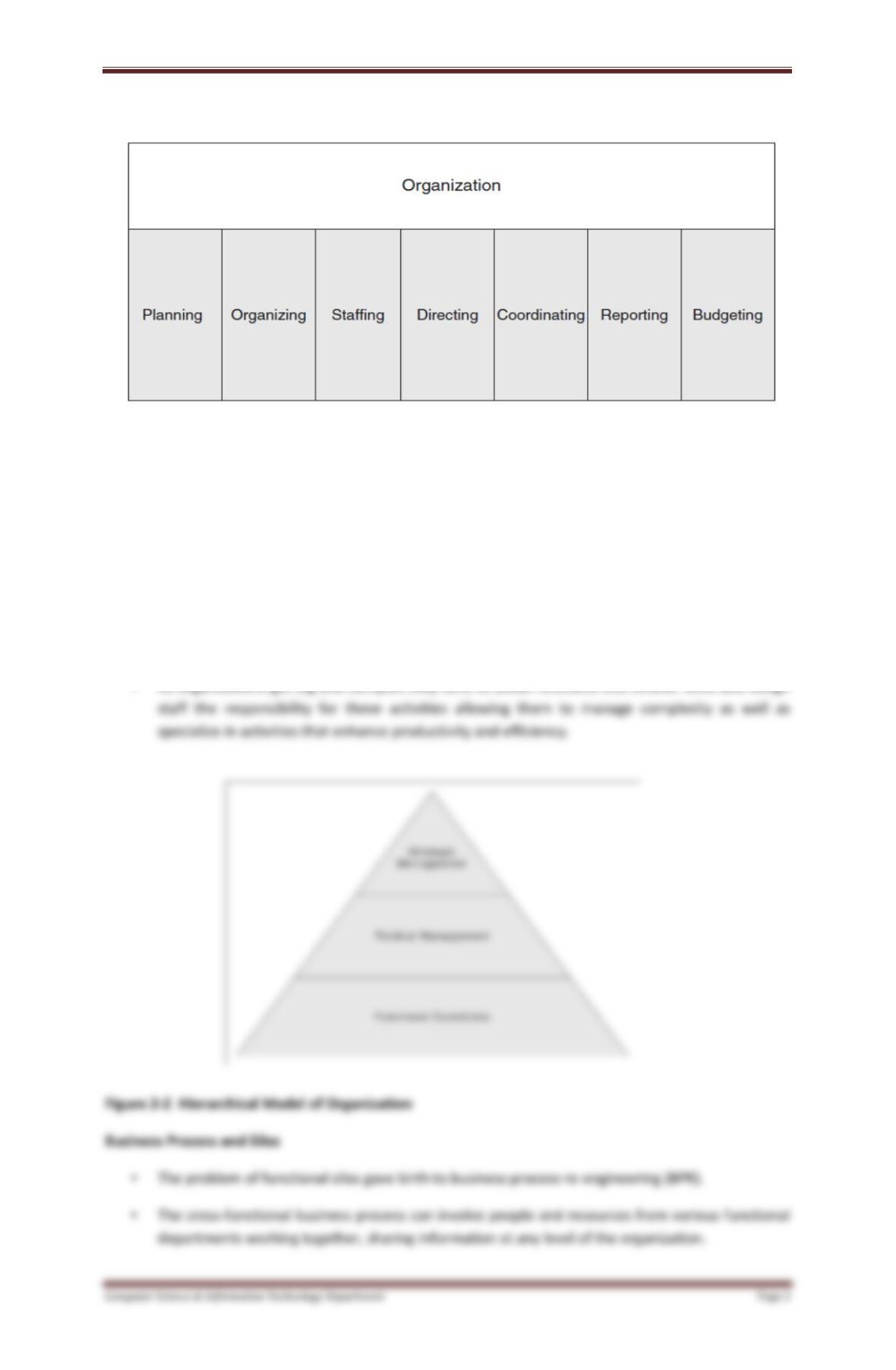
• The POSDCORB (Planning, Organizing, Staffing, Directing, Coordinating, Reporting and
Budgeting) categorization by Luther Gulick led to a set of formal organization functions such as
control, management, supervision, and administration starting in late 1930s.
• Classification of organizations into departments like Accounting and Human Resources, reflects
the breaking of complex tasks into smaller manageable tasks that could be assigned to a group
of people who could then be held responsible.
SYSTEMS INETGRATION & ARCHITECTURE – LECTURE NOTE 2
FIGURE 2-1 Functional Model of Organization (POSDCORB) Source: Adapted from
Bernard, C. (1938). The Functions of the Executive. Cambridge: Harvard University Press.
Vertical Silos
• Organizations also divided roles in hierarchical layers from strategic planning to management
control and operation control.
• CEOs and Presidents plan long-term strategy, midlevel management focuses on tactical issues
and on the execution of organizational policy whereas the lower-level management task is to
focus on the day-to-day operations of the company.