Ch. 7, Experiment B.2-B.3
Synthesis of Nylon-6,6
Abstract
In the synthesis of Nylon-6,6, the objectives of this experiment include the
production of adipoyl chloride, maintaining the adipoyl chloride at a constant
temperature around 90-95° C, adding 2 different solvents for interfacial
polymerization, and obtaining nylon-6,6 fibers. Techniques utilized in this lab
include the reflux apparatus setup and the interfacial polymerization technique. Two
reactions of carboxylic acid derivatives involved in this experiment include an SN2
reaction of thionyl chloride with adipic acid to form adipoyl chloride and a
nucleophilic substitution reaction of Adipoyl chloride with 1,6-Hexanediamine to
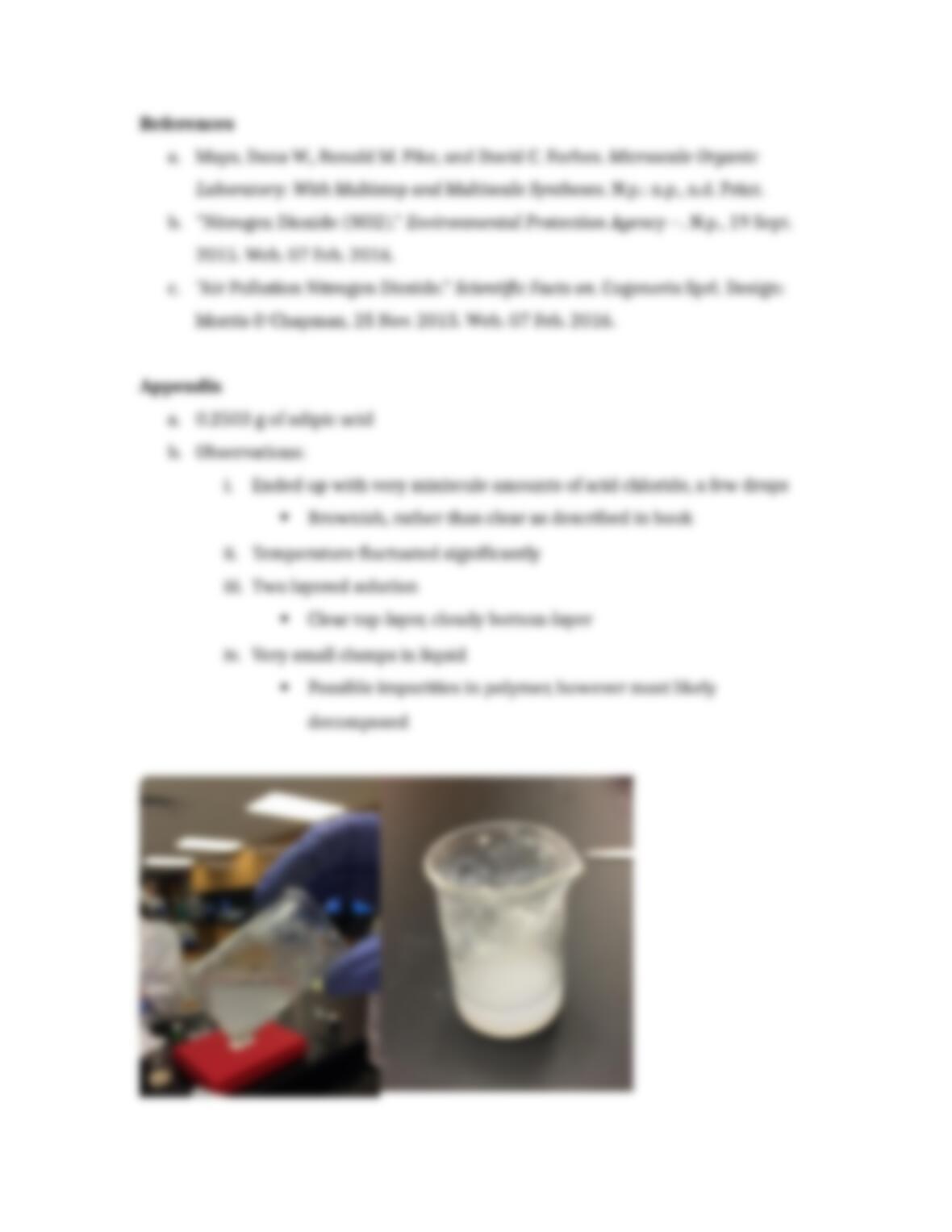
form Nylon-6,6. The resulting compound, Nylon-6,6 was not formed in the
experiment due to denaturation during the heating portion of the experiment.
Introduction
a. The purpose of this experiment is to convert the adipic acid previously made
into its corresponding acid chloride through a reaction with thionyl chloride.
The resulting adipoyl chloride is then used with 1,6-hexanediamine in a step-
growth polymerization to prepare the polyamide, nylon.
b. The three major types of intermolecular interactions that exist between the
molecules include hydrogen bonding, dipole-dipole interactions, and London
dispersion forces. The most important intermolecular force, and the main
interaction responsible for nylon-6,6 being such a strong polymer, is the
hydrogen bonding that occurs between the nitrogen bonded hydrogen of one
nylon chain with the carbonyl oxygen of another. These hydrogen bonds are
responsible for making such strong crystals of nylon because they hold the
nylon chains together very tight and closely.